 Add to Chrome
 Add to Firefox
 Add to Edge
CLASE: A Hybrid Method for Chinese Legalese Stylistic Evaluation
Feb 13, 2026
Legal text generated by large language models (LLMs) can usually achieve reasonable factual accuracy, but it frequently fails to adhere to the specialised stylistic norms and linguistic conventions of legal writing. In order to improve stylistic quality, a crucial first step is to establish a reliable evaluation method. However, having legal experts manually develop such a metric is impractical, as the implicit stylistic requirements in legal writing practice are difficult to formalise into explicit rubrics. Meanwhile, existing automatic evaluation methods also fall short: reference-based metrics conflate semantic accuracy with stylistic fidelity, and LLM-as-a-judge evaluations suffer from opacity and inconsistency. To address these challenges, we introduce CLASE (Chinese LegAlese Stylistic Evaluation), a hybrid evaluation method that focuses on the stylistic performance of legal text. The method incorporates a hybrid scoring mechanism that combines 1) linguistic feature-based scores and 2) experience-guided LLM-as-a-judge scores. Both the feature coefficients and the LLM scoring experiences are learned from contrastive pairs of authentic legal documents and their LLM-restored counterparts. This hybrid design captures both surface-level features and implicit stylistic norms in a transparent, reference-free manner. Experiments on 200 Chinese legal documents show that CLASE achieves substantially higher alignment with human judgments than traditional metrics and pure LLM-as-a-judge methods. Beyond improved alignment, CLASE provides interpretable score breakdowns and suggestions for improvements, offering a scalable and practical solution for professional stylistic evaluation in legal text generation (Code and data for CLASE is available at: https://github.com/rexera/CLASE).

Towards Computational Chinese Paleography
Jan 11, 2026Chinese paleography, the study of ancient Chinese writing, is undergoing a computational turn powered by artificial intelligence. This position paper charts the trajectory of this emerging field, arguing that it is evolving from automating isolated visual tasks to creating integrated digital ecosystems for scholarly research. We first map the landscape of digital resources, analyzing critical datasets for oracle bone, bronze, and bamboo slip scripts. The core of our analysis follows the field's methodological pipeline: from foundational visual processing (image restoration, character recognition), through contextual analysis (artifact rejoining, dating), to the advanced reasoning required for automated decipherment and human-AI collaboration. We examine the technological shift from classical computer vision to modern deep learning paradigms, including transformers and large multimodal models. Finally, we synthesize the field's core challenges -- notably data scarcity and a disconnect between current AI capabilities and the holistic nature of humanistic inquiry -- and advocate for a future research agenda focused on creating multimodal, few-shot, and human-centric systems to augment scholarly expertise.
PanelTR: Zero-Shot Table Reasoning Framework Through Multi-Agent Scientific Discussion
Aug 08, 2025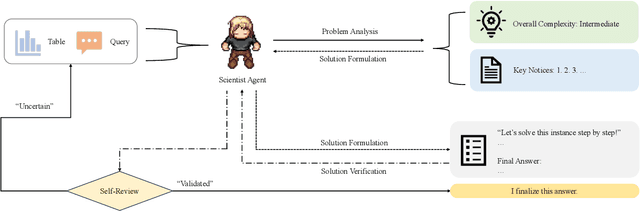
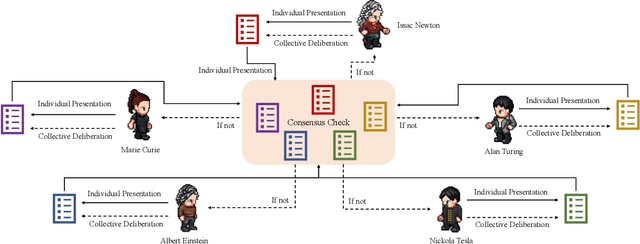
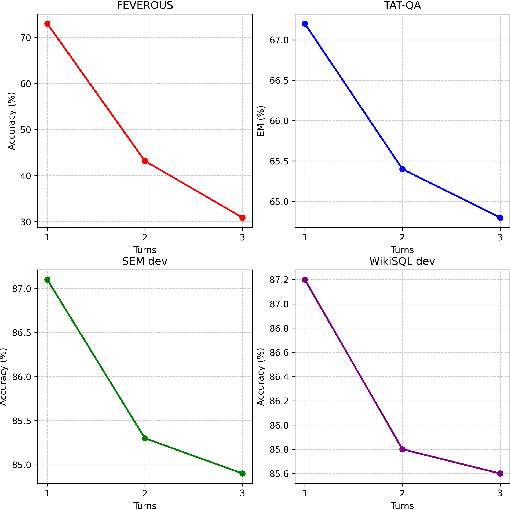
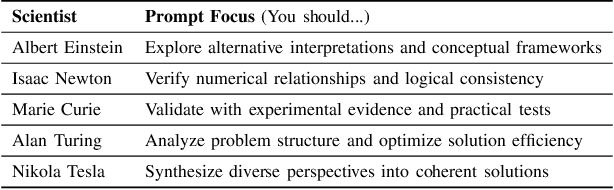
Table reasoning, including tabular QA and fact verification, often depends on annotated data or complex data augmentation, limiting flexibility and generalization. LLMs, despite their versatility, often underperform compared to simple supervised models. To approach these issues, we introduce PanelTR, a framework utilizing LLM agent scientists for robust table reasoning through a structured scientific approach. PanelTR's workflow involves agent scientists conducting individual investigations, engaging in self-review, and participating in collaborative peer-review discussions. This process, driven by five scientist personas, enables semantic-level transfer without relying on data augmentation or parametric optimization. Experiments across four benchmarks show that PanelTR outperforms vanilla LLMs and rivals fully supervised models, all while remaining independent of training data. Our findings indicate that structured scientific methodology can effectively handle complex tasks beyond table reasoning with flexible semantic understanding in a zero-shot context.