 Add to Chrome
 Add to Firefox
 Add to Edge
OpenWebRL: Demystifying Online Multi-turn Reinforcement Learning for Visual Web Agents
Jun 01, 2026
Building capable visual web agents requires long-horizon reasoning, precise grounding, and robust interaction with dynamic real-world websites. Despite rapid progress, the strongest systems remain largely proprietary, while open agents still depend heavily on supervised post-training over large collections of curated web trajectories. This dependence creates a major scalability bottleneck: high-quality demonstrations are expensive to collect, and static datasets offer limited coverage of the diverse, ever-changing open web. Although online RL has shown promise for text-based agents, its potential for training visual web agents directly on live websites remains largely underexplored. In this paper, we introduce OpenWebRL, an open framework for training visual web agents with online multi-turn RL on real websites. OpenWebRL covers the full training pipeline, including scalable live-browser infrastructure, supervised initialization, multimodal context management, trajectory-level success judging, and efficient multi-turn policy optimization. Using this framework, we train OpenWebRL-4B, which establishes a new open-source state of the art on challenging live-web benchmarks. With only 0.4K initialization trajectories and 2.2K open-ended RL training tasks, OpenWebRL-4B achieves 67.0% success on Online-Mind2Web and 64.0% on DeepShop, outperforming prior open agents of similar or larger scale and remaining competitive with proprietary systems including OpenAI CUA and Gemini CUA. Beyond strong benchmark performance, we systematically study the key design choices that make online RL effective for visual web agents, and analyze how RL improves agentic reasoning. Overall, our work offers a practical path toward building more capable, reproducible, and cost-efficient open web agents. We will release our training data, models, and code to support future research.

TOC-Bench: A Temporal Object Consistency Benchmark for Video Large Language Models
May 11, 2026Video large language models (Video-LLMs) have achieved remarkable progress in general video understanding, yet their ability to maintain temporal object consistency remains insufficiently explored. Existing benchmarks primarily focus on event recognition, action understanding, or coarse temporal reasoning, but rarely evaluate whether a model can consistently preserve the identity, state, and temporal continuity of the same object across occlusion, disappearance, reappearance, state transitions, and cross-object interactions. As a result, current evaluations may overestimate temporal reasoning ability while overlooking failures in object-centric temporal coherence. To address this issue, we introduce TOC-Bench, a diagnostic benchmark specifically designed to evaluate temporal object consistency in Video-LLMs. TOC-Bench is explicitly object-track grounded, where each queried subject is associated with a per frame object trajectory and structured temporal event timeline. To ensure that benchmark items depend on temporally ordered visual evidence rather than language priors, single-frame shortcuts, or unordered frame cues, we propose a three-layer temporal-necessity filtering protocol that removes 60.7% of candidate QA pairs and retains 17,900 temporally dependent items spanning 10 diagnostic dimensions. From this filtered pool, we further construct a human-verified benchmark containing 2,323 high-quality QA pairs over 1,951 videos. Experiments on representative Video-LLMs show that temporal object consistency remains a major unsolved challenge. Current models exhibit substantial weaknesses in event counting, event ordering, identity-sensitive reasoning, and hallucination-aware verification, despite strong performance on general video understanding benchmarks.
CAPTCHA Solving for Native GUI Agents: Automated Reasoning-Action Data Generation and Self-Corrective Training
Mar 23, 2026GUI agents are rapidly shifting from multi-module pipelines to end-to-end, native vision-language models (VLMs) that perceive raw screenshots and directly interact with digital devices. Despite rapid progress on general GUI tasks, CAPTCHA solving remains a major challenge. On the other hand, although specialized CAPTCHA solving pipelines exist, they cannot handle general GUI tasks. To address this gap, we introduce ReCAP: a CAPTCHA-capable native GUI agent that can robustly solve modern, interactive CAPTCHA challenges, while preserving their performance as a general GUI agent. We first develop a dynamic CAPTCHA system spanning seven representative CAPTCHA types, designed to stress primitive and complementary capabilities for CAPTCHA solving (e.g., robust OCR under heavy noise and text stylization, fine-grained visual understanding, and precise control). Then, we develop an automated data collection and curation pipeline that generates large-scale CAPTCHA interaction trajectories paired with reasoning traces. As CAPTCHA solving often requires multi-step interaction and recovery from intermediate mistakes, we further leverage failed trajectories to construct self-correction data, training agents to reflect on errors and correct their actions online. Across held-out test sets, ReCAP improves CAPTCHA-solving success from roughly 30\% to 80\%, while maintaining strong performance on general GUI-agent benchmarks.
Multi-Integration of Labels across Categories for Component Identification (MILCCI)
Feb 04, 2026Many fields collect large-scale temporal data through repeated measurements (trials), where each trial is labeled with a set of metadata variables spanning several categories. For example, a trial in a neuroscience study may be linked to a value from category (a): task difficulty, and category (b): animal choice. A critical challenge in time-series analysis is to understand how these labels are encoded within the multi-trial observations, and disentangle the distinct effect of each label entry across categories. Here, we present MILCCI, a novel data-driven method that i) identifies the interpretable components underlying the data, ii) captures cross-trial variability, and iii) integrates label information to understand each category's representation within the data. MILCCI extends a sparse per-trial decomposition that leverages label similarities within each category to enable subtle, label-driven cross-trial adjustments in component compositions and to distinguish the contribution of each category. MILCCI also learns each component's corresponding temporal trace, which evolves over time within each trial and varies flexibly across trials. We demonstrate MILCCI's performance through both synthetic and real-world examples, including voting patterns, online page view trends, and neuronal recordings.
Whole-Body Proprioceptive Morphing: A Modular Soft Gripper for Robust Cross-Scale Grasping
Oct 31, 2025Biological systems, such as the octopus, exhibit masterful cross-scale manipulation by adaptively reconfiguring their entire form, a capability that remains elusive in robotics. Conventional soft grippers, while compliant, are mostly constrained by a fixed global morphology, and prior shape-morphing efforts have been largely confined to localized deformations, failing to replicate this biological dexterity. Inspired by this natural exemplar, we introduce the paradigm of collaborative, whole-body proprioceptive morphing, realized in a modular soft gripper architecture. Our design is a distributed network of modular self-sensing pneumatic actuators that enables the gripper to intelligently reconfigure its entire topology, achieving multiple morphing states that are controllable to form diverse polygonal shapes. By integrating rich proprioceptive feedback from embedded sensors, our system can seamlessly transition from a precise pinch to a large envelope grasp. We experimentally demonstrate that this approach expands the grasping envelope and enhances generalization across diverse object geometries (standard and irregular) and scales (up to 10$\times$), while also unlocking novel manipulation modalities such as multi-object and internal hook grasping. This work presents a low-cost, easy-to-fabricate, and scalable framework that fuses distributed actuation with integrated sensing, offering a new pathway toward achieving biological levels of dexterity in robotic manipulation.
Top-$k$ Feature Importance Ranking
Sep 18, 2025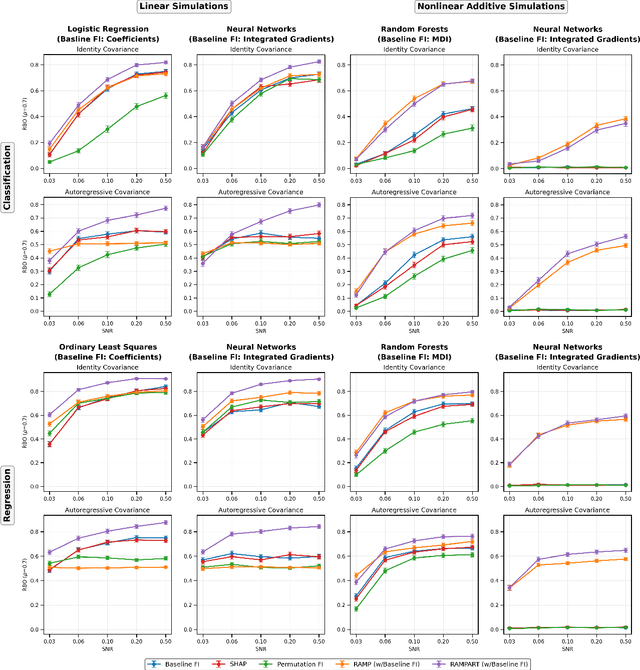
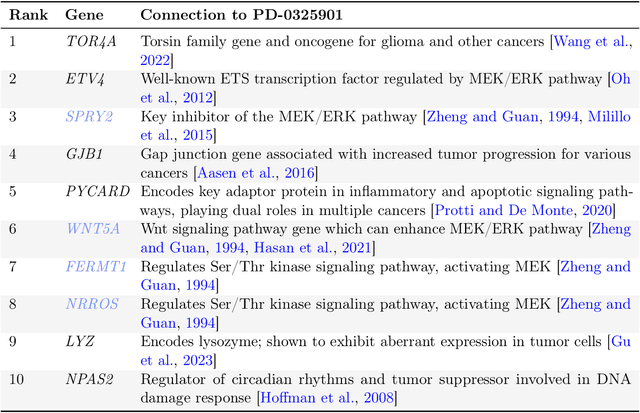

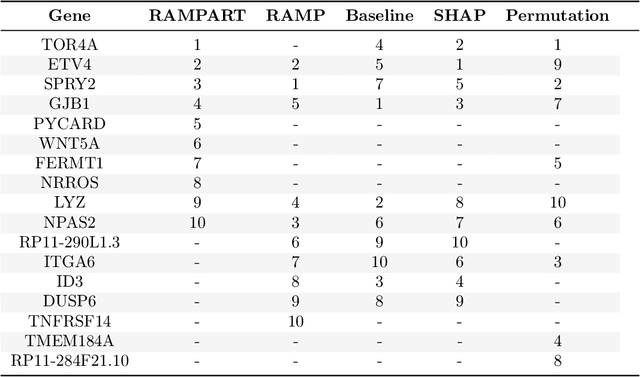
Accurate ranking of important features is a fundamental challenge in interpretable machine learning with critical applications in scientific discovery and decision-making. Unlike feature selection and feature importance, the specific problem of ranking important features has received considerably less attention. We introduce RAMPART (Ranked Attributions with MiniPatches And Recursive Trimming), a framework that utilizes any existing feature importance measure in a novel algorithm specifically tailored for ranking the top-$k$ features. Our approach combines an adaptive sequential halving strategy that progressively focuses computational resources on promising features with an efficient ensembling technique using both observation and feature subsampling. Unlike existing methods that convert importance scores to ranks as post-processing, our framework explicitly optimizes for ranking accuracy. We provide theoretical guarantees showing that RAMPART achieves the correct top-$k$ ranking with high probability under mild conditions, and demonstrate through extensive simulation studies that RAMPART consistently outperforms popular feature importance methods, concluding with a high-dimensional genomics case study.
Knowing or Guessing? Robust Medical Visual Question Answering via Joint Consistency and Contrastive Learning
Aug 26, 2025In high-stakes medical applications, consistent answering across diverse question phrasings is essential for reliable diagnosis. However, we reveal that current Medical Vision-Language Models (Med-VLMs) exhibit concerning fragility in Medical Visual Question Answering, as their answers fluctuate significantly when faced with semantically equivalent rephrasings of medical questions. We attribute this to two limitations: (1) insufficient alignment of medical concepts, leading to divergent reasoning patterns, and (2) hidden biases in training data that prioritize syntactic shortcuts over semantic understanding. To address these challenges, we construct RoMed, a dataset built upon original VQA datasets containing 144k questions with variations spanning word-level, sentence-level, and semantic-level perturbations. When evaluating state-of-the-art (SOTA) models like LLaVA-Med on RoMed, we observe alarming performance drops (e.g., a 40\% decline in Recall) compared to original VQA benchmarks, exposing critical robustness gaps. To bridge this gap, we propose Consistency and Contrastive Learning (CCL), which integrates two key components: (1) knowledge-anchored consistency learning, aligning Med-VLMs with medical knowledge rather than shallow feature patterns, and (2) bias-aware contrastive learning, mitigating data-specific priors through discriminative representation refinement. CCL achieves SOTA performance on three popular VQA benchmarks and notably improves answer consistency by 50\% on the challenging RoMed test set, demonstrating significantly enhanced robustness. Code will be released.
Practical Poisoning Attacks against Retrieval-Augmented Generation
Apr 04, 2025Large language models (LLMs) have demonstrated impressive natural language processing abilities but face challenges such as hallucination and outdated knowledge. Retrieval-Augmented Generation (RAG) has emerged as a state-of-the-art approach to mitigate these issues. While RAG enhances LLM outputs, it remains vulnerable to poisoning attacks. Recent studies show that injecting poisoned text into the knowledge database can compromise RAG systems, but most existing attacks assume that the attacker can insert a sufficient number of poisoned texts per query to outnumber correct-answer texts in retrieval, an assumption that is often unrealistic. To address this limitation, we propose CorruptRAG, a practical poisoning attack against RAG systems in which the attacker injects only a single poisoned text, enhancing both feasibility and stealth. Extensive experiments across multiple datasets demonstrate that CorruptRAG achieves higher attack success rates compared to existing baselines.
MT-PCR: Leveraging Modality Transformation for Large-Scale Point Cloud Registration with Limited Overlap
Mar 17, 2025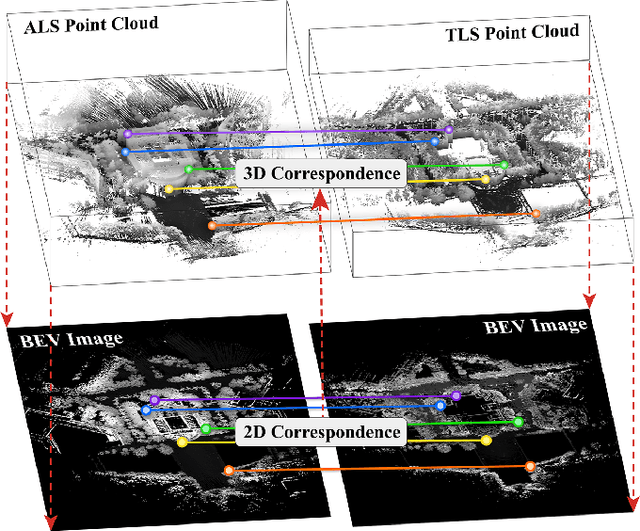
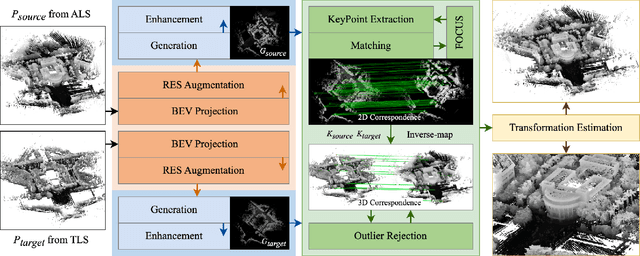
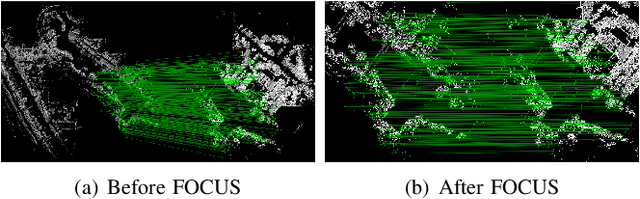
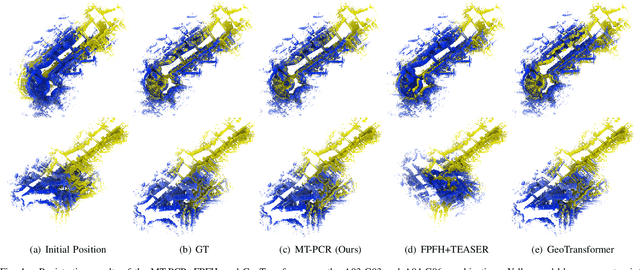
Large-scale scene point cloud registration with limited overlap is a challenging task due to computational load and constrained data acquisition. To tackle these issues, we propose a point cloud registration method, MT-PCR, based on Modality Transformation. MT-PCR leverages a BEV capturing the maximal overlap information to improve the accuracy and utilizes images to provide complementary spatial features. Specifically, MT-PCR converts 3D point clouds to BEV images and eastimates correspondence by 2D image keypoints extraction and matching. Subsequently, the 2D correspondence estimates are then transformed back to 3D point clouds using inverse mapping. We have applied MT-PCR to Terrestrial Laser Scanning and Aerial Laser Scanning point cloud registration on the GrAco dataset, involving 8 low-overlap, square-kilometer scale registration scenarios. Experiments and comparisons with commonly used methods demonstrate that MT-PCR can achieve superior accuracy and robustness in large-scale scenes with limited overlap.
From GPT-4 to Gemini and Beyond: Assessing the Landscape of MLLMs on Generalizability, Trustworthiness and Causality through Four Modalities
Jan 29, 2024
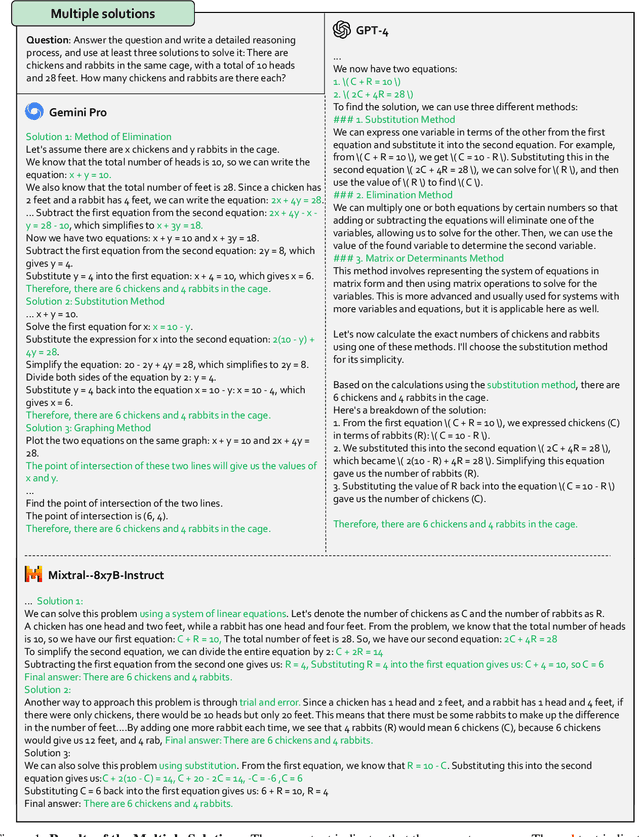
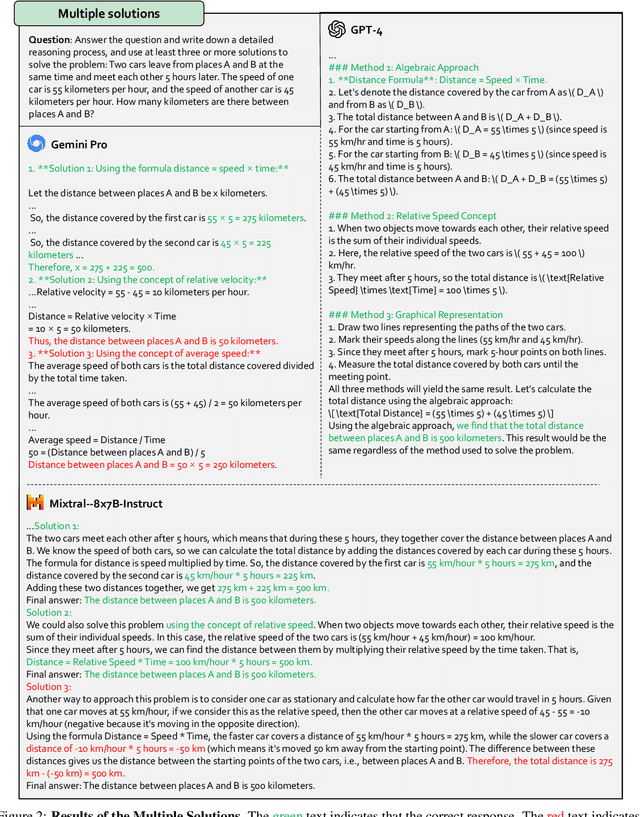

Multi-modal Large Language Models (MLLMs) have shown impressive abilities in generating reasonable responses with respect to multi-modal contents. However, there is still a wide gap between the performance of recent MLLM-based applications and the expectation of the broad public, even though the most powerful OpenAI's GPT-4 and Google's Gemini have been deployed. This paper strives to enhance understanding of the gap through the lens of a qualitative study on the generalizability, trustworthiness, and causal reasoning capabilities of recent proprietary and open-source MLLMs across four modalities: ie, text, code, image, and video, ultimately aiming to improve the transparency of MLLMs. We believe these properties are several representative factors that define the reliability of MLLMs, in supporting various downstream applications. To be specific, we evaluate the closed-source GPT-4 and Gemini and 6 open-source LLMs and MLLMs. Overall we evaluate 230 manually designed cases, where the qualitative results are then summarized into 12 scores (ie, 4 modalities times 3 properties). In total, we uncover 14 empirical findings that are useful to understand the capabilities and limitations of both proprietary and open-source MLLMs, towards more reliable downstream multi-modal applications.