 Add to Chrome
 Add to Firefox
 Add to Edge
MedUAG: Unified Understanding and Generation for Medical Multimodal Models
Aug 19, 2026
Recent Multimodal Large Language Models (MLLMs) are rapidly evolving into unified understanding and generation (UAG) frameworks. However, extending these unified paradigms to the medical domain is hindered by: the absence of comprehensive training and evaluation benchmarks, and the lack of broadly validated unified medical model. To address these gaps, we present a comprehensive foundation for medical UAG. First, we construct MedUAGCorpus, the largest unified medical understanding and generation dataset to date, comprising over 6 million instances across 14 imaging modalities. Second, we introduce MedUAGBench, a systematic benchmark that expands medical generation evaluation to 12 diverse tasks under standardized protocols. Finally, leveraging these resources, we develop MedUAG, an end-to-end trained unified medical model. Extensive experiments demonstrate that MedUAG achieves strong performance across a wide array of understanding and generation tasks, establishing a competitive baseline and paving the way for next-generation medical multimodal systems.

MedUP: Awakening Unified Understanding and Perception in Medical Vision-Language Models
Aug 11, 2026Medical Vision-Language Models (Med-VLMs) excel at verbalizing visual content, yet precise visual perception, segmentation, and grounding remain challenging. Existing approaches either verbalize regions as coordinate strings or rely on external modules that decouple perception from understanding, creating representation gaps for region-language alignment. We present MedUP, a Med-VLM that natively unifies perception and understanding within a shared token space. At its core lies UniMedTok, a region tokenizer that encodes masks as discrete tokens in the LLM vocabulary, enabling the model to seamlessly interleave mask tokens with text. We curate UniMed-Train, a 1.84M-instance corpus spanning text-guided segmentation, region-grounded understanding, medical VQA and CoT-based segmentation, and introduce UniMed-Bench for unified evaluation. Extensive experiments show that MedUP outperforms native, agentic, and dual-decoder Med-VLMs across all tasks while remaining competitive with specialist segmentors, demonstrating the strong potential of unified understanding and perception modeling.
MedStreamBench: A Time-Aware Benchmark for Streaming and Proactive Medical Video Understanding
Jul 02, 2026Existing medical video benchmarks primarily evaluate whether a model produces the correct answer, but rarely assess whether it answers at the right time. In real clinical settings, AI systems must decide not only what to predict, but also when to answer, defer judgment, or proactively raise alerts. This creates a critical gap between benchmark evaluation and deployment requirements. We present MedStreamBench, a benchmark for time-aware medical video understanding. MedStreamBench integrates 22 medical datasets and 5,419 QA instances across four temporal settings: retrospective, present, future, and proactive. Unlike conventional benchmarks that assume full-video access, MedStreamBench restricts models to temporally bounded evidence windows and supports both single-turn and streaming evaluation. We further introduce a proactive monitoring setting that requires models to determine whether and when clinically relevant alerts should be triggered. Beyond answer correctness, MedStreamBench evaluates temporal behavior through responsiveness and post-evidence stability. Experiments on leading general-purpose and medical vision-language models reveal a substantial gap between offline recognition and temporally grounded decision-making, with performance dropping markedly in streaming and proactive settings. Our benchmark is available at https://huggingface.co/datasets/Venn2024/MedStreamBench.
How Far Are Video Models from True Multimodal Reasoning?
Apr 21, 2026Despite remarkable progress toward general-purpose video models, a critical question remains unanswered: how far are these models from achieving true multimodal reasoning? Existing benchmarks fail to address this question rigorously, as they remain constrained by straightforward task designs and fragmented evaluation metrics that neglect complex multimodal reasoning. To bridge this gap, we introduce CLVG-Bench, an evaluation framework designed to probe video models' zero-shot reasoning capabilities via Context Learning in Video Generation. CLVG-Bench comprises more than 1,000 high-quality, manually annotated metadata across 6 categories and 47 subcategories, covering complex scenarios including physical simulation, logical reasoning, and interactive contexts. To enable rigorous and scalable assessment, we further propose an Adaptive Video Evaluator (AVE) that aligns with human expert perception using minimal annotations, delivering interpretable textual feedback across diverse video context tasks. Extensive experiments reveal a striking answer to our central question: while state-of-the-art (SOTA) video models, such as Seedance 2.0, demonstrate competence on certain understanding and reasoning subtasks, they fall substantially short with logically grounded and interactive generation tasks (achieving success rates <25% and ~0%, respectively), exposing multimodal reasoning and physical grounding as critical bottlenecks. By systematically quantifying these limitations, the proposed method provides actionable feedbacks and a clear roadmap toward truly robust, general-purpose video models. CLVG-Bench and code are released here.
Learning Transferable Temporal Primitives for Video Reasoning via Synthetic Videos
Mar 18, 2026The transition from image to video understanding requires vision-language models (VLMs) to shift from recognizing static patterns to reasoning over temporal dynamics such as motion trajectories, speed changes, and state transitions. Yet current post-training methods fall short due to two critical limitations: (1) existing datasets often lack temporal-centricity, where answers can be inferred from isolated keyframes rather than requiring holistic temporal integration; and (2) training data generated by proprietary models contains systematic errors in fundamental temporal perception, such as confusing motion directions or misjudging speeds. We introduce SynRL, a post-training framework that teaches models temporal primitives, the fundamental building blocks of temporal understanding including direction, speed, and state tracking. Our key insight is that these abstract primitives, learned from programmatically generated synthetic videos, transfer effectively to real-world scenarios. We decompose temporal understanding into short-term perceptual primitives (speed, direction) and long-term cognitive primitives, constructing 7.7K CoT and 7K RL samples with ground-truth frame-level annotations through code-based video generation. Despite training on simple geometric shapes, SynRL achieves substantial improvements across 15 benchmarks spanning temporal grounding, complex reasoning, and general video understanding. Remarkably, our 7.7K synthetic CoT samples outperform Video-R1 with 165K real-world samples. We attribute this to fundamental temporal skills, such as tracking frame by frame changes and comparing velocity, that transfer effectively from abstract synthetic patterns to complex real-world scenarios. This establishes a new paradigm for video post-training: video temporal learning through carefully designed synthetic data provides a more cost efficient scaling path.
CodePercept: Code-Grounded Visual STEM Perception for MLLMs
Mar 11, 2026When MLLMs fail at Science, Technology, Engineering, and Mathematics (STEM) visual reasoning, a fundamental question arises: is it due to perceptual deficiencies or reasoning limitations? Through systematic scaling analysis that independently scales perception and reasoning components, we uncover a critical insight: scaling perception consistently outperforms scaling reasoning. This reveals perception as the true lever limiting current STEM visual reasoning. Motivated by this insight, our work focuses on systematically enhancing the perception capabilities of MLLMs by establishing code as a powerful perceptual medium--executable code provides precise semantics that naturally align with the structured nature of STEM visuals. Specifically, we construct ICC-1M, a large-scale dataset comprising 1M Image-Caption-Code triplets that materializes this code-as-perception paradigm through two complementary approaches: (1) Code-Grounded Caption Generation treats executable code as ground truth for image captions, eliminating the hallucinations inherent in existing knowledge distillation methods; (2) STEM Image-to-Code Translation prompts models to generate reconstruction code, mitigating the ambiguity of natural language for perception enhancement. To validate this paradigm, we further introduce STEM2Code-Eval, a novel benchmark that directly evaluates visual perception in STEM domains. Unlike existing work relying on problem-solving accuracy as a proxy that only measures problem-relevant understanding, our benchmark requires comprehensive visual comprehension through executable code generation for image reconstruction, providing deterministic and verifiable assessment. Code is available at https://github.com/TongkunGuan/Qwen-CodePercept.
From Narrow to Panoramic Vision: Attention-Guided Cold-Start Reshapes Multimodal Reasoning
Mar 04, 2026The cold-start initialization stage plays a pivotal role in training Multimodal Large Reasoning Models (MLRMs), yet its mechanisms remain insufficiently understood. To analyze this stage, we introduce the Visual Attention Score (VAS), an attention-based metric that quantifies how much a model attends to visual tokens. We find that reasoning performance is strongly correlated with VAS (r=0.9616): models with higher VAS achieve substantially stronger multimodal reasoning. Surprisingly, multimodal cold-start fails to elevate VAS, resulting in attention distributions close to the base model, whereas text-only cold-start leads to a clear increase. We term this counter-intuitive phenomenon Lazy Attention Localization. To validate its causal role, we design training-free interventions that directly modulate attention allocation during inference, performance gains of 1$-$2% without any retraining. Building on these insights, we further propose Attention-Guided Visual Anchoring and Reflection (AVAR), a comprehensive cold-start framework that integrates visual-anchored data synthesis, attention-guided objectives, and visual-anchored reward shaping. Applied to Qwen2.5-VL-7B, AVAR achieves an average gain of 7.0% across 7 multimodal reasoning benchmarks. Ablation studies further confirm that each component of AVAR contributes step-wise to the overall gains. The code, data, and models are available at https://github.com/lrlbbzl/Qwen-AVAR.
Knowing or Guessing? Robust Medical Visual Question Answering via Joint Consistency and Contrastive Learning
Aug 26, 2025In high-stakes medical applications, consistent answering across diverse question phrasings is essential for reliable diagnosis. However, we reveal that current Medical Vision-Language Models (Med-VLMs) exhibit concerning fragility in Medical Visual Question Answering, as their answers fluctuate significantly when faced with semantically equivalent rephrasings of medical questions. We attribute this to two limitations: (1) insufficient alignment of medical concepts, leading to divergent reasoning patterns, and (2) hidden biases in training data that prioritize syntactic shortcuts over semantic understanding. To address these challenges, we construct RoMed, a dataset built upon original VQA datasets containing 144k questions with variations spanning word-level, sentence-level, and semantic-level perturbations. When evaluating state-of-the-art (SOTA) models like LLaVA-Med on RoMed, we observe alarming performance drops (e.g., a 40\% decline in Recall) compared to original VQA benchmarks, exposing critical robustness gaps. To bridge this gap, we propose Consistency and Contrastive Learning (CCL), which integrates two key components: (1) knowledge-anchored consistency learning, aligning Med-VLMs with medical knowledge rather than shallow feature patterns, and (2) bias-aware contrastive learning, mitigating data-specific priors through discriminative representation refinement. CCL achieves SOTA performance on three popular VQA benchmarks and notably improves answer consistency by 50\% on the challenging RoMed test set, demonstrating significantly enhanced robustness. Code will be released.
CAPO: Reinforcing Consistent Reasoning in Medical Decision-Making
Jun 15, 2025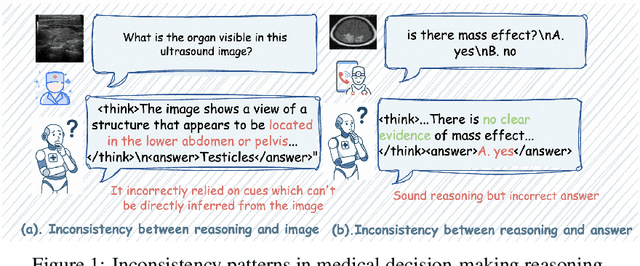
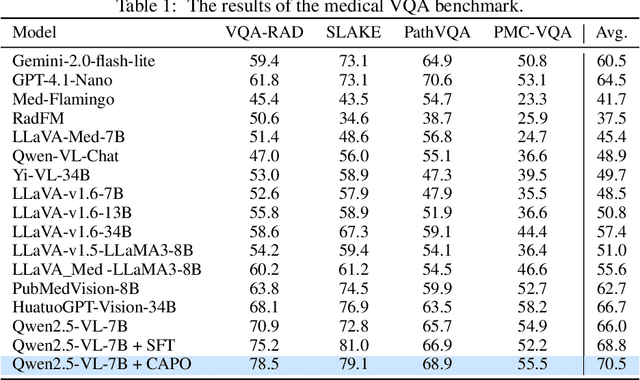
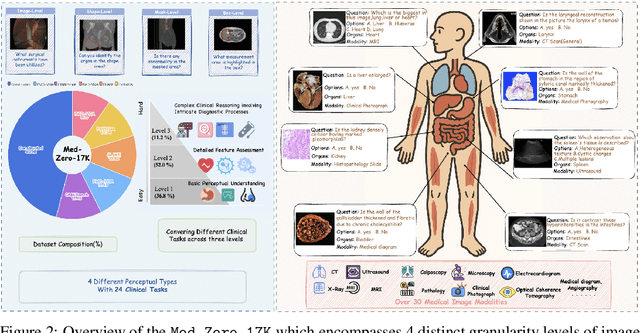
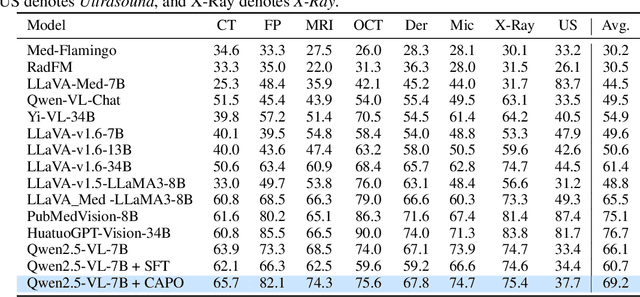
In medical visual question answering (Med-VQA), achieving accurate responses relies on three critical steps: precise perception of medical imaging data, logical reasoning grounded in visual input and textual questions, and coherent answer derivation from the reasoning process. Recent advances in general vision-language models (VLMs) show that large-scale reinforcement learning (RL) could significantly enhance both reasoning capabilities and overall model performance. However, their application in medical domains is hindered by two fundamental challenges: 1) misalignment between perceptual understanding and reasoning stages, and 2) inconsistency between reasoning pathways and answer generation, both compounded by the scarcity of high-quality medical datasets for effective large-scale RL. In this paper, we first introduce Med-Zero-17K, a curated dataset for pure RL-based training, encompassing over 30 medical image modalities and 24 clinical tasks. Moreover, we propose a novel large-scale RL framework for Med-VLMs, Consistency-Aware Preference Optimization (CAPO), which integrates rewards to ensure fidelity between perception and reasoning, consistency in reasoning-to-answer derivation, and rule-based accuracy for final responses. Extensive experiments on both in-domain and out-of-domain scenarios demonstrate the superiority of our method over strong VLM baselines, showcasing strong generalization capability to 3D Med-VQA benchmarks and R1-like training paradigms.
OmniV-Med: Scaling Medical Vision-Language Model for Universal Visual Understanding
Apr 20, 2025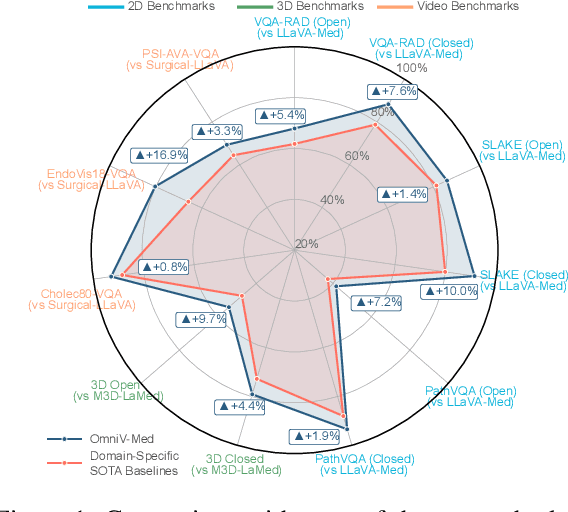
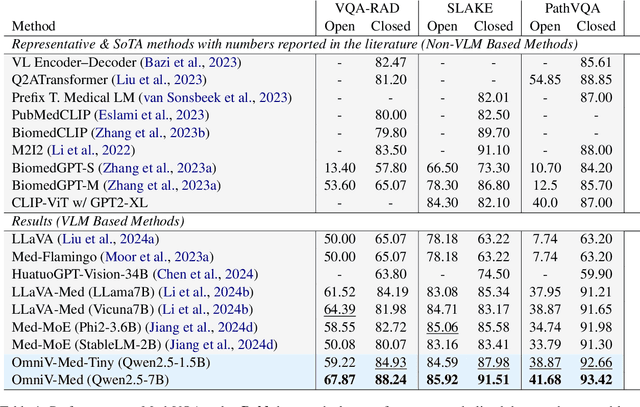
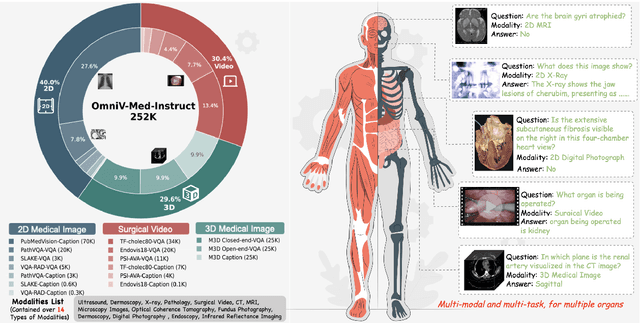
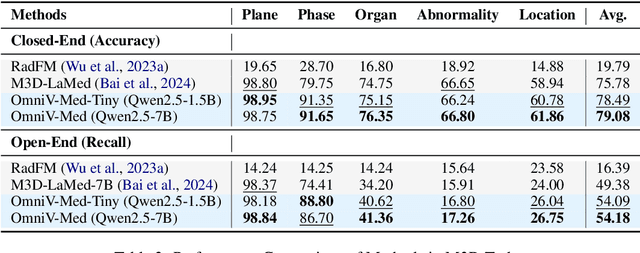
The practical deployment of medical vision-language models (Med-VLMs) necessitates seamless integration of textual data with diverse visual modalities, including 2D/3D images and videos, yet existing models typically employ separate encoders for different modalities. To address this limitation, we present OmniV-Med, a unified framework for multimodal medical understanding. Our technical contributions are threefold: First, we construct OmniV-Med-Instruct, a comprehensive multimodal medical dataset containing 252K instructional samples spanning 14 medical image modalities and 11 clinical tasks. Second, we devise a rotary position-adaptive encoder that processes multi-resolution 2D/3D images and videos within a unified architecture, diverging from conventional modality-specific encoders. Third, we introduce a medical-aware token pruning mechanism that exploits spatial-temporal redundancy in volumetric data (e.g., consecutive CT slices) and medical videos, effectively reducing 60\% of visual tokens without performance degradation. Empirical evaluations demonstrate that OmniV-Med-7B achieves state-of-the-art performance on 7 benchmarks spanning 2D/3D medical imaging and video understanding tasks. Notably, our lightweight variant (OmniV-Med-1.5B) attains comparable performance while requiring only 8 RTX3090 GPUs for training and supporting efficient long-video inference. Data, code and model will be released.