 Add to Chrome
 Add to Firefox
 Add to Edge
OpenWebRL: Demystifying Online Multi-turn Reinforcement Learning for Visual Web Agents
Jun 01, 2026
Building capable visual web agents requires long-horizon reasoning, precise grounding, and robust interaction with dynamic real-world websites. Despite rapid progress, the strongest systems remain largely proprietary, while open agents still depend heavily on supervised post-training over large collections of curated web trajectories. This dependence creates a major scalability bottleneck: high-quality demonstrations are expensive to collect, and static datasets offer limited coverage of the diverse, ever-changing open web. Although online RL has shown promise for text-based agents, its potential for training visual web agents directly on live websites remains largely underexplored. In this paper, we introduce OpenWebRL, an open framework for training visual web agents with online multi-turn RL on real websites. OpenWebRL covers the full training pipeline, including scalable live-browser infrastructure, supervised initialization, multimodal context management, trajectory-level success judging, and efficient multi-turn policy optimization. Using this framework, we train OpenWebRL-4B, which establishes a new open-source state of the art on challenging live-web benchmarks. With only 0.4K initialization trajectories and 2.2K open-ended RL training tasks, OpenWebRL-4B achieves 67.0% success on Online-Mind2Web and 64.0% on DeepShop, outperforming prior open agents of similar or larger scale and remaining competitive with proprietary systems including OpenAI CUA and Gemini CUA. Beyond strong benchmark performance, we systematically study the key design choices that make online RL effective for visual web agents, and analyze how RL improves agentic reasoning. Overall, our work offers a practical path toward building more capable, reproducible, and cost-efficient open web agents. We will release our training data, models, and code to support future research.

Orchard: An Open-Source Agentic Modeling Framework
May 14, 2026Agentic modeling aims to transform LLMs into autonomous agents capable of solving complex tasks through planning, reasoning, tool use, and multi-turn interaction with environments. Despite major investment, open research remains constrained by infrastructure and training gaps. Many high-performing systems rely on proprietary codebases, models, or services, while most open-source frameworks focus on orchestration and evaluation rather than scalable agent training. We present Orchard, an open-source framework for scalable agentic modeling. At its core is Orchard Env, a lightweight environment service providing reusable primitives for sandbox lifecycle management across task domains, agent harnesses, and pipeline stages. On top of Orchard Env, we build three agentic modeling recipes. Orchard-SWE targets coding agents. We distill 107K trajectories from MiniMax-M2.5 and Qwen3.5-397B, introduce credit-assignment SFT to learn from productive segments of unresolved trajectories, and apply Balanced Adaptive Rollout for RL. Starting from Qwen3-30B-A3B-Thinking, Orchard-SWE achieves 64.3% on SWE-bench Verified after SFT and 67.5% after SFT+RL, setting a new state of the art among open-source models of comparable size. Orchard-GUI trains a 4B vision-language computer-use agent using only 0.4K distilled trajectories and 2.2K open-ended tasks. It achieves 74.1%, 67.0%, and 64.0% success rates on WebVoyager, Online-Mind2Web, and DeepShop, respectively, making it the strongest open-source model while remaining competitive with proprietary systems. Orchard-Claw targets personal assistant agents. Trained with only 0.2K synthetic tasks, it achieves 59.6% pass@3 on Claw-Eval and 73.9% when paired with a stronger ZeroClaw harness. Collectively, these results show that a lightweight, open, harness-agnostic environment layer enables reusable agentic data, training recipes, and evaluations across domains.
WebXSkill: Skill Learning for Autonomous Web Agents
Apr 14, 2026Autonomous web agents powered by large language models (LLMs) have shown promise in completing complex browser tasks, yet they still struggle with long-horizon workflows. A key bottleneck is the grounding gap in existing skill formulations: textual workflow skills provide natural language guidance but cannot be directly executed, while code-based skills are executable but opaque to the agent, offering no step-level understanding for error recovery or adaptation. We introduce WebXSkill, a framework that bridges this gap with executable skills, each pairing a parameterized action program with step-level natural language guidance, enabling both direct execution and agent-driven adaptation. WebXSkill operates in three stages: skill extraction mines reusable action subsequences from readily available synthetic agent trajectories and abstracts them into parameterized skills, skill organization indexes skills into a URL-based graph for context-aware retrieval, and skill deployment exposes two complementary modes, grounded mode for fully automated multi-step execution and guided mode where skills serve as step-by-step instructions that the agent follows with its native planning. On WebArena and WebVoyager, WebXSkill improves task success rate by up to 9.8 and 12.9 points over the baseline, respectively, demonstrating the effectiveness of executable skills for web agents. The code is publicly available at https://github.com/aiming-lab/WebXSkill.
The Tool Illusion: Rethinking Tool Use in Web Agents
Apr 03, 2026As web agents rapidly evolve, an increasing body of work has moved beyond conventional atomic browser interactions and explored tool use as a higher-level action paradigm. Although prior studies have shown the promise of tools, their conclusions are often drawn from limited experimental scales and sometimes non-comparable settings. As a result, several fundamental questions remain unclear: i) whether tools provide consistent gains for web agents, ii) what practical design principles characterize effective tools, and iii) what side effects tool use may introduce. To establish a stronger empirical foundation for future research, we revisit tool use in web agents through an extensive and carefully controlled study across diverse tool sources, backbone models, tool-use frameworks, and evaluation benchmarks. Our findings both revise some prior conclusions and complement others with broader evidence. We hope this study provides a more reliable empirical basis and inspires future research on tool-use web agents.
A Versatile Multimodal Agent for Multimedia Content Generation
Jan 06, 2026With the advancement of AIGC (AI-generated content) technologies, an increasing number of generative models are revolutionizing fields such as video editing, music generation, and even film production. However, due to the limitations of current AIGC models, most models can only serve as individual components within specific application scenarios and are not capable of completing tasks end-to-end in real-world applications. In real-world applications, editing experts often work with a wide variety of images and video inputs, producing multimodal outputs -- a video typically includes audio, text, and other elements. This level of integration across multiple modalities is something current models are unable to achieve effectively. However, the rise of agent-based systems has made it possible to use AI tools to tackle complex content generation tasks. To deal with the complex scenarios, in this paper, we propose a MultiMedia-Agent designed to automate complex content creation. Our agent system includes a data generation pipeline, a tool library for content creation, and a set of metrics for evaluating preference alignment. Notably, we introduce the skill acquisition theory to model the training data curation and agent training. We designed a two-stage correlation strategy for plan optimization, including self-correlation and model preference correlation. Additionally, we utilized the generated plans to train the MultiMedia-Agent via a three stage approach including base/success plan finetune and preference optimization. The comparison results demonstrate that the our approaches are effective and the MultiMedia-Agent can generate better multimedia content compared to novel models.
Ask a Strong LLM Judge when Your Reward Model is Uncertain
Oct 23, 2025Reward model (RM) plays a pivotal role in reinforcement learning with human feedback (RLHF) for aligning large language models (LLMs). However, classical RMs trained on human preferences are vulnerable to reward hacking and generalize poorly to out-of-distribution (OOD) inputs. By contrast, strong LLM judges equipped with reasoning capabilities demonstrate superior generalization, even without additional training, but incur significantly higher inference costs, limiting their applicability in online RLHF. In this work, we propose an uncertainty-based routing framework that efficiently complements a fast RM with a strong but costly LLM judge. Our approach formulates advantage estimation in policy gradient (PG) methods as pairwise preference classification, enabling principled uncertainty quantification to guide routing. Uncertain pairs are forwarded to the LLM judge, while confident ones are evaluated by the RM. Experiments on RM benchmarks demonstrate that our uncertainty-based routing strategy significantly outperforms random judge calling at the same cost, and downstream alignment results showcase its effectiveness in improving online RLHF.
WebAgent-R1: Training Web Agents via End-to-End Multi-Turn Reinforcement Learning
May 22, 2025While reinforcement learning (RL) has demonstrated remarkable success in enhancing large language models (LLMs), it has primarily focused on single-turn tasks such as solving math problems. Training effective web agents for multi-turn interactions remains challenging due to the complexity of long-horizon decision-making across dynamic web interfaces. In this work, we present WebAgent-R1, a simple yet effective end-to-end multi-turn RL framework for training web agents. It learns directly from online interactions with web environments by asynchronously generating diverse trajectories, entirely guided by binary rewards depending on task success. Experiments on the WebArena-Lite benchmark demonstrate the effectiveness of WebAgent-R1, boosting the task success rate of Qwen-2.5-3B from 6.1% to 33.9% and Llama-3.1-8B from 8.5% to 44.8%, significantly outperforming existing state-of-the-art methods and strong proprietary models such as OpenAI o3. In-depth analyses reveal the effectiveness of the thinking-based prompting strategy and test-time scaling through increased interactions for web tasks. We further investigate different RL initialization policies by introducing two variants, namely WebAgent-R1-Zero and WebAgent-R1-CoT, which highlight the importance of the warm-up training stage (i.e., behavior cloning) and provide insights on incorporating long chain-of-thought (CoT) reasoning in web agents.
Towards Trustworthy GUI Agents: A Survey
Mar 30, 2025GUI agents, powered by large foundation models, can interact with digital interfaces, enabling various applications in web automation, mobile navigation, and software testing. However, their increasing autonomy has raised critical concerns about their security, privacy, and safety. This survey examines the trustworthiness of GUI agents in five critical dimensions: security vulnerabilities, reliability in dynamic environments, transparency and explainability, ethical considerations, and evaluation methodologies. We also identify major challenges such as vulnerability to adversarial attacks, cascading failure modes in sequential decision-making, and a lack of realistic evaluation benchmarks. These issues not only hinder real-world deployment but also call for comprehensive mitigation strategies beyond task success. As GUI agents become more widespread, establishing robust safety standards and responsible development practices is essential. This survey provides a foundation for advancing trustworthy GUI agents through systematic understanding and future research.
Interpreting and Steering LLMs with Mutual Information-based Explanations on Sparse Autoencoders
Feb 21, 2025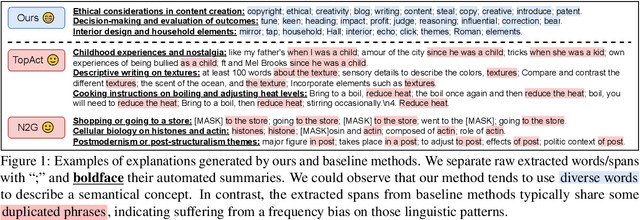
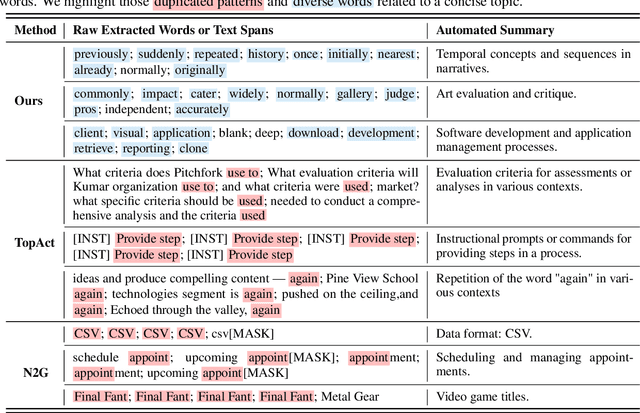
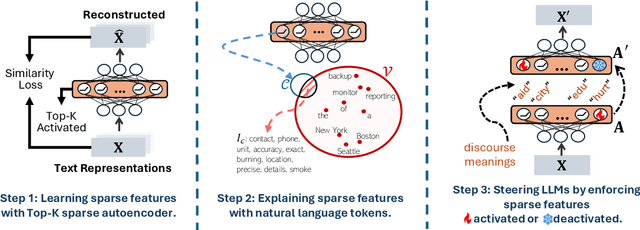
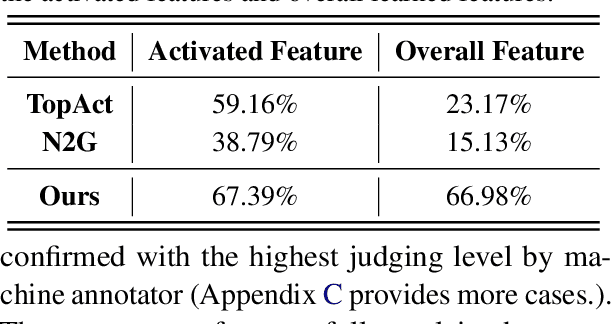
Large language models (LLMs) excel at handling human queries, but they can occasionally generate flawed or unexpected responses. Understanding their internal states is crucial for understanding their successes, diagnosing their failures, and refining their capabilities. Although sparse autoencoders (SAEs) have shown promise for interpreting LLM internal representations, limited research has explored how to better explain SAE features, i.e., understanding the semantic meaning of features learned by SAE. Our theoretical analysis reveals that existing explanation methods suffer from the frequency bias issue, where they emphasize linguistic patterns over semantic concepts, while the latter is more critical to steer LLM behaviors. To address this, we propose using a fixed vocabulary set for feature interpretations and designing a mutual information-based objective, aiming to better capture the semantic meaning behind these features. We further propose two runtime steering strategies that adjust the learned feature activations based on their corresponding explanations. Empirical results show that, compared to baselines, our method provides more discourse-level explanations and effectively steers LLM behaviors to defend against jailbreak attacks. These findings highlight the value of explanations for steering LLM behaviors in downstream applications. We will release our code and data once accepted.
OpenWebVoyager: Building Multimodal Web Agents via Iterative Real-World Exploration, Feedback and Optimization
Oct 25, 2024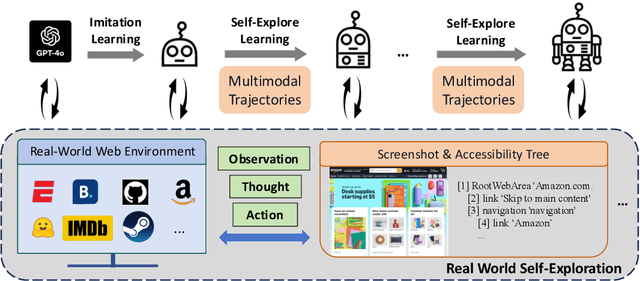
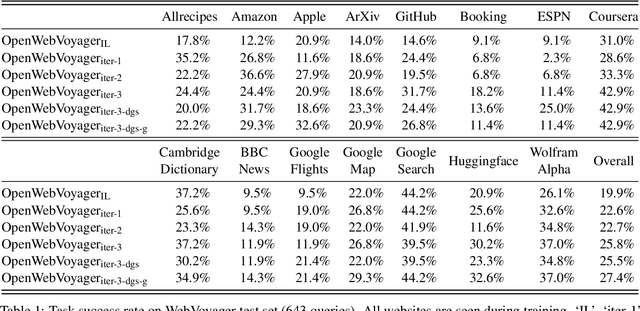

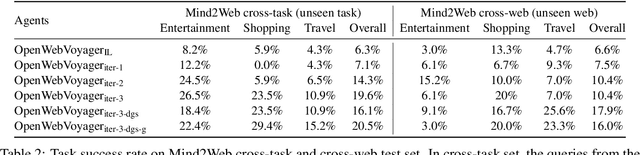
The rapid development of large language and multimodal models has sparked significant interest in using proprietary models, such as GPT-4o, to develop autonomous agents capable of handling real-world scenarios like web navigation. Although recent open-source efforts have tried to equip agents with the ability to explore environments and continuously improve over time, they are building text-only agents in synthetic environments where the reward signals are clearly defined. Such agents struggle to generalize to realistic settings that require multimodal perception abilities and lack ground-truth signals. In this paper, we introduce an open-source framework designed to facilitate the development of multimodal web agent that can autonomously conduct real-world exploration and improve itself. We first train the base model with imitation learning to gain the basic abilities. We then let the agent explore the open web and collect feedback on its trajectories. After that, it further improves its policy by learning from well-performing trajectories judged by another general-purpose model. This exploration-feedback-optimization cycle can continue for several iterations. Experimental results show that our web agent successfully improves itself after each iteration, demonstrating strong performance across multiple test sets.