 Add to Chrome
 Add to Firefox
 Add to Edge
Securing Autonomous Vehicle Systems via Twin-Aware Federated Reinforcement Learning
Jul 09, 2026
Federated reinforcement learning (FRL) is crucial for enabling collaborative learning across multiple agents without sharing raw data, thereby enhancing privacy and scalability in the decision-making process within dynamic vehicular environments. However, poisoning attacks pose a significant threat to the security and reliability of FRL-based systems, particularly in safety-critical autonomous driving, where this vulnerability remains largely unexplored. These attacks can compromise the global control model by subtly injecting malicious system parameters, leading to potential hazards. To counter these challenges, we present \alg (\underline{Sec}ure \underline{A}ggregation with \underline{p}oisoning-\underline{p}revention and historical reinforcement) as a defensive framework aimed at enhancing the robustness of FRL systems designed for safety-critical driving scenarios. \alg strategically integrates digital twins for rehearsal-based learning and leverages historical aggregated model parameters along with a selected central gradient to ensure that only benign data is aggregated, effectively mitigating the influence of malicious agents. Theoretical guarantees are provided for the convergence performance of \alg in the presence of poisoning attacks. We also validate the effectiveness of \alg using developed digital twins that model realistic highway environments to evaluate the control of autonomous vehicles under adversarial conditions.

Beware What You Autocomplete: Forensic Attribution of Backdoored Code Completions
Jul 09, 2026Large language models have enabled powerful code completion systems that assist developers by predicting subsequent lines of code. However, these models remain vulnerable to backdoor attacks, where malicious fine-tuning data covertly implants unsafe behaviors. Despite advances in defensive techniques, adaptive and sophisticated backdoor attacks still evade detection and mitigation. We present CodeTracer, a forensic framework that traces malicious code completions back to the backdoor fine-tuning data responsible for them. Operating under realistic post-deployment constraints, CodeTracer relies solely on the fine-tuning corpus and the reported miscompletion event. It extracts a structured behavioral fingerprint from the compromised output, narrows the search to semantically relevant code samples, and employs LLM-based reasoning to attribute unsafe logic to specific backdoor data. Extensive evaluations across three representative vulnerability cases and ten backdoor attacks, along with sixteen competitive baselines, demonstrate that CodeTracer consistently achieves high forensic accuracy, low false identification rates, and strong robustness against adaptive attacks.
Who Broke the System? Failure Localization in LLM-Based Multi-Agent Systems
Jul 08, 2026Large language model (LLM) based multi-agent systems enable complex problem solving through coordinated reasoning and action, but their distributed structure also introduces new challenges in diagnosing system-level failures. When an execution fails, identifying which agent is responsible and at what point the trajectory first becomes irreversibly misdirected is difficult due to long-horizon interactions and tightly coupled agent behaviors. In this paper, we study the problem of failure localization in LLM-based multi-agent systems and present AgentLocate, a framework that attributes failures to both a specific agent and the earliest decisive step. AgentLocate combines an LLM-based judging mechanism with multi-perspective verification by independent evaluators, whose assessments are aggregated using a confidence-aware strategy. The resulting feedback is further used to adapt the judge through lightweight fine-tuning, improving attribution quality. We evaluate AgentLocate on two complementary benchmarks covering diverse tasks, agent configurations, and trajectory lengths. Experimental results show that AgentLocate consistently outperforms existing failure localization methods in identifying both responsible agents and failure steps, while remaining efficient in terms of token usage and running time.
Patcher: Post-Hoc Patching of Backdoored Large Language Models
Jun 02, 2026Large language models remain vulnerable to jailbreak backdoor attacks, where adversaries poison safety alignment data to embed hidden triggers that bypass safety mechanisms. Existing defenses often require comprehensive attack information or multiple triggered examples, making them impractical when defenders only observe a single reported failure case without knowing whether it stems from a backdoor attack or a natural alignment bug. This paper presents Patcher, a post-hoc defense framework that repairs backdoored language models using only a single reported failure case and the model parameters. Patcher operates in two stages. First, it localizes backdoor triggers by computing response-conditioned gradient-based saliency scores and applying adaptive clustering to separate triggers from benign context. Second, it patches the model through a constrained fine-tuning objective that breaks the trigger-response association while preserving benign-task utility and robustness to non-triggered jailbreak attacks through KL-divergence constraints. We conduct extensive evaluations across multiple backdoor attack strategies and demonstrate that Patcher successfully localizes triggers and neutralizes backdoors while maintaining model utility. We further show robustness against adaptive attacks designed to evade our defense. This work represents a significant step toward practical defenses against training-time attacks in deployed language models.
SecureAFL: Secure Asynchronous Federated Learning
Apr 04, 2026Federated learning (FL) enables multiple clients to collaboratively train a global machine learning model via a server without sharing their private training data. In traditional FL, the system follows a synchronous approach, where the server waits for model updates from numerous clients before aggregating them to update the global model. However, synchronous FL is hindered by the straggler problem. To address this, the asynchronous FL architecture allows the server to update the global model immediately upon receiving any client's local model update. Despite its advantages, the decentralized nature of asynchronous FL makes it vulnerable to poisoning attacks. Several defenses tailored for asynchronous FL have been proposed, but these mechanisms remain susceptible to advanced attacks or rely on unrealistic server assumptions. In this paper, we introduce SecureAFL, an innovative framework designed to secure asynchronous FL against poisoning attacks. SecureAFL improves the robustness of asynchronous FL by detecting and discarding anomalous updates while estimating the contributions of missing clients. Additionally, it utilizes Byzantine-robust aggregation techniques, such as coordinate-wise median, to integrate the received and estimated updates. Extensive experiments on various real-world datasets demonstrate the effectiveness of SecureAFL.
SecureSplit: Mitigating Backdoor Attacks in Split Learning
Jan 20, 2026Split Learning (SL) offers a framework for collaborative model training that respects data privacy by allowing participants to share the same dataset while maintaining distinct feature sets. However, SL is susceptible to backdoor attacks, in which malicious clients subtly alter their embeddings to insert hidden triggers that compromise the final trained model. To address this vulnerability, we introduce SecureSplit, a defense mechanism tailored to SL. SecureSplit applies a dimensionality transformation strategy to accentuate subtle differences between benign and poisoned embeddings, facilitating their separation. With this enhanced distinction, we develop an adaptive filtering approach that uses a majority-based voting scheme to remove contaminated embeddings while preserving clean ones. Rigorous experiments across four datasets (CIFAR-10, MNIST, CINIC-10, and ImageNette), five backdoor attack scenarios, and seven alternative defenses confirm the effectiveness of SecureSplit under various challenging conditions.
Practical Framework for Privacy-Preserving and Byzantine-robust Federated Learning
Dec 19, 2025Federated Learning (FL) allows multiple clients to collaboratively train a model without sharing their private data. However, FL is vulnerable to Byzantine attacks, where adversaries manipulate client models to compromise the federated model, and privacy inference attacks, where adversaries exploit client models to infer private data. Existing defenses against both backdoor and privacy inference attacks introduce significant computational and communication overhead, creating a gap between theory and practice. To address this, we propose ABBR, a practical framework for Byzantine-robust and privacy-preserving FL. We are the first to utilize dimensionality reduction to speed up the private computation of complex filtering rules in privacy-preserving FL. Additionally, we analyze the accuracy loss of vector-wise filtering in low-dimensional space and introduce an adaptive tuning strategy to minimize the impact of malicious models that bypass filtering on the global model. We implement ABBR with state-of-the-art Byzantine-robust aggregation rules and evaluate it on public datasets, showing that it runs significantly faster, has minimal communication overhead, and maintains nearly the same Byzantine-resilience as the baselines.
Enhancing Privacy in Decentralized Min-Max Optimization: A Differentially Private Approach
Aug 10, 2025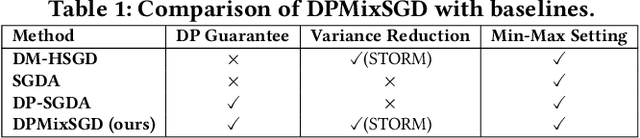
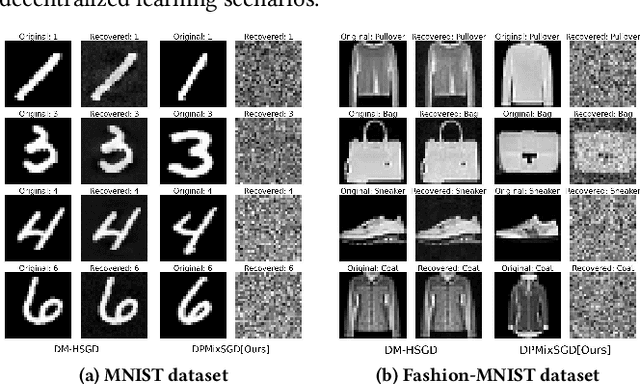
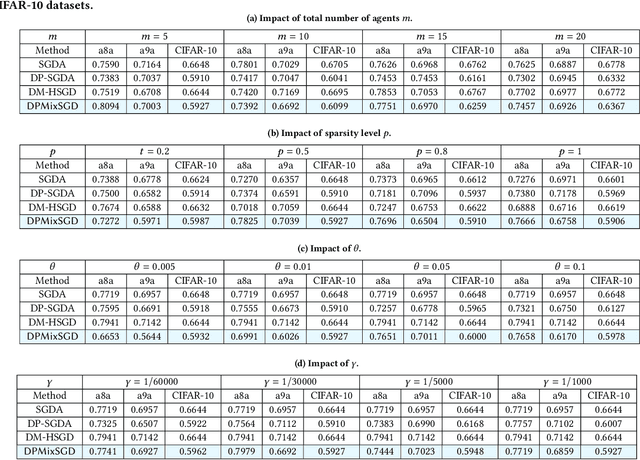

Decentralized min-max optimization allows multi-agent systems to collaboratively solve global min-max optimization problems by facilitating the exchange of model updates among neighboring agents, eliminating the need for a central server. However, sharing model updates in such systems carry a risk of exposing sensitive data to inference attacks, raising significant privacy concerns. To mitigate these privacy risks, differential privacy (DP) has become a widely adopted technique for safeguarding individual data. Despite its advantages, implementing DP in decentralized min-max optimization poses challenges, as the added noise can hinder convergence, particularly in non-convex scenarios with complex agent interactions in min-max optimization problems. In this work, we propose an algorithm called DPMixSGD (Differential Private Minmax Hybrid Stochastic Gradient Descent), a novel privacy-preserving algorithm specifically designed for non-convex decentralized min-max optimization. Our method builds on the state-of-the-art STORM-based algorithm, one of the fastest decentralized min-max solutions. We rigorously prove that the noise added to local gradients does not significantly compromise convergence performance, and we provide theoretical bounds to ensure privacy guarantees. To validate our theoretical findings, we conduct extensive experiments across various tasks and models, demonstrating the effectiveness of our approach.
Benchmarking Poisoning Attacks against Retrieval-Augmented Generation
May 24, 2025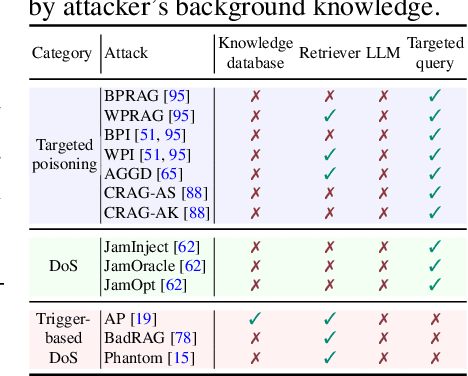
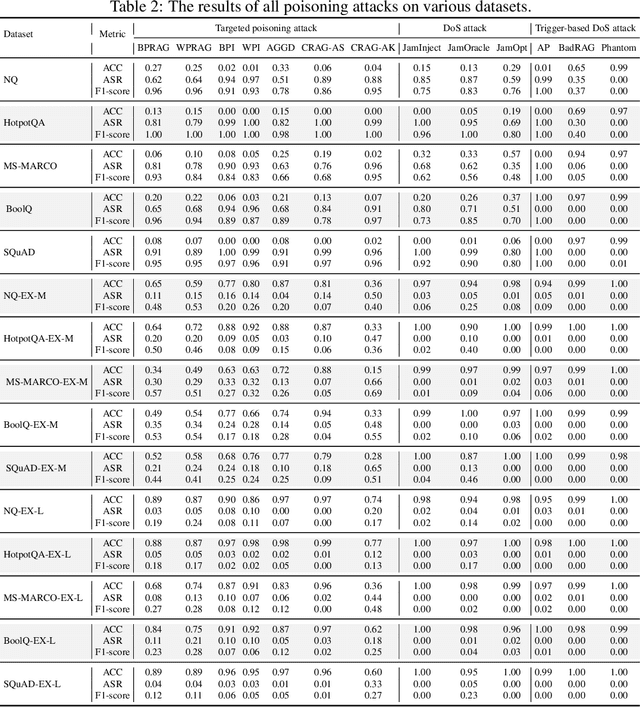
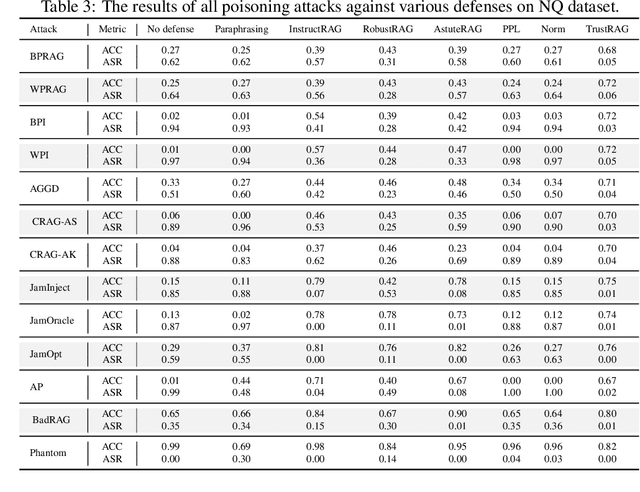
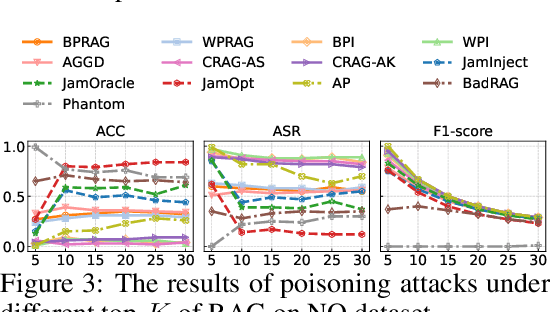
Retrieval-Augmented Generation (RAG) has proven effective in mitigating hallucinations in large language models by incorporating external knowledge during inference. However, this integration introduces new security vulnerabilities, particularly to poisoning attacks. Although prior work has explored various poisoning strategies, a thorough assessment of their practical threat to RAG systems remains missing. To address this gap, we propose the first comprehensive benchmark framework for evaluating poisoning attacks on RAG. Our benchmark covers 5 standard question answering (QA) datasets and 10 expanded variants, along with 13 poisoning attack methods and 7 defense mechanisms, representing a broad spectrum of existing techniques. Using this benchmark, we conduct a comprehensive evaluation of all included attacks and defenses across the full dataset spectrum. Our findings show that while existing attacks perform well on standard QA datasets, their effectiveness drops significantly on the expanded versions. Moreover, our results demonstrate that various advanced RAG architectures, such as sequential, branching, conditional, and loop RAG, as well as multi-turn conversational RAG, multimodal RAG systems, and RAG-based LLM agent systems, remain susceptible to poisoning attacks. Notably, current defense techniques fail to provide robust protection, underscoring the pressing need for more resilient and generalizable defense strategies.
Toward Malicious Clients Detection in Federated Learning
May 14, 2025Federated learning (FL) enables multiple clients to collaboratively train a global machine learning model without sharing their raw data. However, the decentralized nature of FL introduces vulnerabilities, particularly to poisoning attacks, where malicious clients manipulate their local models to disrupt the training process. While Byzantine-robust aggregation rules have been developed to mitigate such attacks, they remain inadequate against more advanced threats. In response, recent advancements have focused on FL detection techniques to identify potentially malicious participants. Unfortunately, these methods often misclassify numerous benign clients as threats or rely on unrealistic assumptions about the server's capabilities. In this paper, we propose a novel algorithm, SafeFL, specifically designed to accurately identify malicious clients in FL. The SafeFL approach involves the server collecting a series of global models to generate a synthetic dataset, which is then used to distinguish between malicious and benign models based on their behavior. Extensive testing demonstrates that SafeFL outperforms existing methods, offering superior efficiency and accuracy in detecting malicious clients.