 Add to Chrome
 Add to Firefox
 Add to Edge
OneReason Technical Report
Jun 04, 2026
Generative recommendation models in the OneRec family have been widely deployed in many real-world services, such as short-video, live-streaming, advertising, and e-commerce. However, these generative models can only benefit from the scaling advantage, while their reasoning ability is hard to activate, since we cannot construct meaningful Chain-of-Thought (CoT) sequences consisting of itemic tokens only. Inspired by the success of the reasoning-style ``think before answer'' paradigm in the LLM field, we conduct preliminary studies (i.e., OneRec-Think, OpenOneRec) to explore reasoning capability in generative recommendation. Nevertheless, we notice an unexpected phenomenon: the thinking mode does not show advantages over the non-thinking mode. Drawing insights from recent findings on CoT robustness in multi-modal language models, we argue that effective reasoning in recommendation rests on two factors: perception, the ability to ground itemic tokens in their underlying language semantics, and cognition, the ability to reorganize a user's behavior sequence into coherent latent interest points. We therefore propose OneReason, which includes: (1) strong itemic token perception in pre-training, (2) a three-level cognition-enhanced CoT format for recommendation tasks in SFT, and (3) a specialize-then-unify training recipe in RL to enhance the thinking ability.

Unlocking Proactivity in Task-Oriented Dialogue
May 21, 2026Proactive task-oriented dialogue (TOD), such as outbound sales, demands a persuasive agent that actively probes the user's concerns and steers the conversation toward acceptance within a bounded number of turns. Yet post-trained LLMs are inherently conservative, and reward-shaping RL (e.g., GRPO) struggles since it only re-weights what an already passive policy samples. We show that conditioning on the user's latent concerns unlocks proactive capability that no amount of sampling can undermine, establishing these concerns as a pivotal training-time signal. To operationalize this finding, we build the \textbf{Cognitive User Simulator}, which models each user as a stratified persona comprising observable external traits and hidden internal concerns. The simulator produces faithful and diverse interactions, while emitting per-turn state dynamics that track persuasion progress. We then introduce \textbf{Simulator-Induced Asymmetric-View Policy Optimization}, which converts the modeled concerns and the simulation state transition into complementary training objectives: (1) \emph{Asymmetric On-Policy Self-Distillation} that transfers concern-aware behavior from a privileged view of the same policy into its deployable, conversation-only view; and (2) \emph{State-Transition Policy Refinement} ...
SAGE: A Service Agent Graph-guided Evaluation Benchmark
Apr 10, 2026The development of Large Language Models (LLMs) has catalyzed automation in customer service, yet benchmarking their performance remains challenging. Existing benchmarks predominantly rely on static paradigms and single-dimensional metrics, failing to account for diverse user behaviors or the strict adherence to structured Standard Operating Procedures (SOPs) required in real-world deployments. To bridge this gap, we propose SAGE (Service Agent Graph-guided Evaluation), a universal multi-agent benchmark for automated, dual-axis assessment. SAGE formalizes unstructured SOPs into Dynamic Dialogue Graphs, enabling precise verification of logical compliance and comprehensive path coverage. We introduce an Adversarial Intent Taxonomy and a modular Extension Mechanism, enabling low-cost deployment across domains and facilitating automated dialogue data synthesis. Evaluation is conducted via a framework where Judge Agents and a Rule Engine analyze interactions between User and Service Agents to generate deterministic ground truth. Extensive experiments on 27 LLMs across 6 industrial scenarios reveal a significant ``Execution Gap'' where models accurately classify intents but fail to derive correct subsequent actions. We also observe ``Empathy Resilience'', a phenomenon where models maintain polite conversational facades despite underlying logical failures under high adversarial intensity. Code and resources are available at https://anonymous.4open.science/r/SAGE-Bench-4CD3/.
NeuroFlow: Toward Unified Visual Encoding and Decoding from Neural Activity
Apr 10, 2026Visual encoding and decoding models act as gateways to understanding the neural mechanisms underlying human visual perception. Typically, visual encoding models that predict brain activity from stimuli and decoding models that reproduce stimuli from brain activity are treated as distinct tasks, requiring separate models and training procedures. This separation is inefficient and fails to model the consistency between encoding and decoding processes. To address this limitation, we propose NeuroFlow, the first unified framework that jointly models visual encoding and decoding from neural activity within a single flow model. NeuroFlow introduces two key components: (1) NeuroVAE is designed as a variational backbone to model neural variability and establish a compact, semantically structured latent space for bidirectional modeling across visual and neural modalities. (2) Cross-modal Flow Matching (XFM) bypasses the typical paradigm of noise-to-data diffusion guided by a specific modality condition, instead learning a reversibly consistent flow model between visual and neural latent distributions. For the first time, visual encoding and decoding are reformulated as a time-dependent, reversible process within a shared latent space for unified modeling. Empirical results demonstrate that NeuroFlow achieves superior overall performance in visual encoding and decoding tasks with higher computational efficiency compared to any isolated methods. We further analyze principal factors that steer the model toward encoding-decoding consistency and, through brain functional analyses, demonstrate that NeuroFlow captures consistent activation patterns underlying neural variability. NeuroFlow marks a major step toward unified visual encoding and decoding from neural activity, providing mechanistic insights that inform future bidirectional visual brain-computer interfaces.
Reinforcing Real-world Service Agents: Balancing Utility and Cost in Task-oriented Dialogue
Feb 26, 2026The rapid evolution of Large Language Models (LLMs) has accelerated the transition from conversational chatbots to general agents. However, effectively balancing empathetic communication with budget-aware decision-making remains an open challenge. Since existing methods fail to capture these complex strategic trade-offs, we propose InteractCS-RL, a framework that reframes task-oriented dialogue as a multi-granularity reinforcement learning process. Specifically, we first establish a User-centric Interaction Framework to provide a high-fidelity training gym, enabling agents to dynamically explore diverse strategies with persona-driven users. Then, we introduce Cost-aware Multi-turn Policy Optimization (CMPO) with a hybrid advantage estimation strategy. By integrating generative process credits and employing a PID-Lagrangian cost controller, CMPO effectively guides the policy to explore Pareto boundary between user reward and global cost constraints. Extensive experiments on customized real business scenarios demonstrate that InteractCS-RL significantly outperform other baselines across three evaluation dimensions. Further evaluation on tool-agent-user interaction benchmarks verify InteractCS-RL robustness across diverse domains.
SEAD: Self-Evolving Agent for Multi-Turn Service Dialogue
Feb 03, 2026Large Language Models have demonstrated remarkable capabilities in open-domain dialogues. However, current methods exhibit suboptimal performance in service dialogues, as they rely on noisy, low-quality human conversation data. This limitation arises from data scarcity and the difficulty of simulating authentic, goal-oriented user behaviors. To address these issues, we propose SEAD (Self-Evolving Agent for Service Dialogue), a framework that enables agents to learn effective strategies without large-scale human annotations. SEAD decouples user modeling into two components: a Profile Controller that generates diverse user states to manage training curriculum, and a User Role-play Model that focuses on realistic role-playing. This design ensures the environment provides adaptive training scenarios rather than acting as an unfair adversary. Experiments demonstrate that SEAD significantly outperforms Open-source Foundation Models and Closed-source Commercial Models, improving task completion rate by 17.6% and dialogue efficiency by 11.1%. Code is available at: https://github.com/Da1yuqin/SEAD.
Human Motion Video Generation: A Survey
Sep 04, 2025Human motion video generation has garnered significant research interest due to its broad applications, enabling innovations such as photorealistic singing heads or dynamic avatars that seamlessly dance to music. However, existing surveys in this field focus on individual methods, lacking a comprehensive overview of the entire generative process. This paper addresses this gap by providing an in-depth survey of human motion video generation, encompassing over ten sub-tasks, and detailing the five key phases of the generation process: input, motion planning, motion video generation, refinement, and output. Notably, this is the first survey that discusses the potential of large language models in enhancing human motion video generation. Our survey reviews the latest developments and technological trends in human motion video generation across three primary modalities: vision, text, and audio. By covering over two hundred papers, we offer a thorough overview of the field and highlight milestone works that have driven significant technological breakthroughs. Our goal for this survey is to unveil the prospects of human motion video generation and serve as a valuable resource for advancing the comprehensive applications of digital humans. A complete list of the models examined in this survey is available in Our Repository https://github.com/Winn1y/Awesome-Human-Motion-Video-Generation.
* Accepted by TPAMI. Github Repo: https://github.com/Winn1y/Awesome-Human-Motion-Video-Generation IEEE Access: https://ieeexplore.ieee.org/document/11106267
Careful Queries, Credible Results: Teaching RAG Models Advanced Web Search Tools with Reinforcement Learning
Aug 11, 2025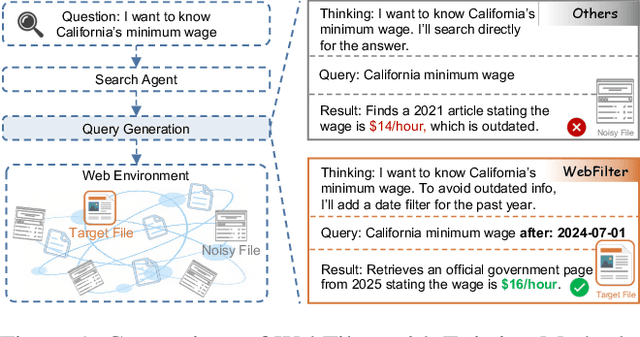
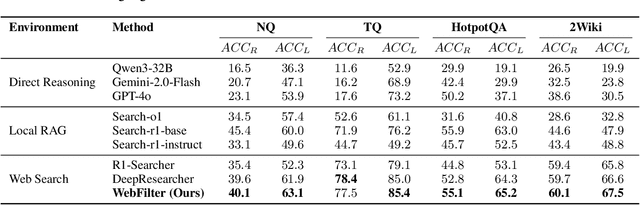
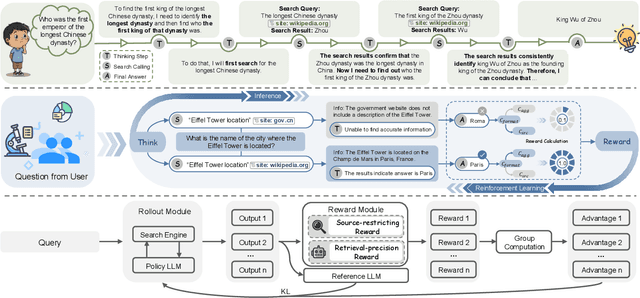
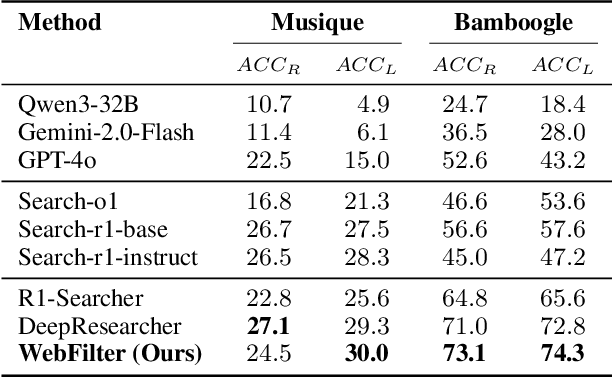
Retrieval-Augmented Generation (RAG) enhances large language models (LLMs) by integrating up-to-date external knowledge, yet real-world web environments present unique challenges. These limitations manifest as two key challenges: pervasive misinformation in the web environment, which introduces unreliable or misleading content that can degrade retrieval accuracy, and the underutilization of web tools, which, if effectively employed, could enhance query precision and help mitigate this noise, ultimately improving the retrieval results in RAG systems. To address these issues, we propose WebFilter, a novel RAG framework that generates source-restricted queries and filters out unreliable content. This approach combines a retrieval filtering mechanism with a behavior- and outcome-driven reward strategy, optimizing both query formulation and retrieval outcomes. Extensive experiments demonstrate that WebFilter improves answer quality and retrieval precision, outperforming existing RAG methods on both in-domain and out-of-domain benchmarks.
RealFactBench: A Benchmark for Evaluating Large Language Models in Real-World Fact-Checking
Jun 14, 2025Large Language Models (LLMs) hold significant potential for advancing fact-checking by leveraging their capabilities in reasoning, evidence retrieval, and explanation generation. However, existing benchmarks fail to comprehensively evaluate LLMs and Multimodal Large Language Models (MLLMs) in realistic misinformation scenarios. To bridge this gap, we introduce RealFactBench, a comprehensive benchmark designed to assess the fact-checking capabilities of LLMs and MLLMs across diverse real-world tasks, including Knowledge Validation, Rumor Detection, and Event Verification. RealFactBench consists of 6K high-quality claims drawn from authoritative sources, encompassing multimodal content and diverse domains. Our evaluation framework further introduces the Unknown Rate (UnR) metric, enabling a more nuanced assessment of models' ability to handle uncertainty and balance between over-conservatism and over-confidence. Extensive experiments on 7 representative LLMs and 4 MLLMs reveal their limitations in real-world fact-checking and offer valuable insights for further research. RealFactBench is publicly available at https://github.com/kalendsyang/RealFactBench.git.
MindAligner: Explicit Brain Functional Alignment for Cross-Subject Visual Decoding from Limited fMRI Data
Feb 07, 2025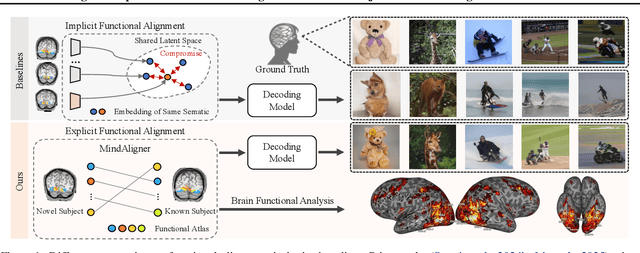


Brain decoding aims to reconstruct visual perception of human subject from fMRI signals, which is crucial for understanding brain's perception mechanisms. Existing methods are confined to the single-subject paradigm due to substantial brain variability, which leads to weak generalization across individuals and incurs high training costs, exacerbated by limited availability of fMRI data. To address these challenges, we propose MindAligner, an explicit functional alignment framework for cross-subject brain decoding from limited fMRI data. The proposed MindAligner enjoys several merits. First, we learn a Brain Transfer Matrix (BTM) that projects the brain signals of an arbitrary new subject to one of the known subjects, enabling seamless use of pre-trained decoding models. Second, to facilitate reliable BTM learning, a Brain Functional Alignment module is proposed to perform soft cross-subject brain alignment under different visual stimuli with a multi-level brain alignment loss, uncovering fine-grained functional correspondences with high interpretability. Experiments indicate that MindAligner not only outperforms existing methods in visual decoding under data-limited conditions, but also provides valuable neuroscience insights in cross-subject functional analysis. The code will be made publicly available.