 Add to Chrome
 Add to Firefox
 Add to Edge
GenHOI: Contact-Aware Humanoid-Object Interaction by Imitating Generated Videos without Task-Specific Training
Jun 11, 2026
Humanoid-Object Interaction (HOI) is a fundamental capability for humanoid robots, yet it remains challenging due to the tight coupling between dynamic balance and stable interaction with diverse objects. Existing methods often require time-consuming task-specific policy training or rely on rigid trajectory replay, which limits their ability to accommodate novel interaction scenarios. In this work, we present \textit{GenHOI}, a simple yet effective framework that enables humanoid robots to perform diverse object-interaction tasks in a zero-shot manner by directly imitating a single generated video, without task-specific training or physical demonstration data. GenHOI first reconstructs the robot-object scene in simulation and renders a first-frame image, which, together with the language command, conditions the synthesis of a task-oriented interaction video. The generated video is then analyzed to identify interaction-relevant contact events and estimate hand-object contact regions, which are encoded as object-centric geometric constraints that convert visual interaction cues into physically grounded optimization priors. Guided by these priors, the reference motion recovered from the video is refined and smoothed to resolve the scale ambiguity inherent in 2D video generation, while adapting a single reference trajectory to unseen robot-object relative poses. The optimized trajectory is finally executed by a closed-loop tracking controller. We validate the proposed framework in extensive simulation and real-world experiments across diverse object-interaction tasks, including box grasping, asymmetric bimanual chair carrying, table lifting from below, and cylindrical-object enveloping.

AttenA+: Rectifying Action Inequality in Robotic Foundation Models
May 13, 2026Existing robotic foundation models, while powerful, are predicated on an implicit assumption of temporal homogeneity: treating all actions as equally informative during optimization. This "flat" training paradigm, inherited from language modeling, remains indifferent to the underlying physical hierarchy of manipulation. In reality, robot trajectories are fundamentally heterogeneous, where low-velocity segments often dictate task success through precision-demanding interactions, while high-velocity motions serve as error-tolerant transitions. Such a misalignment between uniform loss weighting and physical criticality fundamentally limits the performance of current Vision-Language-Action (VLA) models and World-Action Models (WAM) in complex, long-horizon tasks. To rectify this, we introduce AttenA+, an architecture-agnostic framework that prioritizes kinematically critical segments via velocity-driven action attention. By reweighting the training objective based on the inverse velocity field, AttenA+ naturally aligns the model's learning capacity with the physical demands of manipulation. As a plug-and-play enhancement, AttenA+ can be integrated into existing backbones without structural modifications or additional parameters. Extensive experiments demonstrate that AttenA+ significantly elevates the ceilings of current state-of-the-art models. Specifically, it improves OpenVLA-OFT to 98.6% (+1.5%) on the Libero benchmark and pushes FastWAM to 92.4% (+0.6%) on RoboTwin 2.0. Real-world validation on a Franka manipulator further showcases its robustness and cross-task generalization. Our work suggests that mining the intrinsic structural priors of action sequences offers a highly efficient, physics-aware complement to standard scaling laws, paving a new path for general-purpose robotic control.
Elastic Attention Cores for Scalable Vision Transformers
May 12, 2026Vision Transformers (ViTs) achieve strong data-driven scaling by leveraging all-to-all self-attention. However, this flexibility incurs a computational cost that scales quadratically with image resolution, limiting ViTs in high-resolution domains. Underlying this approach is the assumption that pairwise token interactions are necessary for learning rich visual-semantic representations. In this work, we challenge this assumption, demonstrating that effective visual representations can be learned without any direct patch-to-patch interaction. We propose VECA (Visual Elastic Core Attention), a vision transformer architecture that uses efficient linear-time core-periphery structured attention enabled by a small set of learned cores. In VECA, these cores act as a communication interface: patch tokens exchange information exclusively through the core tokens, which are initialized from scratch and propagated across layers. Because the $N$ image patches only directly interact with a resolution invariant set of $C$ learned "core" embeddings, this yields linear complexity $O(N)$ for predetermined $C$, which bypasses quadratic scaling. Compared to prior cross-attention architectures, VECA maintains and iteratively updates the full set of $N$ input tokens, avoiding a small $C$-way bottleneck. Combined with nested training along the core axis, our model can elastically trade off compute and accuracy during inference. Across classification and dense tasks, VECA achieves performance competitive with the latest vision foundation models while reducing computational cost. Our results establish elastic core-periphery attention as a scalable alternative building block for Vision Transformers.
NeuroFlow: Toward Unified Visual Encoding and Decoding from Neural Activity
Apr 10, 2026Visual encoding and decoding models act as gateways to understanding the neural mechanisms underlying human visual perception. Typically, visual encoding models that predict brain activity from stimuli and decoding models that reproduce stimuli from brain activity are treated as distinct tasks, requiring separate models and training procedures. This separation is inefficient and fails to model the consistency between encoding and decoding processes. To address this limitation, we propose NeuroFlow, the first unified framework that jointly models visual encoding and decoding from neural activity within a single flow model. NeuroFlow introduces two key components: (1) NeuroVAE is designed as a variational backbone to model neural variability and establish a compact, semantically structured latent space for bidirectional modeling across visual and neural modalities. (2) Cross-modal Flow Matching (XFM) bypasses the typical paradigm of noise-to-data diffusion guided by a specific modality condition, instead learning a reversibly consistent flow model between visual and neural latent distributions. For the first time, visual encoding and decoding are reformulated as a time-dependent, reversible process within a shared latent space for unified modeling. Empirical results demonstrate that NeuroFlow achieves superior overall performance in visual encoding and decoding tasks with higher computational efficiency compared to any isolated methods. We further analyze principal factors that steer the model toward encoding-decoding consistency and, through brain functional analyses, demonstrate that NeuroFlow captures consistent activation patterns underlying neural variability. NeuroFlow marks a major step toward unified visual encoding and decoding from neural activity, providing mechanistic insights that inform future bidirectional visual brain-computer interfaces.
Meta-learning In-Context Enables Training-Free Cross Subject Brain Decoding
Apr 09, 2026Visual decoding from brain signals is a key challenge at the intersection of computer vision and neuroscience, requiring methods that bridge neural representations and computational models of vision. A field-wide goal is to achieve generalizable, cross-subject models. A major obstacle towards this goal is the substantial variability in neural representations across individuals, which has so far required training bespoke models or fine-tuning separately for each subject. To address this challenge, we introduce a meta-optimized approach for semantic visual decoding from fMRI that generalizes to novel subjects without any fine-tuning. By simply conditioning on a small set of image-brain activation examples from the new individual, our model rapidly infers their unique neural encoding patterns to facilitate robust and efficient visual decoding. Our approach is explicitly optimized for in-context learning of the new subject's encoding model and performs decoding by hierarchical inference, inverting the encoder. First, for multiple brain regions, we estimate the per-voxel visual response encoder parameters by constructing a context over multiple stimuli and responses. Second, we construct a context consisting of encoder parameters and response values over multiple voxels to perform aggregated functional inversion. We demonstrate strong cross-subject and cross-scanner generalization across diverse visual backbones without retraining or fine-tuning. Moreover, our approach requires neither anatomical alignment nor stimulus overlap. This work is a critical step towards a generalizable foundation model for non-invasive brain decoding.
Real-to-Sim for Highly Cluttered Environments via Physics-Consistent Inter-Object Reasoning
Feb 13, 2026Reconstructing physically valid 3D scenes from single-view observations is a prerequisite for bridging the gap between visual perception and robotic control. However, in scenarios requiring precise contact reasoning, such as robotic manipulation in highly cluttered environments, geometric fidelity alone is insufficient. Standard perception pipelines often neglect physical constraints, resulting in invalid states, e.g., floating objects or severe inter-penetration, rendering downstream simulation unreliable. To address these limitations, we propose a novel physics-constrained Real-to-Sim pipeline that reconstructs physically consistent 3D scenes from single-view RGB-D data. Central to our approach is a differentiable optimization pipeline that explicitly models spatial dependencies via a contact graph, jointly refining object poses and physical properties through differentiable rigid-body simulation. Extensive evaluations in both simulation and real-world settings demonstrate that our reconstructed scenes achieve high physical fidelity and faithfully replicate real-world contact dynamics, enabling stable and reliable contact-rich manipulation.
SynBrain: Enhancing Visual-to-fMRI Synthesis via Probabilistic Representation Learning
Aug 14, 2025Deciphering how visual stimuli are transformed into cortical responses is a fundamental challenge in computational neuroscience. This visual-to-neural mapping is inherently a one-to-many relationship, as identical visual inputs reliably evoke variable hemodynamic responses across trials, contexts, and subjects. However, existing deterministic methods struggle to simultaneously model this biological variability while capturing the underlying functional consistency that encodes stimulus information. To address these limitations, we propose SynBrain, a generative framework that simulates the transformation from visual semantics to neural responses in a probabilistic and biologically interpretable manner. SynBrain introduces two key components: (i) BrainVAE models neural representations as continuous probability distributions via probabilistic learning while maintaining functional consistency through visual semantic constraints; (ii) A Semantic-to-Neural Mapper acts as a semantic transmission pathway, projecting visual semantics into the neural response manifold to facilitate high-fidelity fMRI synthesis. Experimental results demonstrate that SynBrain surpasses state-of-the-art methods in subject-specific visual-to-fMRI encoding performance. Furthermore, SynBrain adapts efficiently to new subjects with few-shot data and synthesizes high-quality fMRI signals that are effective in improving data-limited fMRI-to-image decoding performance. Beyond that, SynBrain reveals functional consistency across trials and subjects, with synthesized signals capturing interpretable patterns shaped by biological neural variability. The code will be made publicly available.
Vision Transformers with Self-Distilled Registers
May 27, 2025Vision Transformers (ViTs) have emerged as the dominant architecture for visual processing tasks, demonstrating excellent scalability with increased training data and model size. However, recent work has identified the emergence of artifact tokens in ViTs that are incongruous with the local semantics. These anomalous tokens degrade ViT performance in tasks that require fine-grained localization or structural coherence. An effective mitigation of this issue is to the addition of register tokens to ViTs, which implicitly "absorb" the artifact term during training. Given the availability of various large-scale pre-trained ViTs, in this paper we aim at equipping them with such register tokens without the need of re-training them from scratch, which is infeasible considering their size. Specifically, we propose Post Hoc Registers (PH-Reg), an efficient self-distillation method that integrates registers into an existing ViT without requiring additional labeled data and full retraining. PH-Reg initializes both teacher and student networks from the same pre-trained ViT. The teacher remains frozen and unmodified, while the student is augmented with randomly initialized register tokens. By applying test-time augmentation to the teacher's inputs, we generate denoised dense embeddings free of artifacts, which are then used to optimize only a small subset of unlocked student weights. We show that our approach can effectively reduce the number of artifact tokens, improving the segmentation and depth prediction of the student ViT under zero-shot and linear probing.
Meta-Learning an In-Context Transformer Model of Human Higher Visual Cortex
May 21, 2025Understanding functional representations within higher visual cortex is a fundamental question in computational neuroscience. While artificial neural networks pretrained on large-scale datasets exhibit striking representational alignment with human neural responses, learning image-computable models of visual cortex relies on individual-level, large-scale fMRI datasets. The necessity for expensive, time-intensive, and often impractical data acquisition limits the generalizability of encoders to new subjects and stimuli. BraInCoRL uses in-context learning to predict voxelwise neural responses from few-shot examples without any additional finetuning for novel subjects and stimuli. We leverage a transformer architecture that can flexibly condition on a variable number of in-context image stimuli, learning an inductive bias over multiple subjects. During training, we explicitly optimize the model for in-context learning. By jointly conditioning on image features and voxel activations, our model learns to directly generate better performing voxelwise models of higher visual cortex. We demonstrate that BraInCoRL consistently outperforms existing voxelwise encoder designs in a low-data regime when evaluated on entirely novel images, while also exhibiting strong test-time scaling behavior. The model also generalizes to an entirely new visual fMRI dataset, which uses different subjects and fMRI data acquisition parameters. Further, BraInCoRL facilitates better interpretability of neural signals in higher visual cortex by attending to semantically relevant stimuli. Finally, we show that our framework enables interpretable mappings from natural language queries to voxel selectivity.
Brain Mapping with Dense Features: Grounding Cortical Semantic Selectivity in Natural Images With Vision Transformers
Oct 07, 2024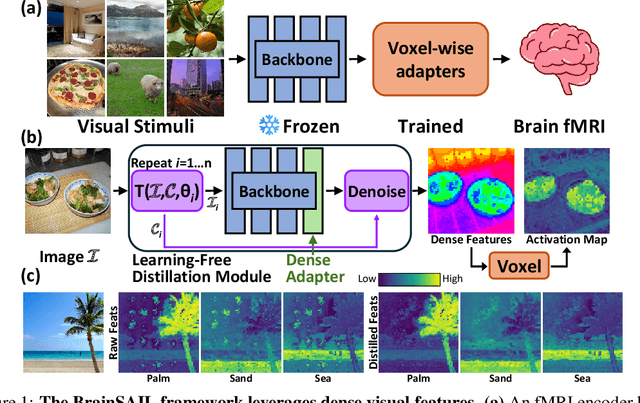

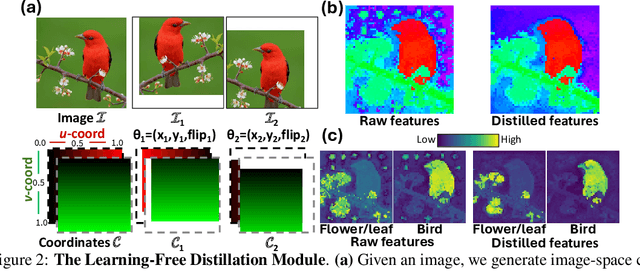
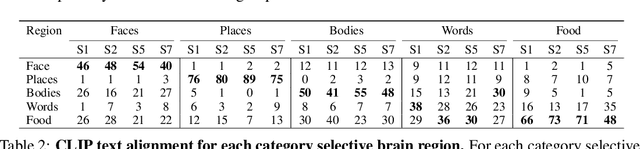
Advances in large-scale artificial neural networks have facilitated novel insights into the functional topology of the brain. Here, we leverage this approach to study how semantic categories are organized in the human visual cortex. To overcome the challenge presented by the co-occurrence of multiple categories in natural images, we introduce BrainSAIL (Semantic Attribution and Image Localization), a method for isolating specific neurally-activating visual concepts in images. BrainSAIL exploits semantically consistent, dense spatial features from pre-trained vision models, building upon their demonstrated ability to robustly predict neural activity. This method derives clean, spatially dense embeddings without requiring any additional training, and employs a novel denoising process that leverages the semantic consistency of images under random augmentations. By unifying the space of whole-image embeddings and dense visual features and then applying voxel-wise encoding models to these features, we enable the identification of specific subregions of each image which drive selectivity patterns in different areas of the higher visual cortex. We validate BrainSAIL on cortical regions with known category selectivity, demonstrating its ability to accurately localize and disentangle selectivity to diverse visual concepts. Next, we demonstrate BrainSAIL's ability to characterize high-level visual selectivity to scene properties and low-level visual features such as depth, luminance, and saturation, providing insights into the encoding of complex visual information. Finally, we use BrainSAIL to directly compare the feature selectivity of different brain encoding models across different regions of interest in visual cortex. Our innovative method paves the way for significant advances in mapping and decomposing high-level visual representations in the human brain.