 Add to Chrome
 Add to Firefox
 Add to Edge
SEAD: Self-Evolving Agent for Multi-Turn Service Dialogue
Feb 03, 2026
Large Language Models have demonstrated remarkable capabilities in open-domain dialogues. However, current methods exhibit suboptimal performance in service dialogues, as they rely on noisy, low-quality human conversation data. This limitation arises from data scarcity and the difficulty of simulating authentic, goal-oriented user behaviors. To address these issues, we propose SEAD (Self-Evolving Agent for Service Dialogue), a framework that enables agents to learn effective strategies without large-scale human annotations. SEAD decouples user modeling into two components: a Profile Controller that generates diverse user states to manage training curriculum, and a User Role-play Model that focuses on realistic role-playing. This design ensures the environment provides adaptive training scenarios rather than acting as an unfair adversary. Experiments demonstrate that SEAD significantly outperforms Open-source Foundation Models and Closed-source Commercial Models, improving task completion rate by 17.6% and dialogue efficiency by 11.1%. Code is available at: https://github.com/Da1yuqin/SEAD.

VenusBench-GD: A Comprehensive Multi-Platform GUI Benchmark for Diverse Grounding Tasks
Dec 18, 2025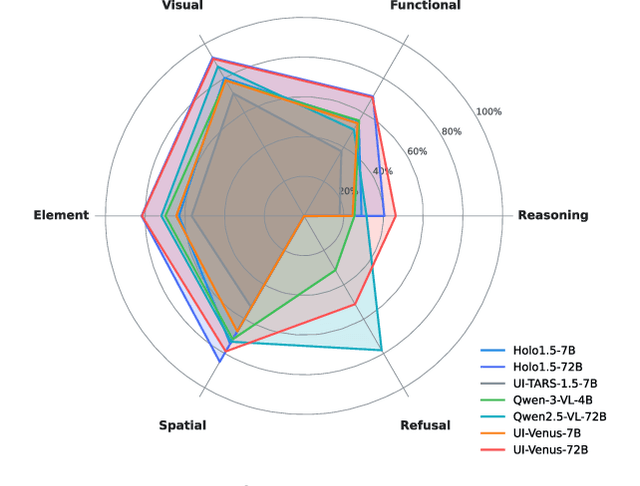
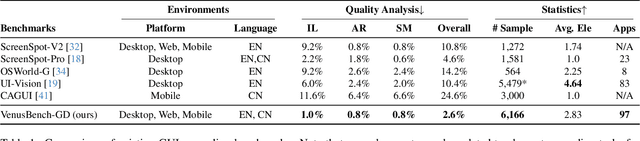
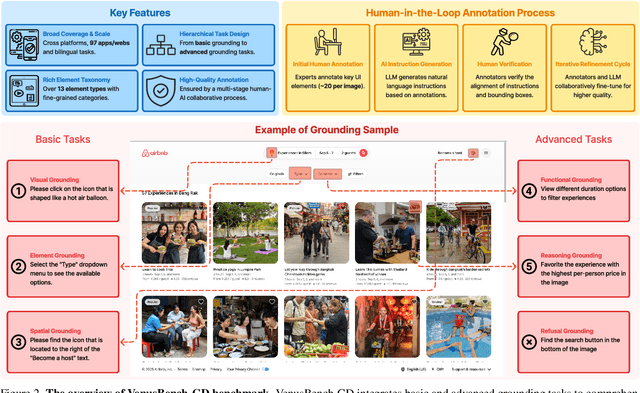
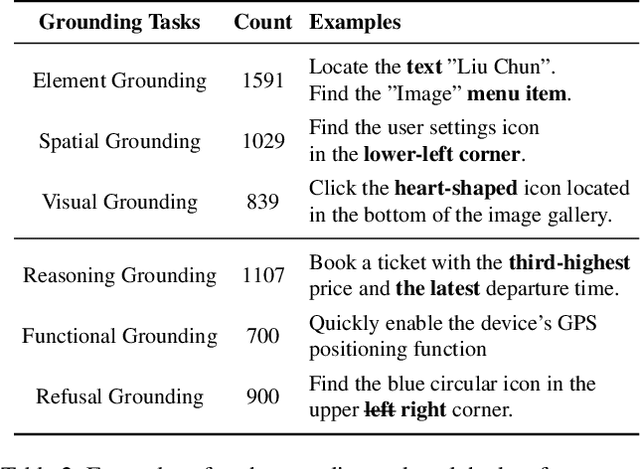
GUI grounding is a critical component in building capable GUI agents. However, existing grounding benchmarks suffer from significant limitations: they either provide insufficient data volume and narrow domain coverage, or focus excessively on a single platform and require highly specialized domain knowledge. In this work, we present VenusBench-GD, a comprehensive, bilingual benchmark for GUI grounding that spans multiple platforms, enabling hierarchical evaluation for real-word applications. VenusBench-GD contributes as follows: (i) we introduce a large-scale, cross-platform benchmark with extensive coverage of applications, diverse UI elements, and rich annotated data, (ii) we establish a high-quality data construction pipeline for grounding tasks, achieving higher annotation accuracy than existing benchmarks, and (iii) we extend the scope of element grounding by proposing a hierarchical task taxonomy that divides grounding into basic and advanced categories, encompassing six distinct subtasks designed to evaluate models from complementary perspectives. Our experimental findings reveal critical insights: general-purpose multimodal models now match or even surpass specialized GUI models on basic grounding tasks. In contrast, advanced tasks, still favor GUI-specialized models, though they exhibit significant overfitting and poor robustness. These results underscore the necessity of comprehensive, multi-tiered evaluation frameworks.