 Add to Chrome
 Add to Firefox
 Add to Edge
DualAnchor: Preserving Language Priors and Improving Lexical Fidelity in Gloss-Free Sign Language Translation
Jul 30, 2026
Recent advances in large language models (LLMs) have led sign language translation (SLT), the task of converting sign-language videos into spoken-language text, to increasingly adopt LLMs as textual backbones. However, despite their strong language modeling capabilities, existing LLM-based SLT methods often undermine rather than exploit this language prior, producing disfluent translations, a failure we term language-prior degradation. Meanwhile, existing methods typically align videos and text at the sentence level, which does not ensure accurate lexical details and creates a lexical fidelity gap. To address both issues, we propose DualAnchor, a gloss-free LLM-based SLT training framework that couples two complementary anchors for linguistically fluent and visually faithful generation. Token-level Prior Anchoring (TPA) preserves the LLM's language prior by regularizing the multimodal decoder at each decoding step toward the next-token distribution of a frozen LLM conditioned on the same autoregressive prefix. Optimal Transport Alignment (OTA) improves lexical fidelity by formulating visual-textual matching as entropy-regularized partial optimal transport, with Sinkhorn optimization inducing a soft alignment between visual tokens and textual content tokens under a cosine cost. DualAnchor achieves strong overall performance on both PHOENIX-2014T and CSL-Daily. Targeted analyses attribute these gains to the complementary effects of the two anchors: TPA improves fluency, whereas OTA reduces fine-grained lexical errors.

Tailoring Teaching to Aptitude: Direction-Adaptive Self-Distillation for LLM Reasoning
May 21, 2026On-policy self-distillation (OPSD) is an emerging LLM post-training paradigm in which the model serves as its own teacher: conditioned on privileged information such as a reference trace or hint, the same policy provides dense token-level supervision on its own rollouts. However, recent studies show that OPSD degrades complex reasoning by suppressing predictive uncertainty, which supports exploration and hypothesis revision. Our token-level analysis shows that this failure arises from applying a uniform direction of teacher supervision across tokens with different uncertainty levels: conformity to the privileged self-teacher suppresses exploration at high entropy, while deviation from the teacher degrades step accuracy at low entropy. Accordingly, we propose \textbf{Direction-Adaptive Self-Distillation} (\textbf{DASD}), which reframes privileged self-distillation from uniform teacher imitation into entropy-routed directional supervision: high-entropy tokens are pushed away from the privileged teacher to preserve exploration, while low-entropy tokens are pulled toward the teacher to stabilize step-level execution. Across six mathematical reasoning benchmarks, DASD achieves the best macro Avg@16 over strong RLVR and self-distillation baselines. Pass@$k$, reasoning-health, and generalization analyses show that these average gains come from preserving exploration without sacrificing step-level execution.
Unlocking Proactivity in Task-Oriented Dialogue
May 21, 2026Proactive task-oriented dialogue (TOD), such as outbound sales, demands a persuasive agent that actively probes the user's concerns and steers the conversation toward acceptance within a bounded number of turns. Yet post-trained LLMs are inherently conservative, and reward-shaping RL (e.g., GRPO) struggles since it only re-weights what an already passive policy samples. We show that conditioning on the user's latent concerns unlocks proactive capability that no amount of sampling can undermine, establishing these concerns as a pivotal training-time signal. To operationalize this finding, we build the \textbf{Cognitive User Simulator}, which models each user as a stratified persona comprising observable external traits and hidden internal concerns. The simulator produces faithful and diverse interactions, while emitting per-turn state dynamics that track persuasion progress. We then introduce \textbf{Simulator-Induced Asymmetric-View Policy Optimization}, which converts the modeled concerns and the simulation state transition into complementary training objectives: (1) \emph{Asymmetric On-Policy Self-Distillation} that transfers concern-aware behavior from a privileged view of the same policy into its deployable, conversation-only view; and (2) \emph{State-Transition Policy Refinement} ...
Mitigating Translationese Bias in Multilingual LLM-as-a-Judge via Disentangled Information Bottleneck
Mar 11, 2026Large language models (LLMs) have become a standard for multilingual evaluation, yet they exhibit a severe systematic translationese bias. In this paper, translationese bias is characterized as LLMs systematically favoring machine-translated text over human-authored references, particularly in low-resource languages. We attribute this bias to spurious correlations with (i) latent manifold alignment with English and (ii) cross-lingual predictability. To mitigate this bias, we propose DIBJudge, a robust fine-tuning framework that learns a minimally sufficient, judgment-critical representation via variational information compression, while explicitly isolating spurious factors into the dedicated bias branch. Furthermore, we incorporate a cross-covariance penalty that explicitly suppresses statistical dependence between robust and bias representations, thereby encouraging effective disentanglement. Extensive evaluations on multilingual reward modeling benchmarks and a dedicated translationese bias evaluation suite demonstrate that the proposed DIBJudge consistently outperforms strong baselines and substantially mitigates translationese bias.
Information-Theoretic Multi-Model Fusion for Target-Oriented Adaptive Sampling in Materials Design
Feb 03, 2026Target-oriented discovery under limited evaluation budgets requires making reliable progress in high-dimensional, heterogeneous design spaces where each new measurement is costly, whether experimental or high-fidelity simulation. We present an information-theoretic framework for target-oriented adaptive sampling that reframes optimization as trajectory discovery: instead of approximating the full response surface, the method maintains and refines a low-entropy information state that concentrates search on target-relevant directions. The approach couples data, model beliefs, and physics/structure priors through dimension-aware information budgeting, adaptive bootstrapped distillation over a heterogeneous surrogate reservoir, and structure-aware candidate manifold analysis with Kalman-inspired multi-model fusion to balance consensus-driven exploitation and disagreement-driven exploration. Evaluated under a single unified protocol without dataset-specific tuning, the framework improves sample efficiency and reliability across 14 single- and multi-objective materials design tasks spanning candidate pools from $600$ to $4 \times 10^6$ and feature dimensions from $10$ to $10^3$, typically reaching top-performing regions within 100 evaluations. Complementary 20-dimensional synthetic benchmarks (Ackley, Rastrigin, Schwefel) further demonstrate robustness to rugged and multimodal landscapes.
Exploring the Feasibility of End-to-End Large Language Model as a Compiler
Nov 06, 2025In recent years, end-to-end Large Language Model (LLM) technology has shown substantial advantages across various domains. As critical system software and infrastructure, compilers are responsible for transforming source code into target code. While LLMs have been leveraged to assist in compiler development and maintenance, their potential as an end-to-end compiler remains largely unexplored. This paper explores the feasibility of LLM as a Compiler (LaaC) and its future directions. We designed the CompilerEval dataset and framework specifically to evaluate the capabilities of mainstream LLMs in source code comprehension and assembly code generation. In the evaluation, we analyzed various errors, explored multiple methods to improve LLM-generated code, and evaluated cross-platform compilation capabilities. Experimental results demonstrate that LLMs exhibit basic capabilities as compilers but currently achieve low compilation success rates. By optimizing prompts, scaling up the model, and incorporating reasoning methods, the quality of assembly code generated by LLMs can be significantly enhanced. Based on these findings, we maintain an optimistic outlook for LaaC and propose practical architectural designs and future research directions. We believe that with targeted training, knowledge-rich prompts, and specialized infrastructure, LaaC has the potential to generate high-quality assembly code and drive a paradigm shift in the field of compilation.
NTIRE 2025 Challenge on Day and Night Raindrop Removal for Dual-Focused Images: Methods and Results
Apr 19, 2025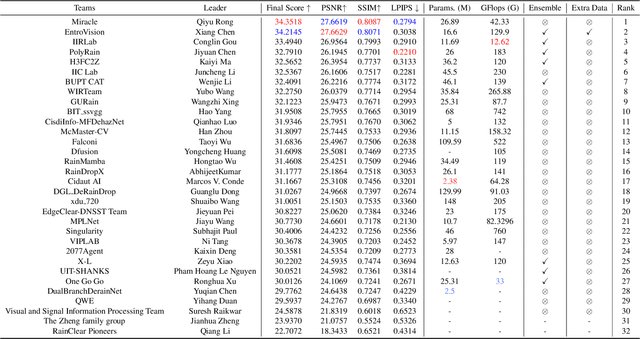
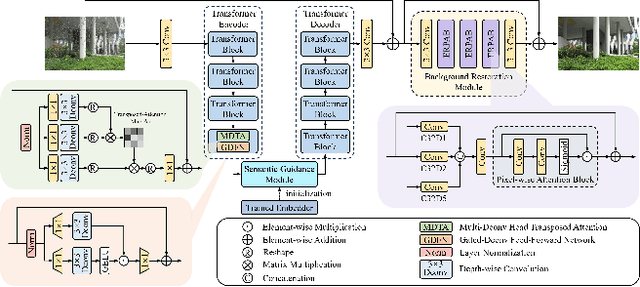
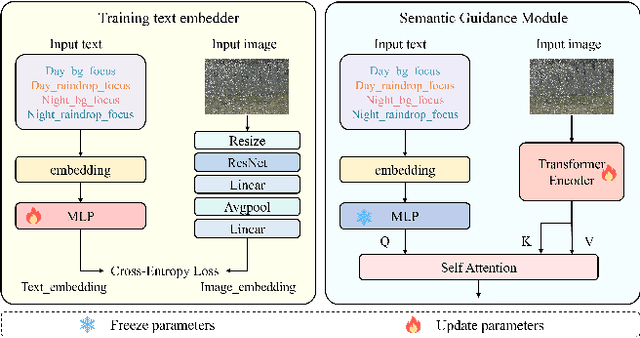
This paper reviews the NTIRE 2025 Challenge on Day and Night Raindrop Removal for Dual-Focused Images. This challenge received a wide range of impressive solutions, which are developed and evaluated using our collected real-world Raindrop Clarity dataset. Unlike existing deraining datasets, our Raindrop Clarity dataset is more diverse and challenging in degradation types and contents, which includes day raindrop-focused, day background-focused, night raindrop-focused, and night background-focused degradations. This dataset is divided into three subsets for competition: 14,139 images for training, 240 images for validation, and 731 images for testing. The primary objective of this challenge is to establish a new and powerful benchmark for the task of removing raindrops under varying lighting and focus conditions. There are a total of 361 participants in the competition, and 32 teams submitting valid solutions and fact sheets for the final testing phase. These submissions achieved state-of-the-art (SOTA) performance on the Raindrop Clarity dataset. The project can be found at https://lixinustc.github.io/CVPR-NTIRE2025-RainDrop-Competition.github.io/.
Exploring Translation Mechanism of Large Language Models
Feb 17, 2025Large language models (LLMs) have succeeded remarkably in multilingual translation tasks. However, the inherent translation mechanisms of LLMs remain poorly understood, largely due to sophisticated architectures and vast parameter scales. In response to this issue, this study explores the translation mechanism of LLM from the perspective of computational components (e.g., attention heads and MLPs). Path patching is utilized to explore causal relationships between components, detecting those crucial for translation tasks and subsequently analyzing their behavioral patterns in human-interpretable terms. Comprehensive analysis reveals that translation is predominantly facilitated by a sparse subset of specialized attention heads (less than 5\%), which extract source language, indicator, and positional features. MLPs subsequently integrate and process these features by transiting towards English-centric latent representations. Notably, building on the above findings, targeted fine-tuning of only 64 heads achieves translation improvement comparable to full-parameter tuning while preserving general capabilities.
LinguaLIFT: An Effective Two-stage Instruction Tuning Framework for Low-Resource Language Tasks
Dec 17, 2024Large language models (LLMs) have demonstrated impressive multilingual understanding and reasoning capabilities, driven by extensive pre-training multilingual corpora and fine-tuning instruction data. However, a performance gap persists between high-resource and low-resource language tasks due to language imbalance in the pre-training corpus, even using more low-resource data during fine-tuning. To alleviate this issue, we propose LinguaLIFT, a two-stage instruction tuning framework for advancing low-resource language tasks. An additional language alignment layer is first integrated into the LLM to adapt a pre-trained multilingual encoder, thereby enhancing multilingual alignment through code-switched fine-tuning. The second stage fine-tunes LLM with English-only instruction data while freezing the language alignment layer, allowing LLM to transfer task-specific capabilities from English to low-resource language tasks. Additionally, we introduce the Multilingual Math World Problem (MMWP) benchmark, which spans 21 low-resource, 17 medium-resource, and 10 high-resource languages, enabling comprehensive evaluation of multilingual reasoning. Experimental results show that LinguaLIFT outperforms several competitive baselines across MMWP and other widely used benchmarks.
Paying More Attention to Source Context: Mitigating Unfaithful Translations from Large Language Model
Jun 11, 2024Large language models (LLMs) have showcased impressive multilingual machine translation ability. However, unlike encoder-decoder style models, decoder-only LLMs lack an explicit alignment between source and target contexts. Analyzing contribution scores during generation processes revealed that LLMs can be biased towards previously generated tokens over corresponding source tokens, leading to unfaithful translations. To address this issue, we propose to encourage LLMs to pay more attention to the source context from both source and target perspectives in zeroshot prompting: 1) adjust source context attention weights; 2) suppress irrelevant target prefix influence; Additionally, we propose 3) avoiding over-reliance on the target prefix in instruction tuning. Experimental results from both human-collected unfaithfulness test sets focusing on LLM-generated unfaithful translations and general test sets, verify our methods' effectiveness across multiple language pairs. Further human evaluation shows our method's efficacy in reducing hallucinatory translations and facilitating faithful translation generation.