 Add to Chrome
 Add to Firefox
 Add to Edge
Elastic Attention Cores for Scalable Vision Transformers
May 12, 2026
Vision Transformers (ViTs) achieve strong data-driven scaling by leveraging all-to-all self-attention. However, this flexibility incurs a computational cost that scales quadratically with image resolution, limiting ViTs in high-resolution domains. Underlying this approach is the assumption that pairwise token interactions are necessary for learning rich visual-semantic representations. In this work, we challenge this assumption, demonstrating that effective visual representations can be learned without any direct patch-to-patch interaction. We propose VECA (Visual Elastic Core Attention), a vision transformer architecture that uses efficient linear-time core-periphery structured attention enabled by a small set of learned cores. In VECA, these cores act as a communication interface: patch tokens exchange information exclusively through the core tokens, which are initialized from scratch and propagated across layers. Because the $N$ image patches only directly interact with a resolution invariant set of $C$ learned "core" embeddings, this yields linear complexity $O(N)$ for predetermined $C$, which bypasses quadratic scaling. Compared to prior cross-attention architectures, VECA maintains and iteratively updates the full set of $N$ input tokens, avoiding a small $C$-way bottleneck. Combined with nested training along the core axis, our model can elastically trade off compute and accuracy during inference. Across classification and dense tasks, VECA achieves performance competitive with the latest vision foundation models while reducing computational cost. Our results establish elastic core-periphery attention as a scalable alternative building block for Vision Transformers.

NeuroFlow: Toward Unified Visual Encoding and Decoding from Neural Activity
Apr 10, 2026Visual encoding and decoding models act as gateways to understanding the neural mechanisms underlying human visual perception. Typically, visual encoding models that predict brain activity from stimuli and decoding models that reproduce stimuli from brain activity are treated as distinct tasks, requiring separate models and training procedures. This separation is inefficient and fails to model the consistency between encoding and decoding processes. To address this limitation, we propose NeuroFlow, the first unified framework that jointly models visual encoding and decoding from neural activity within a single flow model. NeuroFlow introduces two key components: (1) NeuroVAE is designed as a variational backbone to model neural variability and establish a compact, semantically structured latent space for bidirectional modeling across visual and neural modalities. (2) Cross-modal Flow Matching (XFM) bypasses the typical paradigm of noise-to-data diffusion guided by a specific modality condition, instead learning a reversibly consistent flow model between visual and neural latent distributions. For the first time, visual encoding and decoding are reformulated as a time-dependent, reversible process within a shared latent space for unified modeling. Empirical results demonstrate that NeuroFlow achieves superior overall performance in visual encoding and decoding tasks with higher computational efficiency compared to any isolated methods. We further analyze principal factors that steer the model toward encoding-decoding consistency and, through brain functional analyses, demonstrate that NeuroFlow captures consistent activation patterns underlying neural variability. NeuroFlow marks a major step toward unified visual encoding and decoding from neural activity, providing mechanistic insights that inform future bidirectional visual brain-computer interfaces.
Meta-learning In-Context Enables Training-Free Cross Subject Brain Decoding
Apr 09, 2026Visual decoding from brain signals is a key challenge at the intersection of computer vision and neuroscience, requiring methods that bridge neural representations and computational models of vision. A field-wide goal is to achieve generalizable, cross-subject models. A major obstacle towards this goal is the substantial variability in neural representations across individuals, which has so far required training bespoke models or fine-tuning separately for each subject. To address this challenge, we introduce a meta-optimized approach for semantic visual decoding from fMRI that generalizes to novel subjects without any fine-tuning. By simply conditioning on a small set of image-brain activation examples from the new individual, our model rapidly infers their unique neural encoding patterns to facilitate robust and efficient visual decoding. Our approach is explicitly optimized for in-context learning of the new subject's encoding model and performs decoding by hierarchical inference, inverting the encoder. First, for multiple brain regions, we estimate the per-voxel visual response encoder parameters by constructing a context over multiple stimuli and responses. Second, we construct a context consisting of encoder parameters and response values over multiple voxels to perform aggregated functional inversion. We demonstrate strong cross-subject and cross-scanner generalization across diverse visual backbones without retraining or fine-tuning. Moreover, our approach requires neither anatomical alignment nor stimulus overlap. This work is a critical step towards a generalizable foundation model for non-invasive brain decoding.
SynBrain: Enhancing Visual-to-fMRI Synthesis via Probabilistic Representation Learning
Aug 14, 2025Deciphering how visual stimuli are transformed into cortical responses is a fundamental challenge in computational neuroscience. This visual-to-neural mapping is inherently a one-to-many relationship, as identical visual inputs reliably evoke variable hemodynamic responses across trials, contexts, and subjects. However, existing deterministic methods struggle to simultaneously model this biological variability while capturing the underlying functional consistency that encodes stimulus information. To address these limitations, we propose SynBrain, a generative framework that simulates the transformation from visual semantics to neural responses in a probabilistic and biologically interpretable manner. SynBrain introduces two key components: (i) BrainVAE models neural representations as continuous probability distributions via probabilistic learning while maintaining functional consistency through visual semantic constraints; (ii) A Semantic-to-Neural Mapper acts as a semantic transmission pathway, projecting visual semantics into the neural response manifold to facilitate high-fidelity fMRI synthesis. Experimental results demonstrate that SynBrain surpasses state-of-the-art methods in subject-specific visual-to-fMRI encoding performance. Furthermore, SynBrain adapts efficiently to new subjects with few-shot data and synthesizes high-quality fMRI signals that are effective in improving data-limited fMRI-to-image decoding performance. Beyond that, SynBrain reveals functional consistency across trials and subjects, with synthesized signals capturing interpretable patterns shaped by biological neural variability. The code will be made publicly available.
MindAligner: Explicit Brain Functional Alignment for Cross-Subject Visual Decoding from Limited fMRI Data
Feb 07, 2025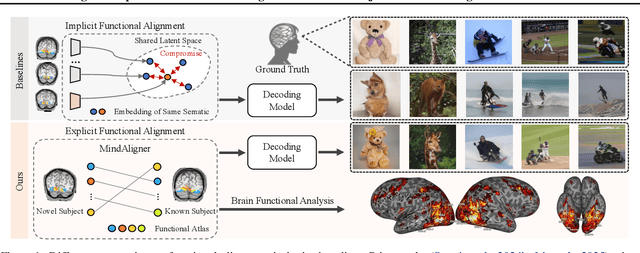


Brain decoding aims to reconstruct visual perception of human subject from fMRI signals, which is crucial for understanding brain's perception mechanisms. Existing methods are confined to the single-subject paradigm due to substantial brain variability, which leads to weak generalization across individuals and incurs high training costs, exacerbated by limited availability of fMRI data. To address these challenges, we propose MindAligner, an explicit functional alignment framework for cross-subject brain decoding from limited fMRI data. The proposed MindAligner enjoys several merits. First, we learn a Brain Transfer Matrix (BTM) that projects the brain signals of an arbitrary new subject to one of the known subjects, enabling seamless use of pre-trained decoding models. Second, to facilitate reliable BTM learning, a Brain Functional Alignment module is proposed to perform soft cross-subject brain alignment under different visual stimuli with a multi-level brain alignment loss, uncovering fine-grained functional correspondences with high interpretability. Experiments indicate that MindAligner not only outperforms existing methods in visual decoding under data-limited conditions, but also provides valuable neuroscience insights in cross-subject functional analysis. The code will be made publicly available.
Neuro-3D: Towards 3D Visual Decoding from EEG Signals
Nov 21, 2024Human's perception of the visual world is shaped by the stereo processing of 3D information. Understanding how the brain perceives and processes 3D visual stimuli in the real world has been a longstanding endeavor in neuroscience. Towards this goal, we introduce a new neuroscience task: decoding 3D visual perception from EEG signals, a neuroimaging technique that enables real-time monitoring of neural dynamics enriched with complex visual cues. To provide the essential benchmark, we first present EEG-3D, a pioneering dataset featuring multimodal analysis data and extensive EEG recordings from 12 subjects viewing 72 categories of 3D objects rendered in both videos and images. Furthermore, we propose Neuro-3D, a 3D visual decoding framework based on EEG signals. This framework adaptively integrates EEG features derived from static and dynamic stimuli to learn complementary and robust neural representations, which are subsequently utilized to recover both the shape and color of 3D objects through the proposed diffusion-based colored point cloud decoder. To the best of our knowledge, we are the first to explore EEG-based 3D visual decoding. Experiments indicate that Neuro-3D not only reconstructs colored 3D objects with high fidelity, but also learns effective neural representations that enable insightful brain region analysis. The dataset and associated code will be made publicly available.
EMOdiffhead: Continuously Emotional Control in Talking Head Generation via Diffusion
Sep 11, 2024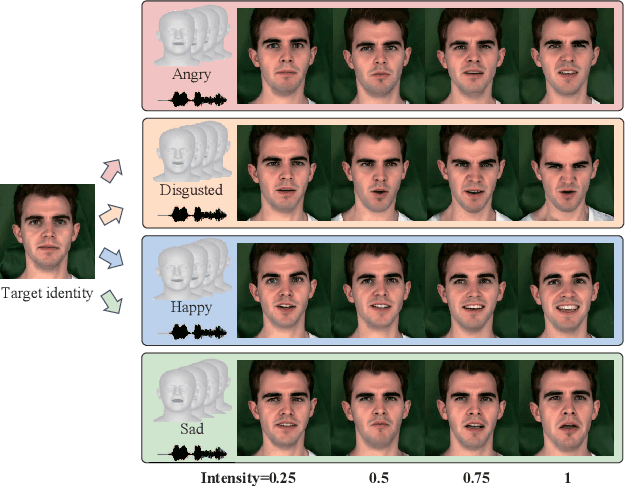

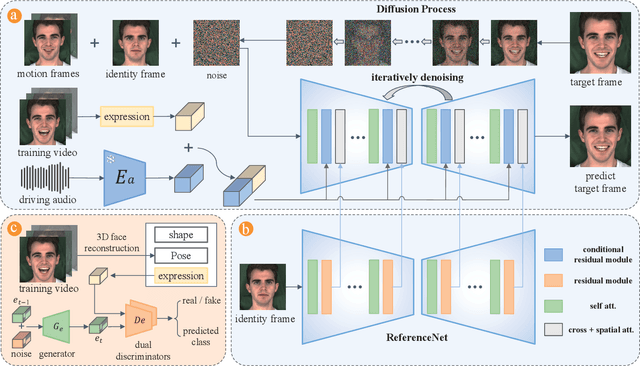

The task of audio-driven portrait animation involves generating a talking head video using an identity image and an audio track of speech. While many existing approaches focus on lip synchronization and video quality, few tackle the challenge of generating emotion-driven talking head videos. The ability to control and edit emotions is essential for producing expressive and realistic animations. In response to this challenge, we propose EMOdiffhead, a novel method for emotional talking head video generation that not only enables fine-grained control of emotion categories and intensities but also enables one-shot generation. Given the FLAME 3D model's linearity in expression modeling, we utilize the DECA method to extract expression vectors, that are combined with audio to guide a diffusion model in generating videos with precise lip synchronization and rich emotional expressiveness. This approach not only enables the learning of rich facial information from emotion-irrelevant data but also facilitates the generation of emotional videos. It effectively overcomes the limitations of emotional data, such as the lack of diversity in facial and background information, and addresses the absence of emotional details in emotion-irrelevant data. Extensive experiments and user studies demonstrate that our approach achieves state-of-the-art performance compared to other emotion portrait animation methods.
Brain-Conditional Multimodal Synthesis: A Survey and Taxonomy
Jan 03, 2024In the era of Artificial Intelligence Generated Content (AIGC), conditional multimodal synthesis technologies (e.g., text-to-image, text-to-video, text-to-audio, etc) are gradually reshaping the natural content in the real world. The key to multimodal synthesis technology is to establish the mapping relationship between different modalities. Brain signals, serving as potential reflections of how the brain interprets external information, exhibit a distinctive One-to-Many correspondence with various external modalities. This correspondence makes brain signals emerge as a promising guiding condition for multimodal content synthesis. Brian-conditional multimodal synthesis refers to decoding brain signals back to perceptual experience, which is crucial for developing practical brain-computer interface systems and unraveling complex mechanisms underlying how the brain perceives and comprehends external stimuli. This survey comprehensively examines the emerging field of AIGC-based Brain-conditional Multimodal Synthesis, termed AIGC-Brain, to delineate the current landscape and future directions. To begin, related brain neuroimaging datasets, functional brain regions, and mainstream generative models are introduced as the foundation of AIGC-Brain decoding and analysis. Next, we provide a comprehensive taxonomy for AIGC-Brain decoding models and present task-specific representative work and detailed implementation strategies to facilitate comparison and in-depth analysis. Quality assessments are then introduced for both qualitative and quantitative evaluation. Finally, this survey explores insights gained, providing current challenges and outlining prospects of AIGC-Brain. Being the inaugural survey in this domain, this paper paves the way for the progress of AIGC-Brain research, offering a foundational overview to guide future work.
UniBrain: Unify Image Reconstruction and Captioning All in One Diffusion Model from Human Brain Activity
Aug 14, 2023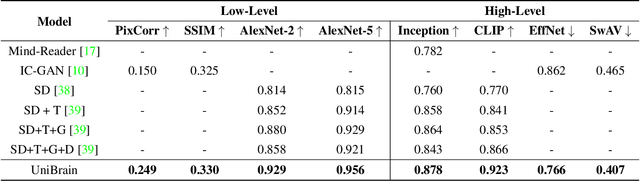
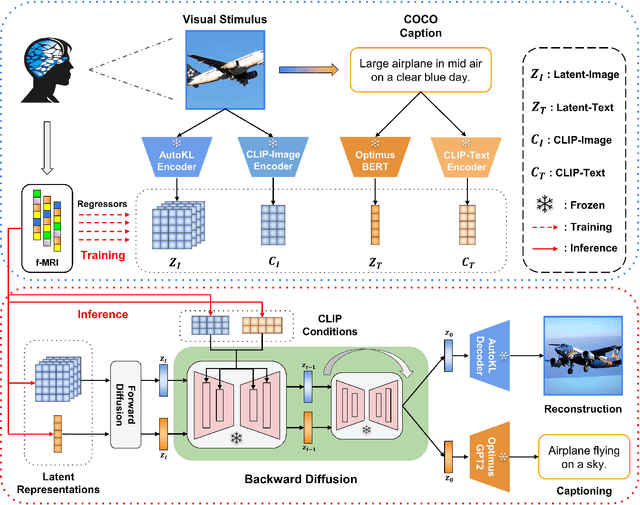
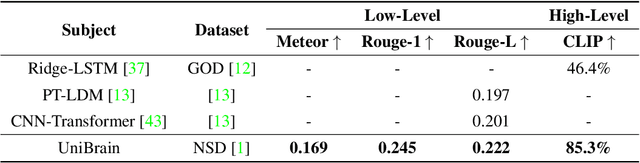
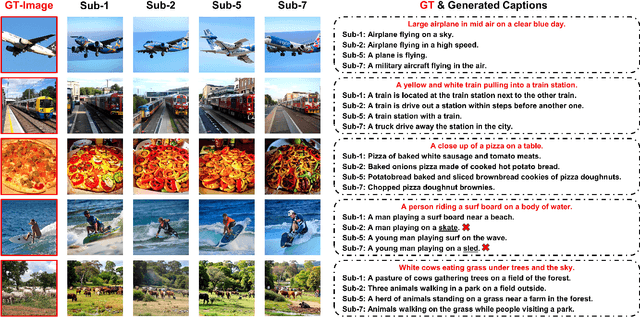
Image reconstruction and captioning from brain activity evoked by visual stimuli allow researchers to further understand the connection between the human brain and the visual perception system. While deep generative models have recently been employed in this field, reconstructing realistic captions and images with both low-level details and high semantic fidelity is still a challenging problem. In this work, we propose UniBrain: Unify Image Reconstruction and Captioning All in One Diffusion Model from Human Brain Activity. For the first time, we unify image reconstruction and captioning from visual-evoked functional magnetic resonance imaging (fMRI) through a latent diffusion model termed Versatile Diffusion. Specifically, we transform fMRI voxels into text and image latent for low-level information and guide the backward diffusion process through fMRI-based image and text conditions derived from CLIP to generate realistic captions and images. UniBrain outperforms current methods both qualitatively and quantitatively in terms of image reconstruction and reports image captioning results for the first time on the Natural Scenes Dataset (NSD) dataset. Moreover, the ablation experiments and functional region-of-interest (ROI) analysis further exhibit the superiority of UniBrain and provide comprehensive insight for visual-evoked brain decoding.