 Add to Chrome
 Add to Firefox
 Add to Edge
SAGE: A Service Agent Graph-guided Evaluation Benchmark
Apr 10, 2026
The development of Large Language Models (LLMs) has catalyzed automation in customer service, yet benchmarking their performance remains challenging. Existing benchmarks predominantly rely on static paradigms and single-dimensional metrics, failing to account for diverse user behaviors or the strict adherence to structured Standard Operating Procedures (SOPs) required in real-world deployments. To bridge this gap, we propose SAGE (Service Agent Graph-guided Evaluation), a universal multi-agent benchmark for automated, dual-axis assessment. SAGE formalizes unstructured SOPs into Dynamic Dialogue Graphs, enabling precise verification of logical compliance and comprehensive path coverage. We introduce an Adversarial Intent Taxonomy and a modular Extension Mechanism, enabling low-cost deployment across domains and facilitating automated dialogue data synthesis. Evaluation is conducted via a framework where Judge Agents and a Rule Engine analyze interactions between User and Service Agents to generate deterministic ground truth. Extensive experiments on 27 LLMs across 6 industrial scenarios reveal a significant ``Execution Gap'' where models accurately classify intents but fail to derive correct subsequent actions. We also observe ``Empathy Resilience'', a phenomenon where models maintain polite conversational facades despite underlying logical failures under high adversarial intensity. Code and resources are available at https://anonymous.4open.science/r/SAGE-Bench-4CD3/.

IGV-RRT: Prior-Real-Time Observation Fusion for Active Object Search in Changing Environments
Mar 23, 2026Object Goal Navigation (ObjectNav) in temporally changing indoor environments is challenging because object relocation can invalidate historical scene knowledge. To address this issue, we propose a probabilistic planning framework that combines uncertainty-aware scene priors with online target relevance estimates derived from a Vision Language Model (VLM). The framework contains a dual-layer semantic mapping module and a real-time planner. The mapping module includes an Information Gain Map (IGM) built from a 3D scene graph (3DSG) during prior exploration to model object co-occurrence relations and provide global guidance on likely target regions. It also maintains a VLM score map (VLM-SM) that fuses confidence-weighted semantic observations into the map for local validation of the current scene. Based on these two cues, we develop a planner that jointly exploits information gain and semantic evidence for online decision making. The planner biases tree expansion toward semantically salient regions with high prior likelihood and strong online relevance (IGV-RRT), while preserving kinematic feasibility through gradient-based analysis. Simulation and real-world experiments demonstrate that the proposed method effectively mitigates the impact of object rearrangement, achieving higher search efficiency and success rates than representative baselines in complex indoor environments.
CoSMo3D: Open-World Promptable 3D Semantic Part Segmentation through LLM-Guided Canonical Spatial Modeling
Mar 01, 2026Open-world promptable 3D semantic segmentation remains brittle as semantics are inferred in the input sensor coordinates. Yet, humans, in contrast, interpret parts via functional roles in a canonical space -- wings extend laterally, handles protrude to the side, and legs support from below. Psychophysical evidence shows that we mentally rotate objects into canonical frames to reveal these roles. To fill this gap, we propose \methodName{}, which attains canonical space perception by inducing a latent canonical reference frame learned directly from data. By construction, we create a unified canonical dataset through LLM-guided intra- and cross-category alignment, exposing canonical spatial regularities across 200 categories. By induction, we realize canonicality inside the model through a dual-branch architecture with canonical map anchoring and canonical box calibration, collapsing pose variation and symmetry into a stable canonical embedding. This shift from input pose space to canonical embedding yields far more stable and transferable part semantics. Experimental results show that \methodName{} establishes new state of the art in open-world promptable 3D segmentation.
Reinforcing Real-world Service Agents: Balancing Utility and Cost in Task-oriented Dialogue
Feb 26, 2026The rapid evolution of Large Language Models (LLMs) has accelerated the transition from conversational chatbots to general agents. However, effectively balancing empathetic communication with budget-aware decision-making remains an open challenge. Since existing methods fail to capture these complex strategic trade-offs, we propose InteractCS-RL, a framework that reframes task-oriented dialogue as a multi-granularity reinforcement learning process. Specifically, we first establish a User-centric Interaction Framework to provide a high-fidelity training gym, enabling agents to dynamically explore diverse strategies with persona-driven users. Then, we introduce Cost-aware Multi-turn Policy Optimization (CMPO) with a hybrid advantage estimation strategy. By integrating generative process credits and employing a PID-Lagrangian cost controller, CMPO effectively guides the policy to explore Pareto boundary between user reward and global cost constraints. Extensive experiments on customized real business scenarios demonstrate that InteractCS-RL significantly outperform other baselines across three evaluation dimensions. Further evaluation on tool-agent-user interaction benchmarks verify InteractCS-RL robustness across diverse domains.
LAER-MoE: Load-Adaptive Expert Re-layout for Efficient Mixture-of-Experts Training
Feb 12, 2026Expert parallelism is vital for effectively training Mixture-of-Experts (MoE) models, enabling different devices to host distinct experts, with each device processing different input data. However, during expert parallel training, dynamic routing results in significant load imbalance among experts: a handful of overloaded experts hinder overall iteration, emerging as a training bottleneck. In this paper, we introduce LAER-MoE, an efficient MoE training framework. The core of LAER-MoE is a novel parallel paradigm, Fully Sharded Expert Parallel (FSEP), which fully partitions each expert parameter by the number of devices and restores partial experts at expert granularity through All-to-All communication during training. This allows for flexible re-layout of expert parameters during training to enhance load balancing. In particular, we perform fine-grained scheduling of communication operations to minimize communication overhead. Additionally, we develop a load balancing planner to formulate re-layout strategies of experts and routing schemes for tokens during training. We perform experiments on an A100 cluster, and the results indicate that our system achieves up to 1.69x acceleration compared to the current state-of-the-art training systems. Source code available at https://github.com/PKU-DAIR/Hetu-Galvatron/tree/laer-moe.
SEAD: Self-Evolving Agent for Multi-Turn Service Dialogue
Feb 03, 2026Large Language Models have demonstrated remarkable capabilities in open-domain dialogues. However, current methods exhibit suboptimal performance in service dialogues, as they rely on noisy, low-quality human conversation data. This limitation arises from data scarcity and the difficulty of simulating authentic, goal-oriented user behaviors. To address these issues, we propose SEAD (Self-Evolving Agent for Service Dialogue), a framework that enables agents to learn effective strategies without large-scale human annotations. SEAD decouples user modeling into two components: a Profile Controller that generates diverse user states to manage training curriculum, and a User Role-play Model that focuses on realistic role-playing. This design ensures the environment provides adaptive training scenarios rather than acting as an unfair adversary. Experiments demonstrate that SEAD significantly outperforms Open-source Foundation Models and Closed-source Commercial Models, improving task completion rate by 17.6% and dialogue efficiency by 11.1%. Code is available at: https://github.com/Da1yuqin/SEAD.
Urban Socio-Semantic Segmentation with Vision-Language Reasoning
Jan 15, 2026As hubs of human activity, urban surfaces consist of a wealth of semantic entities. Segmenting these various entities from satellite imagery is crucial for a range of downstream applications. Current advanced segmentation models can reliably segment entities defined by physical attributes (e.g., buildings, water bodies) but still struggle with socially defined categories (e.g., schools, parks). In this work, we achieve socio-semantic segmentation by vision-language model reasoning. To facilitate this, we introduce the Urban Socio-Semantic Segmentation dataset named SocioSeg, a new resource comprising satellite imagery, digital maps, and pixel-level labels of social semantic entities organized in a hierarchical structure. Additionally, we propose a novel vision-language reasoning framework called SocioReasoner that simulates the human process of identifying and annotating social semantic entities via cross-modal recognition and multi-stage reasoning. We employ reinforcement learning to optimize this non-differentiable process and elicit the reasoning capabilities of the vision-language model. Experiments demonstrate our approach's gains over state-of-the-art models and strong zero-shot generalization. Our dataset and code are available in https://github.com/AMAP-ML/SocioReasoner.
APD-Agents: A Large Language Model-Driven Multi-Agents Collaborative Framework for Automated Page Design
Nov 18, 2025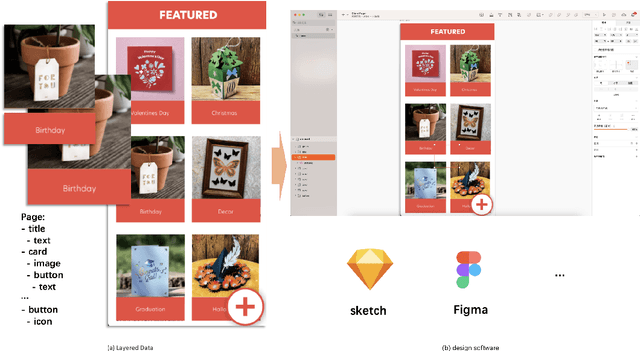
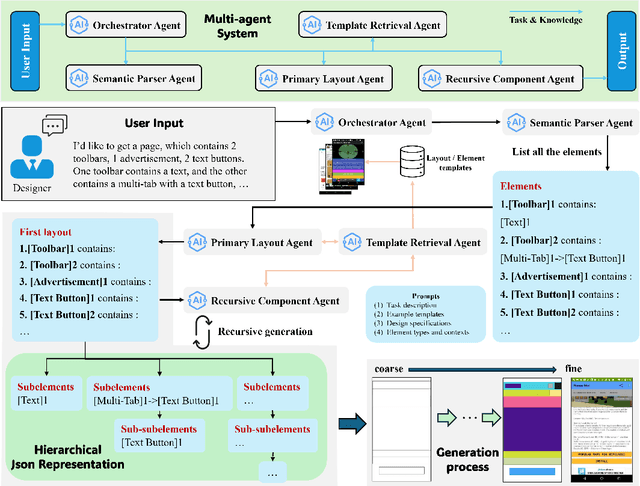
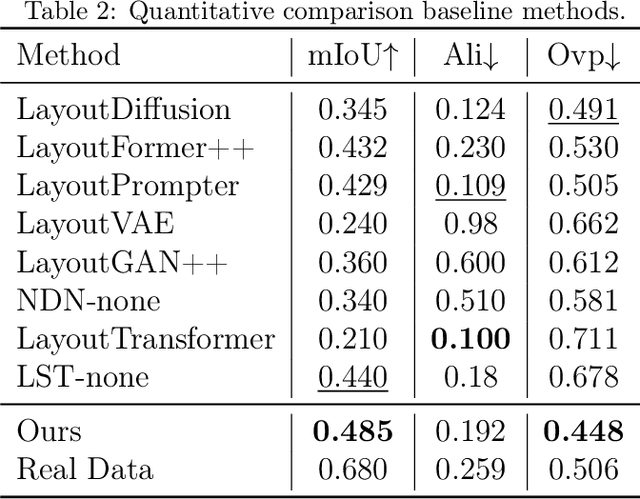
Layout design is a crucial step in developing mobile app pages. However, crafting satisfactory designs is time-intensive for designers: they need to consider which controls and content to present on the page, and then repeatedly adjust their size, position, and style for better aesthetics and structure. Although many design software can now help to perform these repetitive tasks, extensive training is needed to use them effectively. Moreover, collaborative design across app pages demands extra time to align standards and ensure consistent styling. In this work, we propose APD-agents, a large language model (LLM) driven multi-agent framework for automated page design in mobile applications. Our framework contains OrchestratorAgent, SemanticParserAgent, PrimaryLayoutAgent, TemplateRetrievalAgent, and RecursiveComponentAgent. Upon receiving the user's description of the page, the OrchestratorAgent can dynamically can direct other agents to accomplish users' design task. To be specific, the SemanticParserAgent is responsible for converting users' descriptions of page content into structured data. The PrimaryLayoutAgent can generate an initial coarse-grained layout of this page. The TemplateRetrievalAgent can fetch semantically relevant few-shot examples and enhance the quality of layout generation. Besides, a RecursiveComponentAgent can be used to decide how to recursively generate all the fine-grained sub-elements it contains for each element in the layout. Our work fully leverages the automatic collaboration capabilities of large-model-driven multi-agent systems. Experimental results on the RICO dataset show that our APD-agents achieve state-of-the-art performance.
Evaluating Cognitive-Behavioral Fixation via Multimodal User Viewing Patterns on Social Media
Sep 05, 2025Digital social media platforms frequently contribute to cognitive-behavioral fixation, a phenomenon in which users exhibit sustained and repetitive engagement with narrow content domains. While cognitive-behavioral fixation has been extensively studied in psychology, methods for computationally detecting and evaluating such fixation remain underexplored. To address this gap, we propose a novel framework for assessing cognitive-behavioral fixation by analyzing users' multimodal social media engagement patterns. Specifically, we introduce a multimodal topic extraction module and a cognitive-behavioral fixation quantification module that collaboratively enable adaptive, hierarchical, and interpretable assessment of user behavior. Experiments on existing benchmarks and a newly curated multimodal dataset demonstrate the effectiveness of our approach, laying the groundwork for scalable computational analysis of cognitive fixation. All code in this project is publicly available for research purposes at https://github.com/Liskie/cognitive-fixation-evaluation.
Galvatron: An Automatic Distributed System for Efficient Foundation Model Training
Apr 30, 2025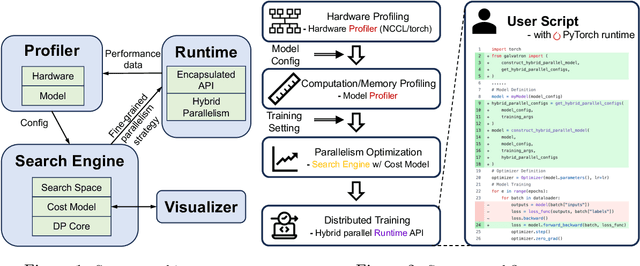
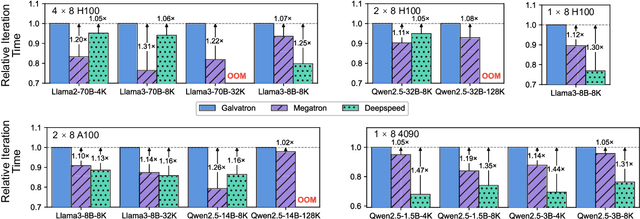
Galvatron is a distributed system for efficiently training large-scale Foundation Models. It overcomes the complexities of selecting optimal parallelism strategies by automatically identifying the most efficient hybrid strategy, incorporating data, tensor, pipeline, sharded data, and sequence parallelism, along with recomputation. The system's architecture includes a profiler for hardware and model analysis, a search engine for strategy optimization using decision trees and dynamic programming, and a runtime for executing these strategies efficiently. Benchmarking on various clusters demonstrates Galvatron's superior throughput compared to existing frameworks. This open-source system offers user-friendly interfaces and comprehensive documentation, making complex distributed training accessible and efficient. The source code of Galvatron is available at https://github.com/PKU-DAIR/Hetu-Galvatron.