 Add to Chrome
 Add to Firefox
 Add to Edge
LiteVSR: Lightweight Adaptation of Frozen Diffusion Transformers for Video Super-Resolution
Jun 08, 2026
Adapting large-scale pre-trained video generators for Video Super-Resolution (VSR) in novel domains remains computationally prohibitive. Methods that reformulate generation as direct Low-Quality to High-Quality mappings deviate from the original generative formulation, demanding extensive fine-tuning. ControlNet-style adapters lose their efficiency under modern Diffusion Transformers since the absence of encoder-decoder hierarchy forces duplication of the entire backbone. We observe that flow matching offers a principled alternative for cross-domain VSR adaptation. By predicting a constant velocity field across all timesteps, the adaptation task reduces to learning a fixed injection pattern rather than time-varying transformations. Building on this insight, we propose LiteVSR, a minimalist framework that performs VSR using a completely frozen Diffusion Transformer with a lightweight State-Aware Adapter. The adapter employs a dual-stream architecture that extracts static structural cues from the LQ input and dynamic cues from intermediate denoising states, aligning them through time-dependent cross-attention to enable adaptive transition from structural alignment to texture refinement as denoising proceeds. LiteVSR achieves competitive restoration quality with only 11.25% trainable parameters and 12 GPU-hours of training on a single A100, while maintaining fast sampling (down to a single step) compatibility.

GRVS: a Generalizable and Recurrent Approach to Monocular Dynamic View Synthesis
Mar 31, 2026Synthesizing novel views from monocular videos of dynamic scenes remains a challenging problem. Scene-specific methods that optimize 4D representations with explicit motion priors often break down in highly dynamic regions where multi-view information is hard to exploit. Diffusion-based approaches that integrate camera control into large pre-trained models can produce visually plausible videos but frequently suffer from geometric inconsistencies across both static and dynamic areas. Both families of methods also require substantial computational resources. Building on the success of generalizable models for static novel view synthesis, we adapt the framework to dynamic inputs and propose a new model with two key components: (1) a recurrent loop that enables unbounded and asynchronous mapping between input and target videos and (2) an efficient use of plane sweeps over dynamic inputs to disentangle camera and scene motion, and achieve fine-grained, six-degrees-of-freedom camera controls. We train and evaluate our model on the UCSD dataset and on Kubric-4D-dyn, a new monocular dynamic dataset featuring longer, higher resolution sequences with more complex scene dynamics than existing alternatives. Our model outperforms four Gaussian Splatting-based scene-specific approaches, as well as two diffusion-based approaches in reconstructing fine-grained geometric details across both static and dynamic regions.
Color When It Counts: Grayscale-Guided Online Triggering for Always-On Streaming Video Sensing
Mar 23, 2026Always-on sensing is essential for next-generation edge/wearable AI systems, yet continuous high-fidelity RGB video capture remains prohibitively expensive for resource-constrained mobile and edge platforms. We present a new paradigm for efficient streaming video understanding: grayscale-always, color-on-demand. Through preliminary studies, we discover that color is not always necessary. Sparse RGB frames suffice for comparable performance when temporal structure is preserved via continuous grayscale streams. Building on this insight, we propose ColorTrigger, an online training-free trigger that selectively activates color capture based on windowed grayscale affinity analysis. Designed for real-time edge deployment, ColorTrigger uses lightweight quadratic programming to detect chromatic redundancy causally, coupled with credit-budgeted control and dynamic token routing to jointly reduce sensing and inference costs. On streaming video understanding benchmarks, ColorTrigger achieves 91.6% of full-color baseline performance while using only 8.1% RGB frames, demonstrating substantial color redundancy in natural videos and enabling practical always-on video sensing on resource-constrained devices.
Diffusion-Based Makeup Transfer with Facial Region-Aware Makeup Features
Mar 20, 2026Current diffusion-based makeup transfer methods commonly use the makeup information encoded by off-the-shelf foundation models (e.g., CLIP) as condition to preserve the makeup style of reference image in the generation. Although effective, these works mainly have two limitations: (1) foundation models pre-trained for generic tasks struggle to capture makeup styles; (2) the makeup features of reference image are injected to the diffusion denoising model as a whole for global makeup transfer, overlooking the facial region-aware makeup features (i.e., eyes, mouth, etc) and limiting the regional controllability for region-specific makeup transfer. To address these, in this work, we propose Facial Region-Aware Makeup features (FRAM), which has two stages: (1) makeup CLIP fine-tuning; (2) identity and facial region-aware makeup injection. For makeup CLIP fine-tuning, unlike prior works using off-the-shelf CLIP, we synthesize annotated makeup style data using GPT-o3 and text-driven image editing model, and then use the data to train a makeup CLIP encoder through self-supervised and image-text contrastive learning. For identity and facial region-aware makeup injection, we construct before-and-after makeup image pairs from the edited images in stage 1 and then use them to learn to inject identity of source image and makeup of reference image to the diffusion denoising model for makeup transfer. Specifically, we use learnable tokens to query the makeup CLIP encoder to extract facial region-aware makeup features for makeup injection, which is learned via an attention loss to enable regional control. As for identity injection, we use a ControlNet Union to encode source image and its 3D mesh simultaneously. The experimental results verify the superiority of our regional controllability and our makeup transfer performance.
LatSearch: Latent Reward-Guided Search for Faster Inference-Time Scaling in Video Diffusion
Mar 15, 2026The recent success of inference-time scaling in large language models has inspired similar explorations in video diffusion. In particular, motivated by the existence of "golden noise" that enhances video quality, prior work has attempted to improve inference by optimising or searching for better initial noise. However, these approaches have notable limitations: they either rely on priors imposed at the beginning of noise sampling or on rewards evaluated only on the denoised and decoded videos. This leads to error accumulation, delayed and sparse reward signals, and prohibitive computational cost, which prevents the use of stronger search algorithms. Crucially, stronger search algorithms are precisely what could unlock substantial gains in controllability, sample efficiency and generation quality for video diffusion, provided their computational cost can be reduced. To fill in this gap, we enable efficient inference-time scaling for video diffusion through latent reward guidance, which provides intermediate, informative and efficient feedback along the denoising trajectory. We introduce a latent reward model that scores partially denoised latents at arbitrary timesteps with respect to visual quality, motion quality, and text alignment. Building on this model, we propose LatSearch, a novel inference-time search mechanism that performs Reward-Guided Resampling and Pruning (RGRP). In the resampling stage, candidates are sampled according to reward-normalised probabilities to reduce over-reliance on the reward model. In the pruning stage, applied at the final scheduled step, only the candidate with the highest cumulative reward is retained, improving both quality and efficiency. We evaluate LatSearch on the VBench-2.0 benchmark and demonstrate that it consistently improves video generation across multiple evaluation dimensions compared to the baseline Wan2.1 model.
Egocentric Co-Pilot: Web-Native Smart-Glasses Agents for Assistive Egocentric AI
Mar 01, 2026What if accessing the web did not require a screen, a stable desk, or even free hands? For people navigating crowded cities, living with low vision, or experiencing cognitive overload, smart glasses coupled with AI agents could turn the web into an always-on assistive layer over daily life. We present Egocentric Co-Pilot, a web-native neuro-symbolic framework that runs on smart glasses and uses a Large Language Model (LLM) to orchestrate a toolbox of perception, reasoning, and web tools. An egocentric reasoning core combines Temporal Chain-of-Thought with Hierarchical Context Compression to support long-horizon question answering and decision support over continuous first-person video, far beyond a single model's context window. Additionally, a lightweight multimodal intent layer maps noisy speech and gaze into structured commands. We further implement and evaluate a cloud-native WebRTC pipeline integrating streaming speech, video, and control messages into a unified channel for smart glasses and browsers. In parallel, we deploy an on-premise WebSocket baseline, exposing concrete trade-offs between local inference and cloud offloading in terms of latency, mobility, and resource use. Experiments on Egolife and HD-EPIC demonstrate competitive or state-of-the-art egocentric QA performance, and a human-in-the-loop study on smart glasses shows higher task completion and user satisfaction than leading commercial baselines. Taken together, these results indicate that web-connected egocentric co-pilots can be a practical path toward more accessible, context-aware assistance in everyday life. By grounding operation in web-native communication primitives and modular, auditable tool use, Egocentric Co-Pilot offers a concrete blueprint for assistive, always-on web agents that support education, accessibility, and social inclusion for people who may benefit most from contextual, egocentric AI.
ICo3D: An Interactive Conversational 3D Virtual Human
Jan 19, 2026This work presents Interactive Conversational 3D Virtual Human (ICo3D), a method for generating an interactive, conversational, and photorealistic 3D human avatar. Based on multi-view captures of a subject, we create an animatable 3D face model and a dynamic 3D body model, both rendered by splatting Gaussian primitives. Once merged together, they represent a lifelike virtual human avatar suitable for real-time user interactions. We equip our avatar with an LLM for conversational ability. During conversation, the audio speech of the avatar is used as a driving signal to animate the face model, enabling precise synchronization. We describe improvements to our dynamic Gaussian models that enhance photorealism: SWinGS++ for body reconstruction and HeadGaS++ for face reconstruction, and provide as well a solution to merge the separate face and body models without artifacts. We also present a demo of the complete system, showcasing several use cases of real-time conversation with the 3D avatar. Our approach offers a fully integrated virtual avatar experience, supporting both oral and written form interactions in immersive environments. ICo3D is applicable to a wide range of fields, including gaming, virtual assistance, and personalized education, among others. Project page: https://ico3d.github.io/
Map2Thought: Explicit 3D Spatial Reasoning via Metric Cognitive Maps
Jan 16, 2026We propose Map2Thought, a framework that enables explicit and interpretable spatial reasoning for 3D VLMs. The framework is grounded in two key components: Metric Cognitive Map (Metric-CogMap) and Cognitive Chain-of-Thought (Cog-CoT). Metric-CogMap provides a unified spatial representation by integrating a discrete grid for relational reasoning with a continuous, metric-scale representation for precise geometric understanding. Building upon the Metric-CogMap, Cog-CoT performs explicit geometric reasoning through deterministic operations, including vector operations, bounding-box distances, and occlusion-aware appearance order cues, producing interpretable inference traces grounded in 3D structure. Experimental results show that Map2Thought enables explainable 3D understanding, achieving 59.9% accuracy using only half the supervision, closely matching the 60.9% baseline trained with the full dataset. It consistently outperforms state-of-the-art methods by 5.3%, 4.8%, and 4.0% under 10%, 25%, and 50% training subsets, respectively, on the VSI-Bench.
Optimizing Multimodal LLMs for Egocentric Video Understanding: A Solution for the HD-EPIC VQA Challenge
Jan 15, 2026Multimodal Large Language Models (MLLMs) struggle with complex video QA benchmarks like HD-EPIC VQA due to ambiguous queries/options, poor long-range temporal reasoning, and non-standardized outputs. We propose a framework integrating query/choice pre-processing, domain-specific Qwen2.5-VL fine-tuning, a novel Temporal Chain-of-Thought (T-CoT) prompting for multi-step reasoning, and robust post-processing. This system achieves 41.6% accuracy on HD-EPIC VQA, highlighting the need for holistic pipeline optimization in demanding video understanding. Our code, fine-tuned models are available at https://github.com/YoungSeng/Egocentric-Co-Pilot.
Off The Grid: Detection of Primitives for Feed-Forward 3D Gaussian Splatting
Dec 17, 2025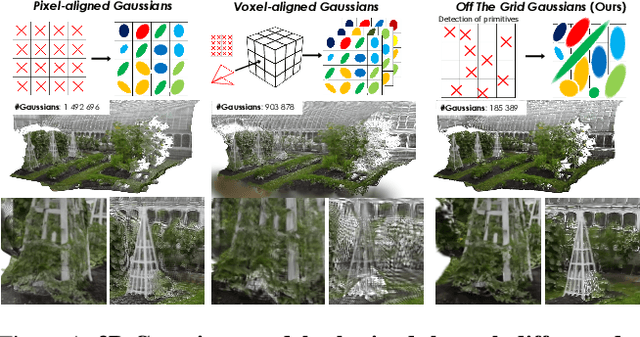
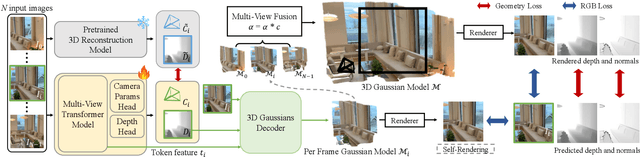
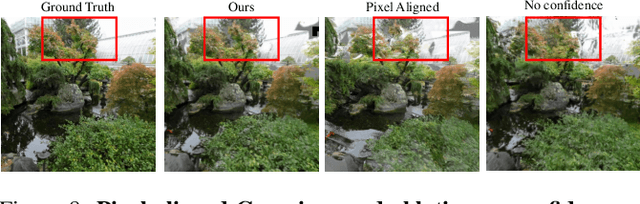

Feed-forward 3D Gaussian Splatting (3DGS) models enable real-time scene generation but are hindered by suboptimal pixel-aligned primitive placement, which relies on a dense, rigid grid and limits both quality and efficiency. We introduce a new feed-forward architecture that detects 3D Gaussian primitives at a sub-pixel level, replacing the pixel grid with an adaptive, "Off The Grid" distribution. Inspired by keypoint detection, our multi-resolution decoder learns to distribute primitives across image patches. This module is trained end-to-end with a 3D reconstruction backbone using self-supervised learning. Our resulting pose-free model generates photorealistic scenes in seconds, achieving state-of-the-art novel view synthesis for feed-forward models. It outperforms competitors while using far fewer primitives, demonstrating a more accurate and efficient allocation that captures fine details and reduces artifacts. Moreover, we observe that by learning to render 3D Gaussians, our 3D reconstruction backbone improves camera pose estimation, suggesting opportunities to train these foundational models without labels.