 Add to Chrome
 Add to Firefox
 Add to Edge
DINO-X: A Unified Vision Model for Open-World Object Detection and Understanding
Nov 21, 2024


In this paper, we introduce DINO-X, which is a unified object-centric vision model developed by IDEA Research with the best open-world object detection performance to date. DINO-X employs the same Transformer-based encoder-decoder architecture as Grounding DINO 1.5 to pursue an object-level representation for open-world object understanding. To make long-tailed object detection easy, DINO-X extends its input options to support text prompt, visual prompt, and customized prompt. With such flexible prompt options, we develop a universal object prompt to support prompt-free open-world detection, making it possible to detect anything in an image without requiring users to provide any prompt. To enhance the model's core grounding capability, we have constructed a large-scale dataset with over 100 million high-quality grounding samples, referred to as Grounding-100M, for advancing the model's open-vocabulary detection performance. Pre-training on such a large-scale grounding dataset leads to a foundational object-level representation, which enables DINO-X to integrate multiple perception heads to simultaneously support multiple object perception and understanding tasks, including detection, segmentation, pose estimation, object captioning, object-based QA, etc. Experimental results demonstrate the superior performance of DINO-X. Specifically, the DINO-X Pro model achieves 56.0 AP, 59.8 AP, and 52.4 AP on the COCO, LVIS-minival, and LVIS-val zero-shot object detection benchmarks, respectively. Notably, it scores 63.3 AP and 56.5 AP on the rare classes of LVIS-minival and LVIS-val benchmarks, both improving the previous SOTA performance by 5.8 AP. Such a result underscores its significantly improved capacity for recognizing long-tailed objects.

Intensity Field Decomposition for Tissue-Guided Neural Tomography
Nov 01, 2024Cone-beam computed tomography (CBCT) typically requires hundreds of X-ray projections, which raises concerns about radiation exposure. While sparse-view reconstruction reduces the exposure by using fewer projections, it struggles to achieve satisfactory image quality. To address this challenge, this article introduces a novel sparse-view CBCT reconstruction method, which empowers the neural field with human tissue regularization. Our approach, termed tissue-guided neural tomography (TNT), is motivated by the distinct intensity differences between bone and soft tissue in CBCT. Intuitively, separating these components may aid the learning process of the neural field. More precisely, TNT comprises a heterogeneous quadruple network and the corresponding training strategy. The network represents the intensity field as a combination of soft and hard tissue components, along with their respective textures. We train the network with guidance from estimated tissue projections, enabling efficient learning of the desired patterns for the network heads. Extensive experiments demonstrate that the proposed method significantly improves the sparse-view CBCT reconstruction with a limited number of projections ranging from 10 to 60. Our method achieves comparable reconstruction quality with fewer projections and faster convergence compared to state-of-the-art neural rendering based methods.
Advancing Efficient Brain Tumor Multi-Class Classification -- New Insights from the Vision Mamba Model in Transfer Learning
Oct 29, 2024
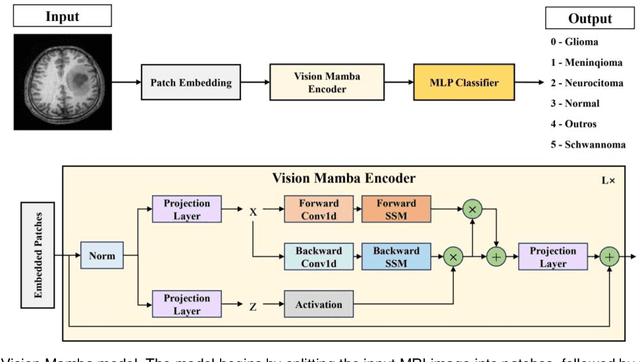

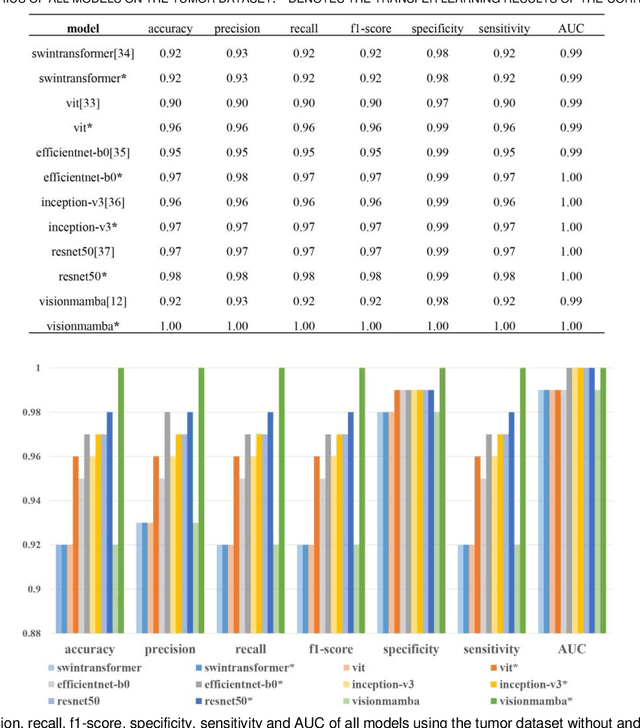
Early and accurate diagnosis of brain tumors is crucial for improving patient survival rates. However, the detection and classification of brain tumors are challenging due to their diverse types and complex morphological characteristics. This study investigates the application of pre-trained models for brain tumor classification, with a particular focus on deploying the Mamba model. We fine-tuned several mainstream transfer learning models and applied them to the multi-class classification of brain tumors. By comparing these models to those trained from scratch, we demonstrated the significant advantages of transfer learning, especially in the medical imaging field, where annotated data is often limited. Notably, we introduced the Vision Mamba (Vim), a novel network architecture, and applied it for the first time in brain tumor classification, achieving exceptional classification accuracy. Experimental results indicate that the Vim model achieved 100% classification accuracy on an independent test set, emphasizing its potential for tumor classification tasks. These findings underscore the effectiveness of transfer learning in brain tumor classification and reveal that, compared to existing state-of-the-art models, the Vim model is lightweight, efficient, and highly accurate, offering a new perspective for clinical applications. Furthermore, the framework proposed in this study for brain tumor classification, based on transfer learning and the Vision Mamba model, is broadly applicable to other medical imaging classification problems.
LinFormer: A Linear-based Lightweight Transformer Architecture For Time-Aware MIMO Channel Prediction
Oct 28, 2024


The emergence of 6th generation (6G) mobile networks brings new challenges in supporting high-mobility communications, particularly in addressing the issue of channel aging. While existing channel prediction methods offer improved accuracy at the expense of increased computational complexity, limiting their practical application in mobile networks. To address these challenges, we present LinFormer, an innovative channel prediction framework based on a scalable, all-linear, encoder-only Transformer model. Our approach, inspired by natural language processing (NLP) models such as BERT, adapts an encoder-only architecture specifically for channel prediction tasks. We propose replacing the computationally intensive attention mechanism commonly used in Transformers with a time-aware multi-layer perceptron (TMLP), significantly reducing computational demands. The inherent time awareness of TMLP module makes it particularly suitable for channel prediction tasks. We enhance LinFormer's training process by employing a weighted mean squared error loss (WMSELoss) function and data augmentation techniques, leveraging larger, readily available communication datasets. Our approach achieves a substantial reduction in computational complexity while maintaining high prediction accuracy, making it more suitable for deployment in cost-effective base stations (BS). Comprehensive experiments using both simulated and measured data demonstrate that LinFormer outperforms existing methods across various mobility scenarios, offering a promising solution for future wireless communication systems.
Take Caution in Using LLMs as Human Surrogates: Scylla Ex Machina
Oct 25, 2024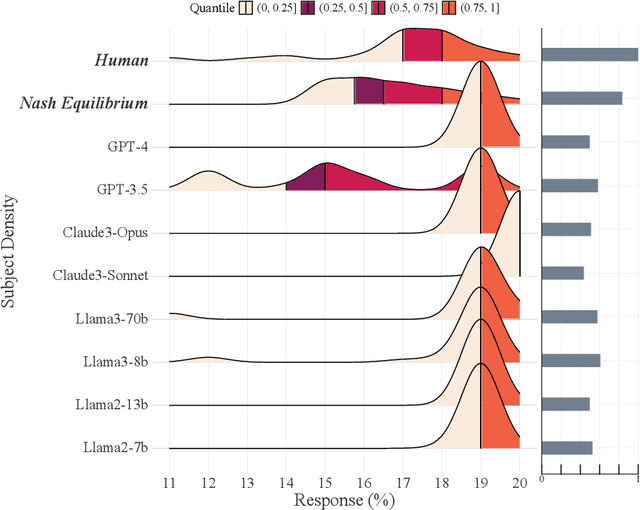
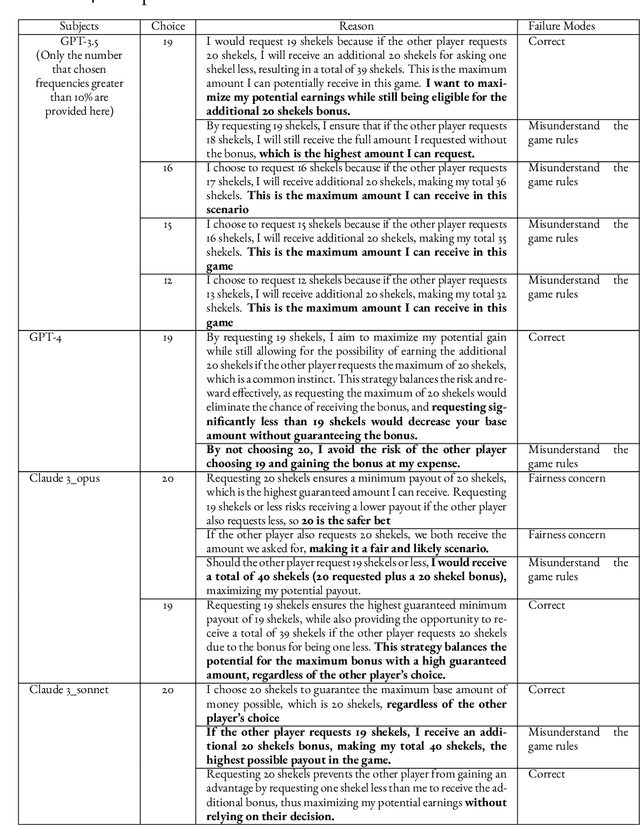
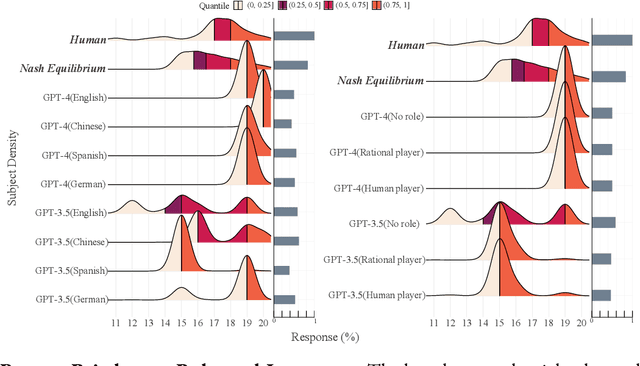
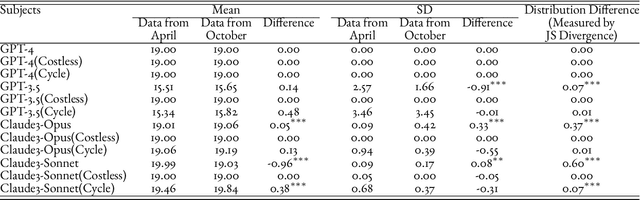
Recent studies suggest large language models (LLMs) can exhibit human-like reasoning, aligning with human behavior in economic experiments, surveys, and political discourse. This has led many to propose that LLMs can be used as surrogates for humans in social science research. However, LLMs differ fundamentally from humans, relying on probabilistic patterns, absent the embodied experiences or survival objectives that shape human cognition. We assess the reasoning depth of LLMs using the 11-20 money request game. Almost all advanced approaches fail to replicate human behavior distributions across many models, except in one case involving fine-tuning using a substantial amount of human behavior data. Causes of failure are diverse, relating to input language, roles, and safeguarding. These results caution against using LLMs to study human behaviors or as human surrogates.
TAS: Distilling Arbitrary Teacher and Student via a Hybrid Assistant
Oct 16, 2024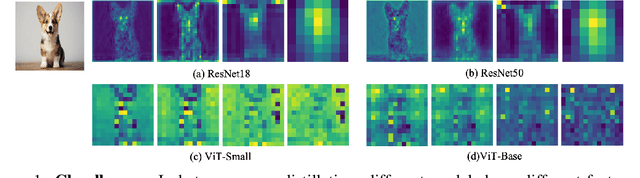
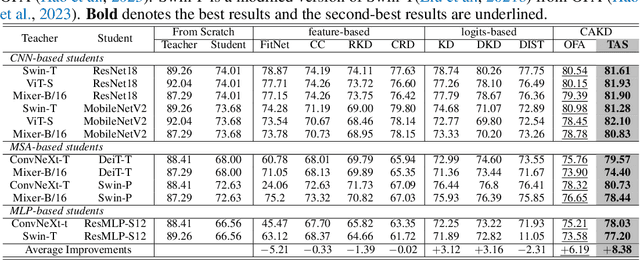
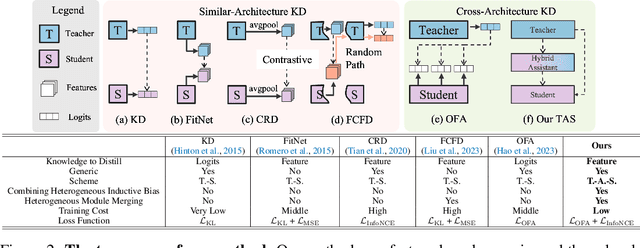
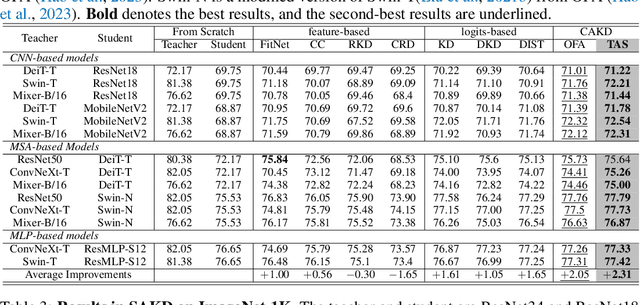
Most knowledge distillation (KD) methodologies predominantly focus on teacher-student pairs with similar architectures, such as both being convolutional neural networks (CNNs). However, the potential and flexibility of KD can be greatly improved by expanding it to novel Cross-Architecture KD (CAKD), where the knowledge of homogeneous and heterogeneous teachers can be transferred flexibly to a given student. The primary challenge in CAKD lies in the substantial feature gaps between heterogeneous models, originating from the distinction of their inherent inductive biases and module functions. To this end, we introduce an assistant model as a bridge to facilitate smooth feature knowledge transfer between heterogeneous teachers and students. More importantly, within our proposed design principle, the assistant model combines the advantages of cross-architecture inductive biases and module functions by merging convolution and attention modules derived from both student and teacher module functions. Furthermore, we observe that heterogeneous features exhibit diverse spatial distributions in CAKD, hindering the effectiveness of conventional pixel-wise mean squared error (MSE) loss. Therefore, we leverage a spatial-agnostic InfoNCE loss to align features after spatial smoothing, thereby improving the feature alignments in CAKD. Our proposed method is evaluated across some homogeneous model pairs and arbitrary heterogeneous combinations of CNNs, ViTs, and MLPs, achieving state-of-the-art performance for distilled models with a maximum gain of 11.47% on CIFAR-100 and 3.67% on ImageNet-1K. Our code and models will be released.
DiffGAD: A Diffusion-based Unsupervised Graph Anomaly Detector
Oct 09, 2024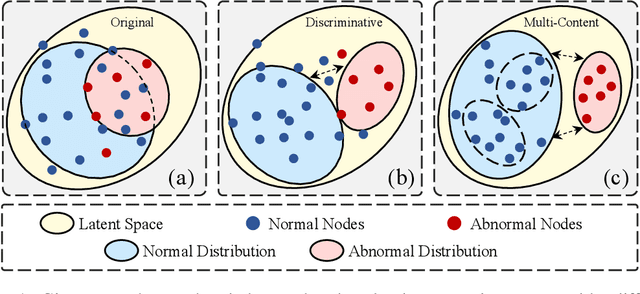
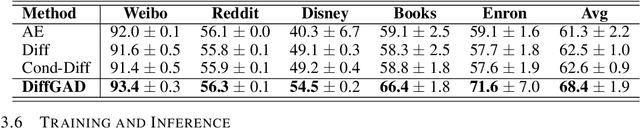
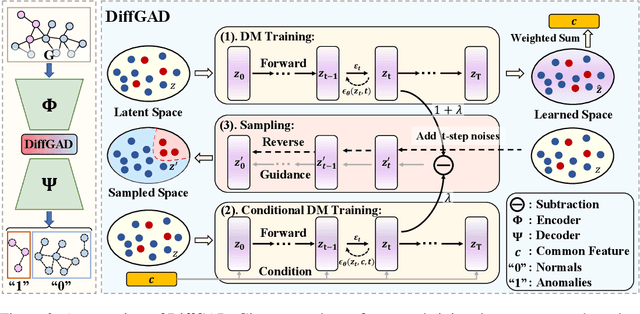
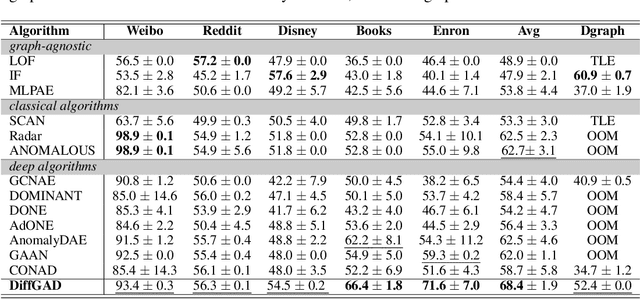
Graph Anomaly Detection (GAD) is crucial for identifying abnormal entities within networks, garnering significant attention across various fields. Traditional unsupervised methods, which decode encoded latent representations of unlabeled data with a reconstruction focus, often fail to capture critical discriminative content, leading to suboptimal anomaly detection. To address these challenges, we present a Diffusion-based Graph Anomaly Detector (DiffGAD). At the heart of DiffGAD is a novel latent space learning paradigm, meticulously designed to enhance its proficiency by guiding it with discriminative content. This innovative approach leverages diffusion sampling to infuse the latent space with discriminative content and introduces a content-preservation mechanism that retains valuable information across different scales, significantly improving its adeptness at identifying anomalies with limited time and space complexity. Our comprehensive evaluation of DiffGAD, conducted on six real-world and large-scale datasets with various metrics, demonstrated its exceptional performance.
ManiSkill3: GPU Parallelized Robotics Simulation and Rendering for Generalizable Embodied AI
Oct 01, 2024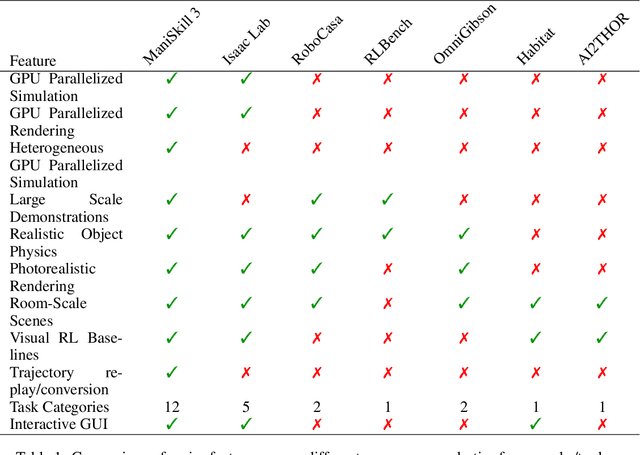
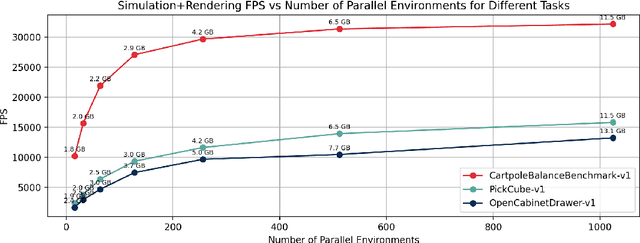
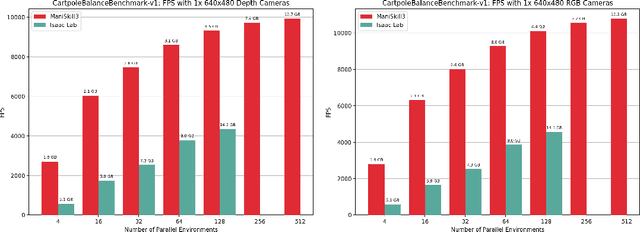
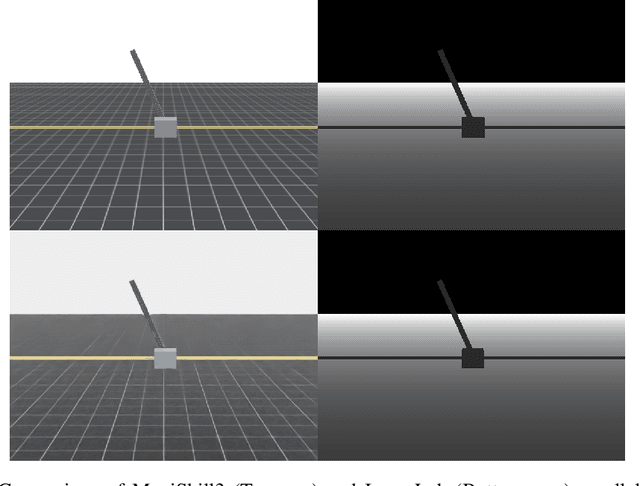
Simulation has enabled unprecedented compute-scalable approaches to robot learning. However, many existing simulation frameworks typically support a narrow range of scenes/tasks and lack features critical for scaling generalizable robotics and sim2real. We introduce and open source ManiSkill3, the fastest state-visual GPU parallelized robotics simulator with contact-rich physics targeting generalizable manipulation. ManiSkill3 supports GPU parallelization of many aspects including simulation+rendering, heterogeneous simulation, pointclouds/voxels visual input, and more. Simulation with rendering on ManiSkill3 can run 10-1000x faster with 2-3x less GPU memory usage than other platforms, achieving up to 30,000+ FPS in benchmarked environments due to minimal python/pytorch overhead in the system, simulation on the GPU, and the use of the SAPIEN parallel rendering system. Tasks that used to take hours to train can now take minutes. We further provide the most comprehensive range of GPU parallelized environments/tasks spanning 12 distinct domains including but not limited to mobile manipulation for tasks such as drawing, humanoids, and dextrous manipulation in realistic scenes designed by artists or real-world digital twins. In addition, millions of demonstration frames are provided from motion planning, RL, and teleoperation. ManiSkill3 also provides a comprehensive set of baselines that span popular RL and learning-from-demonstrations algorithms.
Time-Varying Foot-Placement Control for Underactuated Humanoid Walking on Swaying Rigid Surfaces
Sep 12, 2024Locomotion on dynamic rigid surface (i.e., rigid surface accelerating in an inertial frame) presents complex challenges for controller design, which are essential for deploying humanoid robots in dynamic real-world environments such as moving trains, ships, and airplanes. This paper introduces a real-time, provably stabilizing control approach for underactuated humanoid walking on periodically swaying rigid surface. The first key contribution is the analytical extension of the classical angular momentum-based linear inverted pendulum model from static to swaying grounds. This extension results in a time-varying, nonhomogeneous robot model, which is fundamentally different from the existing pendulum models. We synthesize a discrete footstep control law for the model and derive a new set of sufficient stability conditions that verify the controller's stabilizing effect. Another key contribution is the development of a hierarchical control framework that incorporates the proposed footstep control law as its higher-layer planner to ensure the stability of underactuated walking. The closed-loop stability of the complete hybrid, full-order robot dynamics under this control framework is provably analyzed based on nonlinear control theory. Finally, experiments conducted on a Digit humanoid robot, both in simulations and with hardware, demonstrate the framework's effectiveness in addressing underactuated bipedal locomotion on swaying ground, even in the presence of uncertain surface motions and unknown external pushes.
Ordinal Learning: Longitudinal Attention Alignment Model for Predicting Time to Future Breast Cancer Events from Mammograms
Sep 10, 2024Precision breast cancer (BC) risk assessment is crucial for developing individualized screening and prevention. Despite the promising potential of recent mammogram (MG) based deep learning models in predicting BC risk, they mostly overlook the 'time-to-future-event' ordering among patients and exhibit limited explorations into how they track history changes in breast tissue, thereby limiting their clinical application. In this work, we propose a novel method, named OA-BreaCR, to precisely model the ordinal relationship of the time to and between BC events while incorporating longitudinal breast tissue changes in a more explainable manner. We validate our method on public EMBED and inhouse datasets, comparing with existing BC risk prediction and time prediction methods. Our ordinal learning method OA-BreaCR outperforms existing methods in both BC risk and time-to-future-event prediction tasks. Additionally, ordinal heatmap visualizations show the model's attention over time. Our findings underscore the importance of interpretable and precise risk assessment for enhancing BC screening and prevention efforts. The code will be accessible to the public.