 Add to Chrome
 Add to Firefox
 Add to Edge
SAFE-Diff: Scale-Aware Attention and Feature-Dispersive Diffusion with Uncertainty Estimation for Contrast-Enhanced Breast MRI Synthesis
May 26, 2026
Synthesizing high fidelity contrast enhanced MRI is clinically valuable for safer and more efficient breast cancer screening, yet remains challenging due to complex lesion textures and heterogeneous enhancement patterns.

LoGo-MR: Screening Breast MRI for Cancer Risk Prediction by Efficient Omni-Slice Modeling
Apr 13, 2026Efficient and explainable breast cancer (BC) risk prediction is critical for large-scale population-based screening. Breast MRI provides functional information for personalized risk assessment. Yet effective modeling remains challenging as fully 3D CNNs capture volumetric context at high computational cost, whereas lightweight 2D CNNs fail to model inter-slice continuity. Importantly, breast MRI modeling for shor- and long-term BC risk stratification remains underexplored. In this study, we propose LoGo-MR, a 2.5D local-global structural modeling framework for five-year BC risk prediction. Aligned with clinical interpretation, our framework first employs neighbor-slice encoding to capture subtle local cues linked to short-term risk. It then integrates transformer-enhanced multiple-instance learning (MIL) to model distributed global patterns related to long-term risk and provide interpretable slice importance. We further apply this framework across axial, sagittal, and coronal planes as LoGo3-MR to capture complementary volumetric information. This multi-plane formulation enables voxel-level risk saliency mapping, which may assist radiologists in localizing risk-relevant regions during breast MRI interpretation. Evaluated on a large breast MRI screening cohort (~7.5K), our method outperforms 2D/3D baselines and existing SOTA MIL methods, achieving AUCs of 0.77-0.69 for 1- to 5-year prediction and improving C-index by ~6% over 3D CNNs. LoGo3-MR further improves overall performance with interpretable localization across three planes, and validation across seven backbones shows consistent gains. These results highlight the clinical potential of efficient MRI-based BC risk stratification for large-scale screening. Code will be released publicly.
Ordinal Learning: Longitudinal Attention Alignment Model for Predicting Time to Future Breast Cancer Events from Mammograms
Sep 10, 2024Precision breast cancer (BC) risk assessment is crucial for developing individualized screening and prevention. Despite the promising potential of recent mammogram (MG) based deep learning models in predicting BC risk, they mostly overlook the 'time-to-future-event' ordering among patients and exhibit limited explorations into how they track history changes in breast tissue, thereby limiting their clinical application. In this work, we propose a novel method, named OA-BreaCR, to precisely model the ordinal relationship of the time to and between BC events while incorporating longitudinal breast tissue changes in a more explainable manner. We validate our method on public EMBED and inhouse datasets, comparing with existing BC risk prediction and time prediction methods. Our ordinal learning method OA-BreaCR outperforms existing methods in both BC risk and time-to-future-event prediction tasks. Additionally, ordinal heatmap visualizations show the model's attention over time. Our findings underscore the importance of interpretable and precise risk assessment for enhancing BC screening and prevention efforts. The code will be accessible to the public.
Non-Adversarial Learning: Vector-Quantized Common Latent Space for Multi-Sequence MRI
Jul 03, 2024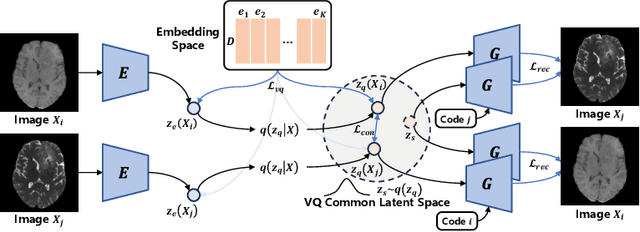
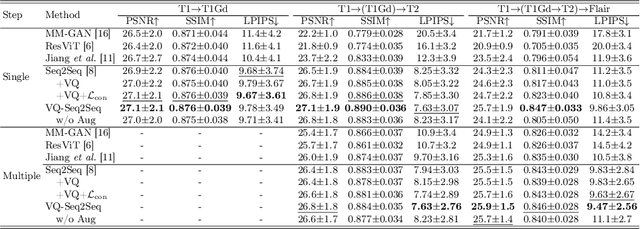
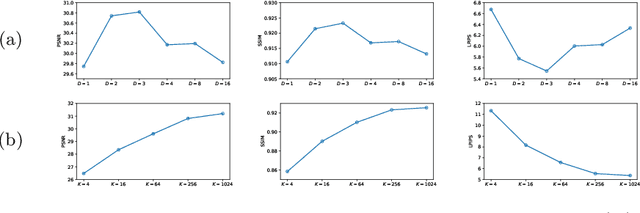
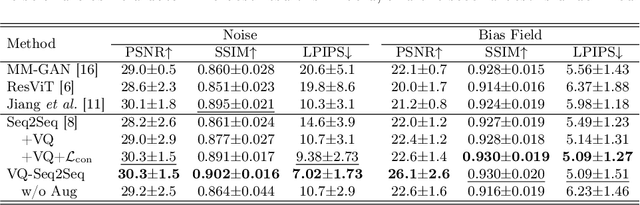
Adversarial learning helps generative models translate MRI from source to target sequence when lacking paired samples. However, implementing MRI synthesis with adversarial learning in clinical settings is challenging due to training instability and mode collapse. To address this issue, we leverage intermediate sequences to estimate the common latent space among multi-sequence MRI, enabling the reconstruction of distinct sequences from the common latent space. We propose a generative model that compresses discrete representations of each sequence to estimate the Gaussian distribution of vector-quantized common (VQC) latent space between multiple sequences. Moreover, we improve the latent space consistency with contrastive learning and increase model stability by domain augmentation. Experiments using BraTS2021 dataset show that our non-adversarial model outperforms other GAN-based methods, and VQC latent space aids our model to achieve (1) anti-interference ability, which can eliminate the effects of noise, bias fields, and artifacts, and (2) solid semantic representation ability, with the potential of one-shot segmentation. Our code is publicly available.