 Add to Chrome
 Add to Firefox
 Add to Edge
Channel Map-Based Channel Estimation for Near-Field UM-MIMO with Movable Planar Arrays
Aug 06, 2026
Accurate channel estimation is essential for coherent transmission in ultra-massive multiple-input multiple-output (UM-MIMO) systems, where near-field propagation and high-dimensional spatial channels impose substantial signal processing challenges. Movable antenna architectures increase the estimation complexity further due to geometry-dependent channel variations. Existing approaches struggle to balance accuracy and complexity, motivating the use of environment-dependent propagation structures for efficient estimation. To this end, this paper proposes a unified channel map-based channel estimation framework for UM-MIMO systems, which integrates movable planar array reconfiguration and near-field spherical-wave modeling to support geometry-aware line-of-sight (LoS) estimation and efficient non-LoS (NLoS) recovery. A channel map-based LoS estimator is proposed combining coarse user position information with a Fisher information-guided antenna placement strategy. Two efficient NLoS estimation methods are also presented, including a sketch-based reduced-subspace estimator for low-complexity processing and a channel map-based estimator that leverages scatterer location information for near-optimal performance. The framework further incorporates visibility-region modeling and a structural similarity-based pilot assignment strategy for multi-user scenarios. Simulation results show that the proposed channel map-based framework improves estimation accuracy, reduces computational overhead, and enhances scalability compared with state-of-the-art benchmarks without channel maps.

Cross-Field Channel Parameter Estimation and Channel Characterization at THz Bands in Indoor Scenarios
Jul 15, 2026The terahertz (THz) frequency band offers the potential for ultra-high data rate transmission in future wireless communication systems. To extend the transmission distance and enhance spectral efficiency, the deployment of large-scale antenna arrays emerges as a promising solution in the THz band. This paper targets the critical challenge of cross-field (hybrid near-field/far-field) channel parameter estimation and channel characterization in such configurations. We first establish a 260-380 GHz virtual uniform linear array (ULA) measurement framework in an indoor scenario, capturing high-resolution channel transfer functions (CTFs) that reveal spatial non-stationarity and cross-field wavefront characteristics. Building upon these empirical observations, we propose a cross-field space-alternating generalized expectation-maximization (SAGE) algorithm that discriminatively estimates near-field and far-field multipath components (MPCs) via Bayesian phase-curvature classification, while explicitly tracking spatial birth-death phenomena through visibility region estimation. Analysis of the measurement data validates the algorithm's effectiveness in resolving cross-field MPCs and quantifies that near-field MPCs account for over 90% of total MPCs at 2 m transmission distance (380 GHz). We observe that spatial non-stationarity intensifies as the carrier frequency increases and the transmission distance decreases. These findings offer quantitative guidelines for channel modeling and system design in wireless THz communication systems.
Channel Charting With Physical Channel Fingerprints For Massive MIMO-OFDM Channel Acquisition
Jun 17, 2026The advancement of 6G mobile communication and positioning technologies has amplified the significance of location-aware tools, such as location-indexed channel fingerprints (CFs) and channel charting, which are becoming key enablers for massive MIMO-OFDM systems. In this paper, we propose a novel channel charting with physical CFs (PCFs) and demonstrate its effectiveness in channel state information (CSI) acquisition. First, we define the PCF based on a cluster-based geometric stochastic channel model (GBSM), enabling a comprehensive representation of physical channel characteristics using a compact set of parameters. We then develop a methodology for PCF acquisition in massive MIMO-OFDM systems. By exploiting the relationship between PCFs and the space-frequency-time (SFT) domain channel, the proposed method extracts PCFs from multi-location channel measurements and constructs a structured channel charting with location-indexed PCFs. Furthermore, we propose a low-complexity algorithm to acquire beam domain statistical CSI (sCSI) using the PCFs in the channel charting. The resulting sCSI can be directly employed as prior information for channel estimation. Simulation results show that the proposed method delivers sCSI performance comparable to traditional online probing techniques, and the generated sCSI can serve as reliable prior knowledge to significantly enhance the accuracy of channel estimation. These results validate the proposed PCF as a powerful and versatile tool for channel acquisition and system design of the next-generation mobile communication.
A Hybrid Near-field Indoor Channel Model for THz Bands Based on Surface Scattering Characteristics
Jun 01, 2026Terahertz (THz) communication and extremely large-scale MIMO (XL-MIMO) are essential for achieving ultra-high data rates in future 6G systems. However, at sub-millimeter wavelengths, typical indoor materials exhibit significant roughness that invalidates conventional ideal smooth surface assumptions, while massive array apertures introduce pronounced near-field effects and spatial non-stationarity. To address these challenges, this paper proposes a hybrid near-field channel model utilizing surface scattering characteristics based on distinct measurement campaigns. First, based on typical indoor materials scattering measurements across the 260-400 GHz band, an improved Beckmann-Kirchhoff (B-K) model is developed to accurately characterize surface roughness and diffuse scattering behavior. The model independently analyzes single-bounce (SB) and multi-bounce (MB) clusters by applying deterministic rough surface scattering theory and geometry-statistical approach, respectively. Then, using near-field spatial non-stationarity measurements from a 630-element virtual array in the 330-360 GHz band, a Dual-Gaussian Mixture Model (DMM) and a Negative Binomial (NB) distribution are adopted to describe the lengths and the number of spatial visibility regions (VRs), respectively. Additionally, a Weibull distribution is employed to model the intra-region power fluctuations. Finally, comprehensive XL-MIMO channel evaluations within the same band demonstrate that the proposed model aligns closely with measured results in terms of the spatial cross-correlation function (SCCF), frequency cross-correlation function (FCF), and channel capacity. By reproducing the spatial sparsity of THz band, the proposed model overcomes the limitation of conventional standard models, such as 3GPP 38.901 and WINNER II, in significantly overestimating channel capacity.
A Novel 6G Dynamic Channel Map Based on a Hybrid Channel Model
Apr 16, 2026In the sixth generation (6G) wireless communication networks, the device density, antenna number, and the complexity of communication scenarios will significantly increase, which brings great challenges for system design and network optimization. By obtaining channel information in advance, channel map has become a promising solution to these challenges in 6G era. However, conventional channel maps cannot be updated in time as physical environment changes. To solve the problem, a novel dynamic channel map (DCM) is proposed in this work. For DCM construction, we further present a ray tracing (RT) and geometric stochastic hybrid channel model (RT-GSHCM), which pre-constructs the DCM offline by RT and updates it online by geometry-based stochastic channel model (GBSM). By this way, the DCM can provide time-varying channel information and channel properties while matintaining accuracy. Next, a channel measurement campaign is conducted, and the measurement results are compared with the RT-GSHCM, RT, and GBSM. The comparison results validate the accuracy of DCM. Meanwhile, the time cost on DCM update is compared with that of conventional channel maps, illustrating the time-efficiency of DCM. Finally, important statistical channel properties of RT-GSHCM are further derived, analyzed, and compared under different configurations of interaction objects in physical environment.
DBU-OFDM: A Trainable Deep Block-Unitary OFDM Waveform for Integrated Sensing and Communication
Apr 11, 2026Orthogonal frequency-division multiplexing (OFDM) is a dominant waveform in modern wireless systems, yet its high peak-to-average power ratio (PAPR) and limited adaptability hinder efficient support for integrated communication and sensing. This paper proposes deep block-unitary precoded OFDM (DBU-OFDM), a structure-preserving learning framework that enables trainable waveform adaptation while preserving the DFT-based signal structure, pilot/null resource protection, and compatibility with low-complexity frequency-domain equalization. The proposed design restricts learning to a block-unitary transformation over data subcarriers and preserves pilot and null resources for structural compatibility. The transform is parameterized by recursive Householder reflections, ensuring strict unitarity as well as differentiable, numerically stable, and complexity-controllable implementation. Results show that DBU-OFDM achieves PAPR tails close to block-pilot DFT-s-OFDM while retaining comb-type pilots, improves communication reliability in frequency-selective fading via frequency-domain diversity, and enhances range and velocity estimation in direct sensing, especially in dimension-limited settings. Over-the-air USRP experiments and FPGA prototyping further verify its practical feasibility, demonstrating low error vector magnitude (EVM), clear PAPR reduction in real transmission, and hardware throughput up to 200~MS/s with microsecond-level latency. DBU-OFDM therefore offers a practical intermediate solution between conventional model-based OFDM waveforms and unconstrained neural transceivers for next-generation integrated communication and sensing systems.
Data-Model Co-Driven Continuous Channel Map Construction: A Perceptive Foundation for Embodied Intelligent Agents in 6G Networks
Apr 01, 2026Future 6G networks will host massive numbers of embodied intelligent agents, which require real-time channel awareness over continuous-space for autonomous decision-making. By pre-obtaining location-specific channel state information (CSI), channel map can be served as a foundational world model for embodied intelligence to achieve wireless channel perception. However, acquiring CSI via measurements is costly, so in practice only sparse observations are available, leaving agents blind to channel conditions at unvisited locations. Meanwhile, purely model-driven channel maps can provide dense CSI but often yields unsatisfactory accuracy and robustness, while purely data-driven interpolation from sparse measurements is computationally prohibitive for real-time updates. To address these challenges, this paper proposes a data-model co-driven (DMcD) framework that performs a two-stage interpolation toward a space-time continuous channel map, First, a hybrid ray tracing and geometry-based channel model (H-RT/GBSM) is developed to capture dynamic scatterers, providing dense, time-variant channel properties that match measurement statistics as a physically consistent prior. Then, an inductive edge-conditioned graph neural network (InductE-GNN) fuses the prior with sparse measurements to perform real-time spatial interpolation, enabling rapid online adaptation without retraining, ensuring the synchronization with the dynamic physical reality. Evaluations with measured datasets show that the proposed DMcD framework significantly outperforms data-only and model-only baselines, providing accurate and queryable channel information for embodied intelligent agents.
Channel Extrapolation for MIMO Systems with the Assistance of Multi-path Information Induced from Channel State Information
Jan 29, 2026Acquiring channel state information (CSI) through traditional methods, such as channel estimation, is increasingly challenging for the emerging sixth generation (6G) mobile networks due to high overhead. To address this issue, channel extrapolation techniques have been proposed to acquire complete CSI from a limited number of known CSIs. To improve extrapolation accuracy, environmental information, such as visual images or radar data, has been utilized, which poses challenges including additional hardware, privacy and multi-modal alignment concerns. To this end, this paper proposes a novel channel extrapolation framework by leveraging environment-related multi-path characteristics induced directly from CSI without integrating additional modalities. Specifically, we propose utilizing the multi-path characteristics in the form of power-delay profile (PDP), which is acquired using a CSI-to-PDP module. CSI-to-PDP module is trained in an AE-based framework by reconstructing the PDPs and constraining the latent low-dimensional features to represent the CSI. We further extract the total power & power-weighted delay of all the identified paths in PDP as the multi-path information. Building on this, we proposed a MAE architecture trained in a self-supervised manner to perform channel extrapolation. Unlike standard MAE approaches, our method employs separate encoders to extract features from the masked CSI and the multi-path information, which are then fused by a cross-attention module. Extensive simulations demonstrate that this framework improves extrapolation performance dramatically, with a minor increase in inference time (around 0.1 ms). Furthermore, our model shows strong generalization capabilities, particularly when only a small portion of the CSI is known, outperforming existing benchmarks.
MambaNet: Mamba-assisted Channel Estimation Neural Network With Attention Mechanism
Jan 23, 2026This paper proposes a Mamba-assisted neural network framework incorporating self-attention mechanism to achieve improved channel estimation with low complexity for orthogonal frequency-division multiplexing (OFDM) waveforms, particularly for configurations with a large number of subcarriers. With the integration of customized Mamba architecture, the proposed framework handles large-scale subcarrier channel estimation efficiently while capturing long-distance dependencies among these subcarriers effectively. Unlike conventional Mamba structure, this paper implements a bidirectional selective scan to improve channel estimation performance, because channel gains at different subcarriers are non-causal. Moreover, the proposed framework exhibits relatively lower space complexity than transformer-based neural networks. Simulation results tested on the 3GPP TS 36.101 channel demonstrate that compared to other baseline neural network solutions, the proposed method achieves improved channel estimation performance with a reduced number of tunable parameters.
Large-Model AI for Near Field Beam Prediction: A CNN-GPT2 Framework for 6G XL-MIMO
Oct 26, 2025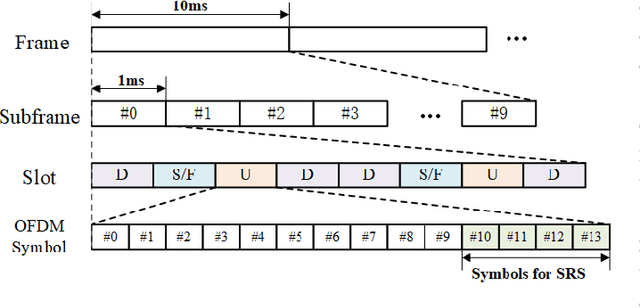
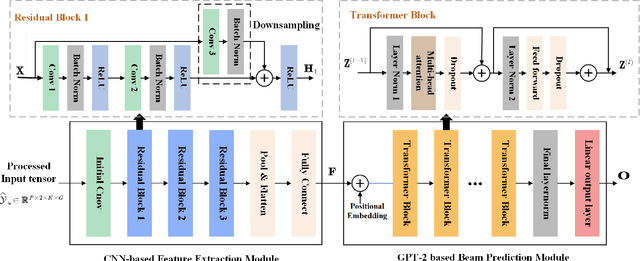


The emergence of extremely large-scale antenna arrays (ELAA) in millimeter-wave (mmWave) communications, particularly in high-mobility scenarios, highlights the importance of near-field beam prediction. Unlike the conventional far-field assumption, near-field beam prediction requires codebooks that jointly sample the angular and distance domains, which leads to a dramatic increase in pilot overhead. Moreover, unlike the far- field case where the optimal beam evolution is temporally smooth, the optimal near-field beam index exhibits abrupt and nonlinear dynamics due to its joint dependence on user angle and distance, posing significant challenges for temporal modeling. To address these challenges, we propose a novel Convolutional Neural Network-Generative Pre-trained Transformer 2 (CNN-GPT2) based near-field beam prediction framework. Specifically, an uplink pilot transmission strategy is designed to enable efficient channel probing through widebeam analog precoding and frequency-varying digital precoding. The received pilot signals are preprocessed and passed through a CNN-based feature extractor, followed by a GPT-2 model that captures temporal dependencies across multiple frames and directly predicts the near-field beam index in an end-to-end manner.