 Add to Chrome
 Add to Firefox
 Add to Edge
MetaDent: Labeling Clinical Images for Vision-Language Models in Dentistry
Apr 16, 2026
Vision-Language Models (VLMs) have demonstrated significant potential in medical image analysis, yet their application in intraoral photography remains largely underexplored due to the lack of fine-grained, annotated datasets and comprehensive benchmarks. To address this, we present MetaDent, a comprehensive resource that includes (1) a novel and large-scale dentistry image dataset collected from clinical, public, and web sources; (2) a semi-structured annotation framework designed to capture the hierarchical and clinically nuanced nature of dental photography; and (3) comprehensive benchmark suites for evaluating state-of-the-art VLMs on clinical image understanding. Our labeling approach combines a high-level image summary with point-by-point, free-text descriptions of abnormalities. This method enables rich, scalable, and task-agnostic representations. We curated 60,669 dental images from diverse sources and annotated a representative subset of 2,588 images using this meta-labeling scheme. Leveraging Large Language Models (LLMs), we derive standardized benchmarks: approximately 15K Visual Question Answering (VQA) pairs and an 18-class multi-label classification dataset, which we validated with human review and error analysis to justify that the LLM-driven transition reliably preserves fidelity and semantic accuracy. We then evaluate state-of-the-art VLMs across VQA, classification, and image captioning tasks. Quantitative results reveal that even the most advanced models struggle with a fine-grained understanding of intraoral scenes, achieving moderate accuracy and producing inconsistent or incomplete descriptions in image captioning. We publicly release our dataset, annotations, and tools to foster reproducible research and accelerate the development of vision-language systems for dental applications.
* Project website: https://menxli.github.io/metadent

Intensity Field Decomposition for Tissue-Guided Neural Tomography
Nov 01, 2024Cone-beam computed tomography (CBCT) typically requires hundreds of X-ray projections, which raises concerns about radiation exposure. While sparse-view reconstruction reduces the exposure by using fewer projections, it struggles to achieve satisfactory image quality. To address this challenge, this article introduces a novel sparse-view CBCT reconstruction method, which empowers the neural field with human tissue regularization. Our approach, termed tissue-guided neural tomography (TNT), is motivated by the distinct intensity differences between bone and soft tissue in CBCT. Intuitively, separating these components may aid the learning process of the neural field. More precisely, TNT comprises a heterogeneous quadruple network and the corresponding training strategy. The network represents the intensity field as a combination of soft and hard tissue components, along with their respective textures. We train the network with guidance from estimated tissue projections, enabling efficient learning of the desired patterns for the network heads. Extensive experiments demonstrate that the proposed method significantly improves the sparse-view CBCT reconstruction with a limited number of projections ranging from 10 to 60. Our method achieves comparable reconstruction quality with fewer projections and faster convergence compared to state-of-the-art neural rendering based methods.
Towards Human-like Perception: Learning Structural Causal Model in Heterogeneous Graph
Dec 10, 2023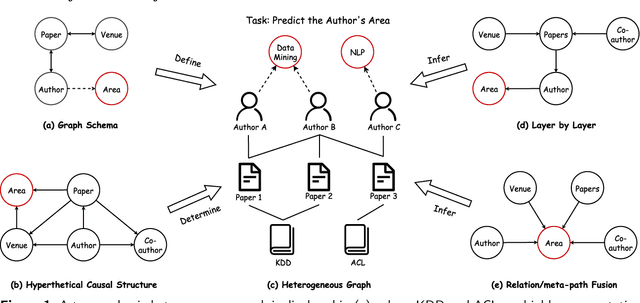
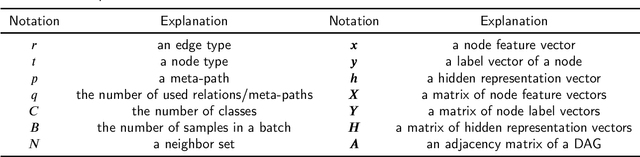
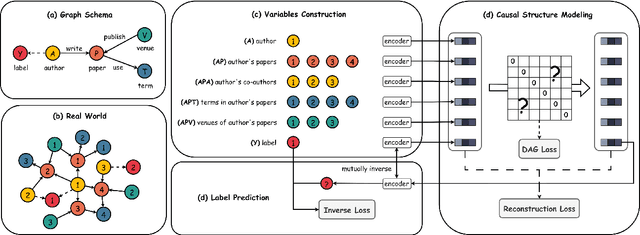

Heterogeneous graph neural networks have become popular in various domains. However, their generalizability and interpretability are limited due to the discrepancy between their inherent inference flows and human reasoning logic or underlying causal relationships for the learning problem. This study introduces a novel solution, HG-SCM (Heterogeneous Graph as Structural Causal Model). It can mimic the human perception and decision process through two key steps: constructing intelligible variables based on semantics derived from the graph schema and automatically learning task-level causal relationships among these variables by incorporating advanced causal discovery techniques. We compared HG-SCM to seven state-of-the-art baseline models on three real-world datasets, under three distinct and ubiquitous out-of-distribution settings. HG-SCM achieved the highest average performance rank with minimal standard deviation, substantiating its effectiveness and superiority in terms of both predictive power and generalizability. Additionally, the visualization and analysis of the auto-learned causal diagrams for the three tasks aligned well with domain knowledge and human cognition, demonstrating prominent interpretability. HG-SCM's human-like nature and its enhanced generalizability and interpretability make it a promising solution for special scenarios where transparency and trustworthiness are paramount.
* 28 pages, 10 figures, 6 tables, accepted by Information Processing & Management