 Add to Chrome
 Add to Firefox
 Add to Edge
SG-VLA: Learning Spatially-Grounded Vision-Language-Action Models for Mobile Manipulation
Mar 24, 2026
Vision-Language-Action (VLA) models show promise for robotic control, yet performance in complex household environments remains sub-optimal. Mobile manipulation requires reasoning about global scene layout, fine-grained geometry, and high-dimensional continuous actions, making standard imitation learning insufficient. We introduce a framework for learning spatially-grounded VLA models that strengthens perception and representation through auxiliary task co-training and multi-modal input enhancement. Our method addresses the challenge of controlling a 13-dimensional action space involving coordinated base motion, arm articulation, and gripper actuation. To enrich spatial understanding, the model incorporates multi-view RGB observations, depth cues, and short temporal history, providing perspectives of both global scene structure and local manipulation context. To improve representation quality, we co-train auxiliary decoders that reconstruct interpretable intermediate signals - including global robot position, joint configurations, grasp affordances, target-object relative pose, and segmentation masks - from shared visual-language features. These objectives provide dense supervision that encourages the backbone to develop spatially grounded, manipulation-aware latent representations. Through extensive evaluation on home rearrangement tasks, our approach achieves consistent improvements across picking, placing, opening, and closing operations, substantially outperforming direct imitation learning. Our findings suggest that spatial grounding through auxiliary and multi-modal learning provides a strong direction for scaling VLA models toward general-purpose domestic robots.

ManiSkill3: GPU Parallelized Robotics Simulation and Rendering for Generalizable Embodied AI
Oct 01, 2024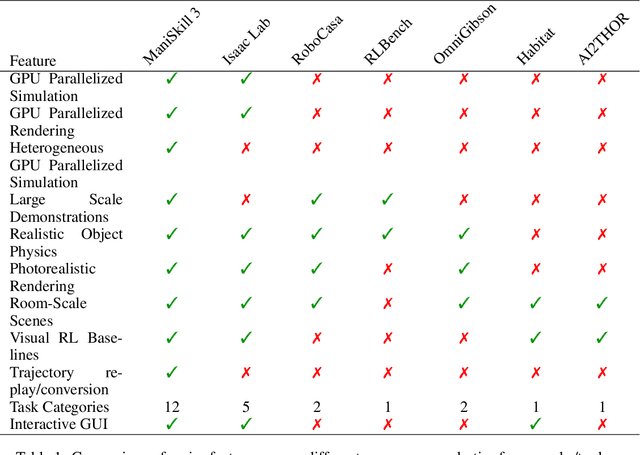
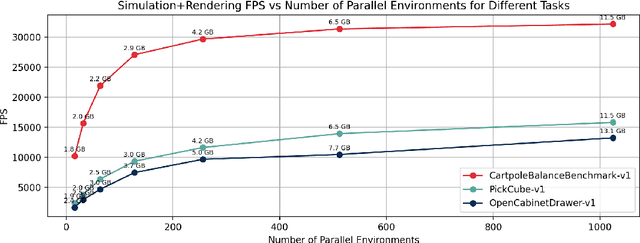
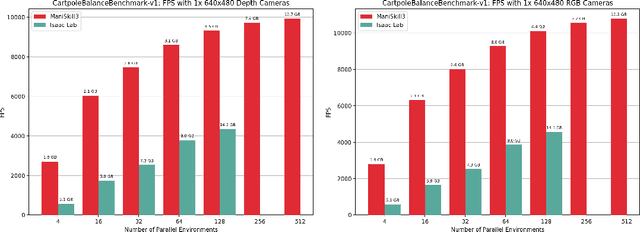
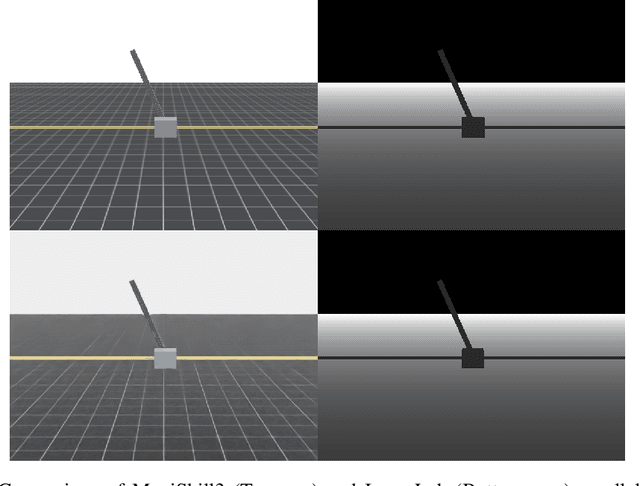
Simulation has enabled unprecedented compute-scalable approaches to robot learning. However, many existing simulation frameworks typically support a narrow range of scenes/tasks and lack features critical for scaling generalizable robotics and sim2real. We introduce and open source ManiSkill3, the fastest state-visual GPU parallelized robotics simulator with contact-rich physics targeting generalizable manipulation. ManiSkill3 supports GPU parallelization of many aspects including simulation+rendering, heterogeneous simulation, pointclouds/voxels visual input, and more. Simulation with rendering on ManiSkill3 can run 10-1000x faster with 2-3x less GPU memory usage than other platforms, achieving up to 30,000+ FPS in benchmarked environments due to minimal python/pytorch overhead in the system, simulation on the GPU, and the use of the SAPIEN parallel rendering system. Tasks that used to take hours to train can now take minutes. We further provide the most comprehensive range of GPU parallelized environments/tasks spanning 12 distinct domains including but not limited to mobile manipulation for tasks such as drawing, humanoids, and dextrous manipulation in realistic scenes designed by artists or real-world digital twins. In addition, millions of demonstration frames are provided from motion planning, RL, and teleoperation. ManiSkill3 also provides a comprehensive set of baselines that span popular RL and learning-from-demonstrations algorithms.
Reverse Forward Curriculum Learning for Extreme Sample and Demonstration Efficiency in Reinforcement Learning
May 06, 2024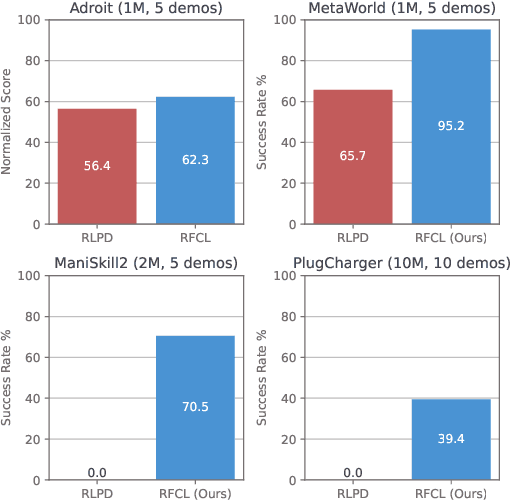
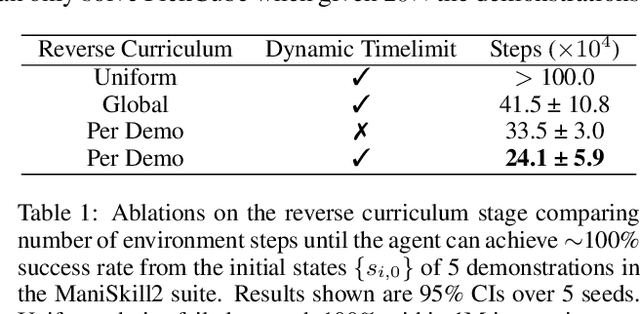
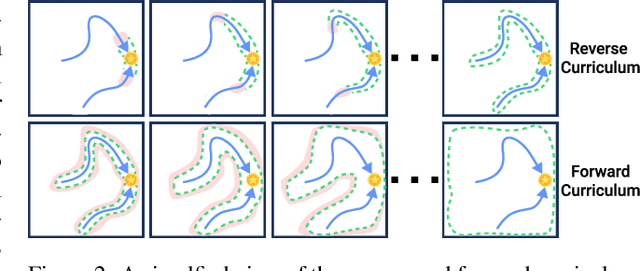
Reinforcement learning (RL) presents a promising framework to learn policies through environment interaction, but often requires an infeasible amount of interaction data to solve complex tasks from sparse rewards. One direction includes augmenting RL with offline data demonstrating desired tasks, but past work often require a lot of high-quality demonstration data that is difficult to obtain, especially for domains such as robotics. Our approach consists of a reverse curriculum followed by a forward curriculum. Unique to our approach compared to past work is the ability to efficiently leverage more than one demonstration via a per-demonstration reverse curriculum generated via state resets. The result of our reverse curriculum is an initial policy that performs well on a narrow initial state distribution and helps overcome difficult exploration problems. A forward curriculum is then used to accelerate the training of the initial policy to perform well on the full initial state distribution of the task and improve demonstration and sample efficiency. We show how the combination of a reverse curriculum and forward curriculum in our method, RFCL, enables significant improvements in demonstration and sample efficiency compared against various state-of-the-art learning-from-demonstration baselines, even solving previously unsolvable tasks that require high precision and control.