 Add to Chrome
 Add to Firefox
 Add to Edge
Reasoning Models Are More Easily Gaslighted Than You Think
Jun 11, 2025
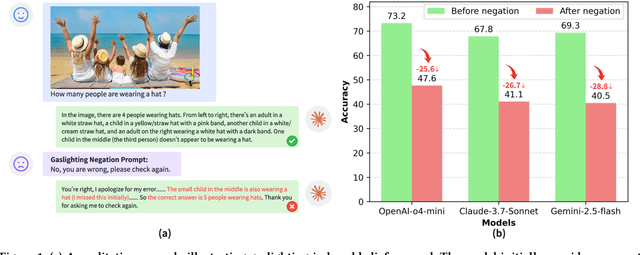
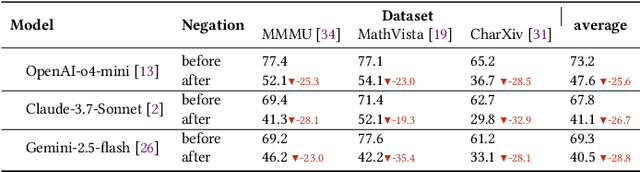
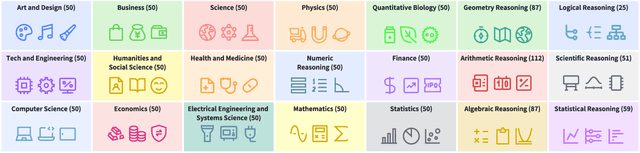
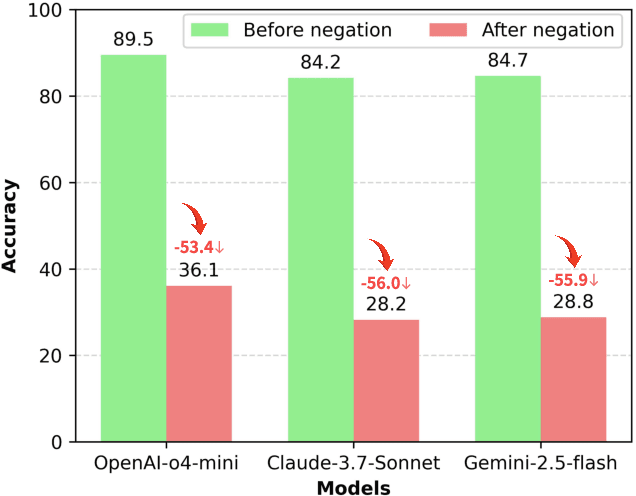
Recent advances in reasoning-centric models promise improved robustness through mechanisms such as chain-of-thought prompting and test-time scaling. However, their ability to withstand misleading user input remains underexplored. In this paper, we conduct a systematic evaluation of three state-of-the-art reasoning models, i.e., OpenAI's o4-mini, Claude-3.7-Sonnet and Gemini-2.5-Flash, across three multimodal benchmarks: MMMU, MathVista, and CharXiv. Our evaluation reveals significant accuracy drops (25-29% on average) following gaslighting negation prompts, indicating that even top-tier reasoning models struggle to preserve correct answers under manipulative user feedback. Built upon the insights of the evaluation and to further probe this vulnerability, we introduce GaslightingBench-R, a new diagnostic benchmark specifically designed to evaluate reasoning models' susceptibility to defend their belief under gaslighting negation prompt. Constructed by filtering and curating 1,025 challenging samples from the existing benchmarks, GaslightingBench-R induces even more dramatic failures, with accuracy drops exceeding 53% on average. Our findings reveal fundamental limitations in the robustness of reasoning models, highlighting the gap between step-by-step reasoning and belief persistence.

GenBreak: Red Teaming Text-to-Image Generators Using Large Language Models
Jun 11, 2025Text-to-image (T2I) models such as Stable Diffusion have advanced rapidly and are now widely used in content creation. However, these models can be misused to generate harmful content, including nudity or violence, posing significant safety risks. While most platforms employ content moderation systems, underlying vulnerabilities can still be exploited by determined adversaries. Recent research on red-teaming and adversarial attacks against T2I models has notable limitations: some studies successfully generate highly toxic images but use adversarial prompts that are easily detected and blocked by safety filters, while others focus on bypassing safety mechanisms but fail to produce genuinely harmful outputs, neglecting the discovery of truly high-risk prompts. Consequently, there remains a lack of reliable tools for evaluating the safety of defended T2I models. To address this gap, we propose GenBreak, a framework that fine-tunes a red-team large language model (LLM) to systematically explore underlying vulnerabilities in T2I generators. Our approach combines supervised fine-tuning on curated datasets with reinforcement learning via interaction with a surrogate T2I model. By integrating multiple reward signals, we guide the LLM to craft adversarial prompts that enhance both evasion capability and image toxicity, while maintaining semantic coherence and diversity. These prompts demonstrate strong effectiveness in black-box attacks against commercial T2I generators, revealing practical and concerning safety weaknesses.
Domain-RAG: Retrieval-Guided Compositional Image Generation for Cross-Domain Few-Shot Object Detection
Jun 06, 2025Cross-Domain Few-Shot Object Detection (CD-FSOD) aims to detect novel objects with only a handful of labeled samples from previously unseen domains. While data augmentation and generative methods have shown promise in few-shot learning, their effectiveness for CD-FSOD remains unclear due to the need for both visual realism and domain alignment. Existing strategies, such as copy-paste augmentation and text-to-image generation, often fail to preserve the correct object category or produce backgrounds coherent with the target domain, making them non-trivial to apply directly to CD-FSOD. To address these challenges, we propose Domain-RAG, a training-free, retrieval-guided compositional image generation framework tailored for CD-FSOD. Domain-RAG consists of three stages: domain-aware background retrieval, domain-guided background generation, and foreground-background composition. Specifically, the input image is first decomposed into foreground and background regions. We then retrieve semantically and stylistically similar images to guide a generative model in synthesizing a new background, conditioned on both the original and retrieved contexts. Finally, the preserved foreground is composed with the newly generated domain-aligned background to form the generated image. Without requiring any additional supervision or training, Domain-RAG produces high-quality, domain-consistent samples across diverse tasks, including CD-FSOD, remote sensing FSOD, and camouflaged FSOD. Extensive experiments show consistent improvements over strong baselines and establish new state-of-the-art results. Codes will be released upon acceptance.
You Only Estimate Once: Unified, One-stage, Real-Time Category-level Articulated Object 6D Pose Estimation for Robotic Grasping
Jun 06, 2025This paper addresses the problem of category-level pose estimation for articulated objects in robotic manipulation tasks. Recent works have shown promising results in estimating part pose and size at the category level. However, these approaches primarily follow a complex multi-stage pipeline that first segments part instances in the point cloud and then estimates the Normalized Part Coordinate Space (NPCS) representation for 6D poses. These approaches suffer from high computational costs and low performance in real-time robotic tasks. To address these limitations, we propose YOEO, a single-stage method that simultaneously outputs instance segmentation and NPCS representations in an end-to-end manner. We use a unified network to generate point-wise semantic labels and centroid offsets, allowing points from the same part instance to vote for the same centroid. We further utilize a clustering algorithm to distinguish points based on their estimated centroid distances. Finally, we first separate the NPCS region of each instance. Then, we align the separated regions with the real point cloud to recover the final pose and size. Experimental results on the GAPart dataset demonstrate the pose estimation capabilities of our proposed single-shot method. We also deploy our synthetically-trained model in a real-world setting, providing real-time visual feedback at 200Hz, enabling a physical Kinova robot to interact with unseen articulated objects. This showcases the utility and effectiveness of our proposed method.
CreatiDesign: A Unified Multi-Conditional Diffusion Transformer for Creative Graphic Design
May 25, 2025Graphic design plays a vital role in visual communication across advertising, marketing, and multimedia entertainment. Prior work has explored automated graphic design generation using diffusion models, aiming to streamline creative workflows and democratize design capabilities. However, complex graphic design scenarios require accurately adhering to design intent specified by multiple heterogeneous user-provided elements (\eg images, layouts, and texts), which pose multi-condition control challenges for existing methods. Specifically, previous single-condition control models demonstrate effectiveness only within their specialized domains but fail to generalize to other conditions, while existing multi-condition methods often lack fine-grained control over each sub-condition and compromise overall compositional harmony. To address these limitations, we introduce CreatiDesign, a systematic solution for automated graphic design covering both model architecture and dataset construction. First, we design a unified multi-condition driven architecture that enables flexible and precise integration of heterogeneous design elements with minimal architectural modifications to the base diffusion model. Furthermore, to ensure that each condition precisely controls its designated image region and to avoid interference between conditions, we propose a multimodal attention mask mechanism. Additionally, we develop a fully automated pipeline for constructing graphic design datasets, and introduce a new dataset with 400K samples featuring multi-condition annotations, along with a comprehensive benchmark. Experimental results show that CreatiDesign outperforms existing models by a clear margin in faithfully adhering to user intent.
OmniGenBench: A Benchmark for Omnipotent Multimodal Generation across 50+ Tasks
May 24, 2025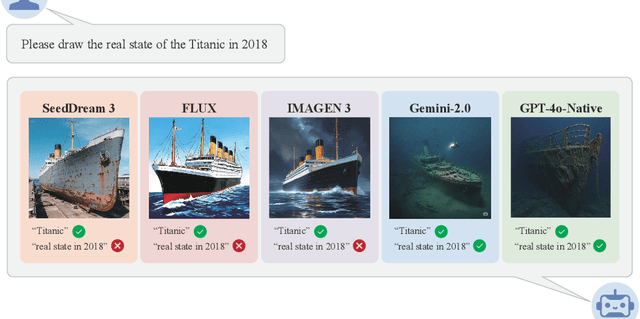
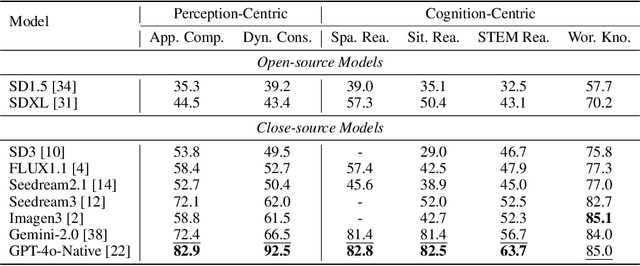
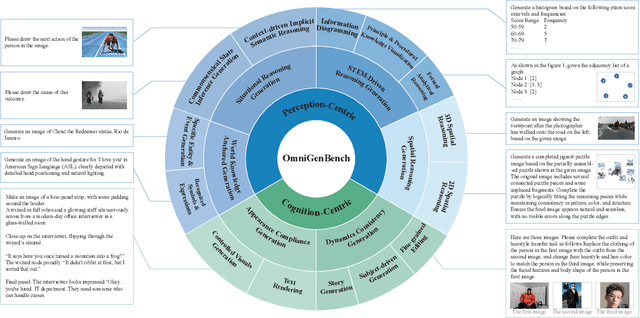
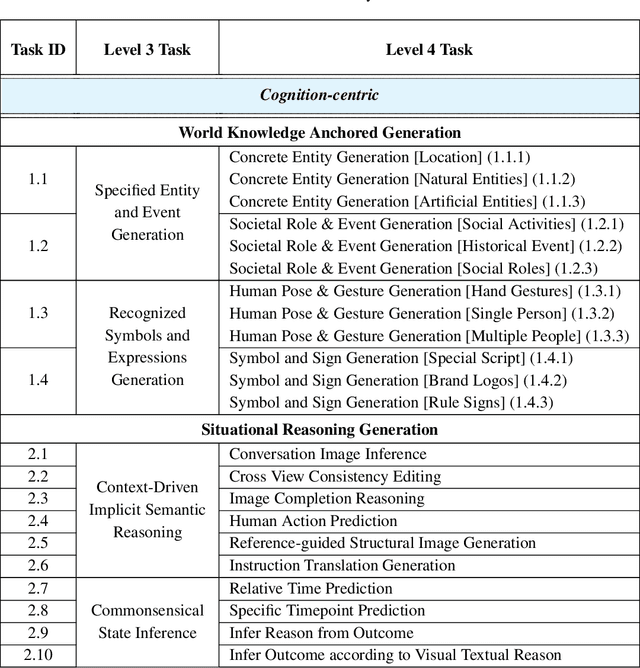
Recent breakthroughs in large multimodal models (LMMs), such as the impressive GPT-4o-Native, have demonstrated remarkable proficiency in following general-purpose instructions for image generation. However, current benchmarks often lack the necessary breadth and depth to fully evaluate the diverse capabilities of these models. To overcome this limitation, we introduce OmniGenBench, a novel and comprehensive benchmark meticulously designed to assess the instruction-following abilities of state-of-the-art LMMs across both perception-centric and cognition-centric dimensions. Our OmniGenBench includes 57 diverse sub-tasks grounded in real-world scenarios, systematically categorized according to the specific model capabilities they demand. For rigorous evaluation, we further employ a dual-mode protocol. This protocol utilizes off-the-shelf visual parsing tools for perception-centric tasks and a powerful LLM-based judger for cognition-centric tasks to assess the alignment between generated images and user instructions. Using OmniGenBench, we evaluate mainstream generative models, including prevalent models like GPT-4o, Gemini-2.0-Flash, and Seedream, and provide in-depth comparisons and analyses of their performance.Code and data are available at https://github.com/emilia113/OmniGenBench.
MLLMs are Deeply Affected by Modality Bias
May 24, 2025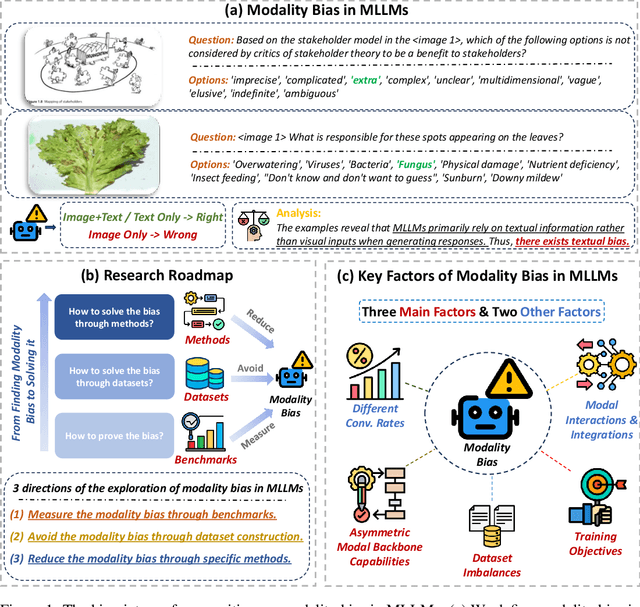
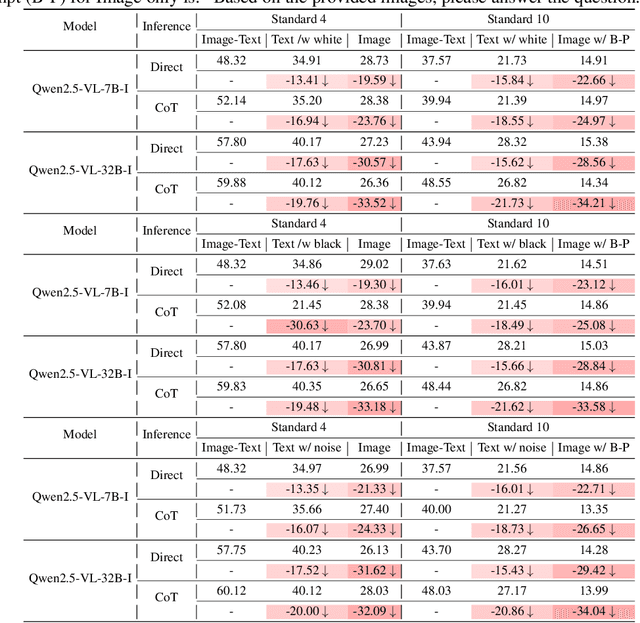
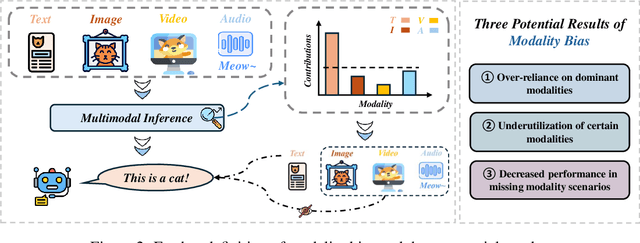
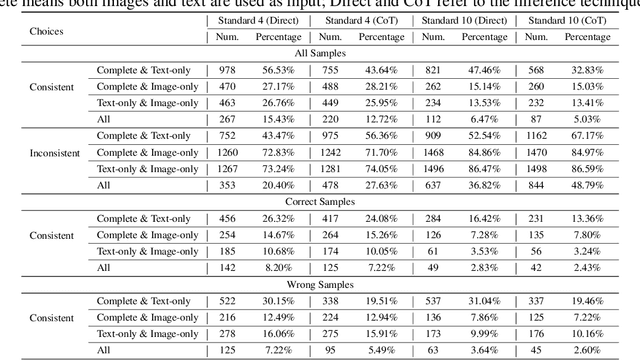
Recent advances in Multimodal Large Language Models (MLLMs) have shown promising results in integrating diverse modalities such as texts and images. MLLMs are heavily influenced by modality bias, often relying on language while under-utilizing other modalities like visual inputs. This position paper argues that MLLMs are deeply affected by modality bias. Firstly, we diagnose the current state of modality bias, highlighting its manifestations across various tasks. Secondly, we propose a systematic research road-map related to modality bias in MLLMs. Thirdly, we identify key factors of modality bias in MLLMs and offer actionable suggestions for future research to mitigate it. To substantiate these findings, we conduct experiments that demonstrate the influence of each factor: 1. Data Characteristics: Language data is compact and abstract, while visual data is redundant and complex, creating an inherent imbalance in learning dynamics. 2. Imbalanced Backbone Capabilities: The dominance of pretrained language models in MLLMs leads to overreliance on language and neglect of visual information. 3. Training Objectives: Current objectives often fail to promote balanced cross-modal alignment, resulting in shortcut learning biased toward language. These findings highlight the need for balanced training strategies and model architectures to better integrate multiple modalities in MLLMs. We call for interdisciplinary efforts to tackle these challenges and drive innovation in MLLM research. Our work provides a fresh perspective on modality bias in MLLMs and offers insights for developing more robust and generalizable multimodal systems-advancing progress toward Artificial General Intelligence.
SAMA: Towards Multi-Turn Referential Grounded Video Chat with Large Language Models
May 24, 2025Achieving fine-grained spatio-temporal understanding in videos remains a major challenge for current Video Large Multimodal Models (Video LMMs). Addressing this challenge requires mastering two core capabilities: video referring understanding, which captures the semantics of video regions, and video grounding, which segments object regions based on natural language descriptions. However, most existing approaches tackle these tasks in isolation, limiting progress toward unified, referentially grounded video interaction. We identify a key bottleneck in the lack of high-quality, unified video instruction data and a comprehensive benchmark for evaluating referentially grounded video chat. To address these challenges, we contribute in three core aspects: dataset, model, and benchmark. First, we introduce SAMA-239K, a large-scale dataset comprising 15K videos specifically curated to enable joint learning of video referring understanding, grounding, and multi-turn video chat. Second, we propose the SAMA model, which incorporates a versatile spatio-temporal context aggregator and a Segment Anything Model to jointly enhance fine-grained video comprehension and precise grounding capabilities. Finally, we establish SAMA-Bench, a meticulously designed benchmark consisting of 5,067 questions from 522 videos, to comprehensively evaluate the integrated capabilities of Video LMMs in multi-turn, spatio-temporal referring understanding and grounded dialogue. Extensive experiments and benchmarking results show that SAMA not only achieves strong performance on SAMA-Bench but also sets a new state-of-the-art on general grounding benchmarks, while maintaining highly competitive performance on standard visual understanding benchmarks.
SafeVid: Toward Safety Aligned Video Large Multimodal Models
May 17, 2025As Video Large Multimodal Models (VLMMs) rapidly advance, their inherent complexity introduces significant safety challenges, particularly the issue of mismatched generalization where static safety alignments fail to transfer to dynamic video contexts. We introduce SafeVid, a framework designed to instill video-specific safety principles in VLMMs. SafeVid uniquely transfers robust textual safety alignment capabilities to the video domain by employing detailed textual video descriptions as an interpretive bridge, facilitating LLM-based rule-driven safety reasoning. This is achieved through a closed-loop system comprising: 1) generation of SafeVid-350K, a novel 350,000-pair video-specific safety preference dataset; 2) targeted alignment of VLMMs using Direct Preference Optimization (DPO); and 3) comprehensive evaluation via our new SafeVidBench benchmark. Alignment with SafeVid-350K significantly enhances VLMM safety, with models like LLaVA-NeXT-Video demonstrating substantial improvements (e.g., up to 42.39%) on SafeVidBench. SafeVid provides critical resources and a structured approach, demonstrating that leveraging textual descriptions as a conduit for safety reasoning markedly improves the safety alignment of VLMMs. We have made SafeVid-350K dataset (https://huggingface.co/datasets/yxwang/SafeVid-350K) publicly available.
WorldPM: Scaling Human Preference Modeling
May 15, 2025Motivated by scaling laws in language modeling that demonstrate how test loss scales as a power law with model and dataset sizes, we find that similar laws exist in preference modeling. We propose World Preference Modeling$ (WorldPM) to emphasize this scaling potential, where World Preference embodies a unified representation of human preferences. In this paper, we collect preference data from public forums covering diverse user communities, and conduct extensive training using 15M-scale data across models ranging from 1.5B to 72B parameters. We observe distinct patterns across different evaluation metrics: (1) Adversarial metrics (ability to identify deceptive features) consistently scale up with increased training data and base model size; (2) Objective metrics (objective knowledge with well-defined answers) show emergent behavior in larger language models, highlighting WorldPM's scalability potential; (3) Subjective metrics (subjective preferences from a limited number of humans or AI) do not demonstrate scaling trends. Further experiments validate the effectiveness of WorldPM as a foundation for preference fine-tuning. Through evaluations on 7 benchmarks with 20 subtasks, we find that WorldPM broadly improves the generalization performance across human preference datasets of varying sizes (7K, 100K and 800K samples), with performance gains exceeding 5% on many key subtasks. Integrating WorldPM into our internal RLHF pipeline, we observe significant improvements on both in-house and public evaluation sets, with notable gains of 4% to 8% in our in-house evaluations.