 Add to Chrome
 Add to Firefox
 Add to Edge
The Second LoViF 2026 Challenge on Real-World All-in-One Image Restoration: Methods and Results
Jul 23, 2026
This paper presents a review of the second LoViF Challenge on Real-World All-in-One Image Restoration. The challenge aims to advance unified image restoration under diverse real-world degradation conditions, including blur, low-light, haze, rain, and snow. It provides a common benchmark for evaluating the restoration accuracy, robustness, and generalization capability of models across multiple degradation categories within a unified framework. The competition attracted 158 registered participants, and 20 teams were included in the final ranking after their submitted results were successfully reproduced and verified. This report provides a comprehensive analysis of the submitted solutions and corresponding results, highlighting recent advances in real-world all-in-one image restoration. The summarized methods and empirical findings reveal effective design strategies and establish an updated benchmark for future research in real-world low-level vision.

EmoStyle: Affective Conditioning of Style-Specialist Experts for Emotional Image Generation
Jul 11, 2026Emotion-aware artistic image generation requires an image to match the input prompt, follow the specified artistic style, and convey the target emotion. In this challenge, the main difficulty is that the visual and affective attributes available in the training data are not explicitly provided at test time. Without these attributes, the generator has to decide not only what to depict, but also how the target emotion should be expressed through color, lighting, brushwork, composition, line, and layout. This creates a control gap between the available test prompt and the fine-grained conditions needed for emotion-aware artistic generation. To bridge this gap, we propose EmoStyle, a Z-Image-based framework that converts the input prompt into a structured generation state. An LLM reasoner first predicts affective cues (valence-arousal, dominant emotion, and therapeutic-effect labels) and an aspect-ratio decision. Instead of using these predictions only as additional prompt text, we encode the affective fields into an affective condition vector and inject it into the denoising blocks through AdaLN-style modulation. This allows the inferred control variables to directly guide the generation of intermediate features. Since emotional expression is also style-dependent, we further train a dedicated LoRA adapter for each artistic style bucket and select the corresponding expert during inference, enabling the same affective cues to be rendered with bucket-specific priors for color, texture, brushwork, and composition. Finally, a lightweight VLM-guided candidate selection step ranks the generated images based on prompt alignment, style consistency, emotional expression, and visual quality. In Track 1 of the AffectiveArt Challenge 2026, our USTC\_PI\_LAB\_TEAM submission achieved first place.
Audio-Visual Exchange-Aware Token Pruning for Efficient Audio-Visual Captioning
Jun 09, 2026Audio-visual captioning generates natural language descriptions from video and audio content. Multimodal LLMs have advanced this task, but both modalities contribute many tokens to the LLM input, where prefill self-attention scales quadratically. Existing token-pruning methods usually retain tokens by attention, saliency, or cross-entropy loss, yet the hard threshold selection makes it difficult to retain tokens that are truly valuable, especially for high-confusing tokens near the decision boundary. To this end, we propose a AVEX-Prune, an RL-based audio-visual dynamic token pruning method in this work. In our AVEX-Prune, an audio-visual token exchange strategy is proposed to select truly valuable tokens by replacing low-confidence retained tokens with high-confidence candidate tokens from the same or the other modality, and measuring the differences in caption generation from token swaps. AVEX-Prune preserves full-token quality at a 40% retention ratio on both VILA 1.5-8B (54.5 vs. 54.6) and VideoLLaMA 2 (57.0 vs. 56.8).
CreatiParser: Generative Image Parsing of Raster Graphic Designs into Editable Layers
Apr 21, 2026Graphic design images consist of multiple editable layers, such as text, background, and decorative elements, while most generative models produce rasterized outputs without explicit layer structures, limiting downstream editing. Existing graphic design parsing methods typically rely on multi-stage pipelines combining layout prediction, matting, and inpainting, which suffer from error accumulation and limited controllability. We propose a hybrid generative framework for raster-to-layer graphic design parsing that decomposes a design image into editable text, background, and sticker layers. Text regions are parsed using a vision-language model into a text rendering protocol, enabling faithful reconstruction and flexible re-editing, while background and sticker layers are generated using a multi-branch diffusion architecture with RGBA support. We further introduce ParserReward and integrate it with Group Relative Policy Optimization to align generation quality with human design preferences. Extensive experiments on two challenging datasets, \emph{i.e.,} the Parser-40K and Crello datasets, demonstrate superior performance over existing methods, \emph{eg.,} achieving an overall average improvement of 23.7\% across all metrics.
EmoVerse: A MLLMs-Driven Emotion Representation Dataset for Interpretable Visual Emotion Analysis
Nov 16, 2025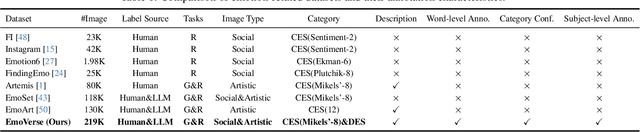
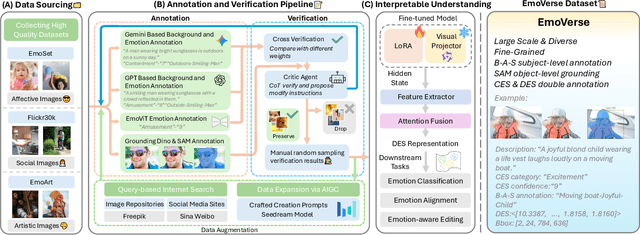
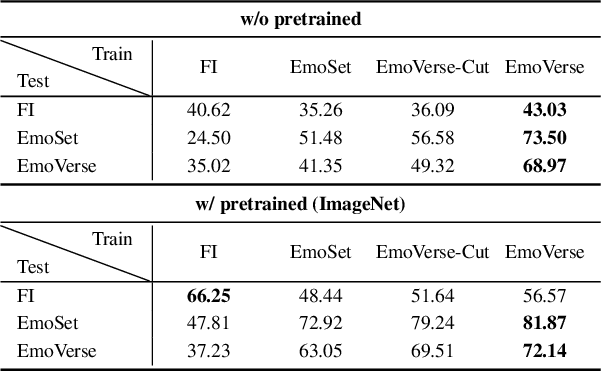
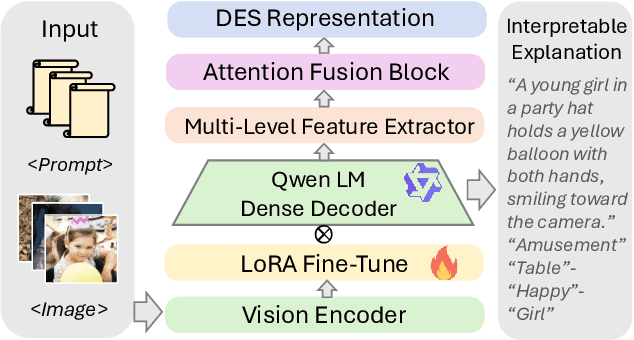
Visual Emotion Analysis (VEA) aims to bridge the affective gap between visual content and human emotional responses. Despite its promise, progress in this field remains limited by the lack of open-source and interpretable datasets. Most existing studies assign a single discrete emotion label to an entire image, offering limited insight into how visual elements contribute to emotion. In this work, we introduce EmoVerse, a large-scale open-source dataset that enables interpretable visual emotion analysis through multi-layered, knowledge-graph-inspired annotations. By decomposing emotions into Background-Attribute-Subject (B-A-S) triplets and grounding each element to visual regions, EmoVerse provides word-level and subject-level emotional reasoning. With over 219k images, the dataset further includes dual annotations in Categorical Emotion States (CES) and Dimensional Emotion Space (DES), facilitating unified discrete and continuous emotion representation. A novel multi-stage pipeline ensures high annotation reliability with minimal human effort. Finally, we introduce an interpretable model that maps visual cues into DES representations and provides detailed attribution explanations. Together, the dataset, pipeline, and model form a comprehensive foundation for advancing explainable high-level emotion understanding.
CreatiPoster: Towards Editable and Controllable Multi-Layer Graphic Design Generation
Jun 12, 2025Graphic design plays a crucial role in both commercial and personal contexts, yet creating high-quality, editable, and aesthetically pleasing graphic compositions remains a time-consuming and skill-intensive task, especially for beginners. Current AI tools automate parts of the workflow, but struggle to accurately incorporate user-supplied assets, maintain editability, and achieve professional visual appeal. Commercial systems, like Canva Magic Design, rely on vast template libraries, which are impractical for replicate. In this paper, we introduce CreatiPoster, a framework that generates editable, multi-layer compositions from optional natural-language instructions or assets. A protocol model, an RGBA large multimodal model, first produces a JSON specification detailing every layer (text or asset) with precise layout, hierarchy, content and style, plus a concise background prompt. A conditional background model then synthesizes a coherent background conditioned on this rendered foreground layers. We construct a benchmark with automated metrics for graphic-design generation and show that CreatiPoster surpasses leading open-source approaches and proprietary commercial systems. To catalyze further research, we release a copyright-free corpus of 100,000 multi-layer designs. CreatiPoster supports diverse applications such as canvas editing, text overlay, responsive resizing, multilingual adaptation, and animated posters, advancing the democratization of AI-assisted graphic design. Project homepage: https://github.com/graphic-design-ai/creatiposter
CreatiDesign: A Unified Multi-Conditional Diffusion Transformer for Creative Graphic Design
May 25, 2025Graphic design plays a vital role in visual communication across advertising, marketing, and multimedia entertainment. Prior work has explored automated graphic design generation using diffusion models, aiming to streamline creative workflows and democratize design capabilities. However, complex graphic design scenarios require accurately adhering to design intent specified by multiple heterogeneous user-provided elements (\eg images, layouts, and texts), which pose multi-condition control challenges for existing methods. Specifically, previous single-condition control models demonstrate effectiveness only within their specialized domains but fail to generalize to other conditions, while existing multi-condition methods often lack fine-grained control over each sub-condition and compromise overall compositional harmony. To address these limitations, we introduce CreatiDesign, a systematic solution for automated graphic design covering both model architecture and dataset construction. First, we design a unified multi-condition driven architecture that enables flexible and precise integration of heterogeneous design elements with minimal architectural modifications to the base diffusion model. Furthermore, to ensure that each condition precisely controls its designated image region and to avoid interference between conditions, we propose a multimodal attention mask mechanism. Additionally, we develop a fully automated pipeline for constructing graphic design datasets, and introduce a new dataset with 400K samples featuring multi-condition annotations, along with a comprehensive benchmark. Experimental results show that CreatiDesign outperforms existing models by a clear margin in faithfully adhering to user intent.
CreatiLayout: Siamese Multimodal Diffusion Transformer for Creative Layout-to-Image Generation
Dec 05, 2024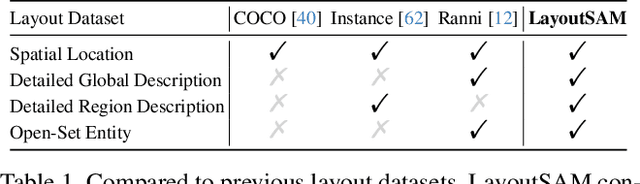

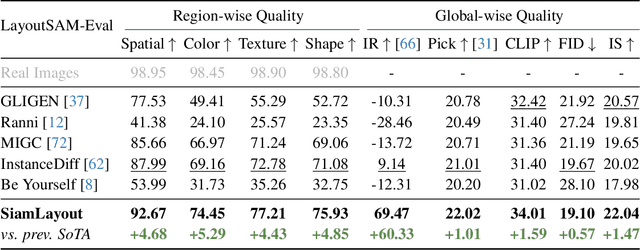

Diffusion models have been recognized for their ability to generate images that are not only visually appealing but also of high artistic quality. As a result, Layout-to-Image (L2I) generation has been proposed to leverage region-specific positions and descriptions to enable more precise and controllable generation. However, previous methods primarily focus on UNet-based models (e.g., SD1.5 and SDXL), and limited effort has explored Multimodal Diffusion Transformers (MM-DiTs), which have demonstrated powerful image generation capabilities. Enabling MM-DiT for layout-to-image generation seems straightforward but is challenging due to the complexity of how layout is introduced, integrated, and balanced among multiple modalities. To this end, we explore various network variants to efficiently incorporate layout guidance into MM-DiT, and ultimately present SiamLayout. To Inherit the advantages of MM-DiT, we use a separate set of network weights to process the layout, treating it as equally important as the image and text modalities. Meanwhile, to alleviate the competition among modalities, we decouple the image-layout interaction into a siamese branch alongside the image-text one and fuse them in the later stage. Moreover, we contribute a large-scale layout dataset, named LayoutSAM, which includes 2.7 million image-text pairs and 10.7 million entities. Each entity is annotated with a bounding box and a detailed description. We further construct the LayoutSAM-Eval benchmark as a comprehensive tool for evaluating the L2I generation quality. Finally, we introduce the Layout Designer, which taps into the potential of large language models in layout planning, transforming them into experts in layout generation and optimization. Our code, model, and dataset will be available at https://creatilayout.github.io.
Multi-Attention Network for Compressed Video Referring Object Segmentation
Jul 26, 2022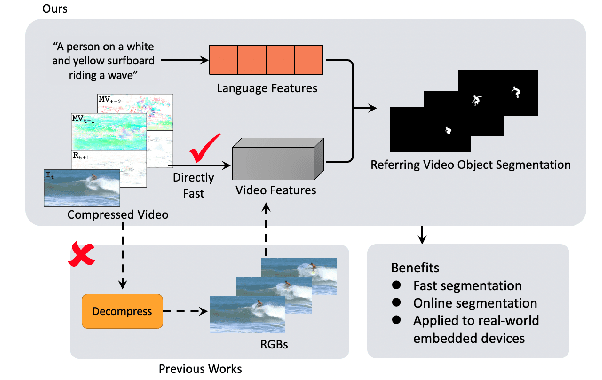
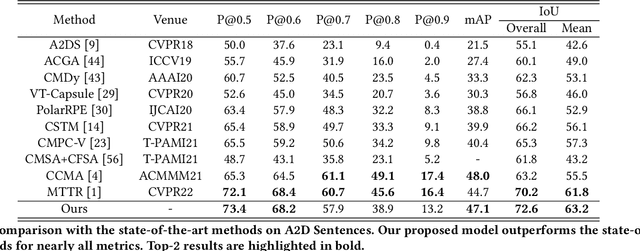
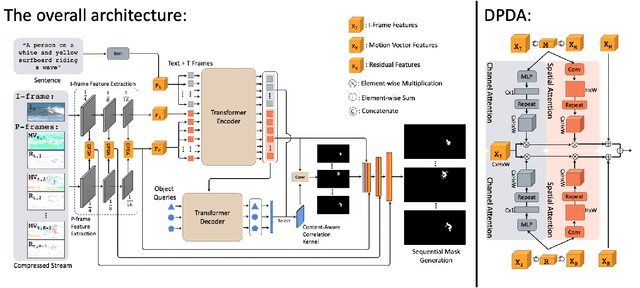
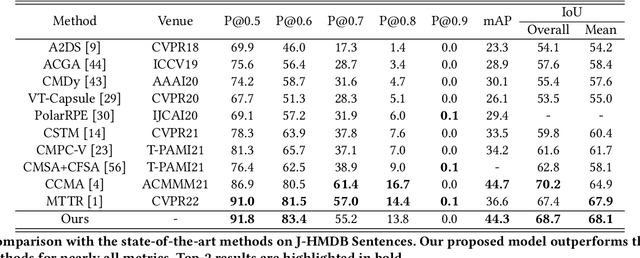
Referring video object segmentation aims to segment the object referred by a given language expression. Existing works typically require compressed video bitstream to be decoded to RGB frames before being segmented, which increases computation and storage requirements and ultimately slows the inference down. This may hamper its application in real-world computing resource limited scenarios, such as autonomous cars and drones. To alleviate this problem, in this paper, we explore the referring object segmentation task on compressed videos, namely on the original video data flow. Besides the inherent difficulty of the video referring object segmentation task itself, obtaining discriminative representation from compressed video is also rather challenging. To address this problem, we propose a multi-attention network which consists of dual-path dual-attention module and a query-based cross-modal Transformer module. Specifically, the dual-path dual-attention module is designed to extract effective representation from compressed data in three modalities, i.e., I-frame, Motion Vector and Residual. The query-based cross-modal Transformer firstly models the correlation between linguistic and visual modalities, and then the fused multi-modality features are used to guide object queries to generate a content-aware dynamic kernel and to predict final segmentation masks. Different from previous works, we propose to learn just one kernel, which thus removes the complicated post mask-matching procedure of existing methods. Extensive promising experimental results on three challenging datasets show the effectiveness of our method compared against several state-of-the-art methods which are proposed for processing RGB data. Source code is available at: https://github.com/DexiangHong/MANet.
SC-Transformer++: Structured Context Transformer for Generic Event Boundary Detection
Jun 25, 2022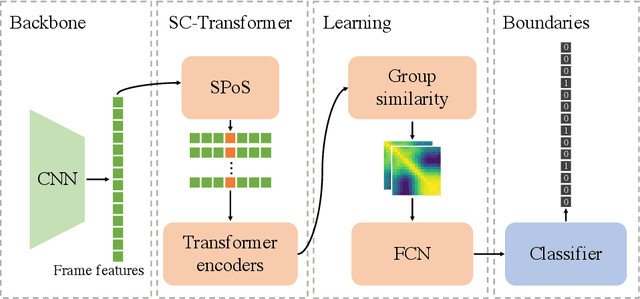
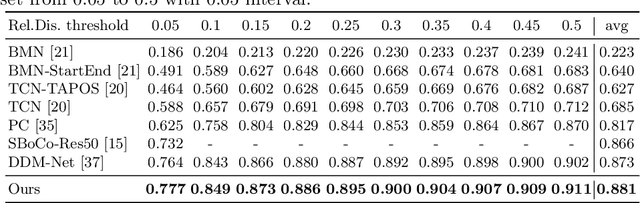
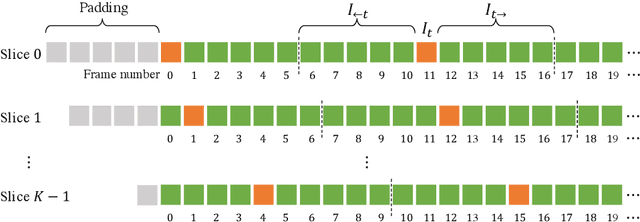
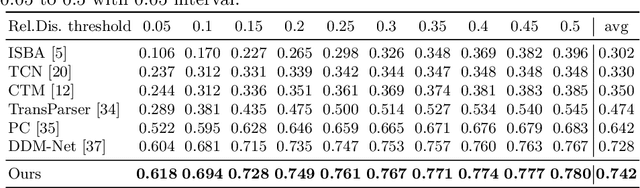
This report presents the algorithm used in the submission of Generic Event Boundary Detection (GEBD) Challenge at CVPR 2022. In this work, we improve the existing Structured Context Transformer (SC-Transformer) method for GEBD. Specifically, a transformer decoder module is added after transformer encoders to extract high quality frame features. The final classification is performed jointly on the results of the original binary classifier and a newly introduced multi-class classifier branch. To enrich motion information, optical flow is introduced as a new modality. Finally, model ensemble is used to further boost performance. The proposed method achieves 86.49% F1 score on Kinetics-GEBD test set. which improves 2.86% F1 score compared to the previous SOTA method.