 Add to Chrome
 Add to Firefox
 Add to Edge
Towards Context-Invariant Safety Alignment for Large Language Models
May 20, 2026
Preference-based post-training aligns LLMs with human intent, yet safety behavior often remains brittle. A model may refuse a harmful request in a standard prompt but comply when the same intent is wrapped in adversarial wording. We suggest that robust safety requires context-invariant alignment, where behavior depends on the underlying intent rather than surface form. Enforcing invariance is difficult in alignment because not all training signals are equally trustworthy; for some prompt variants we can obtain verifiable feedback (e.g., multiple-choice), while for open-ended variants we typically rely on noisy, gameable reward proxies (e.g., learned judges). As a result, standard symmetric invariance regularizers can reduce cross-context discrepancies by lowering performance on reliable variants instead of improving open-ended robustness. To address this, we introduce Anchor Invariance Regularization (AIR), which treats verifiable prompts as anchors and uses a stop-gradient target to regularize only the open-ended variants toward the anchor performance. AIR is implemented as a plug-in auxiliary loss and combined with group-based preference optimization (e.g., GRPO) via heterogeneous prompt grouping. Across Safety, Moral Reasoning, and Math, AIR improves context invariance, boosting in-distribution group accuracy by 12.71% and out-of-distribution consistency by 33.49%, making safety constraints robust to adversarial framings.

Safactory: A Scalable Agent Factory for Trustworthy Autonomous Intelligence
May 07, 2026As large models evolve from conversational assistants into autonomous agents, challenges increasingly arise from long-horizon decision making, tool use, and real environment interaction. Existing agenticinfrastructure remain fragmented across evaluation, data management, and agent evolution, making it difficult to discover risks systematically and improve models in a continuous closed loop. In this report, we present \textbf{Safactory}, a scalable agent factory for trustworthy autonomous intelligence. Safactory integrates three tightly coupled platforms: a \textbf{Parallel Simulation Platform} for trajectory generation, a \textbf{Trustworthy Data Platform} for trajectory storage and experience extraction, and an \textbf{Autonomous Evolution Platform} for asynchronous reinforcement learning and on-policy distillation. As far as we know, Safactory is the first framework to propose a unified evolutionary pipeline for next-generation trustworthy autonomous intelligence.
Mechanistic Origin of Moral Indifference in Language Models
Mar 16, 2026Existing behavioral alignment techniques for Large Language Models (LLMs) often neglect the discrepancy between surface compliance and internal unaligned representations, leaving LLMs vulnerable to long-tail risks. More crucially, we posit that LLMs possess an inherent state of moral indifference due to compressing distinct moral concepts into uniform probability distributions. We verify and remedy this indifference in LLMs' latent representations, utilizing 251k moral vectors constructed upon Prototype Theory and the Social-Chemistry-101 dataset. Firstly, our analysis across 23 models reveals that current LLMs fail to represent the distinction between opposed moral categories and fine-grained typicality gradients within these categories; notably, neither model scaling, architecture, nor explicit alignment reshapes this indifference. We then employ Sparse Autoencoders on Qwen3-8B, isolate mono-semantic moral features, and targetedly reconstruct their topological relationships to align with ground-truth moral vectors. This representational alignment naturally improves moral reasoning and granularity, achieving a 75% pairwise win-rate on the independent adversarial Flames benchmark. Finally, we elaborate on the remedial nature of current intervention methods from an experientialist philosophy, arguing that endogenously aligned AI might require a transformation from post-hoc corrections to proactive cultivation.
From Sparse Decisions to Dense Reasoning: A Multi-attribute Trajectory Paradigm for Multimodal Moderation
Jan 28, 2026Safety moderation is pivotal for identifying harmful content. Despite the success of textual safety moderation, its multimodal counterparts remain hindered by a dual sparsity of data and supervision. Conventional reliance on binary labels lead to shortcut learning, which obscures the intrinsic classification boundaries necessary for effective multimodal discrimination. Hence, we propose a novel learning paradigm (UniMod) that transitions from sparse decision-making to dense reasoning traces. By constructing structured trajectories encompassing evidence grounding, modality assessment, risk mapping, policy decision, and response generation, we reformulate monolithic decision tasks into a multi-dimensional boundary learning process. This approach forces the model to ground its decision in explicit safety semantics, preventing the model from converging on superficial shortcuts. To facilitate this paradigm, we develop a multi-head scalar reward model (UniRM). UniRM provides multi-dimensional supervision by assigning attribute-level scores to the response generation stage. Furthermore, we introduce specialized optimization strategies to decouple task-specific parameters and rebalance training dynamics, effectively resolving interference between diverse objectives in multi-task learning. Empirical results show UniMod achieves competitive textual moderation performance and sets a new multimodal benchmark using less than 40\% of the training data used by leading baselines. Ablations further validate our multi-attribute trajectory reasoning, offering an effective and efficient framework for multimodal moderation. Supplementary materials are available at \href{https://trustworthylab.github.io/UniMod/}{project website}.
OpenRT: An Open-Source Red Teaming Framework for Multimodal LLMs
Jan 04, 2026The rapid integration of Multimodal Large Language Models (MLLMs) into critical applications is increasingly hindered by persistent safety vulnerabilities. However, existing red-teaming benchmarks are often fragmented, limited to single-turn text interactions, and lack the scalability required for systematic evaluation. To address this, we introduce OpenRT, a unified, modular, and high-throughput red-teaming framework designed for comprehensive MLLM safety evaluation. At its core, OpenRT architects a paradigm shift in automated red-teaming by introducing an adversarial kernel that enables modular separation across five critical dimensions: model integration, dataset management, attack strategies, judging methods, and evaluation metrics. By standardizing attack interfaces, it decouples adversarial logic from a high-throughput asynchronous runtime, enabling systematic scaling across diverse models. Our framework integrates 37 diverse attack methodologies, spanning white-box gradients, multi-modal perturbations, and sophisticated multi-agent evolutionary strategies. Through an extensive empirical study on 20 advanced models (including GPT-5.2, Claude 4.5, and Gemini 3 Pro), we expose critical safety gaps: even frontier models fail to generalize across attack paradigms, with leading models exhibiting average Attack Success Rates as high as 49.14%. Notably, our findings reveal that reasoning models do not inherently possess superior robustness against complex, multi-turn jailbreaks. By open-sourcing OpenRT, we provide a sustainable, extensible, and continuously maintained infrastructure that accelerates the development and standardization of AI safety.
UniMark: Artificial Intelligence Generated Content Identification Toolkit
Dec 13, 2025The rapid proliferation of Artificial Intelligence Generated Content has precipitated a crisis of trust and urgent regulatory demands. However, existing identification tools suffer from fragmentation and a lack of support for visible compliance marking. To address these gaps, we introduce the \textbf{UniMark}, an open-source, unified framework for multimodal content governance. Our system features a modular unified engine that abstracts complexities across text, image, audio, and video modalities. Crucially, we propose a novel dual-operation strategy, natively supporting both \emph{Hidden Watermarking} for copyright protection and \emph{Visible Marking} for regulatory compliance. Furthermore, we establish a standardized evaluation framework with three specialized benchmarks (Image/Video/Audio-Bench) to ensure rigorous performance assessment. This toolkit bridges the gap between advanced algorithms and engineering implementation, fostering a more transparent and secure digital ecosystem.
Evolve the Method, Not the Prompts: Evolutionary Synthesis of Jailbreak Attacks on LLMs
Nov 16, 2025Automated red teaming frameworks for Large Language Models (LLMs) have become increasingly sophisticated, yet they share a fundamental limitation: their jailbreak logic is confined to selecting, combining, or refining pre-existing attack strategies. This binds their creativity and leaves them unable to autonomously invent entirely new attack mechanisms. To overcome this gap, we introduce \textbf{EvoSynth}, an autonomous framework that shifts the paradigm from attack planning to the evolutionary synthesis of jailbreak methods. Instead of refining prompts, EvoSynth employs a multi-agent system to autonomously engineer, evolve, and execute novel, code-based attack algorithms. Crucially, it features a code-level self-correction loop, allowing it to iteratively rewrite its own attack logic in response to failure. Through extensive experiments, we demonstrate that EvoSynth not only establishes a new state-of-the-art by achieving an 85.5\% Attack Success Rate (ASR) against highly robust models like Claude-Sonnet-4.5, but also generates attacks that are significantly more diverse than those from existing methods. We release our framework to facilitate future research in this new direction of evolutionary synthesis of jailbreak methods. Code is available at: https://github.com/dongdongunique/EvoSynth.
Beyond Correctness: Confidence-Aware Reward Modeling for Enhancing Large Language Model Reasoning
Nov 09, 2025Recent advancements in large language models (LLMs) have shifted the post-training paradigm from traditional instruction tuning and human preference alignment toward reinforcement learning (RL) focused on reasoning capabilities. However, numerous technical reports indicate that purely rule-based reward RL frequently results in poor-quality reasoning chains or inconsistencies between reasoning processes and final answers, particularly when the base model is of smaller scale. During the RL exploration process, models might employ low-quality reasoning chains due to the lack of knowledge, occasionally producing correct answers randomly and receiving rewards based on established rule-based judges. This constrains the potential for resource-limited organizations to conduct direct reinforcement learning training on smaller-scale models. We propose a novel confidence-based reward model tailored for enhancing STEM reasoning capabilities. Unlike conventional approaches, our model penalizes not only incorrect answers but also low-confidence correct responses, thereby promoting more robust and logically consistent reasoning. We validate the effectiveness of our approach through static evaluations, Best-of-N inference tests, and PPO-based RL training. Our method outperforms several state-of-the-art open-source reward models across diverse STEM benchmarks. We release our codes and model in https://github.com/qianxiHe147/C2RM.
A Rigorous Benchmark with Multidimensional Evaluation for Deep Research Agents: From Answers to Reports
Oct 02, 2025Artificial intelligence is undergoing the paradigm shift from closed language models to interconnected agent systems capable of external perception and information integration. As a representative embodiment, Deep Research Agents (DRAs) systematically exhibit the capabilities for task decomposition, cross-source retrieval, multi-stage reasoning, and structured output, which markedly enhance performance on complex and open-ended tasks. However, existing benchmarks remain deficient in evaluation dimensions, response formatting, and scoring mechanisms, limiting their capacity to assess such systems effectively. This paper introduces a rigorous benchmark and a multidimensional evaluation framework tailored to DRAs and report-style responses. The benchmark comprises 214 expert-curated challenging queries distributed across 10 broad thematic domains, each accompanied by manually constructed reference bundles to support composite evaluation. The framework enables comprehensive evaluation of long-form reports generated by DRAs, incorporating integrated scoring metrics for semantic quality, topical focus, and retrieval trustworthiness. Extensive experimentation confirms the superior performance of mainstream DRAs over web-search-tool-augmented reasoning models, yet reveals considerable scope for further improvement. This study provides a robust foundation for capability assessment, architectural refinement, and paradigm advancement in DRA systems.
SafeWork-R1: Coevolving Safety and Intelligence under the AI-45$^{\circ}$ Law
Jul 24, 2025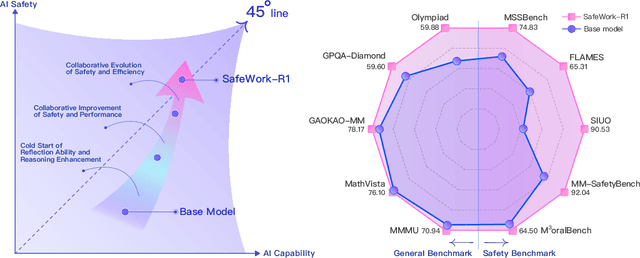
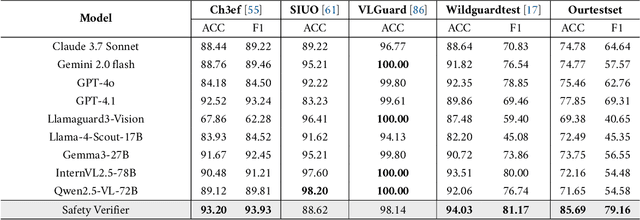
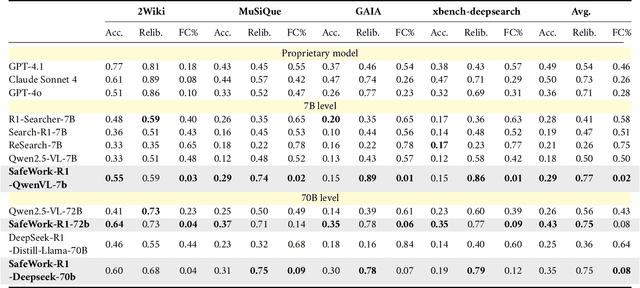
We introduce SafeWork-R1, a cutting-edge multimodal reasoning model that demonstrates the coevolution of capabilities and safety. It is developed by our proposed SafeLadder framework, which incorporates large-scale, progressive, safety-oriented reinforcement learning post-training, supported by a suite of multi-principled verifiers. Unlike previous alignment methods such as RLHF that simply learn human preferences, SafeLadder enables SafeWork-R1 to develop intrinsic safety reasoning and self-reflection abilities, giving rise to safety `aha' moments. Notably, SafeWork-R1 achieves an average improvement of $46.54\%$ over its base model Qwen2.5-VL-72B on safety-related benchmarks without compromising general capabilities, and delivers state-of-the-art safety performance compared to leading proprietary models such as GPT-4.1 and Claude Opus 4. To further bolster its reliability, we implement two distinct inference-time intervention methods and a deliberative search mechanism, enforcing step-level verification. Finally, we further develop SafeWork-R1-InternVL3-78B, SafeWork-R1-DeepSeek-70B, and SafeWork-R1-Qwen2.5VL-7B. All resulting models demonstrate that safety and capability can co-evolve synergistically, highlighting the generalizability of our framework in building robust, reliable, and trustworthy general-purpose AI.