 Add to Chrome
 Add to Firefox
 Add to Edge
A Survey of Large Language Model Empowered Agents for Recommendation and Search: Towards Next-Generation Information Retrieval
Mar 07, 2025
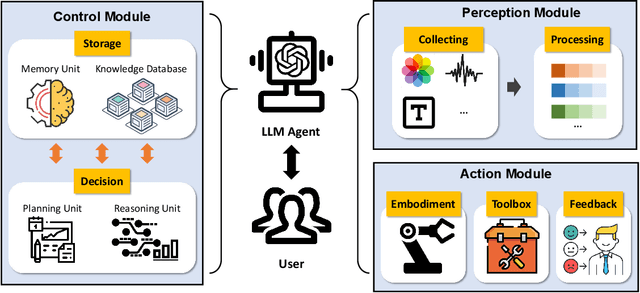
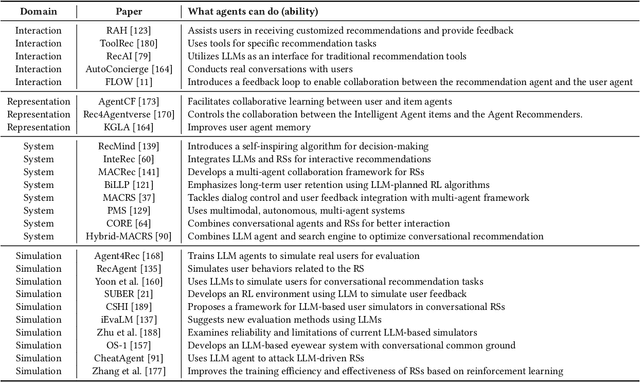
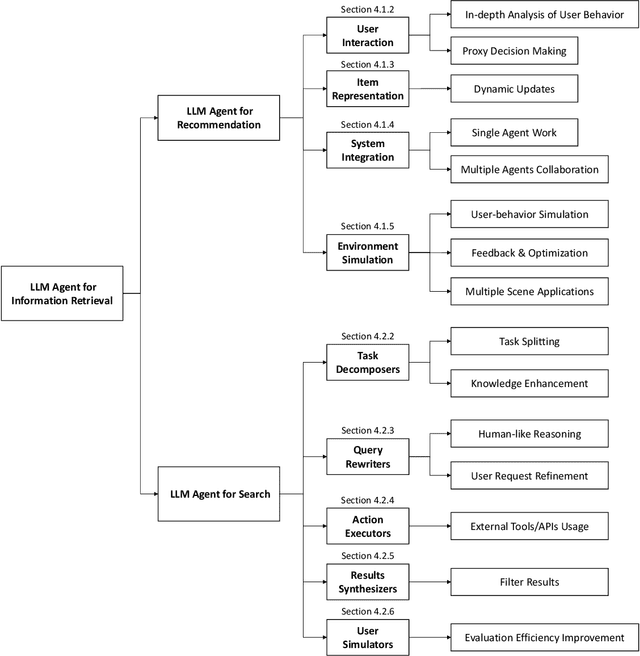
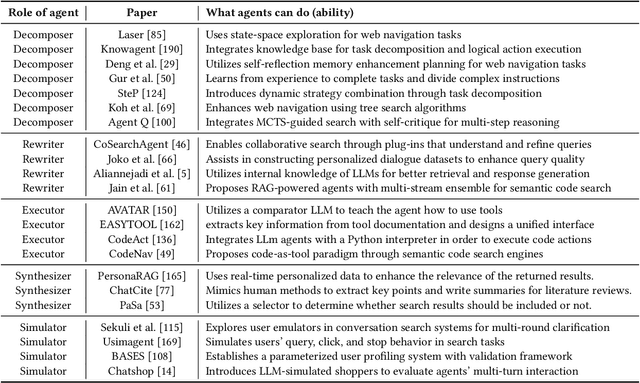
Information technology has profoundly altered the way humans interact with information. The vast amount of content created, shared, and disseminated online has made it increasingly difficult to access relevant information. Over the past two decades, search and recommendation systems (collectively referred to as information retrieval systems) have evolved significantly to address these challenges. Recent advances in large language models (LLMs) have demonstrated capabilities that surpass human performance in various language-related tasks and exhibit general understanding, reasoning, and decision-making abilities. This paper explores the transformative potential of large language model agents in enhancing search and recommendation systems. We discuss the motivations and roles of LLM agents, and establish a classification framework to elaborate on the existing research. We highlight the immense potential of LLM agents in addressing current challenges in search and recommendation, providing insights into future research directions. This paper is the first to systematically review and classify the research on LLM agents in these domains, offering a novel perspective on leveraging this advanced AI technology for information retrieval. To help understand the existing works, we list the existing papers on agent-based simulation with large language models at this link: https://github.com/tsinghua-fib-lab/LLM-Agent-for-Recommendation-and-Search.

Knowledge-Decoupled Synergetic Learning: An MLLM based Collaborative Approach to Few-shot Multimodal Dialogue Intention Recognition
Mar 06, 2025Few-shot multimodal dialogue intention recognition is a critical challenge in the e-commerce domainn. Previous methods have primarily enhanced model classification capabilities through post-training techniques. However, our analysis reveals that training for few-shot multimodal dialogue intention recognition involves two interconnected tasks, leading to a seesaw effect in multi-task learning. This phenomenon is attributed to knowledge interference stemming from the superposition of weight matrix updates during the training process. To address these challenges, we propose Knowledge-Decoupled Synergetic Learning (KDSL), which mitigates these issues by utilizing smaller models to transform knowledge into interpretable rules, while applying the post-training of larger models. By facilitating collaboration between the large and small multimodal large language models for prediction, our approach demonstrates significant improvements. Notably, we achieve outstanding results on two real Taobao datasets, with enhancements of 6.37\% and 6.28\% in online weighted F1 scores compared to the state-of-the-art method, thereby validating the efficacy of our framework.
BHViT: Binarized Hybrid Vision Transformer
Mar 05, 2025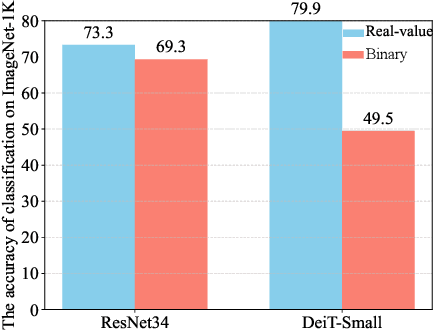
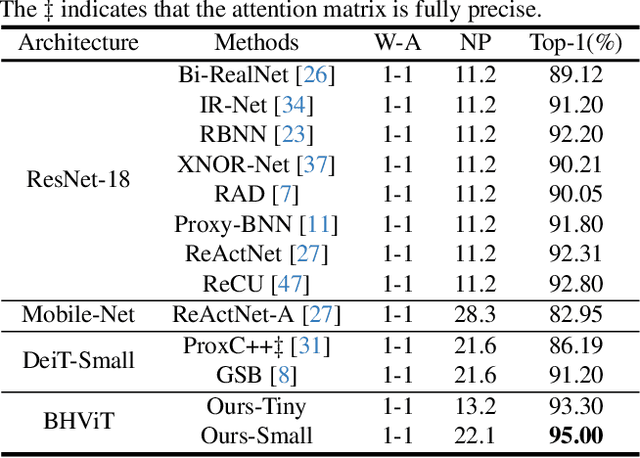
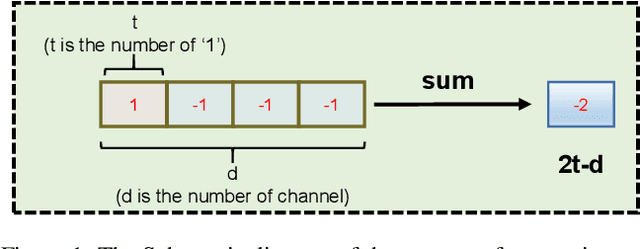
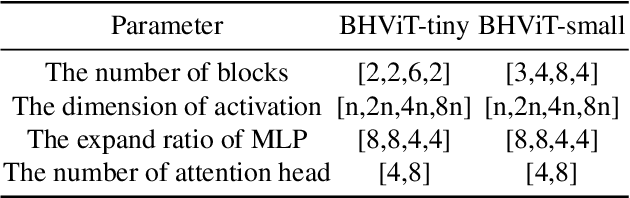
Model binarization has made significant progress in enabling real-time and energy-efficient computation for convolutional neural networks (CNN), offering a potential solution to the deployment challenges faced by Vision Transformers (ViTs) on edge devices. However, due to the structural differences between CNN and Transformer architectures, simply applying binary CNN strategies to the ViT models will lead to a significant performance drop. To tackle this challenge, we propose BHViT, a binarization-friendly hybrid ViT architecture and its full binarization model with the guidance of three important observations. Initially, BHViT utilizes the local information interaction and hierarchical feature aggregation technique from coarse to fine levels to address redundant computations stemming from excessive tokens. Then, a novel module based on shift operations is proposed to enhance the performance of the binary Multilayer Perceptron (MLP) module without significantly increasing computational overhead. In addition, an innovative attention matrix binarization method based on quantization decomposition is proposed to evaluate the token's importance in the binarized attention matrix. Finally, we propose a regularization loss to address the inadequate optimization caused by the incompatibility between the weight oscillation in the binary layers and the Adam Optimizer. Extensive experimental results demonstrate that our proposed algorithm achieves SOTA performance among binary ViT methods.
Efficient Long Sequential Low-rank Adaptive Attention for Click-through rate Prediction
Mar 04, 2025In the context of burgeoning user historical behavior data, Accurate click-through rate(CTR) prediction requires effective modeling of lengthy user behavior sequences. As the volume of such data keeps swelling, the focus of research has shifted towards developing effective long-term behavior modeling methods to capture latent user interests. Nevertheless, the complexity introduced by large scale data brings about computational hurdles. There is a pressing need to strike a balance between achieving high model performance and meeting the strict response time requirements of online services. While existing retrieval-based methods (e.g., similarity filtering or attention approximation) achieve practical runtime efficiency, they inherently compromise information fidelity through aggressive sequence truncation or attention sparsification. This paper presents a novel attention mechanism. It overcomes the shortcomings of existing methods while ensuring computational efficiency. This mechanism learn compressed representation of sequence with length $L$ via low-rank projection matrices (rank $r \ll L$), reducing attention complexity from $O(L)$ to $O(r)$. It also integrates a uniquely designed loss function to preserve nonlinearity of attention. In the inference stage, the mechanism adopts matrix absorption and prestorage strategies. These strategies enable it to effectively satisfy online constraints. Comprehensive offline and online experiments demonstrate that the proposed method outperforms current state-of-the-art solutions.
Discrete Differential Evolution Particle Swarm Optimization Algorithm for Energy Saving Flexible Job Shop Scheduling Problem Considering Machine Multi States
Mar 04, 2025As the continuous deepening of low-carbon emission reduction policies, the manufacturing industries urgently need sensible energy-saving scheduling schemes to achieve the balance between improving production efficiency and reducing energy consumption. In energy-saving scheduling, reasonable machine states-switching is a key point to achieve expected goals, i.e., whether the machines need to switch speed between different operations, and whether the machines need to add extra setup time between different jobs. Regarding this matter, this work proposes a novel machine multi states-based energy saving flexible job scheduling problem (EFJSP-M), which simultaneously takes into account machine multi speeds and setup time. To address the proposed EFJSP-M, a kind of discrete differential evolution particle swarm optimization algorithm (D-DEPSO) is designed. In specific, D-DEPSO includes a hybrid initialization strategy to improve the initial population performance, an updating mechanism embedded with differential evolution operators to enhance population diversity, and a critical path variable neighborhood search strategy to expand the solution space. At last, based on datasets DPs and MKs, the experiment results compared with five state-of-the-art algorithms demonstrate the feasible of EFJSP-M and the superior of D-DEPSO.
Hierarchical Causal Transformer with Heterogeneous Information for Expandable Sequential Recommendation
Mar 04, 2025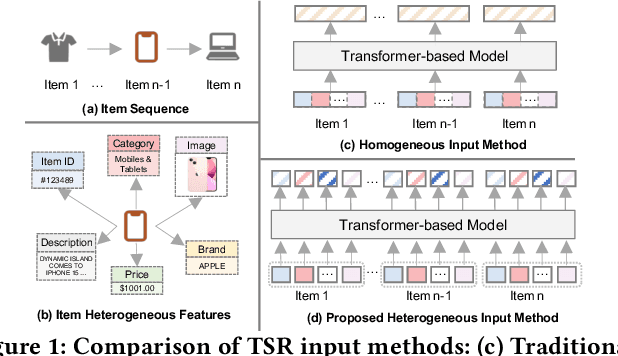
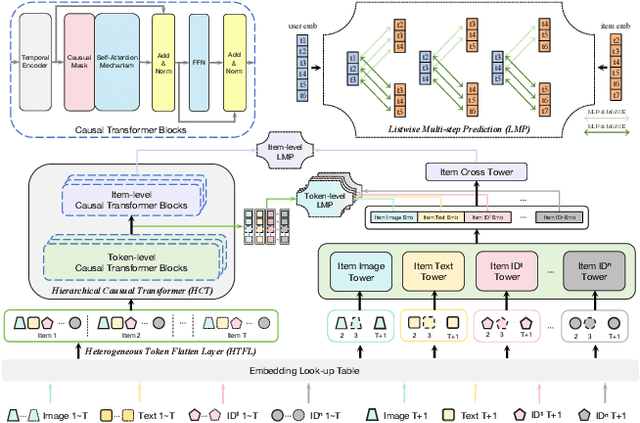
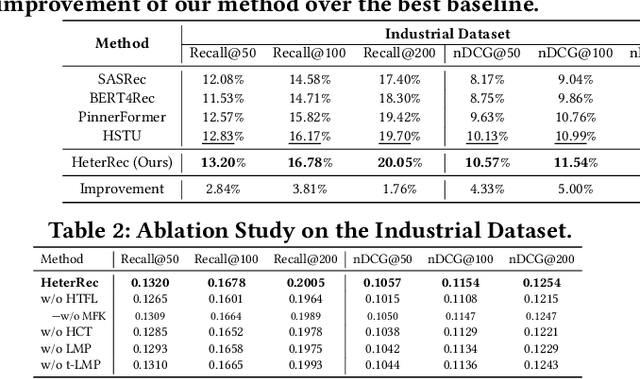
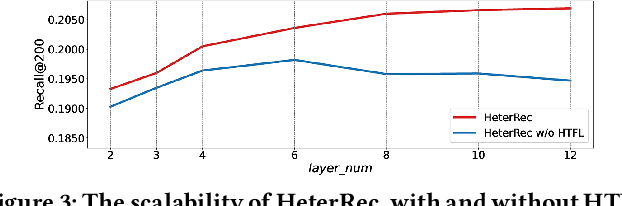
Sequential recommendation systems leveraging transformer architectures have demonstrated exceptional capabilities in capturing user behavior patterns. At the core of these systems lies the critical challenge of constructing effective item representations. Traditional approaches employ feature fusion through simple concatenation or basic neural architectures to create uniform representation sequences. However, these conventional methods fail to address the intrinsic diversity of item attributes, thereby constraining the transformer's capacity to discern fine-grained patterns and hindering model extensibility. Although recent research has begun incorporating user-related heterogeneous features into item sequences, the equally crucial item-side heterogeneous feature continue to be neglected. To bridge this methodological gap, we present HeterRec - an innovative framework featuring two novel components: the Heterogeneous Token Flattening Layer (HTFL) and Hierarchical Causal Transformer (HCT). HTFL pioneers a sophisticated tokenization mechanism that decomposes items into multi-dimensional token sets and structures them into heterogeneous sequences, enabling scalable performance enhancement through model expansion. The HCT architecture further enhances pattern discovery through token-level and item-level attention mechanisms. furthermore, we develop a Listwise Multi-step Prediction (LMP) objective function to optimize learning process. Rigorous validation, including real-world industrial platforms, confirms HeterRec's state-of-the-art performance in both effective and efficiency.
Dynamical Diffusion: Learning Temporal Dynamics with Diffusion Models
Mar 02, 2025Diffusion models have emerged as powerful generative frameworks by progressively adding noise to data through a forward process and then reversing this process to generate realistic samples. While these models have achieved strong performance across various tasks and modalities, their application to temporal predictive learning remains underexplored. Existing approaches treat predictive learning as a conditional generation problem, but often fail to fully exploit the temporal dynamics inherent in the data, leading to challenges in generating temporally coherent sequences. To address this, we introduce Dynamical Diffusion (DyDiff), a theoretically sound framework that incorporates temporally aware forward and reverse processes. Dynamical Diffusion explicitly models temporal transitions at each diffusion step, establishing dependencies on preceding states to better capture temporal dynamics. Through the reparameterization trick, Dynamical Diffusion achieves efficient training and inference similar to any standard diffusion model. Extensive experiments across scientific spatiotemporal forecasting, video prediction, and time series forecasting demonstrate that Dynamical Diffusion consistently improves performance in temporal predictive tasks, filling a crucial gap in existing methodologies. Code is available at this repository: https://github.com/thuml/dynamical-diffusion.
Sparse Alignment Enhanced Latent Diffusion Transformer for Zero-Shot Speech Synthesis
Feb 26, 2025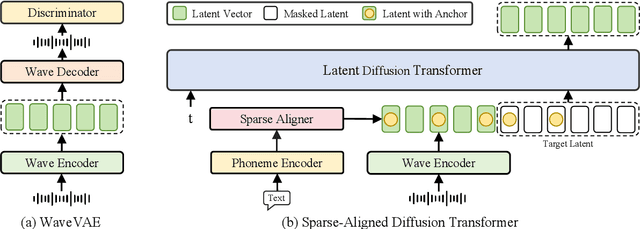
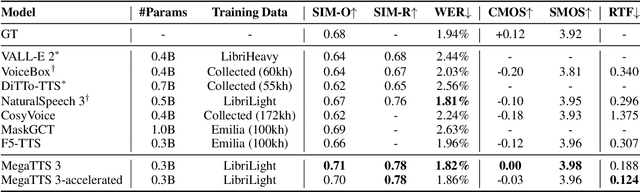
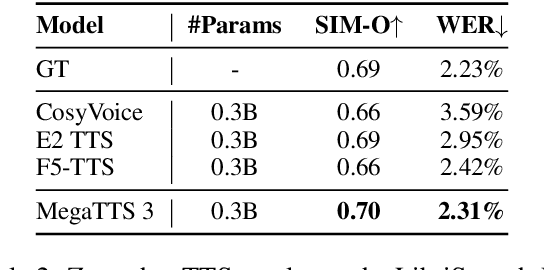
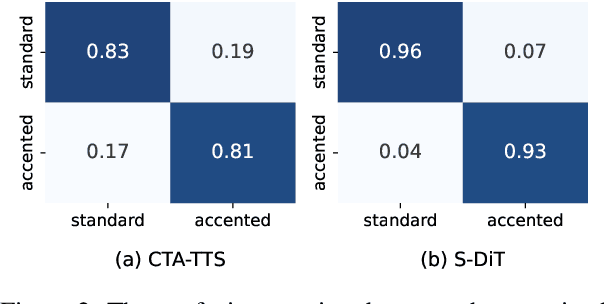
While recent zero-shot text-to-speech (TTS) models have significantly improved speech quality and expressiveness, mainstream systems still suffer from issues related to speech-text alignment modeling: 1) models without explicit speech-text alignment modeling exhibit less robustness, especially for hard sentences in practical applications; 2) predefined alignment-based models suffer from naturalness constraints of forced alignments. This paper introduces \textit{S-DiT}, a TTS system featuring an innovative sparse alignment algorithm that guides the latent diffusion transformer (DiT). Specifically, we provide sparse alignment boundaries to S-DiT to reduce the difficulty of alignment learning without limiting the search space, thereby achieving high naturalness. Moreover, we employ a multi-condition classifier-free guidance strategy for accent intensity adjustment and adopt the piecewise rectified flow technique to accelerate the generation process. Experiments demonstrate that S-DiT achieves state-of-the-art zero-shot TTS speech quality and supports highly flexible control over accent intensity. Notably, our system can generate high-quality one-minute speech with only 8 sampling steps. Audio samples are available at https://sditdemo.github.io/sditdemo/.
ESANS: Effective and Semantic-Aware Negative Sampling for Large-Scale Retrieval Systems
Feb 22, 2025Industrial recommendation systems typically involve a two-stage process: retrieval and ranking, which aims to match users with millions of items. In the retrieval stage, classic embedding-based retrieval (EBR) methods depend on effective negative sampling techniques to enhance both performance and efficiency. However, existing techniques often suffer from false negatives, high cost for ensuring sampling quality and semantic information deficiency. To address these limitations, we propose Effective and Semantic-Aware Negative Sampling (ESANS), which integrates two key components: Effective Dense Interpolation Strategy (EDIS) and Multimodal Semantic-Aware Clustering (MSAC). EDIS generates virtual samples within the low-dimensional embedding space to improve the diversity and density of the sampling distribution while minimizing computational costs. MSAC refines the negative sampling distribution by hierarchically clustering item representations based on multimodal information (visual, textual, behavioral), ensuring semantic consistency and reducing false negatives. Extensive offline and online experiments demonstrate the superior efficiency and performance of ESANS.
Protein Large Language Models: A Comprehensive Survey
Feb 21, 2025Protein-specific large language models (Protein LLMs) are revolutionizing protein science by enabling more efficient protein structure prediction, function annotation, and design. While existing surveys focus on specific aspects or applications, this work provides the first comprehensive overview of Protein LLMs, covering their architectures, training datasets, evaluation metrics, and diverse applications. Through a systematic analysis of over 100 articles, we propose a structured taxonomy of state-of-the-art Protein LLMs, analyze how they leverage large-scale protein sequence data for improved accuracy, and explore their potential in advancing protein engineering and biomedical research. Additionally, we discuss key challenges and future directions, positioning Protein LLMs as essential tools for scientific discovery in protein science. Resources are maintained at https://github.com/Yijia-Xiao/Protein-LLM-Survey.