 Add to Chrome
 Add to Firefox
 Add to Edge
OneSearch-V2: The Latent Reasoning Enhanced Self-distillation Generative Search Framework
Mar 25, 2026
Generative Retrieval (GR) has emerged as a promising paradigm for modern search systems. Compared to multi-stage cascaded architecture, it offers advantages such as end-to-end joint optimization and high computational efficiency. OneSearch, as a representative industrial-scale deployed generative search framework, has brought significant commercial and operational benefits. However, its inadequate understanding of complex queries, inefficient exploitation of latent user intents, and overfitting to narrow historical preferences have limited its further performance improvement. To address these challenges, we propose \textbf{OneSearch-V2}, a latent reasoning enhanced self-distillation generative search framework. It contains three key innovations: (1) a thought-augmented complex query understanding module, which enables deep query understanding and overcomes the shallow semantic matching limitations of direct inference; (2) a reasoning-internalized self-distillation training pipeline, which uncovers users' potential yet precise e-commerce intentions beyond log-fitting through implicit in-context learning; (3) a behavior preference alignment optimization system, which mitigates reward hacking arising from the single conversion metric, and addresses personal preference via direct user feedback. Extensive offline evaluations demonstrate OneSearch-V2's strong query recognition and user profiling capabilities. Online A/B tests further validate its business effectiveness, yielding +3.98\% item CTR, +3.05\% buyer conversion rate, and +2.11\% order volume. Manual evaluation further confirms gains in search experience quality, with +1.65\% in page good rate and +1.37\% in query-item relevance. More importantly, OneSearch-V2 effectively mitigates common search system issues such as information bubbles and long-tail sparsity, without incurring additional inference costs or serving latency.

REST: Receding Horizon Explorative Steiner Tree for Zero-Shot Object-Goal Navigation
Mar 19, 2026Zero-shot object-goal navigation (ZSON) requires navigating unknown environments to find a target object without task-specific training. Prior hierarchical training-free solutions invest in scene understanding (\textit{belief}) and high-level decision-making (\textit{policy}), yet overlook the design of \textit{option}, i.e., a subgoal candidate proposed from evolving belief and presented to policy for selection. In practice, options are reduced to isolated waypoints scored independently: single destinations hide the value gathered along the journey; an unstructured collection obscures the relationships among candidates. Our insight is that the option space should be a \textit{tree of paths}. Full paths expose en-route information gain that destination-only scoring systematically neglects; a tree of shared segments enables coarse-to-fine LLM reasoning that dismisses or pursues entire branches before examining individual leaves, compressing the combinatorial path space into an efficient hierarchy. We instantiate this insight in \textbf{REST} (Receding Horizon Explorative Steiner Tree), a training-free framework that (1) builds an explicit open-vocabulary 3D map from online RGB-D streams; (2) grows an agent-centric tree of safe and informative paths as the option space via sampling-based planning; and (3) textualizes each branch into a spatial narrative and selects the next-best path through chain-of-thought LLM reasoning. Across the Gibson, HM3D, and HSSD benchmarks, REST consistently ranks among the top methods in success rate while achieving the best or second-best path efficiency, demonstrating a favorable efficiency-success balance.
SignNav: Leveraging Signage for Semantic Visual Navigation in Large-Scale Indoor Environments
Mar 17, 2026Humans routinely leverage semantic hints provided by signage to navigate to destinations within novel Large-Scale Indoor (LSI) environments, such as hospitals and airport terminals. However, this capability remains underexplored within the field of embodied navigation. This paper introduces a novel embodied navigation task, SignNav, which requires the agent to interpret semantic hint from signage and reason about the subsequent action based on current observation. To facilitate research in this domain, we construct the LSI-Dataset for the training and evaluation of various SignNav agents. Dynamically changing semantic hints and sparse placement of signage in LSI environments present significant challenges to the SignNav task. To address these challenges, we propose the Spatial-Temporal Aware Transformer (START) model for end-to-end decision-making. The spatial-aware module grounds the semantic hint of signage into physical world, while the temporal-aware module captures long-range dependencies between historical states and current observation. Leveraging a two-stage training strategy with Dataset Aggregation (DAgger), our approach achieves state-of-the-art performance, recording an 80% Success Rate (SR) and 0.74 NDTW on val-unseen split. Real-world deployment further demonstrates the practicality of our method in physical environment without pre-built map.
OneMall: One Architecture, More Scenarios -- End-to-End Generative Recommender Family at Kuaishou E-Commerce
Feb 02, 2026In the wave of generative recommendation, we present OneMall, an end-to-end generative recommendation framework tailored for e-commerce services at Kuaishou. Our OneMall systematically unifies the e-commerce's multiple item distribution scenarios, such as Product-card, short-video and live-streaming. Specifically, it comprises three key components, aligning the entire model training pipeline to the LLM's pre-training/post-training: (1) E-commerce Semantic Tokenizer: we provide a tokenizer solution that captures both real-world semantics and business-specific item relations across different scenarios; (2) Transformer-based Architecture: we largely utilize Transformer as our model backbone, e.g., employing Query-Former for long sequence compression, Cross-Attention for multi-behavior sequence fusion, and Sparse MoE for scalable auto-regressive generation; (3) Reinforcement Learning Pipeline: we further connect retrieval and ranking models via RL, enabling the ranking model to serve as a reward signal for end-to-end policy retrieval model optimization. Extensive experiments demonstrate that OneMall achieves consistent improvements across all e-commerce scenarios: +13.01\% GMV in product-card, +15.32\% Orders in Short-Video, and +2.78\% Orders in Live-Streaming. OneMall has been deployed, serving over 400 million daily active users at Kuaishou.
OneMall: One Model, More Scenarios -- End-to-End Generative Recommender Family at Kuaishou E-Commerce
Jan 29, 2026In the wave of generative recommendation, we present OneMall, an end-to-end generative recommendation framework tailored for e-commerce services at Kuaishou. Our OneMall systematically unifies the e-commerce's multiple item distribution scenarios, such as Product-card, short-video and live-streaming. Specifically, it comprises three key components, aligning the entire model training pipeline to the LLM's pre-training/post-training: (1) E-commerce Semantic Tokenizer: we provide a tokenizer solution that captures both real-world semantics and business-specific item relations across different scenarios; (2) Transformer-based Architecture: we largely utilize Transformer as our model backbone, e.g., employing Query-Former for long sequence compression, Cross-Attention for multi-behavior sequence fusion, and Sparse MoE for scalable auto-regressive generation; (3) Reinforcement Learning Pipeline: we further connect retrieval and ranking models via RL, enabling the ranking model to serve as a reward signal for end-to-end policy retrieval model optimization. Extensive experiments demonstrate that OneMall achieves consistent improvements across all e-commerce scenarios: +13.01\% GMV in product-card, +15.32\% Orders in Short-Video, and +2.78\% Orders in Live-Streaming. OneMall has been deployed, serving over 400 million daily active users at Kuaishou.
Super LiDAR Reflectance for Robotic Perception
Aug 14, 2025Conventionally, human intuition often defines vision as a modality of passive optical sensing, while active optical sensing is typically regarded as measuring rather than the default modality of vision. However, the situation now changes: sensor technologies and data-driven paradigms empower active optical sensing to redefine the boundaries of vision, ushering in a new era of active vision. Light Detection and Ranging (LiDAR) sensors capture reflectance from object surfaces, which remains invariant under varying illumination conditions, showcasing significant potential in robotic perception tasks such as detection, recognition, segmentation, and Simultaneous Localization and Mapping (SLAM). These applications often rely on dense sensing capabilities, typically achieved by high-resolution, expensive LiDAR sensors. A key challenge with low-cost LiDARs lies in the sparsity of scan data, which limits their broader application. To address this limitation, this work introduces an innovative framework for generating dense LiDAR reflectance images from sparse data, leveraging the unique attributes of non-repeating scanning LiDAR (NRS-LiDAR). We tackle critical challenges, including reflectance calibration and the transition from static to dynamic scene domains, facilitating the reconstruction of dense reflectance images in real-world settings. The key contributions of this work include a comprehensive dataset for LiDAR reflectance image densification, a densification network tailored for NRS-LiDAR, and diverse applications such as loop closure and traffic lane detection using the generated dense reflectance images.
High-Fidelity Differential-information Driven Binary Vision Transformer
Jul 03, 2025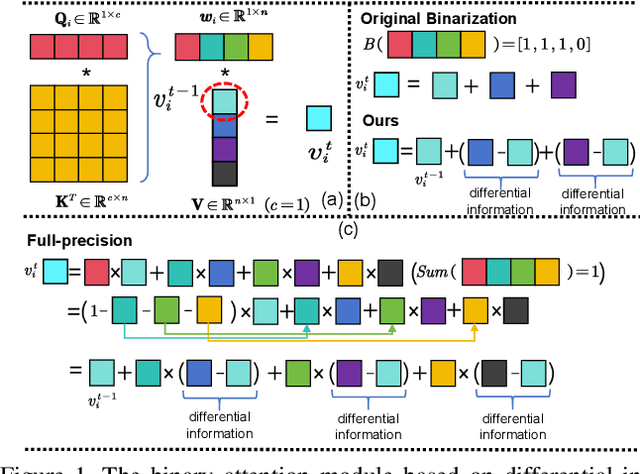
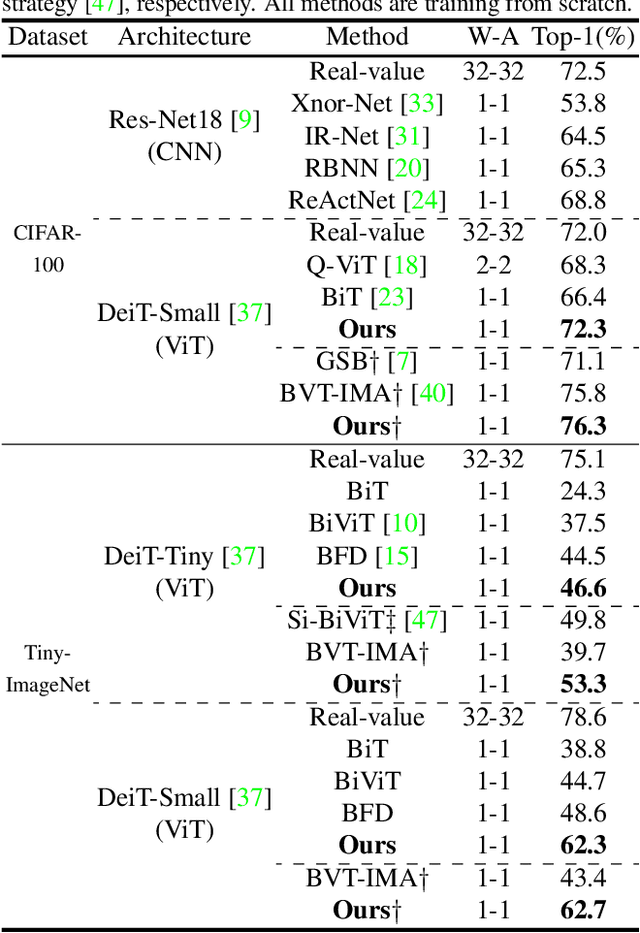
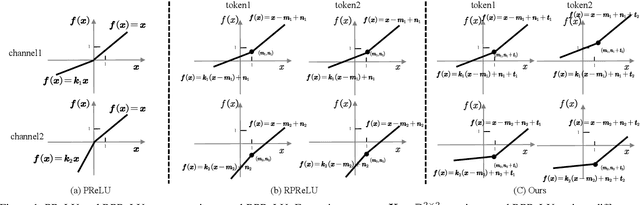
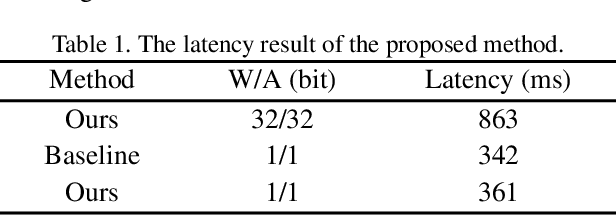
The binarization of vision transformers (ViTs) offers a promising approach to addressing the trade-off between high computational/storage demands and the constraints of edge-device deployment. However, existing binary ViT methods often suffer from severe performance degradation or rely heavily on full-precision modules. To address these issues, we propose DIDB-ViT, a novel binary ViT that is highly informative while maintaining the original ViT architecture and computational efficiency. Specifically, we design an informative attention module incorporating differential information to mitigate information loss caused by binarization and enhance high-frequency retention. To preserve the fidelity of the similarity calculations between binary Q and K tensors, we apply frequency decomposition using the discrete Haar wavelet and integrate similarities across different frequencies. Additionally, we introduce an improved RPReLU activation function to restructure the activation distribution, expanding the model's representational capacity. Experimental results demonstrate that our DIDB-ViT significantly outperforms state-of-the-art network quantization methods in multiple ViT architectures, achieving superior image classification and segmentation performance.
TS-Diff: Two-Stage Diffusion Model for Low-Light RAW Image Enhancement
May 07, 2025This paper presents a novel Two-Stage Diffusion Model (TS-Diff) for enhancing extremely low-light RAW images. In the pre-training stage, TS-Diff synthesizes noisy images by constructing multiple virtual cameras based on a noise space. Camera Feature Integration (CFI) modules are then designed to enable the model to learn generalizable features across diverse virtual cameras. During the aligning stage, CFIs are averaged to create a target-specific CFI$^T$, which is fine-tuned using a small amount of real RAW data to adapt to the noise characteristics of specific cameras. A structural reparameterization technique further simplifies CFI$^T$ for efficient deployment. To address color shifts during the diffusion process, a color corrector is introduced to ensure color consistency by dynamically adjusting global color distributions. Additionally, a novel dataset, QID, is constructed, featuring quantifiable illumination levels and a wide dynamic range, providing a comprehensive benchmark for training and evaluation under extreme low-light conditions. Experimental results demonstrate that TS-Diff achieves state-of-the-art performance on multiple datasets, including QID, SID, and ELD, excelling in denoising, generalization, and color consistency across various cameras and illumination levels. These findings highlight the robustness and versatility of TS-Diff, making it a practical solution for low-light imaging applications. Source codes and models are available at https://github.com/CircccleK/TS-Diff
HDiffTG: A Lightweight Hybrid Diffusion-Transformer-GCN Architecture for 3D Human Pose Estimation
May 07, 2025We propose HDiffTG, a novel 3D Human Pose Estimation (3DHPE) method that integrates Transformer, Graph Convolutional Network (GCN), and diffusion model into a unified framework. HDiffTG leverages the strengths of these techniques to significantly improve pose estimation accuracy and robustness while maintaining a lightweight design. The Transformer captures global spatiotemporal dependencies, the GCN models local skeletal structures, and the diffusion model provides step-by-step optimization for fine-tuning, achieving a complementary balance between global and local features. This integration enhances the model's ability to handle pose estimation under occlusions and in complex scenarios. Furthermore, we introduce lightweight optimizations to the integrated model and refine the objective function design to reduce computational overhead without compromising performance. Evaluation results on the Human3.6M and MPI-INF-3DHP datasets demonstrate that HDiffTG achieves state-of-the-art (SOTA) performance on the MPI-INF-3DHP dataset while excelling in both accuracy and computational efficiency. Additionally, the model exhibits exceptional robustness in noisy and occluded environments. Source codes and models are available at https://github.com/CirceJie/HDiffTG
BHViT: Binarized Hybrid Vision Transformer
Mar 05, 2025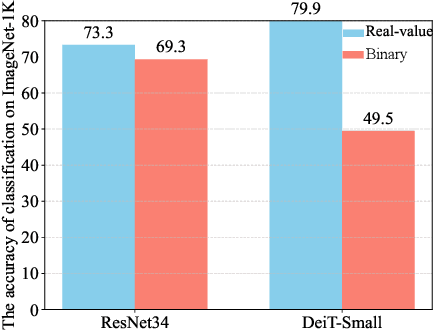
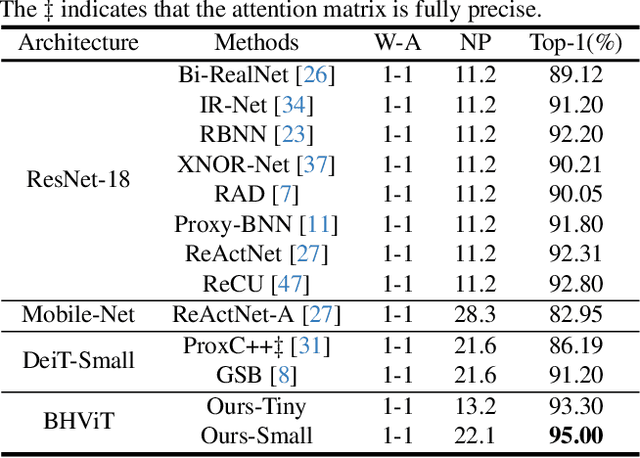
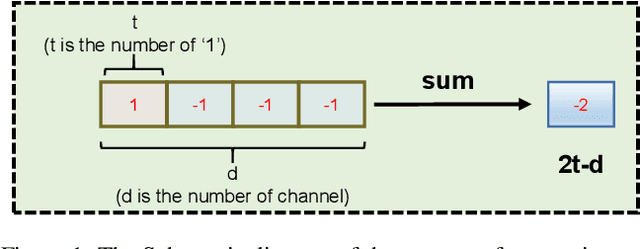
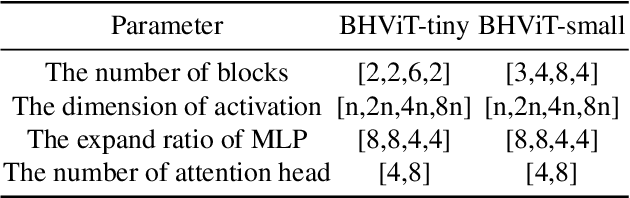
Model binarization has made significant progress in enabling real-time and energy-efficient computation for convolutional neural networks (CNN), offering a potential solution to the deployment challenges faced by Vision Transformers (ViTs) on edge devices. However, due to the structural differences between CNN and Transformer architectures, simply applying binary CNN strategies to the ViT models will lead to a significant performance drop. To tackle this challenge, we propose BHViT, a binarization-friendly hybrid ViT architecture and its full binarization model with the guidance of three important observations. Initially, BHViT utilizes the local information interaction and hierarchical feature aggregation technique from coarse to fine levels to address redundant computations stemming from excessive tokens. Then, a novel module based on shift operations is proposed to enhance the performance of the binary Multilayer Perceptron (MLP) module without significantly increasing computational overhead. In addition, an innovative attention matrix binarization method based on quantization decomposition is proposed to evaluate the token's importance in the binarized attention matrix. Finally, we propose a regularization loss to address the inadequate optimization caused by the incompatibility between the weight oscillation in the binary layers and the Adam Optimizer. Extensive experimental results demonstrate that our proposed algorithm achieves SOTA performance among binary ViT methods.