 Add to Chrome
 Add to Firefox
 Add to Edge
RCLRec: Reverse Curriculum Learning for Modeling Sparse Conversions in Generative Recommendation
Mar 30, 2026
Conversion objectives in large-scale recommender systems are sparse, making them difficult to optimize. Generative recommendation (GR) partially alleviates data sparsity by organizing multi-type behaviors into a unified token sequence with shared representations, but conversion signals remain insufficiently modeled. While recent behavior-aware GR models encode behavior types and employ behavior-aware attention to highlight decision-related intermediate behaviors, they still rely on standard attention over the full history and provide no additional supervision for conversions, leaving conversion sparsity largely unresolved. To address these challenges, we propose RCLRec, a reverse curriculum learning-based GR framework for sparse conversion supervision. For each conversion target, RCLRec constructs a short curriculum by selecting a subsequence of conversion-related items from the history in reverse. Their semantic tokens are fed to the decoder as a prefix, together with the target conversion tokens, under a joint generation objective. This design provides additional instance-specific intermediate supervision, alleviating conversion sparsity and focusing the model on the user's critical decision process. We further introduce a curriculum quality-aware loss to ensure that the selected curricula are informative for conversion prediction. Experiments on offline datasets and an online A/B test show that RCLRec achieves superior performance, with +2.09% advertising revenue and +1.86% orders in online deployment.

Hierarchical Causal Transformer with Heterogeneous Information for Expandable Sequential Recommendation
Mar 04, 2025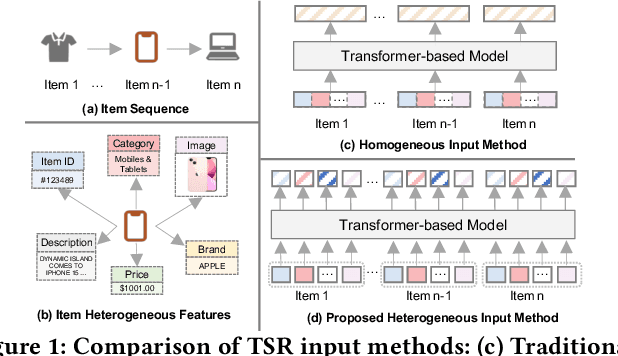
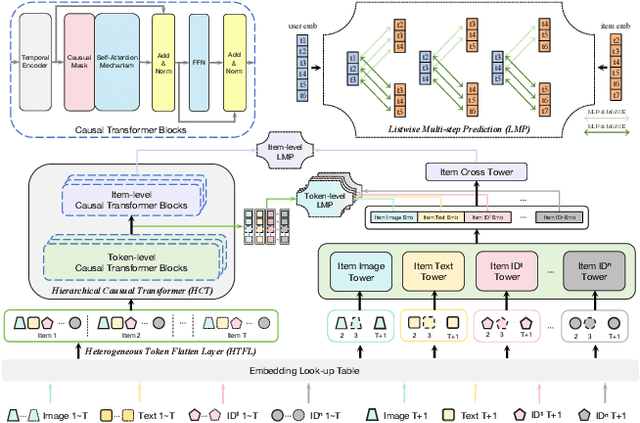
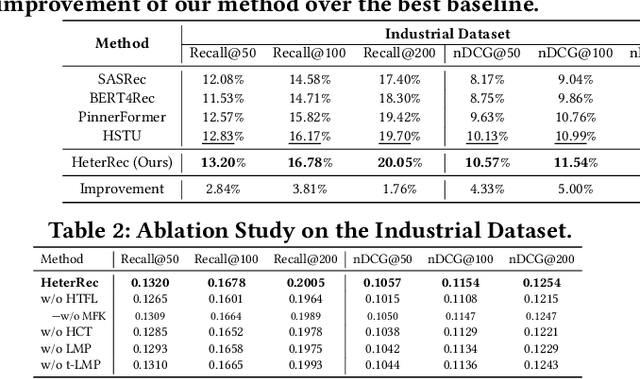
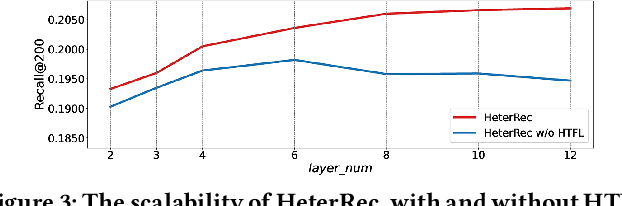
Sequential recommendation systems leveraging transformer architectures have demonstrated exceptional capabilities in capturing user behavior patterns. At the core of these systems lies the critical challenge of constructing effective item representations. Traditional approaches employ feature fusion through simple concatenation or basic neural architectures to create uniform representation sequences. However, these conventional methods fail to address the intrinsic diversity of item attributes, thereby constraining the transformer's capacity to discern fine-grained patterns and hindering model extensibility. Although recent research has begun incorporating user-related heterogeneous features into item sequences, the equally crucial item-side heterogeneous feature continue to be neglected. To bridge this methodological gap, we present HeterRec - an innovative framework featuring two novel components: the Heterogeneous Token Flattening Layer (HTFL) and Hierarchical Causal Transformer (HCT). HTFL pioneers a sophisticated tokenization mechanism that decomposes items into multi-dimensional token sets and structures them into heterogeneous sequences, enabling scalable performance enhancement through model expansion. The HCT architecture further enhances pattern discovery through token-level and item-level attention mechanisms. furthermore, we develop a Listwise Multi-step Prediction (LMP) objective function to optimize learning process. Rigorous validation, including real-world industrial platforms, confirms HeterRec's state-of-the-art performance in both effective and efficiency.