 Add to Chrome
 Add to Firefox
 Add to Edge
Open the Eyes of MPNN: Vision Enhances MPNN in Link Prediction
May 13, 2025
Message-passing graph neural networks (MPNNs) and structural features (SFs) are cornerstones for the link prediction task. However, as a common and intuitive mode of understanding, the potential of visual perception has been overlooked in the MPNN community. For the first time, we equip MPNNs with vision structural awareness by proposing an effective framework called Graph Vision Network (GVN), along with a more efficient variant (E-GVN). Extensive empirical results demonstrate that with the proposed frameworks, GVN consistently benefits from the vision enhancement across seven link prediction datasets, including challenging large-scale graphs. Such improvements are compatible with existing state-of-the-art (SOTA) methods and GVNs achieve new SOTA results, thereby underscoring a promising novel direction for link prediction.

HMPNet: A Feature Aggregation Architecture for Maritime Object Detection from a Shipborne Perspective
May 13, 2025In the realm of intelligent maritime navigation, object detection from a shipborne perspective is paramount. Despite the criticality, the paucity of maritime-specific data impedes the deployment of sophisticated visual perception techniques, akin to those utilized in autonomous vehicular systems, within the maritime context. To bridge this gap, we introduce Navigation12, a novel dataset annotated for 12 object categories under diverse maritime environments and weather conditions. Based upon this dataset, we propose HMPNet, a lightweight architecture tailored for shipborne object detection. HMPNet incorporates a hierarchical dynamic modulation backbone to bolster feature aggregation and expression, complemented by a matrix cascading poly-scale neck and a polymerization weight sharing detector, facilitating efficient multi-scale feature aggregation. Empirical evaluations indicate that HMPNet surpasses current state-of-the-art methods in terms of both accuracy and computational efficiency, realizing a 3.3% improvement in mean Average Precision over YOLOv11n, the prevailing model, and reducing parameters by 23%.
JAEGER: Dual-Level Humanoid Whole-Body Controller
May 10, 2025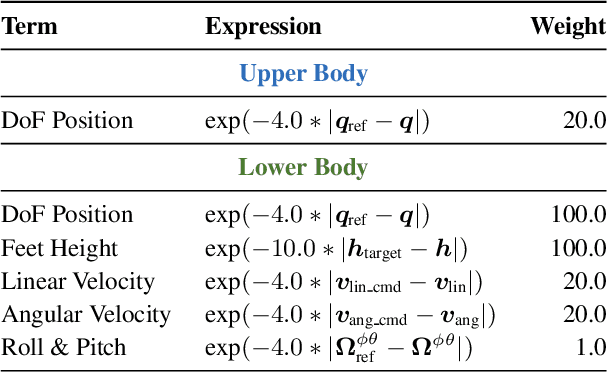
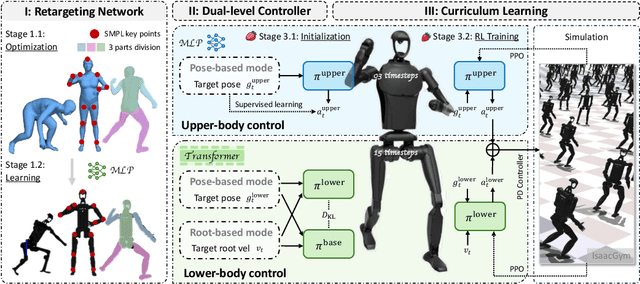
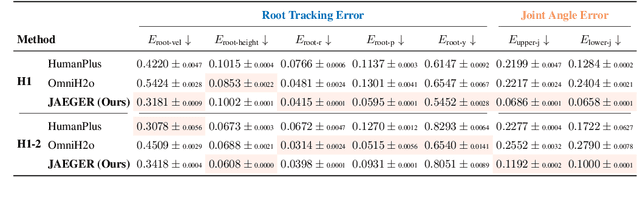
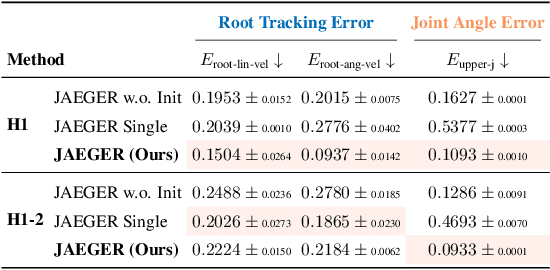
This paper presents JAEGER, a dual-level whole-body controller for humanoid robots that addresses the challenges of training a more robust and versatile policy. Unlike traditional single-controller approaches, JAEGER separates the control of the upper and lower bodies into two independent controllers, so that they can better focus on their distinct tasks. This separation alleviates the dimensionality curse and improves fault tolerance. JAEGER supports both root velocity tracking (coarse-grained control) and local joint angle tracking (fine-grained control), enabling versatile and stable movements. To train the controller, we utilize a human motion dataset (AMASS), retargeting human poses to humanoid poses through an efficient retargeting network, and employ a curriculum learning approach. This method performs supervised learning for initialization, followed by reinforcement learning for further exploration. We conduct our experiments on two humanoid platforms and demonstrate the superiority of our approach against state-of-the-art methods in both simulation and real environments.
RM-R1: Reward Modeling as Reasoning
May 05, 2025Reward modeling is essential for aligning large language models (LLMs) with human preferences, especially through reinforcement learning from human feedback (RLHF). To provide accurate reward signals, a reward model (RM) should stimulate deep thinking and conduct interpretable reasoning before assigning a score or a judgment. However, existing RMs either produce opaque scalar scores or directly generate the prediction of a preferred answer, making them struggle to integrate natural language critiques, thus lacking interpretability. Inspired by recent advances of long chain-of-thought (CoT) on reasoning-intensive tasks, we hypothesize and validate that integrating reasoning capabilities into reward modeling significantly enhances RM's interpretability and performance. In this work, we introduce a new class of generative reward models -- Reasoning Reward Models (ReasRMs) -- which formulate reward modeling as a reasoning task. We propose a reasoning-oriented training pipeline and train a family of ReasRMs, RM-R1. The training consists of two key stages: (1) distillation of high-quality reasoning chains and (2) reinforcement learning with verifiable rewards. RM-R1 improves LLM rollouts by self-generating reasoning traces or chat-specific rubrics and evaluating candidate responses against them. Empirically, our models achieve state-of-the-art or near state-of-the-art performance of generative RMs across multiple comprehensive reward model benchmarks, outperforming much larger open-weight models (e.g., Llama3.1-405B) and proprietary ones (e.g., GPT-4o) by up to 13.8%. Beyond final performance, we perform thorough empirical analysis to understand the key ingredients of successful ReasRM training. To facilitate future research, we release six ReasRM models along with code and data at https://github.com/RM-R1-UIUC/RM-R1.
Leveraging Pretrained Diffusion Models for Zero-Shot Part Assembly
May 01, 20253D part assembly aims to understand part relationships and predict their 6-DoF poses to construct realistic 3D shapes, addressing the growing demand for autonomous assembly, which is crucial for robots. Existing methods mainly estimate the transformation of each part by training neural networks under supervision, which requires a substantial quantity of manually labeled data. However, the high cost of data collection and the immense variability of real-world shapes and parts make traditional methods impractical for large-scale applications. In this paper, we propose first a zero-shot part assembly method that utilizes pre-trained point cloud diffusion models as discriminators in the assembly process, guiding the manipulation of parts to form realistic shapes. Specifically, we theoretically demonstrate that utilizing a diffusion model for zero-shot part assembly can be transformed into an Iterative Closest Point (ICP) process. Then, we propose a novel pushing-away strategy to address the overlap parts, thereby further enhancing the robustness of the method. To verify our work, we conduct extensive experiments and quantitative comparisons to several strong baseline methods, demonstrating the effectiveness of the proposed approach, which even surpasses the supervised learning method. The code has been released on https://github.com/Ruiyuan-Zhang/Zero-Shot-Assembly.
* 10 pages, 12 figures, Accepted by IJCAI-2025
CAE-DFKD: Bridging the Transferability Gap in Data-Free Knowledge Distillation
Apr 30, 2025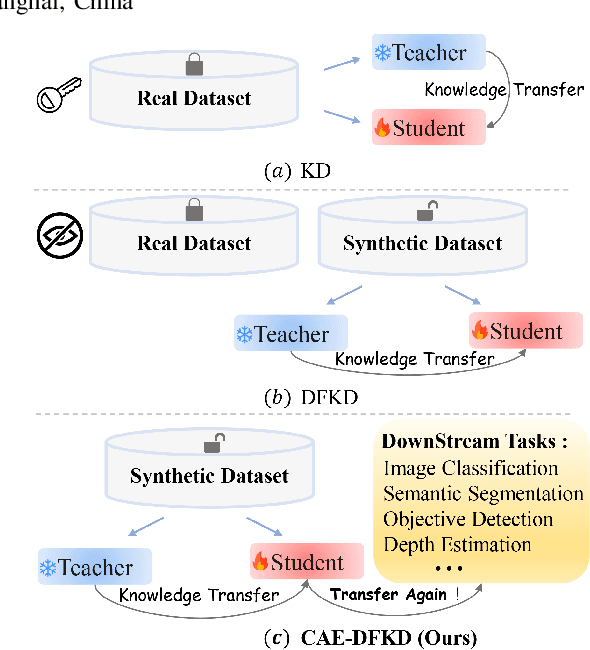

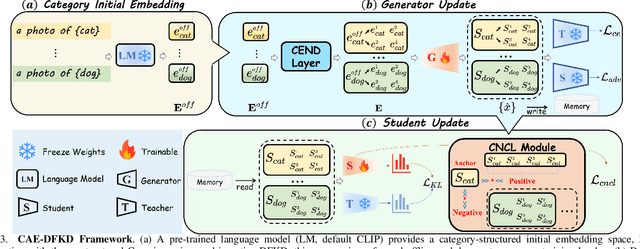
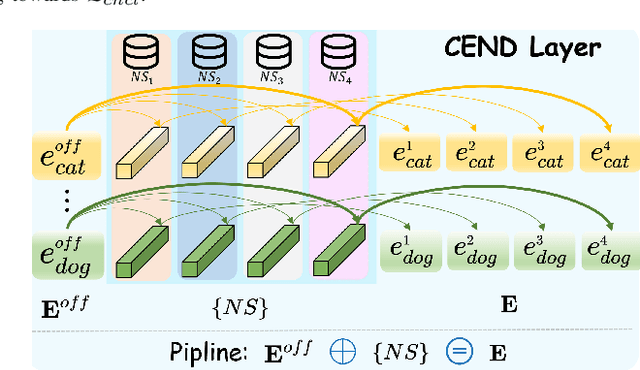
Data-Free Knowledge Distillation (DFKD) enables the knowledge transfer from the given pre-trained teacher network to the target student model without access to the real training data. Existing DFKD methods focus primarily on improving image recognition performance on associated datasets, often neglecting the crucial aspect of the transferability of learned representations. In this paper, we propose Category-Aware Embedding Data-Free Knowledge Distillation (CAE-DFKD), which addresses at the embedding level the limitations of previous rely on image-level methods to improve model generalization but fail when directly applied to DFKD. The superiority and flexibility of CAE-DFKD are extensively evaluated, including: \textit{\textbf{i.)}} Significant efficiency advantages resulting from altering the generator training paradigm; \textit{\textbf{ii.)}} Competitive performance with existing DFKD state-of-the-art methods on image recognition tasks; \textit{\textbf{iii.)}} Remarkable transferability of data-free learned representations demonstrated in downstream tasks.
Nexus-Gen: A Unified Model for Image Understanding, Generation, and Editing
Apr 30, 2025Unified multimodal large language models (MLLMs) aim to integrate multimodal understanding and generation abilities through a single framework. Despite their versatility, existing open-source unified models exhibit performance gaps against domain-specific architectures. To bridge this gap, we present Nexus-Gen, a unified model that synergizes the language reasoning capabilities of LLMs with the image synthesis power of diffusion models. To align the embedding space of the LLM and diffusion model, we conduct a dual-phase alignment training process. (1) The autoregressive LLM learns to predict image embeddings conditioned on multimodal inputs, while (2) the vision decoder is trained to reconstruct high-fidelity images from these embeddings. During training the LLM, we identified a critical discrepancy between the autoregressive paradigm's training and inference phases, where error accumulation in continuous embedding space severely degrades generation quality. To avoid this issue, we introduce a prefilled autoregression strategy that prefills input sequence with position-embedded special tokens instead of continuous embeddings. Through dual-phase training, Nexus-Gen has developed the integrated capability to comprehensively address the image understanding, generation and editing tasks. All models, datasets, and codes are published at https://github.com/modelscope/Nexus-Gen.git to facilitate further advancements across the field.
ISDrama: Immersive Spatial Drama Generation through Multimodal Prompting
Apr 29, 2025Multimodal immersive spatial drama generation focuses on creating continuous multi-speaker binaural speech with dramatic prosody based on multimodal prompts, with potential applications in AR, VR, and others. This task requires simultaneous modeling of spatial information and dramatic prosody based on multimodal inputs, with high data collection costs. To the best of our knowledge, our work is the first attempt to address these challenges. We construct MRSDrama, the first multimodal recorded spatial drama dataset, containing binaural drama audios, scripts, videos, geometric poses, and textual prompts. Then, we propose ISDrama, the first immersive spatial drama generation model through multimodal prompting. ISDrama comprises these primary components: 1) Multimodal Pose Encoder, based on contrastive learning, considering the Doppler effect caused by moving speakers to extract unified pose information from multimodal prompts. 2) Immersive Drama Transformer, a flow-based mamba-transformer model that generates high-quality drama, incorporating Drama-MOE to select proper experts for enhanced prosody and pose control. We also design a context-consistent classifier-free guidance strategy to coherently generate complete drama. Experimental results show that ISDrama outperforms baseline models on objective and subjective metrics. The demos and dataset are available at https://aaronz345.github.io/ISDramaDemo.
Versatile Framework for Song Generation with Prompt-based Control
Apr 29, 2025Song generation focuses on producing controllable high-quality songs based on various prompts. However, existing methods struggle to generate vocals and accompaniments with prompt-based control and proper alignment. Additionally, they fall short in supporting various tasks. To address these challenges, we introduce VersBand, a multi-task song generation framework for synthesizing high-quality, aligned songs with prompt-based control. VersBand comprises these primary models: 1) VocalBand, a decoupled model, leverages the flow-matching method for generating singing styles, pitches, and mel-spectrograms, allowing fast, high-quality vocal generation with style control. 2) AccompBand, a flow-based transformer model, incorporates the Band-MOE, selecting suitable experts for enhanced quality, alignment, and control. This model allows for generating controllable, high-quality accompaniments aligned with vocals. 3) Two generation models, LyricBand for lyrics and MelodyBand for melodies, contribute to the comprehensive multi-task song generation system, allowing for extensive control based on multiple prompts. Experimental results demonstrate that VersBand performs better over baseline models across multiple song generation tasks using objective and subjective metrics. Audio samples are available at https://aaronz345.github.io/VersBandDemo.
AdaQual-Diff: Diffusion-Based Image Restoration via Adaptive Quality Prompting
Apr 17, 2025Restoring images afflicted by complex real-world degradations remains challenging, as conventional methods often fail to adapt to the unique mixture and severity of artifacts present. This stems from a reliance on indirect cues which poorly capture the true perceptual quality deficit. To address this fundamental limitation, we introduce AdaQual-Diff, a diffusion-based framework that integrates perceptual quality assessment directly into the generative restoration process. Our approach establishes a mathematical relationship between regional quality scores from DeQAScore and optimal guidance complexity, implemented through an Adaptive Quality Prompting mechanism. This mechanism systematically modulates prompt structure according to measured degradation severity: regions with lower perceptual quality receive computationally intensive, structurally complex prompts with precise restoration directives, while higher quality regions receive minimal prompts focused on preservation rather than intervention. The technical core of our method lies in the dynamic allocation of computational resources proportional to degradation severity, creating a spatially-varying guidance field that directs the diffusion process with mathematical precision. By combining this quality-guided approach with content-specific conditioning, our framework achieves fine-grained control over regional restoration intensity without requiring additional parameters or inference iterations. Experimental results demonstrate that AdaQual-Diff achieves visually superior restorations across diverse synthetic and real-world datasets.