 Add to Chrome
 Add to Firefox
 Add to Edge
LENS: In-Context Search via Latent Evidence Exploration over Dynamic Raw Documents
Aug 18, 2026
LLM agents increasingly answer questions over dynamic raw-document collections, where files may change before preprocessing, and relevant evidence (spans, sections, pages, or tables) is query-dependent. Existing retrieval-augmented approaches pre-materialize evidence via fixed chunking, embeddings, or persistent indexes: effective for lookup, yet costly, stale-prone, and committed to a granularity before the query is known. We formulate in-context search as Budgeted Evidence Localization over a latent evidence space induced by dynamic raw documents and propose LENS (Latent Evidence Exploration and Search), an index-free framework. Instead of pre-materializing the evidence space, LENS maintains a query-conditioned belief over candidate units, iteratively selecting candidates via complementary lexical, local, and exploratory proposal policies, updating the belief via an LLM relevance oracle, and narrowing toward high-posterior regions under a controllable budget. Evidence is consolidated into compact, source-grounded regions of interest and compressed into self-organizing knowledge clusters reused across related queries. On a controlled 500-question evaluation with matched corpus snapshots, LENS reaches 62.4% exact match and 84.8% evidence recall vs. 65.2% exact match but 50.4% evidence recall for a ReAct-style baseline. Across scales, LENS gives the strongest supporting-fact localization and answer grounding. On a fixed 150-question fullwiki subset over the raw Wikipedia dump with zero indexing, LENS and ReAct are nearly tied in official answer quality (43.3% vs. 42.7% EM), with LENS grounding more answers in retrieved evidence (84.0% vs. 70.7%). A no-retrieval Closed-Book reference highlights the contribution of model memory. LENS is query-ready after corpus changes, needs no preprocessing or persistent index, and preserves source-grounded evidence localization throughout.

Wan-Animate-2: Pushing the Application Boundaries of Character Animation
Aug 06, 2026Character image animation remains a foundational yet challenging task in computer vision. Existing approaches can be broadly categorized into three paradigms: methods based on explicit motion representations suffer from extraction errors and identity drift; methods based on implicit motion features lose fine-grained dynamics through compression; and in-context learning approaches avoid intermediate representations but incur prohibitive computational costs. Furthermore, all current systems are designed for offline synthesis, unable to meet the real-time requirements of interactive applications such as digital avatars and live-streaming hosts. To address these limitations, we present Wan-Animate-2, an end-to-end character animation framework that directly consumes the driving video within a redesigned Diffusion Transformer. Our architecture achieves superior motion fidelity and identity preservation by eliminating intermediate motion extractors entirely. We further introduce text driven viewpoint control that decouples the output camera perspective from the driving video--a capability rarely supported by prior character animation methods that rely on explicit motion representations. Beyond generation quality, we present Wan-Animate-2-Lite, an efficient variant that reduces inference latency to real-time thresholds through a three-stage training paradigm: teacher forcing pretraining with error buffer mechanism, and Self-Forcing distillation with chunk-wise backpropagation. This enables streaming character animation for interactive applications, opening new deployment scenarios that were previously infeasible. Qualitative evaluations and user studies demonstrate that Wan-Animate-2 achieves high-fidelity animation results across diverse characters and motion patterns. To foster further research and community development, we will release the Wan-Animate-2-Base model weights to the public.
Which Tokens Matter? Adaptive Token Selection for RLVR with the Relative Surprisal Index
Jun 30, 2026Reinforcement learning (RL) has become a powerful tool for propelling Large Language Models (LLMs) beyond imitation-based training towards more robust reasoning capabilities. Among existing approaches, RL with Verifiable Rewards (RLVR) has emerged as a pivotal paradigm for advancing LLM reasoning. Despite its empirical success, recent studies have offered different insights. One line of inquiry advocates prioritizing high-entropy token positions during training, while another perspective cautions against allowing low-probability tokens to dominate gradient updates. Notably, although high-entropy tokens are usually correlated with low probability, both paradigms empirically yield substantial performance gains. In this work, we argue that evaluating sampled-token probability or entropy in isolation is insufficient to capture the policy optimization dynamics. To resolve this tension, we introduce the Relative Surprisal Index (RSI), a principled, information-theoretic metric that naturally couples the token's entropy with the probability of the selected token. We show that, under mild conditions, RSI is related to the local ratio between the first-order variations of the logit-gradient norm and predictive entropy under a selected-logit perturbation. Building on RSI, we propose RSI Selection (RSI-S), an entropy-adaptive token filtering method that retains tokens within a stable RSI interval. RSI-S successfully reconciles previous contradictory paradigms and filters out both redundant low-surprisal tokens and unstable high-surprisal tail tokens. Empirical evaluations show that RSI-S achieves higher avg@32 accuracy across different model scales (Qwen2.5-1.5B, 3B, and 7B) on AIME and AMC benchmarks: RSI-S improves avg@32 accuracy by 2--3 percentage points over GRPO. Overall, RSI offers a promising perspective for RLVR improvement.
GroupGuard: A Framework for Modeling and Defending Collusive Attacks in Multi-Agent Systems
Mar 14, 2026While large language model-based agents demonstrate great potential in collaborative tasks, their interactivity also introduces security vulnerabilities. In this paper, we propose and model group collusive attacks, a highly destructive threat in which multiple agents coordinate via sociological strategies to mislead the system. To address this challenge, we introduce GroupGuard, a training-free defense framework that employs a multi-layered defense strategy, including continuous graph-based monitoring, active honeypot inducement, and structural pruning, to identify and isolate collusive agents. Experimental results across five datasets and four topologies demonstrate that group collusive attacks increase the attack success rate by up to 15\% compared to individual attacks. GroupGuard consistently achieves high detection accuracy (up to 88\%) and effectively restores collaborative performance, providing a robust solution for securing multi-agent systems.
Nexus-Gen: A Unified Model for Image Understanding, Generation, and Editing
Apr 30, 2025Unified multimodal large language models (MLLMs) aim to integrate multimodal understanding and generation abilities through a single framework. Despite their versatility, existing open-source unified models exhibit performance gaps against domain-specific architectures. To bridge this gap, we present Nexus-Gen, a unified model that synergizes the language reasoning capabilities of LLMs with the image synthesis power of diffusion models. To align the embedding space of the LLM and diffusion model, we conduct a dual-phase alignment training process. (1) The autoregressive LLM learns to predict image embeddings conditioned on multimodal inputs, while (2) the vision decoder is trained to reconstruct high-fidelity images from these embeddings. During training the LLM, we identified a critical discrepancy between the autoregressive paradigm's training and inference phases, where error accumulation in continuous embedding space severely degrades generation quality. To avoid this issue, we introduce a prefilled autoregression strategy that prefills input sequence with position-embedded special tokens instead of continuous embeddings. Through dual-phase training, Nexus-Gen has developed the integrated capability to comprehensively address the image understanding, generation and editing tasks. All models, datasets, and codes are published at https://github.com/modelscope/Nexus-Gen.git to facilitate further advancements across the field.
Breaking the Modality Barrier: Universal Embedding Learning with Multimodal LLMs
Apr 24, 2025The Contrastive Language-Image Pre-training (CLIP) framework has become a widely used approach for multimodal representation learning, particularly in image-text retrieval and clustering. However, its efficacy is constrained by three key limitations: (1) text token truncation, (2) isolated image-text encoding, and (3) deficient compositionality due to bag-of-words behavior. While recent Multimodal Large Language Models (MLLMs) have demonstrated significant advances in generalized vision-language understanding, their potential for learning transferable multimodal representations remains underexplored.In this work, we present UniME (Universal Multimodal Embedding), a novel two-stage framework that leverages MLLMs to learn discriminative representations for diverse downstream tasks. In the first stage, we perform textual discriminative knowledge distillation from a powerful LLM-based teacher model to enhance the embedding capability of the MLLM\'s language component. In the second stage, we introduce hard negative enhanced instruction tuning to further advance discriminative representation learning. Specifically, we initially mitigate false negative contamination and then sample multiple hard negatives per instance within each batch, forcing the model to focus on challenging samples. This approach not only improves discriminative power but also enhances instruction-following ability in downstream tasks. We conduct extensive experiments on the MMEB benchmark and multiple retrieval tasks, including short and long caption retrieval and compositional retrieval. Results demonstrate that UniME achieves consistent performance improvement across all tasks, exhibiting superior discriminative and compositional capabilities.
EliGen: Entity-Level Controlled Image Generation with Regional Attention
Jan 02, 2025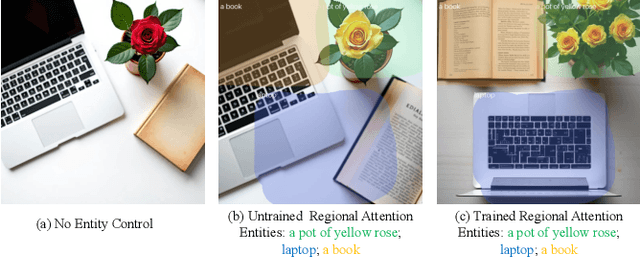

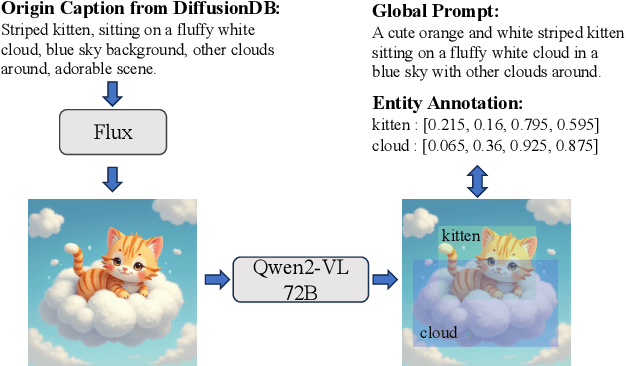

Recent advancements in diffusion models have significantly advanced text-to-image generation, yet global text prompts alone remain insufficient for achieving fine-grained control over individual entities within an image. To address this limitation, we present EliGen, a novel framework for Entity-Level controlled Image Generation. We introduce regional attention, a mechanism for diffusion transformers that requires no additional parameters, seamlessly integrating entity prompts and arbitrary-shaped spatial masks. By contributing a high-quality dataset with fine-grained spatial and semantic entity-level annotations, we train EliGen to achieve robust and accurate entity-level manipulation, surpassing existing methods in both positional control precision and image quality. Additionally, we propose an inpainting fusion pipeline, extending EliGen to multi-entity image inpainting tasks. We further demonstrate its flexibility by integrating it with community models such as IP-Adapter and MLLM, unlocking new creative possibilities. The source code, dataset, and model will be released publicly.
Minimum Tuning to Unlock Long Output from LLMs with High Quality Data as the Key
Oct 15, 2024As large language models rapidly evolve to support longer context, there is a notable disparity in their capability to generate output at greater lengths. Recent study suggests that the primary cause for this imbalance may arise from the lack of data with long-output during alignment training. In light of this observation, attempts are made to re-align foundation models with data that fills the gap, which result in models capable of generating lengthy output when instructed. In this paper, we explore the impact of data-quality in tuning a model for long output, and the possibility of doing so from the starting points of human-aligned (instruct or chat) models. With careful data curation, we show that it possible to achieve similar performance improvement in our tuned models, with only a small fraction of training data instances and compute. In addition, we assess the generalizability of such approaches by applying our tuning-recipes to several models. our findings suggest that, while capacities for generating long output vary across different models out-of-the-box, our approach to tune them with high-quality data using lite compute, consistently yields notable improvement across all models we experimented on. We have made public our curated dataset for tuning long-writing capability, the implementations of model tuning and evaluation, as well as the fine-tuned models, all of which can be openly-accessed.
SWIFT:A Scalable lightWeight Infrastructure for Fine-Tuning
Aug 13, 2024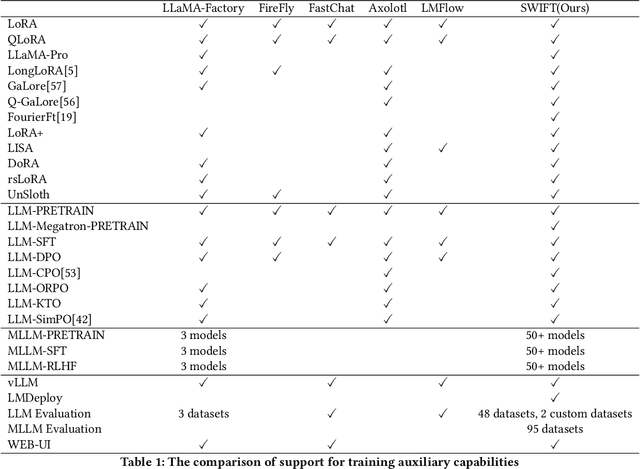
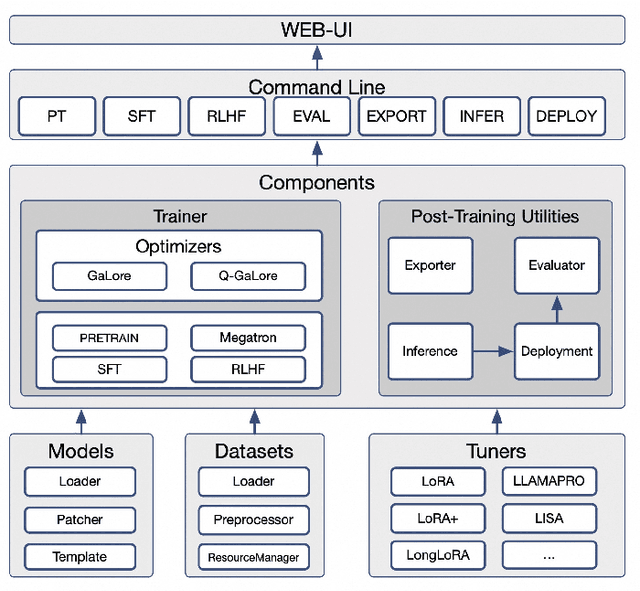
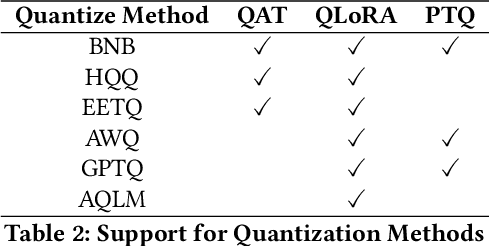
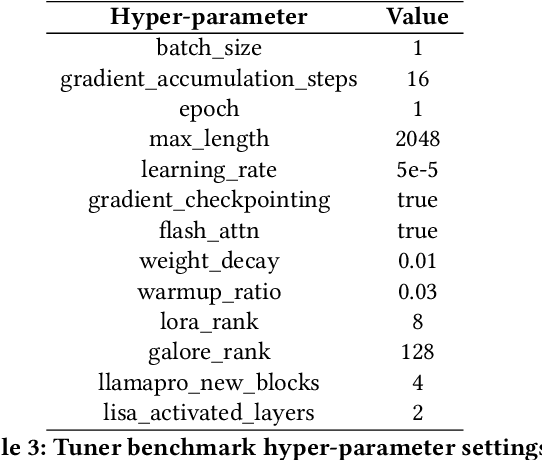
Recent development in Large Language Models (LLMs) and Multi-modal Large Language Models (MLLMs) have leverage Attention-based Transformer architectures and achieved superior performance and generalization capabilities. They have since covered extensive areas of traditional learning tasks. For instance, text-based tasks such as text-classification and sequence-labeling, as well as multi-modal tasks like Visual Question Answering (VQA) and Optical Character Recognition (OCR), which were previously addressed using different models, can now be tackled based on one foundation model. Consequently, the training and lightweight fine-tuning of LLMs and MLLMs, especially those based on Transformer architecture, has become particularly important. In recognition of these overwhelming needs, we develop SWIFT, a customizable one-stop infrastructure for large models. With support of over $300+$ LLMs and $50+$ MLLMs, SWIFT stands as the open-source framework that provide the \textit{most comprehensive support} for fine-tuning large models. In particular, it is the first training framework that provides systematic support for MLLMs. In addition to the core functionalities of fine-tuning, SWIFT also integrates post-training processes such as inference, evaluation, and model quantization, to facilitate fast adoptions of large models in various application scenarios. With a systematic integration of various training techniques, SWIFT offers helpful utilities such as benchmark comparisons among different training techniques for large models. For fine-tuning models specialized in agent framework, we show that notable improvements on the ToolBench leader-board can be achieved by training with customized dataset on SWIFT, with an increase of 5.2%-21.8% in the Act.EM metric over various baseline models, a reduction in hallucination by 1.6%-14.1%, and an average performance improvement of 8%-17%.
FaceChain: A Playground for Identity-Preserving Portrait Generation
Aug 28, 2023


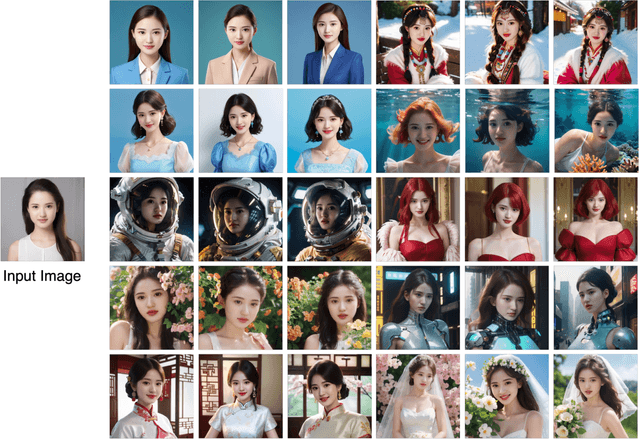
Recent advancement in personalized image generation have unveiled the intriguing capability of pre-trained text-to-image models on learning identity information from a collection of portrait images. However, existing solutions can be vulnerable in producing truthful details, and usually suffer from several defects such as (i) The generated face exhibit its own unique characteristics, \ie facial shape and facial feature positioning may not resemble key characteristics of the input, and (ii) The synthesized face may contain warped, blurred or corrupted regions. In this paper, we present FaceChain, a personalized portrait generation framework that combines a series of customized image-generation model and a rich set of face-related perceptual understanding models (\eg, face detection, deep face embedding extraction, and facial attribute recognition), to tackle aforementioned challenges and to generate truthful personalized portraits, with only a handful of portrait images as input. Concretely, we inject several SOTA face models into the generation procedure, achieving a more efficient label-tagging, data-processing, and model post-processing compared to previous solutions, such as DreamBooth ~\cite{ruiz2023dreambooth} , InstantBooth ~\cite{shi2023instantbooth} , or other LoRA-only approaches ~\cite{hu2021lora} . Through the development of FaceChain, we have identified several potential directions to accelerate development of Face/Human-Centric AIGC research and application. We have designed FaceChain as a framework comprised of pluggable components that can be easily adjusted to accommodate different styles and personalized needs. We hope it can grow to serve the burgeoning needs from the communities. FaceChain is open-sourced under Apache-2.0 license at \url{https://github.com/modelscope/facechain}.