 Add to Chrome
 Add to Firefox
 Add to Edge
HAF: Adapting Generalist VLAs to Humanoid Whole-Body Loco-manipulation via Hierarchical Action Flow and Spectral Latent RL
Aug 17, 2026
Humanoid robots hold great promise as general-purpose agents in human-centered environments, yet generalist vision-language-action (VLA) foundation models are not readily applicable to humanoid whole-body loco-manipulation. The high dimensionality and interdependence of humanoid motions make it challenging for conventional single-stage VLA architectures to coordinate locomotion, waist posture, and dual-arm manipulation effectively. Moreover, policies trained through offline behavior cloning can remain suboptimal during real-world deployment. Although online reinforcement learning can refine policies through real-world interaction, directly tuning large VLA backbones demands excessive computation and may introduce safety risks during real-robot exploration. To address these bottlenecks, we introduce HAF (Humanoid Adaptation Framework), a two-part framework consisting of HAF-VLA and HAF-Steer that transfers off-the-shelf generalist VLA foundation models to humanoid whole-body loco-manipulation. HAF-VLA is a hierarchical action-flow generator built on a pretrained flow-matching VLA. It splits full-body action denoising into three sequential stages with stage embeddings and cross-stage KV caches that retain kinematic dependencies, avoiding incoherent whole-body actions from one-shot generation. On top of the frozen HAF-VLA, HAF-Steer is a latent offline-to-online RL pipeline that leverages flow-matching invertibility and DCT-based dimensionality reduction to restrict RL optimization to a compact noise subspace and train a regularized SAC policy. This avoids updating the large VLA backbone and enables efficient real-world policy refinement. Evaluated on seven real-world humanoid loco-manipulation tasks, HAF surpasses vanilla single-stage VLA baselines and improves whole-body coordination and task performance. Project website: https://grange007.github.io/HAF .

In-Context Reinforcement Learning under Non-Stationarity: A Survey
Jul 01, 2026The development of decision-pretrained transformers, algorithm distillation, long-context meta-RL, and retrieval-augmented agents has renewed interest in in-context reinforcement learning (ICRL): the ability of a pretrained or fine-tuned decision model to infer latent task rules and improve future behavior from interaction context, without test-time parameter updates. This line of work asks when trial-and-error evidence, rewards, transitions, demonstrations, feedback, or retrieved experience can make learning-like computation happen inside the context window. However, existing surveys of ICRL mainly organize the field around pretraining objectives, architectures, context formats, evaluation protocols, and theoretical mechanisms, while the non-stationary setting remains comparatively underexamined. In changing environments, accumulated context is not merely more evidence about a fixed task: the reward specification, transition kernel, observation channel, action interface, constraint model, or demonstration and memory distribution can fall out of alignment with the current regime. Previously useful context can therefore become stale, misleading, or useful again when an old regime returns. We survey non-stationary ICRL as the problem of adapting through context while deployed policy parameters remain fixed: the policy must infer both the current decision rule and which parts of its accumulated evidence still support that rule. We define non-stationary ICRL, relate it to meta-RL, decision sequence modeling, retrieval-augmented RL, value- and model-aware ICRL, and reward-feedback agents, and organize the literature along three questions: what changes, how the change unfolds, and how observable the change is to the agent.
HEX: Humanoid-Aligned Experts for Cross-Embodiment Whole-Body Manipulation
Apr 09, 2026Humans achieve complex manipulation through coordinated whole-body control, whereas most Vision-Language-Action (VLA) models treat robot body parts largely independently, making high-DoF humanoid control challenging and often unstable. We present HEX, a state-centric framework for coordinated manipulation on full-sized bipedal humanoid robots. HEX introduces a humanoid-aligned universal state representation for scalable learning across heterogeneous embodiments, and incorporates a Mixture-of-Experts Unified Proprioceptive Predictor to model whole-body coordination and temporal motion dynamics from large-scale multi-embodiment trajectory data. To efficiently capture temporal visual context, HEX uses lightweight history tokens to summarize past observations, avoiding repeated encoding of historical images during inference. It further employs a residual-gated fusion mechanism with a flow-matching action head to adaptively integrate visual-language cues with proprioceptive dynamics for action generation. Experiments on real-world humanoid manipulation tasks show that HEX achieves state-of-the-art performance in task success rate and generalization, particularly in fast-reaction and long-horizon scenarios.
General Humanoid Whole-Body Control via Pretraining and Fast Adaptation
Feb 12, 2026Learning a general whole-body controller for humanoid robots remains challenging due to the diversity of motion distributions, the difficulty of fast adaptation, and the need for robust balance in high-dynamic scenarios. Existing approaches often require task-specific training or suffer from performance degradation when adapting to new motions. In this paper, we present FAST, a general humanoid whole-body control framework that enables Fast Adaptation and Stable Motion Tracking. FAST introduces Parseval-Guided Residual Policy Adaptation, which learns a lightweight delta action policy under orthogonality and KL constraints, enabling efficient adaptation to out-of-distribution motions while mitigating catastrophic forgetting. To further improve physical robustness, we propose Center-of-Mass-Aware Control, which incorporates CoM-related observations and objectives to enhance balance when tracking challenging reference motions. Extensive experiments in simulation and real-world deployment demonstrate that FAST consistently outperforms state-of-the-art baselines in robustness, adaptation efficiency, and generalization.
RL from Physical Feedback: Aligning Large Motion Models with Humanoid Control
Jun 15, 2025This paper focuses on a critical challenge in robotics: translating text-driven human motions into executable actions for humanoid robots, enabling efficient and cost-effective learning of new behaviors. While existing text-to-motion generation methods achieve semantic alignment between language and motion, they often produce kinematically or physically infeasible motions unsuitable for real-world deployment. To bridge this sim-to-real gap, we propose Reinforcement Learning from Physical Feedback (RLPF), a novel framework that integrates physics-aware motion evaluation with text-conditioned motion generation. RLPF employs a motion tracking policy to assess feasibility in a physics simulator, generating rewards for fine-tuning the motion generator. Furthermore, RLPF introduces an alignment verification module to preserve semantic fidelity to text instructions. This joint optimization ensures both physical plausibility and instruction alignment. Extensive experiments show that RLPF greatly outperforms baseline methods in generating physically feasible motions while maintaining semantic correspondence with text instruction, enabling successful deployment on real humanoid robots.
From Experts to a Generalist: Toward General Whole-Body Control for Humanoid Robots
Jun 15, 2025Achieving general agile whole-body control on humanoid robots remains a major challenge due to diverse motion demands and data conflicts. While existing frameworks excel in training single motion-specific policies, they struggle to generalize across highly varied behaviors due to conflicting control requirements and mismatched data distributions. In this work, we propose BumbleBee (BB), an expert-generalist learning framework that combines motion clustering and sim-to-real adaptation to overcome these challenges. BB first leverages an autoencoder-based clustering method to group behaviorally similar motions using motion features and motion descriptions. Expert policies are then trained within each cluster and refined with real-world data through iterative delta action modeling to bridge the sim-to-real gap. Finally, these experts are distilled into a unified generalist controller that preserves agility and robustness across all motion types. Experiments on two simulations and a real humanoid robot demonstrate that BB achieves state-of-the-art general whole-body control, setting a new benchmark for agile, robust, and generalizable humanoid performance in the real world.
JAEGER: Dual-Level Humanoid Whole-Body Controller
May 10, 2025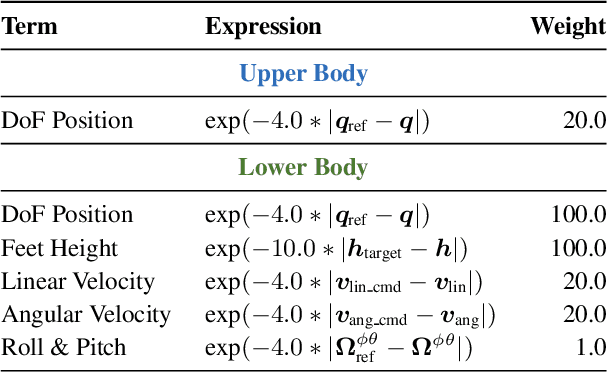
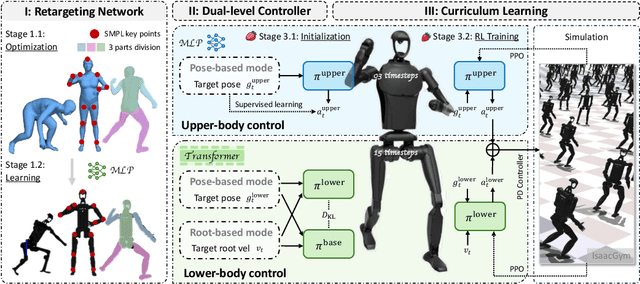
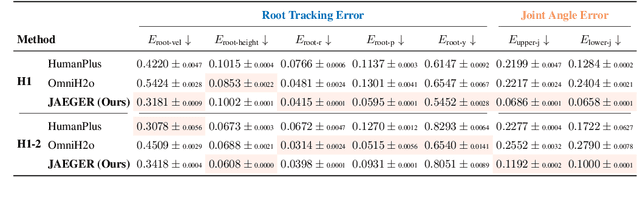
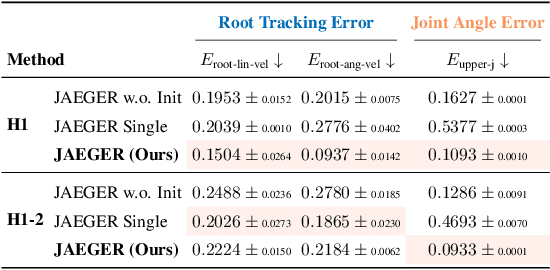
This paper presents JAEGER, a dual-level whole-body controller for humanoid robots that addresses the challenges of training a more robust and versatile policy. Unlike traditional single-controller approaches, JAEGER separates the control of the upper and lower bodies into two independent controllers, so that they can better focus on their distinct tasks. This separation alleviates the dimensionality curse and improves fault tolerance. JAEGER supports both root velocity tracking (coarse-grained control) and local joint angle tracking (fine-grained control), enabling versatile and stable movements. To train the controller, we utilize a human motion dataset (AMASS), retargeting human poses to humanoid poses through an efficient retargeting network, and employ a curriculum learning approach. This method performs supervised learning for initialization, followed by reinforcement learning for further exploration. We conduct our experiments on two humanoid platforms and demonstrate the superiority of our approach against state-of-the-art methods in both simulation and real environments.
SELU: Self-Learning Embodied MLLMs in Unknown Environments
Oct 04, 2024


Recently, multimodal large language models (MLLMs) have demonstrated strong visual understanding and decision-making capabilities, enabling the exploration of autonomously improving MLLMs in unknown environments. However, external feedback like human or environmental feedback is not always available. To address this challenge, existing methods primarily focus on enhancing the decision-making capabilities of MLLMs through voting and scoring mechanisms, while little effort has been paid to improving the environmental comprehension of MLLMs in unknown environments. To fully unleash the self-learning potential of MLLMs, we propose a novel actor-critic self-learning paradigm, dubbed SELU, inspired by the actor-critic paradigm in reinforcement learning. The critic employs self-asking and hindsight relabeling to extract knowledge from interaction trajectories collected by the actor, thereby augmenting its environmental comprehension. Simultaneously, the actor is improved by the self-feedback provided by the critic, enhancing its decision-making. We evaluate our method in the AI2-THOR and VirtualHome environments, and SELU achieves critic improvements of approximately 28% and 30%, and actor improvements of about 20% and 24% via self-learning.
Egocentric Vision Language Planning
Aug 11, 2024We explore leveraging large multi-modal models (LMMs) and text2image models to build a more general embodied agent. LMMs excel in planning long-horizon tasks over symbolic abstractions but struggle with grounding in the physical world, often failing to accurately identify object positions in images. A bridge is needed to connect LMMs to the physical world. The paper proposes a novel approach, egocentric vision language planning (EgoPlan), to handle long-horizon tasks from an egocentric perspective in varying household scenarios. This model leverages a diffusion model to simulate the fundamental dynamics between states and actions, integrating techniques like style transfer and optical flow to enhance generalization across different environmental dynamics. The LMM serves as a planner, breaking down instructions into sub-goals and selecting actions based on their alignment with these sub-goals, thus enabling more generalized and effective decision-making. Experiments show that EgoPlan improves long-horizon task success rates from the egocentric view compared to baselines across household scenarios.
A Survey on Game Playing Agents and Large Models: Methods, Applications, and Challenges
Mar 15, 2024The swift evolution of Large-scale Models (LMs), either language-focused or multi-modal, has garnered extensive attention in both academy and industry. But despite the surge in interest in this rapidly evolving area, there are scarce systematic reviews on their capabilities and potential in distinct impactful scenarios. This paper endeavours to help bridge this gap, offering a thorough examination of the current landscape of LM usage in regards to complex game playing scenarios and the challenges still open. Here, we seek to systematically review the existing architectures of LM-based Agents (LMAs) for games and summarize their commonalities, challenges, and any other insights. Furthermore, we present our perspective on promising future research avenues for the advancement of LMs in games. We hope to assist researchers in gaining a clear understanding of the field and to generate more interest in this highly impactful research direction. A corresponding resource, continuously updated, can be found in our GitHub repository.