 Add to Chrome
 Add to Firefox
 Add to Edge
Visual Late Chunking: An Empirical Study of Contextual Chunking for Efficient Visual Document Retrieval
Apr 11, 2026
Multi-vector models dominate Visual Document Retrieval (VDR) due to their fine-grained matching capabilities, but their high storage and computational costs present a major barrier to practical deployment. In this paper, we propose ColChunk, a plug-and-play framework that introduces multimodal late chunking to construct efficient, contextualized multi-vectors. Unlike existing pruning or fixed-token approaches, ColChunk employs hierarchical clustering on patch-level embeddings, fused with a 2D position prior to ensure spatial-semantic coherence. This adaptive grouping allows for a content-aware representation that preserves global context while drastically reducing the vector count. Evaluations across 24 VDR datasets demonstrate ColChunk achieves over a 90% reduction in storage requirements while simultaneously delivering a 9-point average improvement in nDCG@5 across representative single-vector models. ColChunk provides a practical solution for balancing retrieval accuracy and efficiency in visual document systems.

LineMVGNN: Anti-Money Laundering with Line-Graph-Assisted Multi-View Graph Neural Networks
Mar 24, 2026Anti-money laundering (AML) systems are important for protecting the global economy. However, conventional rule-based methods rely on domain knowledge, leading to suboptimal accuracy and a lack of scalability. Graph neural networks (GNNs) for digraphs (directed graphs) can be applied to transaction graphs and capture suspicious transactions or accounts. However, most spectral GNNs do not naturally support multi-dimensional edge features, lack interpretability due to edge modifications, and have limited scalability owing to their spectral nature. Conversely, most spatial methods may not capture the money flow well. Therefore, in this work, we propose LineMVGNN (Line-Graph-Assisted Multi-View Graph Neural Network), a novel spatial method that considers payment and receipt transactions. Specifically, the LineMVGNN model extends a lightweight MVGNN module, which performs two-way message passing between nodes in a transaction graph. Additionally, LineMVGNN incorporates a line graph view of the original transaction graph to enhance the propagation of transaction information. We conduct experiments on two real-world account-based transaction datasets: the Ethereum phishing transaction network dataset and a financial payment transaction dataset from one of our industry partners. The results show that our proposed method outperforms state-of-the-art methods, reflecting the effectiveness of money laundering detection with line-graph-assisted multi-view graph learning. We also discuss scalability, adversarial robustness, and regulatory considerations of our proposed method.
Beyond the Grid: Layout-Informed Multi-Vector Retrieval with Parsed Visual Document Representations
Mar 02, 2026Harnessing the full potential of visually-rich documents requires retrieval systems that understand not just text, but intricate layouts, a core challenge in Visual Document Retrieval (VDR). The prevailing multi-vector architectures, while powerful, face a crucial storage bottleneck that current optimization strategies, such as embedding merging, pruning, or using abstract tokens, fail to resolve without compromising performance or ignoring vital layout cues. To address this, we introduce ColParse, a novel paradigm that leverages a document parsing model to generate a small set of layout-informed sub-image embeddings, which are then fused with a global page-level vector to create a compact and structurally-aware multi-vector representation. Extensive experiments demonstrate that our method reduces storage requirements by over 95% while simultaneously yielding significant performance gains across numerous benchmarks and base models. ColParse thus bridges the critical gap between the fine-grained accuracy of multi-vector retrieval and the practical demands of large-scale deployment, offering a new path towards efficient and interpretable multimodal information systems.
DynamicGTR: Leveraging Graph Topology Representation Preferences to Boost VLM Capabilities on Graph QAs
Feb 25, 2026Vision-Language Models (VLMs) have emerged as versatile solutions for zero-shot question answering (QA) across various domains. However, enabling VLMs to effectively comprehend structured graphs and perform accurate, efficient QA remains challenging. Existing approaches typically rely on one single graph topology representation (GTR), such as fixed-style visual images or unified text descriptions. This ``one-size-fits-all'' strategy often neglects model-specific and task-specific preferences, resulting in inaccurate or over-lengthy responses to graph-related queries. To address this, we propose the $\mbox{DynamicGTR}$ framework, which dynamically selects the optimal GTR for each query during inference, thereby enhancing the zero-shot graph QA capabilities of VLMs with a customizable accuracy and brevity trade-off. Extensive experiments show that DynamicGTR not only improves VLM-based graph algorithm QA performance but also successfully transfers the experience trained from synthetic graph algorithm tasks to real-world applications like link prediction and node classification, without any additional training. Additionally, DynamicGTR demonstrates strong transferability across tasks, domains, and models, suggesting its potential as a flexible solution for broad graph scenarios.
Unlocking Multimodal Document Intelligence: From Current Triumphs to Future Frontiers of Visual Document Retrieval
Feb 23, 2026With the rapid proliferation of multimodal information, Visual Document Retrieval (VDR) has emerged as a critical frontier in bridging the gap between unstructured visually rich data and precise information acquisition. Unlike traditional natural image retrieval, visual documents exhibit unique characteristics defined by dense textual content, intricate layouts, and fine-grained semantic dependencies. This paper presents the first comprehensive survey of the VDR landscape, specifically through the lens of the Multimodal Large Language Model (MLLM) era. We begin by examining the benchmark landscape, and subsequently dive into the methodological evolution, categorizing approaches into three primary aspects: multimodal embedding models, multimodal reranker models, and the integration of Retrieval-Augmented Generation (RAG) and Agentic systems for complex document intelligence. Finally, we identify persistent challenges and outline promising future directions, aiming to provide a clear roadmap for future multimodal document intelligence.
Sculpting the Vector Space: Towards Efficient Multi-Vector Visual Document Retrieval via Prune-then-Merge Framework
Feb 23, 2026Visual Document Retrieval (VDR), which aims to retrieve relevant pages within vast corpora of visually-rich documents, is of significance in current multimodal retrieval applications. The state-of-the-art multi-vector paradigm excels in performance but suffers from prohibitive overhead, a problem that current efficiency methods like pruning and merging address imperfectly, creating a difficult trade-off between compression rate and feature fidelity. To overcome this dilemma, we introduce Prune-then-Merge, a novel two-stage framework that synergizes these complementary approaches. Our method first employs an adaptive pruning stage to filter out low-information patches, creating a refined, high-signal set of embeddings. Subsequently, a hierarchical merging stage compresses this pre-filtered set, effectively summarizing semantic content without the noise-induced feature dilution seen in single-stage methods. Extensive experiments on 29 VDR datasets demonstrate that our framework consistently outperforms existing methods, significantly extending the near-lossless compression range and providing robust performance at high compression ratios.
SOON: Symmetric Orthogonal Operator Network for Global Subseasonal-to-Seasonal Climate Forecasting
Feb 04, 2026Accurate global Subseasonal-to-Seasonal (S2S) climate forecasting is critical for disaster preparedness and resource management, yet it remains challenging due to chaotic atmospheric dynamics. Existing models predominantly treat atmospheric fields as isotropic images, conflating the distinct physical processes of zonal wave propagation and meridional transport, and leading to suboptimal modeling of anisotropic dynamics. In this paper, we propose the Symmetric Orthogonal Operator Network (SOON) for global S2S climate forecasting. It couples: (1) an Anisotropic Embedding strategy that tokenizes the global grid into latitudinal rings, preserving the integrity of zonal periodic structures; and (2) a stack of SOON Blocks that models the alternating interaction of Zonal and Meridional Operators via a symmetric decomposition, structurally mitigating discretization errors inherent in long-term integration. Extensive experiments on the Earth Reanalysis 5 dataset demonstrate that SOON establishes a new state-of-the-art, significantly outperforming existing methods in both forecasting accuracy and computational efficiency.
SEDformer: Event-Synchronous Spiking Transformers for Irregular Telemetry Time Series Forecasting
Feb 03, 2026Telemetry streams from large-scale Internet-connected systems (e.g., IoT deployments and online platforms) naturally form an irregular multivariate time series (IMTS) whose accurate forecasting is operationally vital. A closer examination reveals a defining Sparsity-Event Duality (SED) property of IMTS, i.e., long stretches with sparse or no observations are punctuated by short, dense bursts where most semantic events (observations) occur. However, existing Graph- and Transformer-based forecasters ignore SED: pre-alignment to uniform grids with heavy padding violates sparsity by inflating sequences and forcing computation at non-informative steps, while relational recasting weakens event semantics by disrupting local temporal continuity. These limitations motivate a more faithful and natural modeling paradigm for IMTS that aligns with its SED property. We find that Spiking Neural Networks meet this requirement, as they communicate via sparse binary spikes and update in an event-driven manner, aligning naturally with the SED nature of IMTS. Therefore, we present SEDformer, an SED-enhanced Spiking Transformer for telemetry IMTS forecasting that couples: (1) a SED-based Spike Encoder converts raw observations into event synchronous spikes using an Event-Aligned LIF neuron, (2) an Event-Preserving Temporal Downsampling module compresses long gaps while retaining salient firings and (3) a stack of SED-based Spike Transformer blocks enable intra-series dependency modeling with a membrane-based linear attention driven by EA-LIF spiking features. Experiments on public telemetry IMTS datasets show that SEDformer attains state-of-the-art forecasting accuracy while reducing energy and memory usage, providing a natural and efficient path for modeling IMTS.
Alternating Training-based Label Smoothing Enhances Prompt Generalization
Aug 25, 2025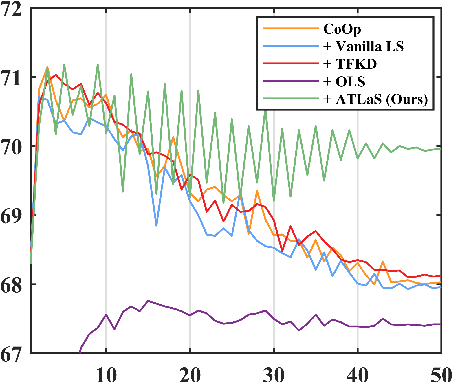

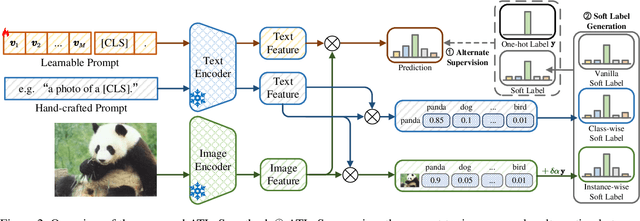
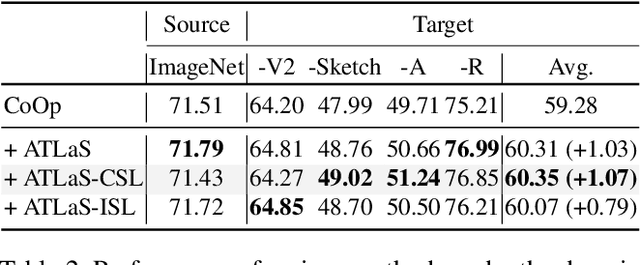
Recent advances in pre-trained vision-language models have demonstrated remarkable zero-shot generalization capabilities. To further enhance these models' adaptability to various downstream tasks, prompt tuning has emerged as a parameter-efficient fine-tuning method. However, despite its efficiency, the generalization ability of prompt remains limited. In contrast, label smoothing (LS) has been widely recognized as an effective regularization technique that prevents models from becoming over-confident and improves their generalization. This inspires us to explore the integration of LS with prompt tuning. However, we have observed that the vanilla LS even weakens the generalization ability of prompt tuning. To address this issue, we propose the Alternating Training-based Label Smoothing (ATLaS) method, which alternately trains with standard one-hot labels and soft labels generated by LS to supervise the prompt tuning. Moreover, we introduce two types of efficient offline soft labels, including Class-wise Soft Labels (CSL) and Instance-wise Soft Labels (ISL), to provide inter-class or instance-class relationships for prompt tuning. The theoretical properties of the proposed ATLaS method are analyzed. Extensive experiments demonstrate that the proposed ATLaS method, combined with CSL and ISL, consistently enhances the generalization performance of prompt tuning. Moreover, the proposed ATLaS method exhibits high compatibility with prevalent prompt tuning methods, enabling seamless integration into existing methods.
Open the Eyes of MPNN: Vision Enhances MPNN in Link Prediction
May 13, 2025Message-passing graph neural networks (MPNNs) and structural features (SFs) are cornerstones for the link prediction task. However, as a common and intuitive mode of understanding, the potential of visual perception has been overlooked in the MPNN community. For the first time, we equip MPNNs with vision structural awareness by proposing an effective framework called Graph Vision Network (GVN), along with a more efficient variant (E-GVN). Extensive empirical results demonstrate that with the proposed frameworks, GVN consistently benefits from the vision enhancement across seven link prediction datasets, including challenging large-scale graphs. Such improvements are compatible with existing state-of-the-art (SOTA) methods and GVNs achieve new SOTA results, thereby underscoring a promising novel direction for link prediction.