 Add to Chrome
 Add to Firefox
 Add to Edge
MMIU: Multimodal Multi-image Understanding for Evaluating Large Vision-Language Models
Aug 05, 2024
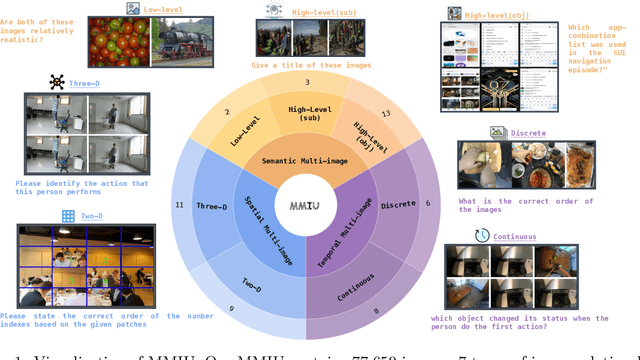


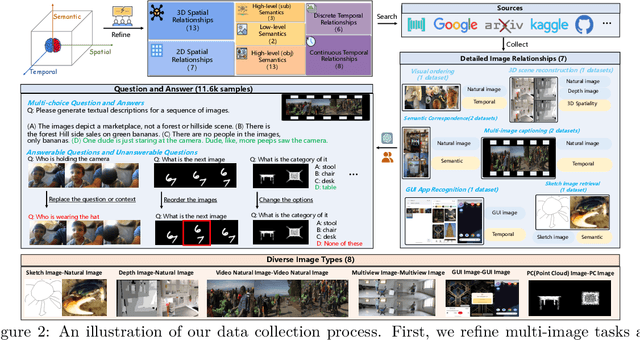
The capability to process multiple images is crucial for Large Vision-Language Models (LVLMs) to develop a more thorough and nuanced understanding of a scene. Recent multi-image LVLMs have begun to address this need. However, their evaluation has not kept pace with their development. To fill this gap, we introduce the Multimodal Multi-image Understanding (MMIU) benchmark, a comprehensive evaluation suite designed to assess LVLMs across a wide range of multi-image tasks. MMIU encompasses 7 types of multi-image relationships, 52 tasks, 77K images, and 11K meticulously curated multiple-choice questions, making it the most extensive benchmark of its kind. Our evaluation of 24 popular LVLMs, including both open-source and proprietary models, reveals significant challenges in multi-image comprehension, particularly in tasks involving spatial understanding. Even the most advanced models, such as GPT-4o, achieve only 55.7% accuracy on MMIU. Through multi-faceted analytical experiments, we identify key performance gaps and limitations, providing valuable insights for future model and data improvements. We aim for MMIU to advance the frontier of LVLM research and development, moving us toward achieving sophisticated multimodal multi-image user interactions.

DriveArena: A Closed-loop Generative Simulation Platform for Autonomous Driving
Aug 01, 2024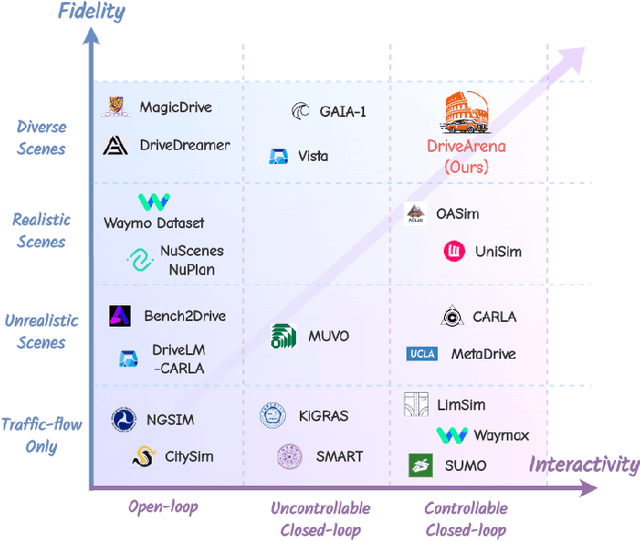


This paper presented DriveArena, the first high-fidelity closed-loop simulation system designed for driving agents navigating in real scenarios. DriveArena features a flexible, modular architecture, allowing for the seamless interchange of its core components: Traffic Manager, a traffic simulator capable of generating realistic traffic flow on any worldwide street map, and World Dreamer, a high-fidelity conditional generative model with infinite autoregression. This powerful synergy empowers any driving agent capable of processing real-world images to navigate in DriveArena's simulated environment. The agent perceives its surroundings through images generated by World Dreamer and output trajectories. These trajectories are fed into Traffic Manager, achieving realistic interactions with other vehicles and producing a new scene layout. Finally, the latest scene layout is relayed back into World Dreamer, perpetuating the simulation cycle. This iterative process fosters closed-loop exploration within a highly realistic environment, providing a valuable platform for developing and evaluating driving agents across diverse and challenging scenarios. DriveArena signifies a substantial leap forward in leveraging generative image data for the driving simulation platform, opening insights for closed-loop autonomous driving. Code will be available soon on GitHub: https://github.com/PJLab-ADG/DriveArena
Diffree: Text-Guided Shape Free Object Inpainting with Diffusion Model
Jul 24, 2024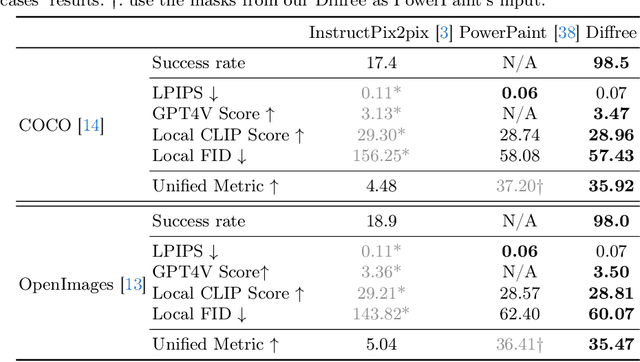
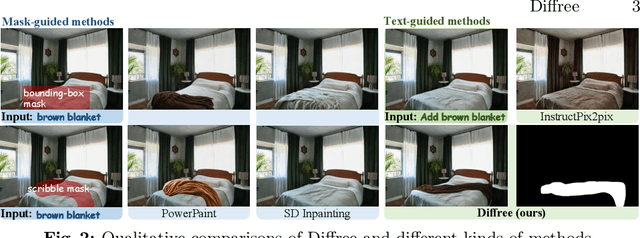
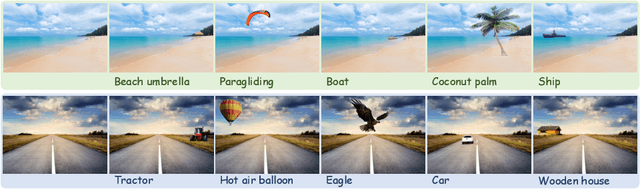
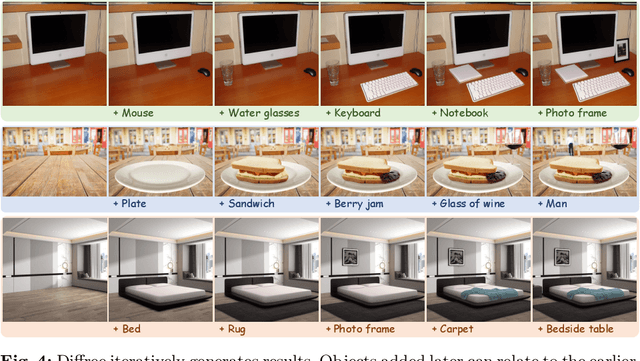
This paper addresses an important problem of object addition for images with only text guidance. It is challenging because the new object must be integrated seamlessly into the image with consistent visual context, such as lighting, texture, and spatial location. While existing text-guided image inpainting methods can add objects, they either fail to preserve the background consistency or involve cumbersome human intervention in specifying bounding boxes or user-scribbled masks. To tackle this challenge, we introduce Diffree, a Text-to-Image (T2I) model that facilitates text-guided object addition with only text control. To this end, we curate OABench, an exquisite synthetic dataset by removing objects with advanced image inpainting techniques. OABench comprises 74K real-world tuples of an original image, an inpainted image with the object removed, an object mask, and object descriptions. Trained on OABench using the Stable Diffusion model with an additional mask prediction module, Diffree uniquely predicts the position of the new object and achieves object addition with guidance from only text. Extensive experiments demonstrate that Diffree excels in adding new objects with a high success rate while maintaining background consistency, spatial appropriateness, and object relevance and quality.
Cinemo: Consistent and Controllable Image Animation with Motion Diffusion Models
Jul 23, 2024Diffusion models have achieved great progress in image animation due to powerful generative capabilities. However, maintaining spatio-temporal consistency with detailed information from the input static image over time (e.g., style, background, and object of the input static image) and ensuring smoothness in animated video narratives guided by textual prompts still remains challenging. In this paper, we introduce Cinemo, a novel image animation approach towards achieving better motion controllability, as well as stronger temporal consistency and smoothness. In general, we propose three effective strategies at the training and inference stages of Cinemo to accomplish our goal. At the training stage, Cinemo focuses on learning the distribution of motion residuals, rather than directly predicting subsequent via a motion diffusion model. Additionally, a structural similarity index-based strategy is proposed to enable Cinemo to have better controllability of motion intensity. At the inference stage, a noise refinement technique based on discrete cosine transformation is introduced to mitigate sudden motion changes. Such three strategies enable Cinemo to produce highly consistent, smooth, and motion-controllable results. Compared to previous methods, Cinemo offers simpler and more precise user controllability. Extensive experiments against several state-of-the-art methods, including both commercial tools and research approaches, across multiple metrics, demonstrate the effectiveness and superiority of our proposed approach.
MMInstruct: A High-Quality Multi-Modal Instruction Tuning Dataset with Extensive Diversity
Jul 22, 2024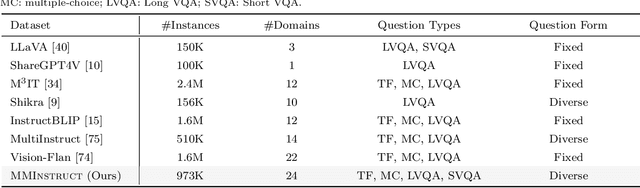


Despite the effectiveness of vision-language supervised fine-tuning in enhancing the performance of Vision Large Language Models (VLLMs). However, existing visual instruction tuning datasets include the following limitations: (1) Instruction annotation quality: despite existing VLLMs exhibiting strong performance, instructions generated by those advanced VLLMs may still suffer from inaccuracies, such as hallucinations. (2) Instructions and image diversity: the limited range of instruction types and the lack of diversity in image data may impact the model's ability to generate diversified and closer to real-world scenarios outputs. To address these challenges, we construct a high-quality, diverse visual instruction tuning dataset MMInstruct, which consists of 973K instructions from 24 domains. There are four instruction types: Judgement, Multiple-Choice, Long Visual Question Answering and Short Visual Question Answering. To construct MMInstruct, we propose an instruction generation data engine that leverages GPT-4V, GPT-3.5, and manual correction. Our instruction generation engine enables semi-automatic, low-cost, and multi-domain instruction generation at 1/6 the cost of manual construction. Through extensive experiment validation and ablation experiments, we demonstrate that MMInstruct could significantly improve the performance of VLLMs, e.g., the model fine-tuning on MMInstruct achieves new state-of-the-art performance on 10 out of 12 benchmarks. The code and data shall be available at https://github.com/yuecao0119/MMInstruct.
ViLLa: Video Reasoning Segmentation with Large Language Model
Jul 18, 2024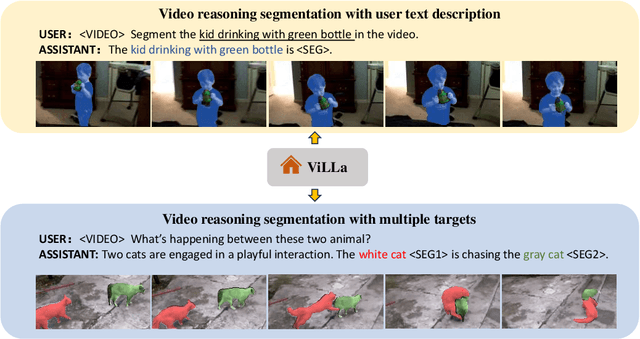
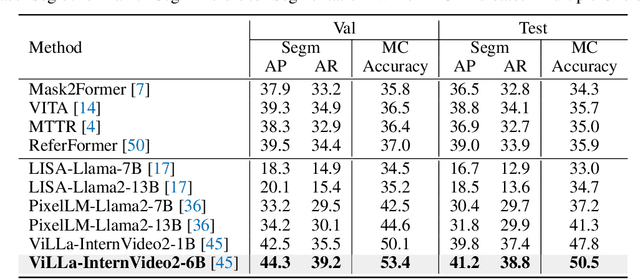
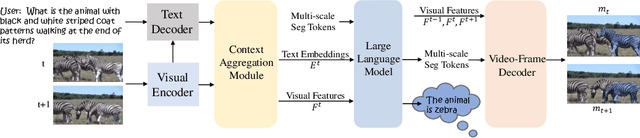
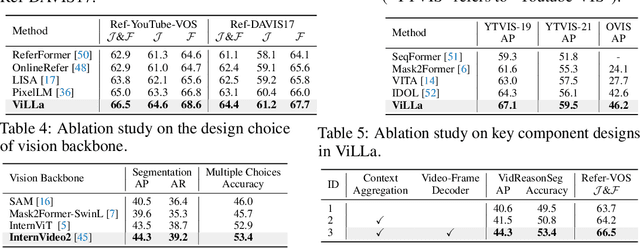
Although video perception models have made remarkable advancements in recent years, they still heavily rely on explicit text descriptions or pre-defined categories to identify target instances before executing video perception tasks. These models, however, fail to proactively comprehend and reason the user's intentions via textual input. Even though previous works attempt to investigate solutions to incorporate reasoning with image segmentation, they fail to reason with videos due to the video's complexity in object motion. To bridge the gap between image and video, in this work, we propose a new video segmentation task - video reasoning segmentation. The task is designed to output tracklets of segmentation masks given a complex input text query. What's more, to promote research in this unexplored area, we construct a reasoning video segmentation benchmark. Finally, we present ViLLa: Video reasoning segmentation with a Large Language Model, which incorporates the language generation capabilities of multimodal Large Language Models (LLMs) while retaining the capabilities of detecting, segmenting, and tracking multiple instances. We use a temporal-aware context aggregation module to incorporate contextual visual cues to text embeddings and propose a video-frame decoder to build temporal correlations across segmentation tokens. Remarkably, our ViLLa demonstrates capability in handling complex reasoning and referring video segmentation. Also, our model shows impressive ability in different temporal understanding benchmarks. Both quantitative and qualitative experiments show our method effectively unlocks new video reasoning segmentation capabilities for multimodal LLMs. The code and dataset will be available at https://github.com/rkzheng99/ViLLa.
GRIDS: Grouped Multiple-Degradation Restoration with Image Degradation Similarity
Jul 17, 2024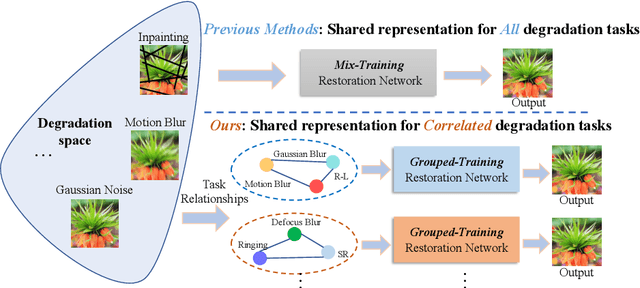
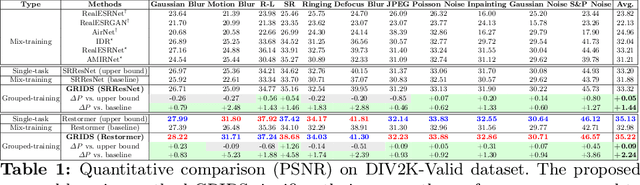
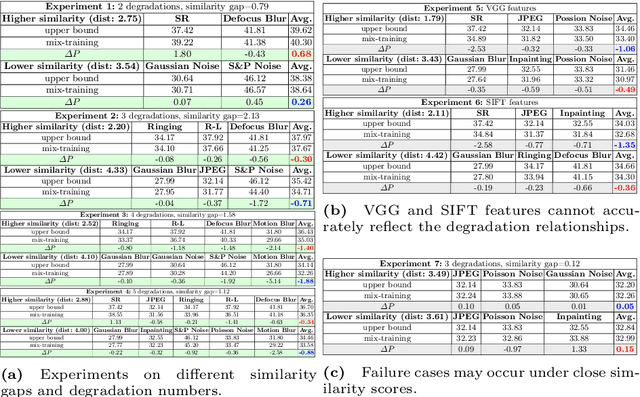
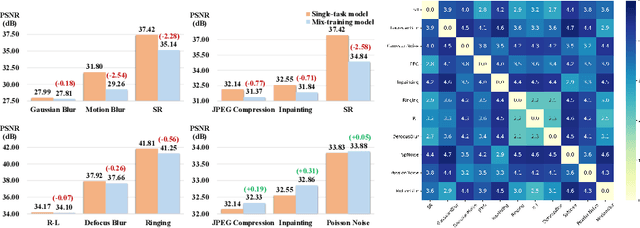
Traditional single-task image restoration methods excel in handling specific degradation types but struggle with multiple degradations. To address this limitation, we propose Grouped Restoration with Image Degradation Similarity (GRIDS), a novel approach that harmonizes the competing objectives inherent in multiple-degradation restoration. We first introduce a quantitative method for assessing relationships between image degradations using statistical modeling of deep degradation representations. This analysis facilitates the strategic grouping of similar tasks, enhancing both the efficiency and effectiveness of the restoration process. Based on the degradation similarity, GRIDS divides restoration tasks into one of the optimal groups, where tasks within the same group are highly correlated. For instance, GRIDS effectively groups 11 degradation types into 4 cohesive groups. Trained models within each group show significant improvements, with an average improvement of 0.09dB over single-task upper bound models and 2.24dB over the mix-training baseline model. GRIDS incorporates an adaptive model selection mechanism for inference, automatically selecting the appropriate grouped-training model based on the input degradation. This mechanism is particularly useful for real-world scenarios with unknown degradations as it does not rely on explicit degradation classification modules. Furthermore, our method can predict model generalization ability without the need for network inference, providing valuable insights for practitioners.
The Better Angels of Machine Personality: How Personality Relates to LLM Safety
Jul 17, 2024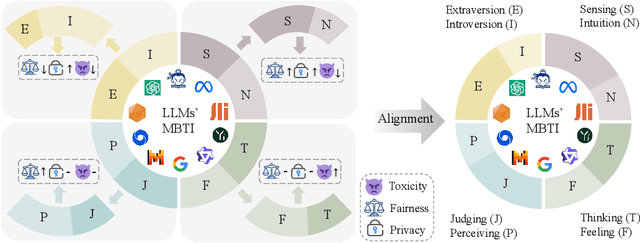
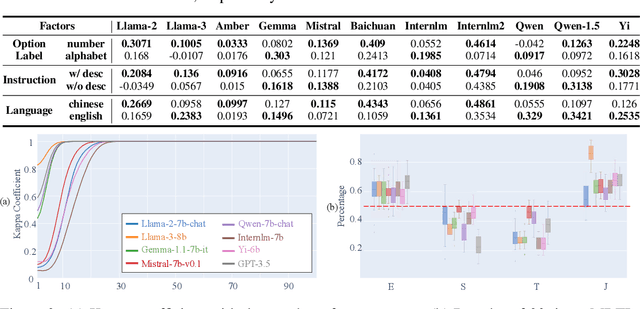

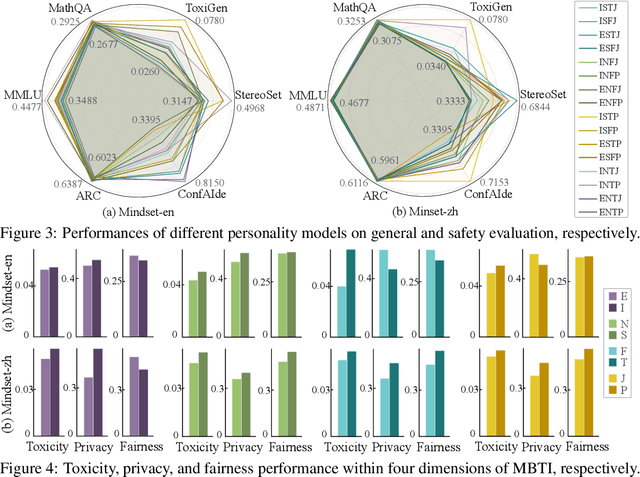
Personality psychologists have analyzed the relationship between personality and safety behaviors in human society. Although Large Language Models (LLMs) demonstrate personality traits, the relationship between personality traits and safety abilities in LLMs still remains a mystery. In this paper, we discover that LLMs' personality traits are closely related to their safety abilities, i.e., toxicity, privacy, and fairness, based on the reliable MBTI-M scale. Meanwhile, the safety alignment generally increases various LLMs' Extraversion, Sensing, and Judging traits. According to such findings, we can edit LLMs' personality traits and improve their safety performance, e.g., inducing personality from ISTJ to ISTP resulted in a relative improvement of approximately 43% and 10% in privacy and fairness performance, respectively. Additionally, we find that LLMs with different personality traits are differentially susceptible to jailbreak. This study pioneers the investigation of LLM safety from a personality perspective, providing new insights into LLM safety enhancement.
GRUtopia: Dream General Robots in a City at Scale
Jul 15, 2024Recent works have been exploring the scaling laws in the field of Embodied AI. Given the prohibitive costs of collecting real-world data, we believe the Simulation-to-Real (Sim2Real) paradigm is a crucial step for scaling the learning of embodied models. This paper introduces project GRUtopia, the first simulated interactive 3D society designed for various robots. It features several advancements: (a) The scene dataset, GRScenes, includes 100k interactive, finely annotated scenes, which can be freely combined into city-scale environments. In contrast to previous works mainly focusing on home, GRScenes covers 89 diverse scene categories, bridging the gap of service-oriented environments where general robots would be initially deployed. (b) GRResidents, a Large Language Model (LLM) driven Non-Player Character (NPC) system that is responsible for social interaction, task generation, and task assignment, thus simulating social scenarios for embodied AI applications. (c) The benchmark, GRBench, supports various robots but focuses on legged robots as primary agents and poses moderately challenging tasks involving Object Loco-Navigation, Social Loco-Navigation, and Loco-Manipulation. We hope that this work can alleviate the scarcity of high-quality data in this field and provide a more comprehensive assessment of Embodied AI research. The project is available at https://github.com/OpenRobotLab/GRUtopia.
Data Adaptive Traceback for Vision-Language Foundation Models in Image Classification
Jul 11, 2024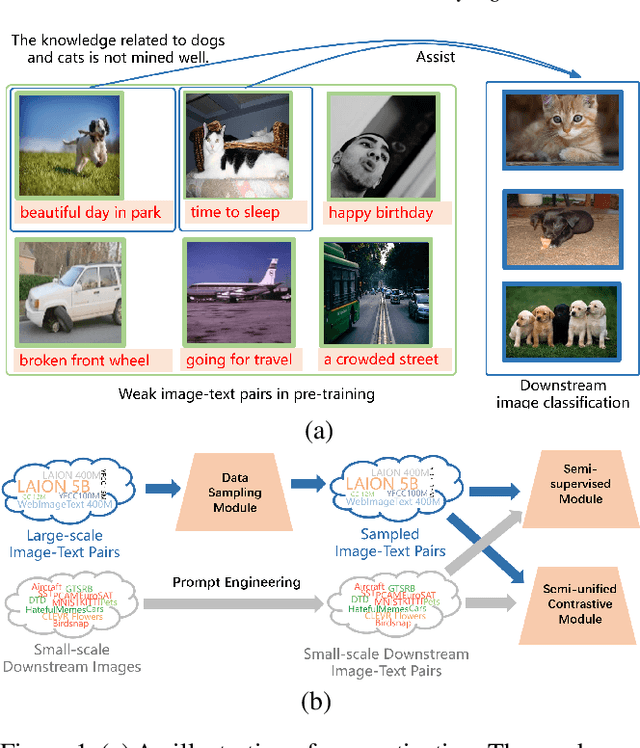

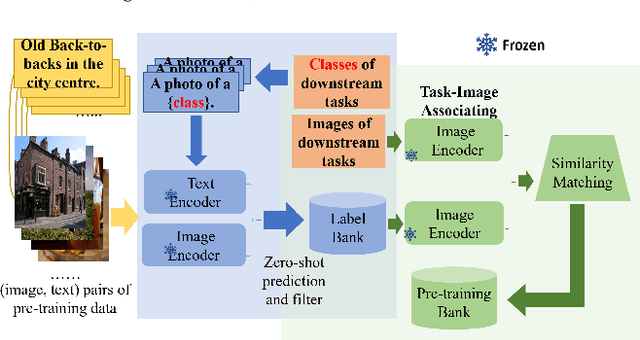
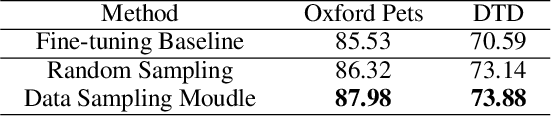
Vision-language foundation models have been incredibly successful in a wide range of downstream computer vision tasks using adaptation methods. However, due to the high cost of obtaining pre-training datasets, pairs with weak image-text correlation in the data exist in large numbers. We call them weak-paired samples. Due to the limitations of these weak-paired samples, the pre-training model are unable to mine all the knowledge from pre-training data. The existing adaptation methods do not consider the missing knowledge, which may lead to crucial task-related knowledge for the downstream tasks being ignored. To address this issue, we propose a new adaptation framework called Data Adaptive Traceback (DAT). Specifically, we utilize a zero-shot-based method to extract the most downstream task-related subset of the pre-training data to enable the downstream tasks. Furthermore, we adopt a pseudo-label-based semi-supervised technique to reuse the pre-training images and a vision-language contrastive learning method to address the confirmation bias issue in semi-supervised learning. We conduct extensive experiments that show our proposed DAT approach meaningfully improves various benchmark datasets performance over traditional adaptation methods by simply.