 Add to Chrome
 Add to Firefox
 Add to Edge
SafeAgent: A Runtime Protection Architecture for Agentic Systems
Apr 19, 2026
Large language model (LLM) agents are vulnerable to prompt-injection attacks that propagate through multi-step workflows, tool interactions, and persistent context, making input-output filtering alone insufficient for reliable protection. This paper presents SafeAgent, a runtime security architecture that treats agent safety as a stateful decision problem over evolving interaction trajectories. The proposed design separates execution governance from semantic risk reasoning through two coordinated components: a runtime controller that mediates actions around the agent loop and a context-aware decision core that operates over persistent session state. The core is formalized as a context-aware advanced machine intelligence and instantiated through operators for risk encoding, utility-cost evaluation, consequence modeling, policy arbitration, and state synchronization. Experiments on Agent Security Bench (ASB) and InjecAgent show that SafeAgent consistently improves robustness over baseline and text-level guardrail methods while maintaining competitive benign-task performance. Ablation studies further show that recovery confidence and policy weighting determine distinct safety-utility operating points.

MedP-CLIP: Medical CLIP with Region-Aware Prompt Integration
Apr 13, 2026Contrastive Language-Image Pre-training (CLIP) has demonstrated outstanding performance in global image understanding and zero-shot transfer through large-scale text-image alignment. However, the core of medical image analysis often lies in the fine-grained understanding of specific anatomical structures or lesion regions. Therefore, precisely comprehending region-of-interest (RoI) information provided by medical professionals or perception models becomes crucial. To address this need, we propose MedP-CLIP, a region-aware medical vision-language model (VLM). MedP-CLIP innovatively integrates medical prior knowledge and designs a feature-level region prompt integration mechanism, enabling it to flexibly respond to various prompt forms (e.g., points, bounding boxes, masks) while maintaining global contextual awareness when focusing on local regions. We pre-train the model on a meticulously constructed large-scale dataset (containing over 6.4 million medical images and 97.3 million region-level annotations), equipping it with cross-disease and cross-modality fine-grained spatial semantic understanding capabilities. Experiments demonstrate that MedP-CLIP significantly outperforms baseline methods in various medical tasks, including zero-shot recognition, interactive segmentation, and empowering multimodal large language models. This model provides a scalable, plug-and-play visual backbone for medical AI, combining holistic image understanding with precise regional analysis.
SegMoTE: Token-Level Mixture of Experts for Medical Image Segmentation
Feb 22, 2026Medical image segmentation is vital for clinical diagnosis and quantitative analysis, yet remains challenging due to the heterogeneity of imaging modalities and the high cost of pixel-level annotations. Although general interactive segmentation models like SAM have achieved remarkable progress, their transfer to medical imaging still faces two key bottlenecks: (i) the lack of adaptive mechanisms for modality- and anatomy-specific tasks, which limits generalization in out-of-distribution medical scenarios; and (ii) current medical adaptation methods fine-tune on large, heterogeneous datasets without selection, leading to noisy supervision, higher cost, and negative transfer. To address these issues, we propose SegMoTE, an efficient and adaptive framework for medical image segmentation. SegMoTE preserves SAM's original prompt interface, efficient inference, and zero-shot generalization while introducing only a small number of learnable parameters to dynamically adapt across modalities and tasks. In addition, we design a progressive prompt tokenization mechanism that enables fully automatic segmentation, significantly reducing annotation dependence. Trained on MedSeg-HQ, a curated dataset less than 1% of existing large-scale datasets, SegMoTE achieves SOTA performance across diverse imaging modalities and anatomical tasks. It represents the first efficient, robust, and scalable adaptation of general segmentation models to the medical domain under extremely low annotation cost, advancing the practical deployment of foundation vision models in clinical applications.
MedKGI: Iterative Differential Diagnosis with Medical Knowledge Graphs and Information-Guided Inquiring
Dec 30, 2025Recent advancements in Large Language Models (LLMs) have demonstrated significant promise in clinical diagnosis. However, current models struggle to emulate the iterative, diagnostic hypothesis-driven reasoning of real clinical scenarios. Specifically, current LLMs suffer from three critical limitations: (1) generating hallucinated medical content due to weak grounding in verified knowledge, (2) asking redundant or inefficient questions rather than discriminative ones that hinder diagnostic progress, and (3) losing coherence over multi-turn dialogues, leading to contradictory or inconsistent conclusions. To address these challenges, we propose MedKGI, a diagnostic framework grounded in clinical practices. MedKGI integrates a medical knowledge graph (KG) to constrain reasoning to validated medical ontologies, selects questions based on information gain to maximize diagnostic efficiency, and adopts an OSCE-format structured state to maintain consistent evidence tracking across turns. Experiments on clinical benchmarks show that MedKGI outperforms strong LLM baselines in both diagnostic accuracy and inquiry efficiency, improving dialogue efficiency by 30% on average while maintaining state-of-the-art accuracy.
PI-MFM: Physics-informed multimodal foundation model for solving partial differential equations
Dec 28, 2025Partial differential equations (PDEs) govern a wide range of physical systems, and recent multimodal foundation models have shown promise for learning PDE solution operators across diverse equation families. However, existing multi-operator learning approaches are data-hungry and neglect physics during training. Here, we propose a physics-informed multimodal foundation model (PI-MFM) framework that directly enforces governing equations during pretraining and adaptation. PI-MFM takes symbolic representations of PDEs as the input, and automatically assembles PDE residual losses from the input expression via a vectorized derivative computation. These designs enable any PDE-encoding multimodal foundation model to be trained or adapted with unified physics-informed objectives across equation families. On a benchmark of 13 parametric one-dimensional time-dependent PDE families, PI-MFM consistently outperforms purely data-driven counterparts, especially with sparse labeled spatiotemporal points, partially observed time domains, or few labeled function pairs. Physics losses further improve robustness against noise, and simple strategies such as resampling collocation points substantially improve accuracy. We also analyze the accuracy, precision, and computational cost of automatic differentiation and finite differences for derivative computation within PI-MFM. Finally, we demonstrate zero-shot physics-informed fine-tuning to unseen PDE families: starting from a physics-informed pretrained model, adapting using only PDE residuals and initial/boundary conditions, without any labeled solution data, rapidly reduces test errors to around 1% and clearly outperforms physics-only training from scratch. These results show that PI-MFM provides a practical and scalable path toward data-efficient, transferable PDE solvers.
Towards Large-scale Generative Ranking
May 08, 2025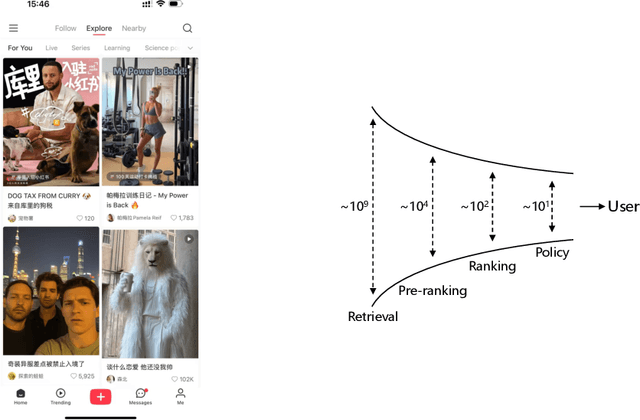
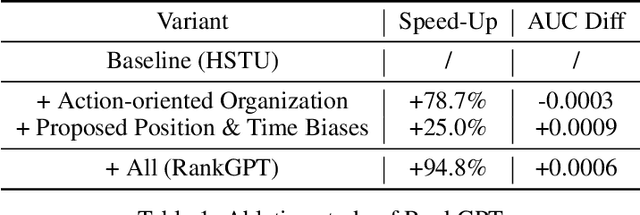
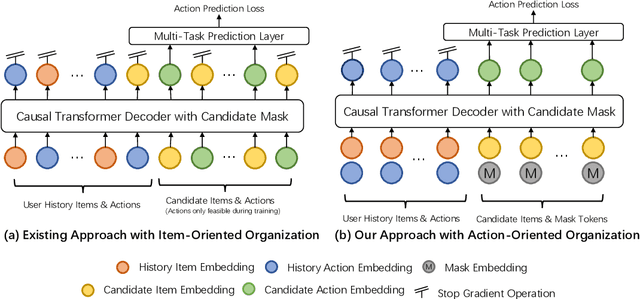

Generative recommendation has recently emerged as a promising paradigm in information retrieval. However, generative ranking systems are still understudied, particularly with respect to their effectiveness and feasibility in large-scale industrial settings. This paper investigates this topic at the ranking stage of Xiaohongshu's Explore Feed, a recommender system that serves hundreds of millions of users. Specifically, we first examine how generative ranking outperforms current industrial recommenders. Through theoretical and empirical analyses, we find that the primary improvement in effectiveness stems from the generative architecture, rather than the training paradigm. To facilitate efficient deployment of generative ranking, we introduce GenRank, a novel generative architecture for ranking. We validate the effectiveness and efficiency of our solution through online A/B experiments. The results show that GenRank achieves significant improvements in user satisfaction with nearly equivalent computational resources compared to the existing production system.
COAST: Intelligent Time-Adaptive Neural Operators
Feb 12, 2025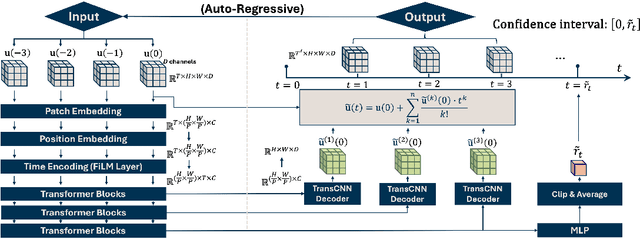
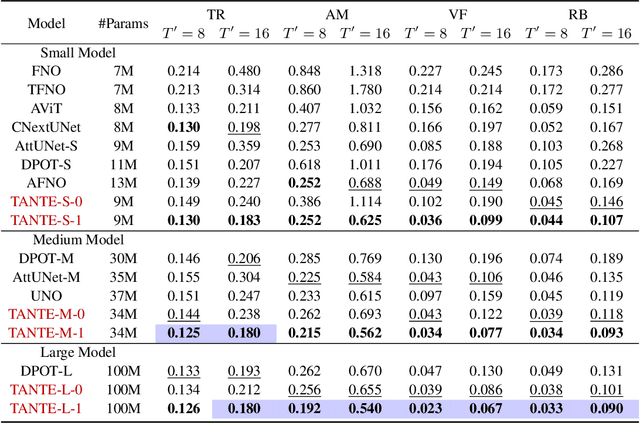
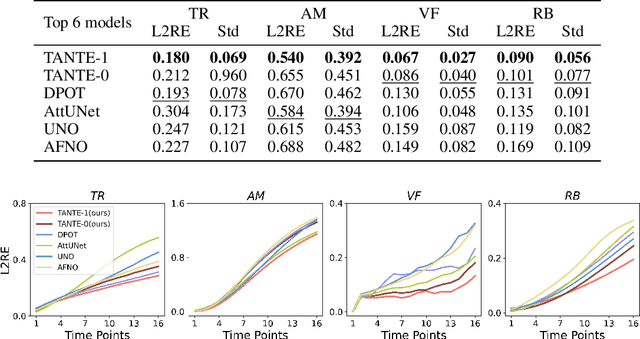
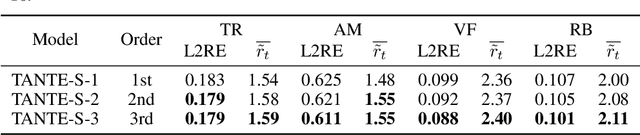
We introduce Causal Operator with Adaptive Solver Transformer (COAST), a novel neural operator learning method that leverages a causal language model (CLM) framework to dynamically adapt time steps. Our method predicts both the evolution of a system and its optimal time step, intelligently balancing computational efficiency and accuracy. We find that COAST generates variable step sizes that correlate with the underlying system intrinsicities, both within and across dynamical systems. Within a single trajectory, smaller steps are taken in regions of high complexity, while larger steps are employed in simpler regions. Across different systems, more complex dynamics receive more granular time steps. Benchmarked on diverse systems with varied dynamics, COAST consistently outperforms state-of-the-art methods, achieving superior performance in both efficiency and accuracy. This work underscores the potential of CLM-based intelligent adaptive solvers for scalable operator learning of dynamical systems.
Interactive Medical Image Segmentation: A Benchmark Dataset and Baseline
Nov 19, 2024Interactive Medical Image Segmentation (IMIS) has long been constrained by the limited availability of large-scale, diverse, and densely annotated datasets, which hinders model generalization and consistent evaluation across different models. In this paper, we introduce the IMed-361M benchmark dataset, a significant advancement in general IMIS research. First, we collect and standardize over 6.4 million medical images and their corresponding ground truth masks from multiple data sources. Then, leveraging the strong object recognition capabilities of a vision foundational model, we automatically generated dense interactive masks for each image and ensured their quality through rigorous quality control and granularity management. Unlike previous datasets, which are limited by specific modalities or sparse annotations, IMed-361M spans 14 modalities and 204 segmentation targets, totaling 361 million masks-an average of 56 masks per image. Finally, we developed an IMIS baseline network on this dataset that supports high-quality mask generation through interactive inputs, including clicks, bounding boxes, text prompts, and their combinations. We evaluate its performance on medical image segmentation tasks from multiple perspectives, demonstrating superior accuracy and scalability compared to existing interactive segmentation models. To facilitate research on foundational models in medical computer vision, we release the IMed-361M and model at https://github.com/uni-medical/IMIS-Bench.
Efficient and generalizable nested Fourier-DeepONet for three-dimensional geological carbon sequestration
Sep 25, 2024
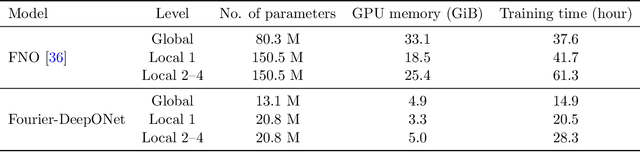

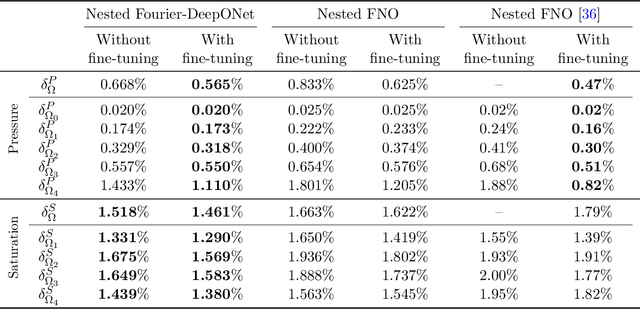
Geological carbon sequestration (GCS) involves injecting CO$_2$ into subsurface geological formations for permanent storage. Numerical simulations could guide decisions in GCS projects by predicting CO$_2$ migration pathways and the pressure distribution in storage formation. However, these simulations are often computationally expensive due to highly coupled physics and large spatial-temporal simulation domains. Surrogate modeling with data-driven machine learning has become a promising alternative to accelerate physics-based simulations. Among these, the Fourier neural operator (FNO) has been applied to three-dimensional synthetic subsurface models. Here, to further improve performance, we have developed a nested Fourier-DeepONet by combining the expressiveness of the FNO with the modularity of a deep operator network (DeepONet). This new framework is twice as efficient as a nested FNO for training and has at least 80% lower GPU memory requirement due to its flexibility to treat temporal coordinates separately. These performance improvements are achieved without compromising prediction accuracy. In addition, the generalization and extrapolation ability of nested Fourier-DeepONet beyond the training range has been thoroughly evaluated. Nested Fourier-DeepONet outperformed the nested FNO for extrapolation in time with more than 50% reduced error. It also exhibited good extrapolation accuracy beyond the training range in terms of reservoir properties, number of wells, and injection rate.
Beyond First-Order: A Multi-Scale Approach to Finger Knuckle Print Biometrics
Jun 28, 2024Recently, finger knuckle prints (FKPs) have gained attention due to their rich textural patterns, positioning them as a promising biometric for identity recognition. Prior FKP recognition methods predominantly leverage first-order feature descriptors, which capture intricate texture details but fail to account for structural information. Emerging research, however, indicates that second-order textures, which describe the curves and arcs of the textures, encompass this overlooked structural information. This paper introduces a novel FKP recognition approach, the Dual-Order Texture Competition Network (DOTCNet), designed to capture texture information in FKP images comprehensively. DOTCNet incorporates three dual-order texture competitive modules (DTCMs), each targeting textures at different scales. Each DTCM employs a learnable texture descriptor, specifically a learnable Gabor filter (LGF), to extract texture features. By leveraging LGFs, the network extracts first and second order textures to describe fine textures and structural features thoroughly. Furthermore, an attention mechanism enhances relevant features in the first-order features, thereby highlighting significant texture details. For second-order features, a competitive mechanism emphasizes structural information while reducing noise from higher-order features. Extensive experimental results reveal that DOTCNet significantly outperforms several standard algorithms on the publicly available PolyU-FKP dataset.