 Add to Chrome
 Add to Firefox
 Add to Edge
TrajSSL: Trajectory-Enhanced Semi-Supervised 3D Object Detection
Sep 17, 2024
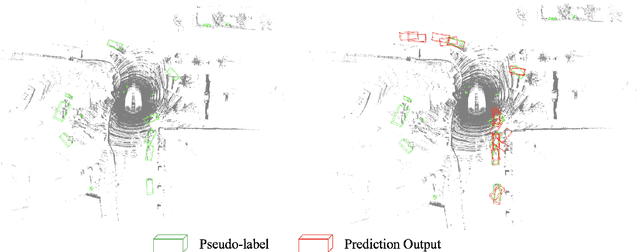
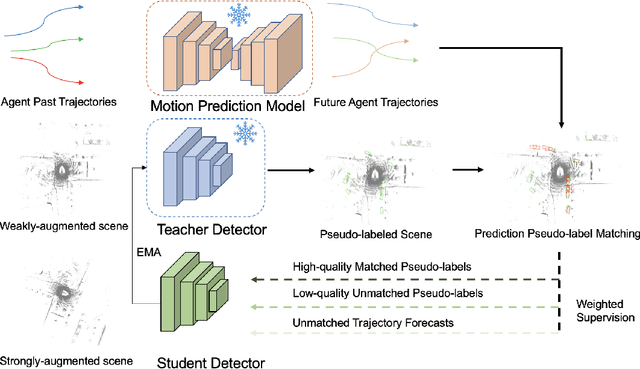
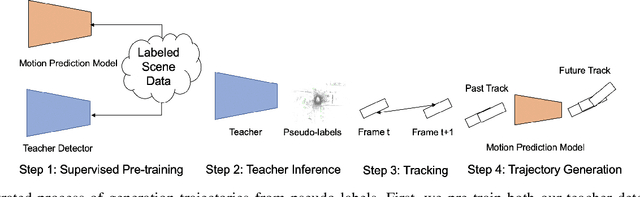
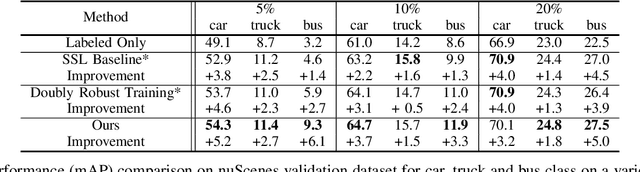
Semi-supervised 3D object detection is a common strategy employed to circumvent the challenge of manually labeling large-scale autonomous driving perception datasets. Pseudo-labeling approaches to semi-supervised learning adopt a teacher-student framework in which machine-generated pseudo-labels on a large unlabeled dataset are used in combination with a small manually-labeled dataset for training. In this work, we address the problem of improving pseudo-label quality through leveraging long-term temporal information captured in driving scenes. More specifically, we leverage pre-trained motion-forecasting models to generate object trajectories on pseudo-labeled data to further enhance the student model training. Our approach improves pseudo-label quality in two distinct manners: first, we suppress false positive pseudo-labels through establishing consistency across multiple frames of motion forecasting outputs. Second, we compensate for false negative detections by directly inserting predicted object tracks into the pseudo-labeled scene. Experiments on the nuScenes dataset demonstrate the effectiveness of our approach, improving the performance of standard semi-supervised approaches in a variety of settings.

Embodiment-Agnostic Action Planning via Object-Part Scene Flow
Sep 16, 2024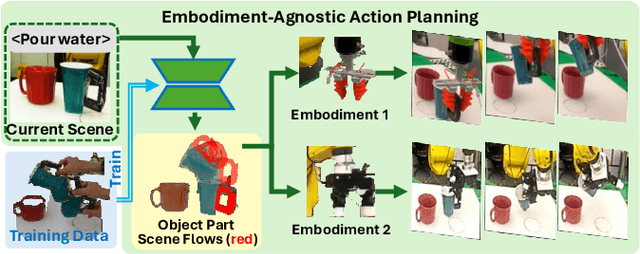

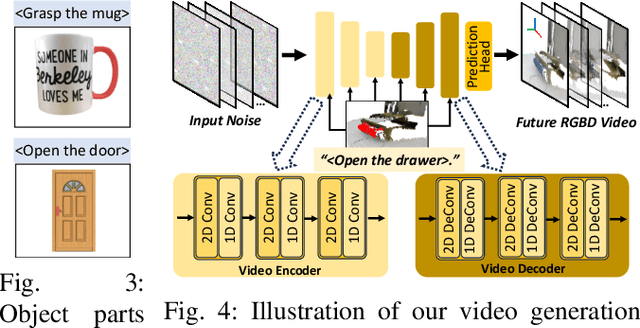

Observing that the key for robotic action planning is to understand the target-object motion when its associated part is manipulated by the end effector, we propose to generate the 3D object-part scene flow and extract its transformations to solve the action trajectories for diverse embodiments. The advantage of our approach is that it derives the robot action explicitly from object motion prediction, yielding a more robust policy by understanding the object motions. Also, beyond policies trained on embodiment-centric data, our method is embodiment-agnostic, generalizable across diverse embodiments, and being able to learn from human demonstrations. Our method comprises three components: an object-part predictor to locate the part for the end effector to manipulate, an RGBD video generator to predict future RGBD videos, and a trajectory planner to extract embodiment-agnostic transformation sequences and solve the trajectory for diverse embodiments. Trained on videos even without trajectory data, our method still outperforms existing works significantly by 27.7% and 26.2% on the prevailing virtual environments MetaWorld and Franka-Kitchen, respectively. Furthermore, we conducted real-world experiments, showing that our policy, trained only with human demonstration, can be deployed to various embodiments.
DSLO: Deep Sequence LiDAR Odometry Based on Inconsistent Spatio-temporal Propagation
Sep 01, 2024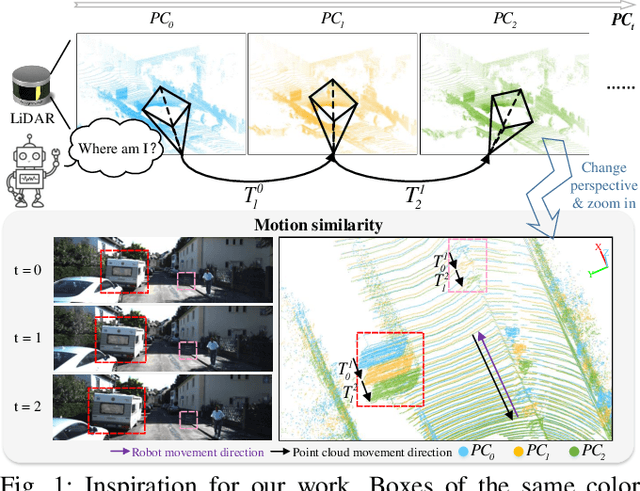


This paper introduces a 3D point cloud sequence learning model based on inconsistent spatio-temporal propagation for LiDAR odometry, termed DSLO. It consists of a pyramid structure with a spatial information reuse strategy, a sequential pose initialization module, a gated hierarchical pose refinement module, and a temporal feature propagation module. First, spatial features are encoded using a point feature pyramid, with features reused in successive pose estimations to reduce computational overhead. Second, a sequential pose initialization method is introduced, leveraging the high-frequency sampling characteristic of LiDAR to initialize the LiDAR pose. Then, a gated hierarchical pose refinement mechanism refines poses from coarse to fine by selectively retaining or discarding motion information from different layers based on gate estimations. Finally, temporal feature propagation is proposed to incorporate the historical motion information from point cloud sequences, and address the spatial inconsistency issue when transmitting motion information embedded in point clouds between frames. Experimental results on the KITTI odometry dataset and Argoverse dataset demonstrate that DSLO outperforms state-of-the-art methods, achieving at least a 15.67\% improvement on RTE and a 12.64\% improvement on RRE, while also achieving a 34.69\% reduction in runtime compared to baseline methods. Our implementation will be available at https://github.com/IRMVLab/DSLO.
Optimizing Diffusion Models for Joint Trajectory Prediction and Controllable Generation
Aug 01, 2024


Diffusion models are promising for joint trajectory prediction and controllable generation in autonomous driving, but they face challenges of inefficient inference steps and high computational demands. To tackle these challenges, we introduce Optimal Gaussian Diffusion (OGD) and Estimated Clean Manifold (ECM) Guidance. OGD optimizes the prior distribution for a small diffusion time $T$ and starts the reverse diffusion process from it. ECM directly injects guidance gradients to the estimated clean manifold, eliminating extensive gradient backpropagation throughout the network. Our methodology streamlines the generative process, enabling practical applications with reduced computational overhead. Experimental validation on the large-scale Argoverse 2 dataset demonstrates our approach's superior performance, offering a viable solution for computationally efficient, high-quality joint trajectory prediction and controllable generation for autonomous driving. Our project webpage is at https://yixiaowang7.github.io/OptTrajDiff_Page/.
WOMD-Reasoning: A Large-Scale Language Dataset for Interaction and Driving Intentions Reasoning
Jul 05, 2024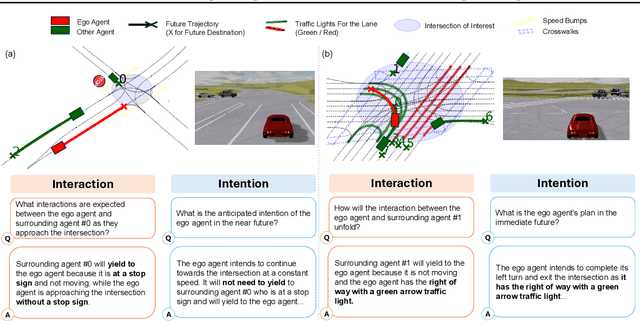
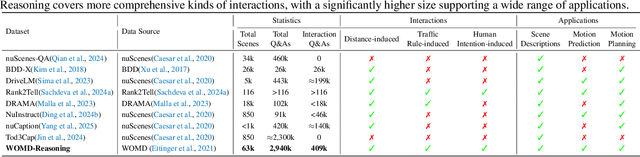
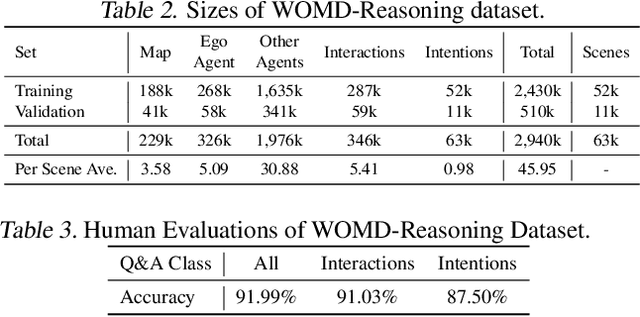
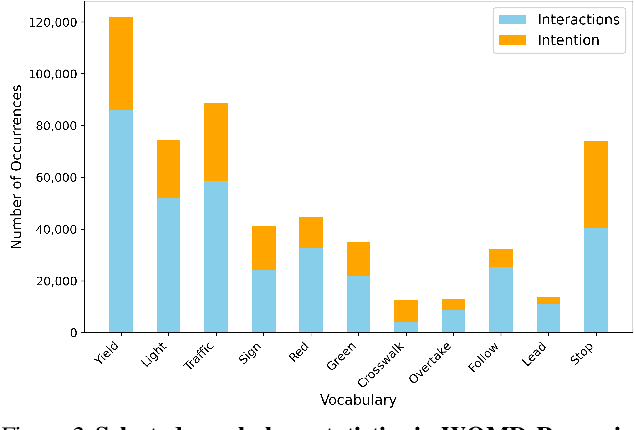
We propose Waymo Open Motion Dataset-Reasoning (WOMD-Reasoning), a language annotation dataset built on WOMD, with a focus on describing and reasoning interactions and intentions in driving scenarios. Previous language datasets primarily captured interactions caused by close distances. However, interactions induced by traffic rules and human intentions, which can occur over long distances, are yet sufficiently covered, despite being very common and more challenging for prediction or planning models to understand. Therefore, our WOMD-Reasoning focuses extensively on these interactions, providing a total of 409k Q&As for varying types of interactions. Additionally, WOMD-Reasoning presents by far the largest Q&A dataset on real-world driving scenarios, with around 3 million Q&As covering various topics of autonomous driving from map descriptions, motion status descriptions, to narratives and analyses of agents' interactions, behaviors, and intentions. This extensive textual information enables fine-tuning driving-related Large Language Models (LLMs) for a wide range of applications like scene description, prediction, planning, etc. By incorporating interaction and intention language from WOMD-Reasoning, we see significant enhancements in the performance of the state-of-the-art trajectory prediction model, Multipath++, with improvements of 10.14% in $MR_6$ and 6.90% in $minFDE_6$, proving the effectiveness of WOMD-Reasoning. We hope WOMD-Reasoning would empower LLMs in driving to offer better interaction understanding and behavioral reasoning. The dataset is available on https://waymo.com/open/download .
Residual-MPPI: Online Policy Customization for Continuous Control
Jul 02, 2024Policies learned through Reinforcement Learning (RL) and Imitation Learning (IL) have demonstrated significant potential in achieving advanced performance in continuous control tasks. However, in real-world environments, it is often necessary to further customize a trained policy when there are additional requirements that were unforeseen during the original training phase. It is possible to fine-tune the policy to meet the new requirements, but this often requires collecting new data with the added requirements and access to the original training metric and policy parameters. In contrast, an online planning algorithm, if capable of meeting the additional requirements, can eliminate the necessity for extensive training phases and customize the policy without knowledge of the original training scheme or task. In this work, we propose a generic online planning algorithm for customizing continuous-control policies at the execution time which we call Residual-MPPI. It is able to customize a given prior policy on new performance metrics in few-shot and even zero-shot online settings. Also, Residual-MPPI only requires access to the action distribution produced by the prior policy, without additional knowledge regarding the original task. Through our experiments, we demonstrate that the proposed Residual-MPPI algorithm can accomplish the few-shot/zero-shot online policy customization task effectively, including customizing the champion-level racing agent, Gran Turismo Sophy (GT Sophy) 1.0, in the challenging car racing scenario, Gran Turismo Sport (GTS) environment. Demo videos are available on our website: https://sites.google.com/view/residual-mppi
Sparse Diffusion Policy: A Sparse, Reusable, and Flexible Policy for Robot Learning
Jul 01, 2024


The increasing complexity of tasks in robotics demands efficient strategies for multitask and continual learning. Traditional models typically rely on a universal policy for all tasks, facing challenges such as high computational costs and catastrophic forgetting when learning new tasks. To address these issues, we introduce a sparse, reusable, and flexible policy, Sparse Diffusion Policy (SDP). By adopting Mixture of Experts (MoE) within a transformer-based diffusion policy, SDP selectively activates experts and skills, enabling efficient and task-specific learning without retraining the entire model. SDP not only reduces the burden of active parameters but also facilitates the seamless integration and reuse of experts across various tasks. Extensive experiments on diverse tasks in both simulations and real world show that SDP 1) excels in multitask scenarios with negligible increases in active parameters, 2) prevents forgetting in continual learning of new tasks, and 3) enables efficient task transfer, offering a promising solution for advanced robotic applications. Demos and codes can be found in https://forrest-110.github.io/sparse_diffusion_policy/.
MEReQ: Max-Ent Residual-Q Inverse RL for Sample-Efficient Alignment from Intervention
Jun 24, 2024Aligning robot behavior with human preferences is crucial for deploying embodied AI agents in human-centered environments. A promising solution is interactive imitation learning from human intervention, where a human expert observes the policy's execution and provides interventions as feedback. However, existing methods often fail to utilize the prior policy efficiently to facilitate learning, thus hindering sample efficiency. In this work, we introduce MEReQ (Maximum-Entropy Residual-Q Inverse Reinforcement Learning), designed for sample-efficient alignment from human intervention. Instead of inferring the complete human behavior characteristics, MEReQ infers a residual reward function that captures the discrepancy between the human expert's and the prior policy's underlying reward functions. It then employs Residual Q-Learning (RQL) to align the policy with human preferences using this residual reward function. Extensive evaluations on simulated and real-world tasks demonstrate that MEReQ achieves sample-efficient policy alignment from human intervention.
$\textit{S}^3$Gaussian: Self-Supervised Street Gaussians for Autonomous Driving
May 30, 2024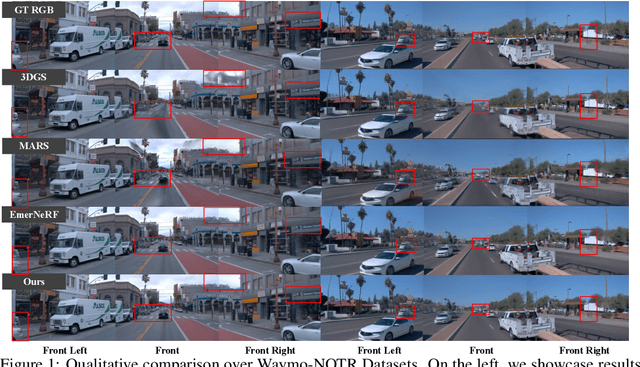
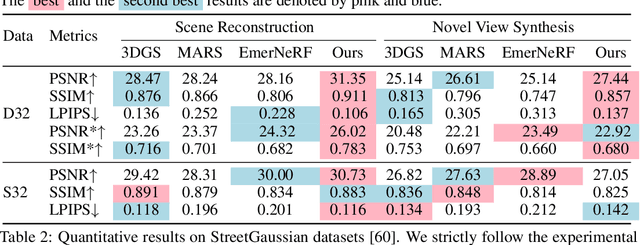
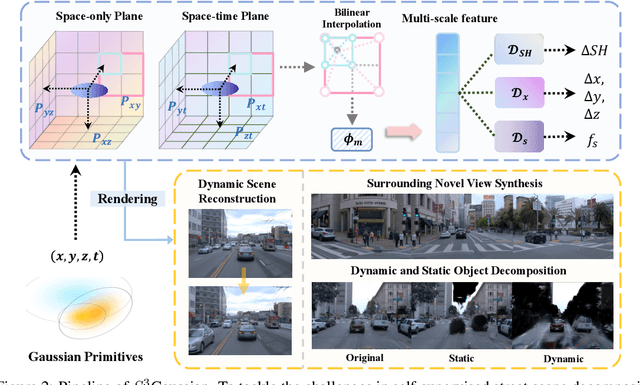
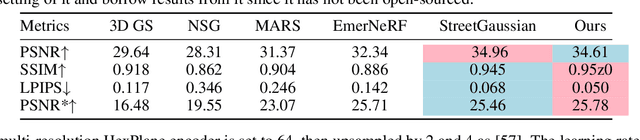
Photorealistic 3D reconstruction of street scenes is a critical technique for developing real-world simulators for autonomous driving. Despite the efficacy of Neural Radiance Fields (NeRF) for driving scenes, 3D Gaussian Splatting (3DGS) emerges as a promising direction due to its faster speed and more explicit representation. However, most existing street 3DGS methods require tracked 3D vehicle bounding boxes to decompose the static and dynamic elements for effective reconstruction, limiting their applications for in-the-wild scenarios. To facilitate efficient 3D scene reconstruction without costly annotations, we propose a self-supervised street Gaussian ($\textit{S}^3$Gaussian) method to decompose dynamic and static elements from 4D consistency. We represent each scene with 3D Gaussians to preserve the explicitness and further accompany them with a spatial-temporal field network to compactly model the 4D dynamics. We conduct extensive experiments on the challenging Waymo-Open dataset to evaluate the effectiveness of our method. Our $\textit{S}^3$Gaussian demonstrates the ability to decompose static and dynamic scenes and achieves the best performance without using 3D annotations. Code is available at: https://github.com/nnanhuang/S3Gaussian/.
NeRF in Robotics: A Survey
May 02, 2024


Meticulous 3D environment representations have been a longstanding goal in computer vision and robotics fields. The recent emergence of neural implicit representations has introduced radical innovation to this field as implicit representations enable numerous capabilities. Among these, the Neural Radiance Field (NeRF) has sparked a trend because of the huge representational advantages, such as simplified mathematical models, compact environment storage, and continuous scene representations. Apart from computer vision, NeRF has also shown tremendous potential in the field of robotics. Thus, we create this survey to provide a comprehensive understanding of NeRF in the field of robotics. By exploring the advantages and limitations of NeRF, as well as its current applications and future potential, we hope to shed light on this promising area of research. Our survey is divided into two main sections: \textit{The Application of NeRF in Robotics} and \textit{The Advance of NeRF in Robotics}, from the perspective of how NeRF enters the field of robotics. In the first section, we introduce and analyze some works that have been or could be used in the field of robotics from the perception and interaction perspectives. In the second section, we show some works related to improving NeRF's own properties, which are essential for deploying NeRF in the field of robotics. In the discussion section of the review, we summarize the existing challenges and provide some valuable future research directions for reference.