 Add to Chrome
 Add to Firefox
 Add to Edge
A Monolithic Hand with Asymmetric Origami Bending and Dual-chamber Actuators
Jul 24, 2026
The passive adaptability inherent in soft robotic hands affords them advantages in applications that require safe and compliant interaction. However, existing soft robotic hands often struggle to simultaneously achieve adequate output performance and easy manufacturing due to their complicated structures. In this paper, we introduce the asymmetric origami bending (AOB) pattern for generating bending motion and the asymmetric dual-chamber (ADC) design for obtaining multifunction capability. The AOB single (AOB-S) chamber and AOB dual-chamber (AOB-D) units are designed and constitute the finger and palm actuators of the proposed Origami-inspired SOft Robotic (OSOR) hand. The OSOR hand achieves bio-inspired fingers-palm motions and adequate output performance within a monolithic structure that significantly simplifies the manufacturing process. By defining the asymmetric ratio to characterize the geometric asymmetry of the unit, the analytical models of the AOB and ADC structures are proposed. The Finite Element Analysis tool for the design of AOB actuators is obtained by geometric analysis. The asymmetric origami design grants the integrated manufacturing of the OSOR hand through a Selective Laser Sintering printing process with a single thermoplastic polyurethane material. The model and simulations are validated by experimental results. Experiments show the finger and palm maximum bending motion range of 203° and 40°, respectively, with output forces of 6.3 N and 16 N. The OSOR hand is capable of pinching a piece of tissue, stably grasping water bottles with two fingers, palm-only grasping, and completing the power grasps in the taxonomy of manufacturing grasps. The compactness, performance, and easy manufacturing of the proposed hand benefit the development of the soft robotic hand with new possibilities.

SparseStreet: Sparse Gaussian Splatting for Real-Time Street Scene Simulation
Jun 02, 2026While 3D Gaussian Splatting has shown promising results in street scene reconstruction, existing methods require massive numbers of Gaussian primitives to capture fine details, leading to prohibitive storage costs and slow rendering speeds. We observe that dynamic objects (e.g., vehicles and pedestrians) demand high-fidelity representations to maintain temporal consistency, while static background regions often contain substantial redundancy. Motivated by this, we propose SparseStreet, a general compression framework specifically designed for street scenes. First, we introduce a node-based learnable pruning strategy that systematically removes low-contributing Gaussian primitives while preserving visually critical regions. Second, after the scene representation stabilizes, we apply background compression, further reducing redundancy in static regions. Our method effectively preserves the geometry and appearance of dynamic objects while significantly reducing the total number of Gaussian primitives. Extensive experiments on the Waymo and nuScenes demonstrate that SparseStreet achieves up to 80% compression ratio with minimal quality degradation, enabling resource-efficient, high-fidelity dynamic scene reconstruction. Project website: https://sparsestreet.github.io/.
Simulating Organized Group Behavior: New Framework, Benchmark, and Analysis
Apr 10, 2026Simulating how organized groups (e.g., corporations) make decisions (e.g., responding to a competitor's move) is essential for understanding real-world dynamics and could benefit relevant applications (e.g., market prediction). In this paper, we formalize this problem as a concrete research platform for group behavior understanding, providing: (1) a task definition with benchmark and evaluation criteria, (2) a structured analytical framework with a corresponding algorithm, and (3) detailed temporal and cross-group analysis. Specifically, we propose Organized Group Behavior Simulation, a task that models organized groups as collective entities from a practical perspective: given a group facing a particular situation (e.g., AI Boom), predict the decision it would take. To support this task, we present GROVE (GRoup Organizational BehaVior Evaluation), a benchmark covering 44 entities with 8,052 real-world context-decision pairs collected from Wikipedia and TechCrunch across 9 domains, with an end-to-end evaluation protocol assessing consistency, initiative, scope, magnitude, and horizon. Beyond straightforward prompting pipelines, we propose a structured analytical framework that converts collective decision-making events into an interpretable, adaptive, and traceable behavioral model, achieving stronger performance than summarization- and retrieval-based baselines. It further introduces an adapter mechanism for time-aware evolution and group-aware transfer, and traceable evidence nodes grounding each decision rule in originating historical events. Our analysis reveals temporal behavioral drift within individual groups, which the time-aware adapter effectively captures for stronger prediction, and structured cross-group similarity that enables knowledge transfer for data-scarce organizations.
EvoLen: Evolution-Guided Tokenization for DNA Language Model
Apr 09, 2026Tokens serve as the basic units of representation in DNA language models (DNALMs), yet their design remains underexplored. Unlike natural language, DNA lacks inherent token boundaries or predefined compositional rules, making tokenization a fundamental modeling decision rather than a naturally specified one. While existing approaches like byte-pair encoding (BPE) excel at capturing token structures that reflect human-generated linguistic regularities, DNA is organized by biological function and evolutionary constraint rather than linguistic convention. We argue that DNA tokenization should prioritize functional sequence patterns like regulatory motifs-short, recurring segments under evolutionary constraint and typically preserved across species. We incorporate evolutionary information directly into the tokenization process through EvoLen, a tokenizer that combines evolutionary stratification with length-aware decoding to better preserve motif-scale functional sequence units. EvoLen uses cross-species evolutionary signals to group DNA sequences, trains separate BPE tokenizers on each group, merges the resulting vocabularies via a rule prioritizing preserved patterns, and applies length-aware decoding with dynamic programming. Through controlled experiments, EvoLen improves the preservation of functional sequence patterns, differentiation across genomic contexts, and alignment with evolutionary constraint, while matching or outperforming standard BPE across diverse DNALM benchmarks. These results demonstrate that tokenization introduces a critical inductive bias and that incorporating evolutionary information yields more biologically meaningful and interpretable sequence representations.
Self-Improving 4D Perception via Self-Distillation
Apr 09, 2026Large-scale multi-view reconstruction models have made remarkable progress, but most existing approaches still rely on fully supervised training with ground-truth 3D/4D annotations. Such annotations are expensive and particularly scarce for dynamic scenes, limiting scalability. We propose SelfEvo, a self-improving framework that continually improves pretrained multi-view reconstruction models using unlabeled videos. SelfEvo introduces a self-distillation scheme using spatiotemporal context asymmetry, enabling self-improvement for learning-based 4D perception without external annotations. We systematically study design choices that make self-improvement effective, including loss signals, forms of asymmetry, and other training strategies. Across eight benchmarks spanning diverse datasets and domains, SelfEvo consistently improves pretrained baselines and generalizes across base models (e.g. VGGT and $π^3$), with significant gains on dynamic scenes. Overall, SelfEvo achieves up to 36.5% relative improvement in video depth estimation and 20.1% in camera estimation, without using any labeled data. Project Page: https://self-evo.github.io/.
Segment Any Motion in Videos
Mar 28, 2025Moving object segmentation is a crucial task for achieving a high-level understanding of visual scenes and has numerous downstream applications. Humans can effortlessly segment moving objects in videos. Previous work has largely relied on optical flow to provide motion cues; however, this approach often results in imperfect predictions due to challenges such as partial motion, complex deformations, motion blur and background distractions. We propose a novel approach for moving object segmentation that combines long-range trajectory motion cues with DINO-based semantic features and leverages SAM2 for pixel-level mask densification through an iterative prompting strategy. Our model employs Spatio-Temporal Trajectory Attention and Motion-Semantic Decoupled Embedding to prioritize motion while integrating semantic support. Extensive testing on diverse datasets demonstrates state-of-the-art performance, excelling in challenging scenarios and fine-grained segmentation of multiple objects. Our code is available at https://motion-seg.github.io/.
EMD: Explicit Motion Modeling for High-Quality Street Gaussian Splatting
Nov 23, 2024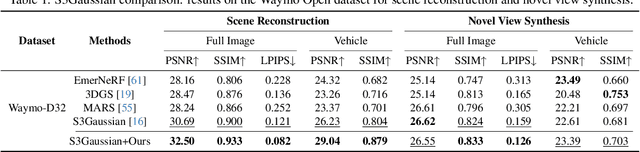
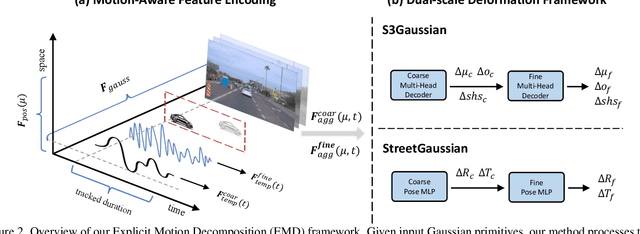
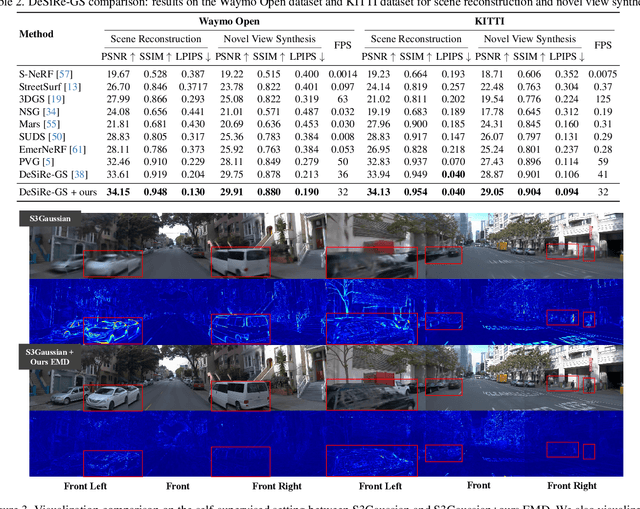

Photorealistic reconstruction of street scenes is essential for developing real-world simulators in autonomous driving. While recent methods based on 3D/4D Gaussian Splatting (GS) have demonstrated promising results, they still encounter challenges in complex street scenes due to the unpredictable motion of dynamic objects. Current methods typically decompose street scenes into static and dynamic objects, learning the Gaussians in either a supervised manner (e.g., w/ 3D bounding-box) or a self-supervised manner (e.g., w/o 3D bounding-box). However, these approaches do not effectively model the motions of dynamic objects (e.g., the motion speed of pedestrians is clearly different from that of vehicles), resulting in suboptimal scene decomposition. To address this, we propose Explicit Motion Decomposition (EMD), which models the motions of dynamic objects by introducing learnable motion embeddings to the Gaussians, enhancing the decomposition in street scenes. The proposed EMD is a plug-and-play approach applicable to various baseline methods. We also propose tailored training strategies to apply EMD to both supervised and self-supervised baselines. Through comprehensive experimentation, we illustrate the effectiveness of our approach with various established baselines. The code will be released at: https://qingpowuwu.github.io/emdgaussian.github.io/.
Repurposing Foundation Model for Generalizable Medical Time Series Classification
Oct 03, 2024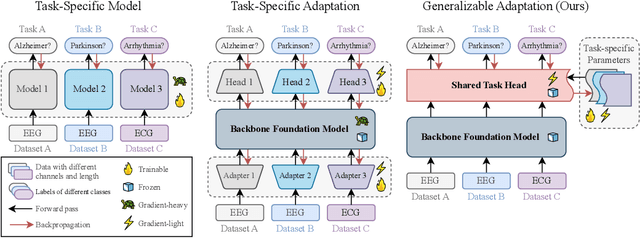


Medical time series (MedTS) classification is critical for a wide range of healthcare applications such as Alzheimer's Disease diagnosis. However, its real-world deployment is severely challenged by poor generalizability due to inter- and intra-dataset heterogeneity in MedTS, including variations in channel configurations, time series lengths, and diagnostic tasks. Here, we propose FORMED, a foundation classification model that leverages a pre-trained backbone and tackles these challenges through re-purposing. FORMED integrates the general representation learning enabled by the backbone foundation model and the medical domain knowledge gained on a curated cohort of MedTS datasets. FORMED can adapt seamlessly to unseen MedTS datasets, regardless of the number of channels, sample lengths, or medical tasks. Experimental results show that, without any task-specific adaptation, the repurposed FORMED achieves performance that is competitive with, and often superior to, 11 baseline models trained specifically for each dataset. Furthermore, FORMED can effectively adapt to entirely new, unseen datasets, with lightweight parameter updates, consistently outperforming baselines. Our results highlight FORMED as a versatile and scalable model for a wide range of MedTS classification tasks, positioning it as a strong foundation model for future research in MedTS analysis.
$\textit{S}^3$Gaussian: Self-Supervised Street Gaussians for Autonomous Driving
May 30, 2024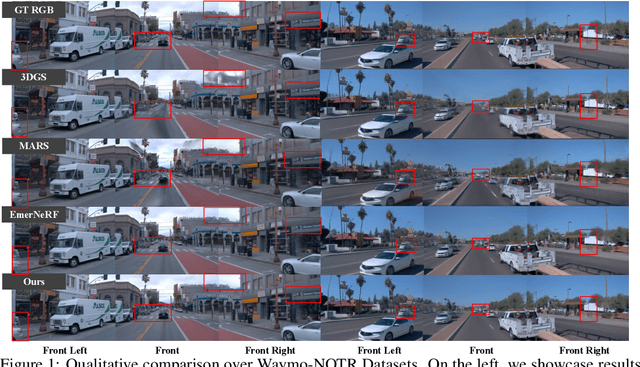
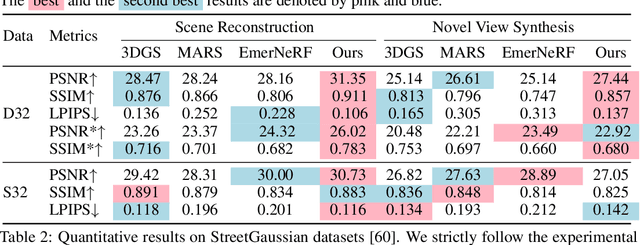
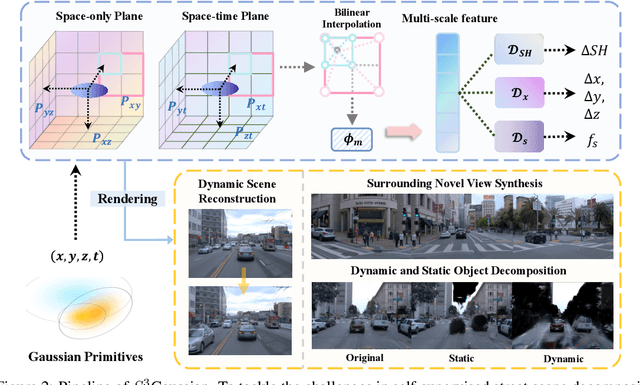
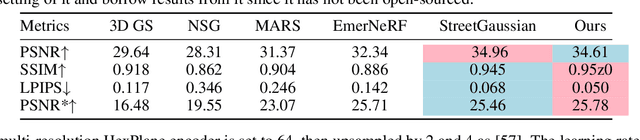
Photorealistic 3D reconstruction of street scenes is a critical technique for developing real-world simulators for autonomous driving. Despite the efficacy of Neural Radiance Fields (NeRF) for driving scenes, 3D Gaussian Splatting (3DGS) emerges as a promising direction due to its faster speed and more explicit representation. However, most existing street 3DGS methods require tracked 3D vehicle bounding boxes to decompose the static and dynamic elements for effective reconstruction, limiting their applications for in-the-wild scenarios. To facilitate efficient 3D scene reconstruction without costly annotations, we propose a self-supervised street Gaussian ($\textit{S}^3$Gaussian) method to decompose dynamic and static elements from 4D consistency. We represent each scene with 3D Gaussians to preserve the explicitness and further accompany them with a spatial-temporal field network to compactly model the 4D dynamics. We conduct extensive experiments on the challenging Waymo-Open dataset to evaluate the effectiveness of our method. Our $\textit{S}^3$Gaussian demonstrates the ability to decompose static and dynamic scenes and achieves the best performance without using 3D annotations. Code is available at: https://github.com/nnanhuang/S3Gaussian/.
UnitNorm: Rethinking Normalization for Transformers in Time Series
May 24, 2024Normalization techniques are crucial for enhancing Transformer models' performance and stability in time series analysis tasks, yet traditional methods like batch and layer normalization often lead to issues such as token shift, attention shift, and sparse attention. We propose UnitNorm, a novel approach that scales input vectors by their norms and modulates attention patterns, effectively circumventing these challenges. Grounded in existing normalization frameworks, UnitNorm's effectiveness is demonstrated across diverse time series analysis tasks, including forecasting, classification, and anomaly detection, via a rigorous evaluation on 6 state-of-the-art models and 10 datasets. Notably, UnitNorm shows superior performance, especially in scenarios requiring robust attention mechanisms and contextual comprehension, evidenced by significant improvements by up to a 1.46 decrease in MSE for forecasting, and a 4.89% increase in accuracy for classification. This work not only calls for a reevaluation of normalization strategies in time series Transformers but also sets a new direction for enhancing model performance and stability. The source code is available at https://anonymous.4open.science/r/UnitNorm-5B84.