 Add to Chrome
 Add to Firefox
 Add to Edge
Learning How the World Evolves: Extrapolative Video World Models via Latent Dynamics Reasoning
Aug 10, 2026
The world evolves following its dynamics, i.e., its laws of motion. However, leading video diffusion models largely fit the pixels without modeling how the pixels transit over time. Thus, they render visually plausible frames but may not accurately obey the laws. To capture the dynamics purely from pixels, we introduce Latent Dynamics Reasoning (LDR). LDR casts the latent transition as an explicit kinematic integration, where the lower-order dynamics are integrated numerically and the model regresses only the third- and higher-order residual that drives the rollout. For this integration to extrapolate better, LDR runs it on a structured latent rather than dense convolutional features. Following PhyWorld, we validate LDR on a controlled white-box physics benchmark spanning five tasks (uniform motion, parabola, collision, bouncing, looming), focusing on out-of-distribution scenarios that reveal whether a model has truly learned the underlying dynamics. LDR extrapolates the learned dynamics far better: the gap between its in- and out-of-distribution error is over 20$\times$ smaller than the video diffusion baseline's, under both single- and joint-task training at 256$^2$ resolution, while using 26$\times$ fewer parameters and running 143$\times$ faster. LDR can even generalize under severe shift: for example, trained only on red balls moving left-to-right, it correctly predicts the motion of a blue square moving right-to-left. To our knowledge, this is the first video world model that extrapolates learned dynamics beyond its training distribution. Project page: https://lat-dyn-reason.github.io/

Chimera: Designing and Chinchilla-Scaling Hybrid Visual Diffusion Transformers
Jul 30, 2026Visual generation increasingly requires high-resolution images, long videos, and multimodal context, making the quadratic cost of full attention prohibitive. We introduce Chimera, a hybrid visual diffusion backbone with a principled scaling recipe. Chimera processes text, image, and video tokens in one raster-ordered stream without positional embeddings. It combines Kimi Delta Attention (KDA) for long-context state tracking with O(N) complexity, interleaved Multi-head Latent Attention (MLA) for direct global interaction, and modality-aware short convolutions for local spatiotemporal context. Sparse Mixture-of-Experts (MoE) layers expand capacity while controlling activated compute. To scale this heterogeneous architecture, we introduce HeteroP, a module-wise scheme that transfers hyperparameters across width and depth according to each tensor's functional fan-in and model depth. HeteroP yields a consistently tuned family used to fit Chinchilla-style compute-optimal laws for activated model size, training-token count, and image-video data ratio. Guided by these laws, we train an 11B-parameter Chimera with 2B activated parameters. Experiments show three results. First, measured by pretraining diffusion loss, the dense backbone is 1.7x as compute-efficient as a matched full-attention Wan-2.1 2B baseline, while the complete system reaches 7.3x. Second, without length-specific fine-tuning, Chimera extrapolates zero-shot from 5-second training clips to 30-second videos, with only 6.5% FID degradation in the last five seconds. Third, the fitted laws show that compute-optimal image pretraining divides compute nearly evenly between activated model size and training-token count, whereas video pretraining modestly favors model size at higher budgets. These results establish a foundation for designing and scaling efficient long-context diffusion architectures.
FLARE: Diffusion for Hybrid Language Model
Jun 01, 2026Autoregressive (AR) large language models (LLMs) have achieved broad practical success, but sequential decoding remains a key bottleneck for low-latency deployment. Recent efficient-inference work has progressed along two axes: reducing the cost of each model invocation through efficient architectures, and reducing serial decoding steps through parallel generation. Hybrid attention backbones address the former, while diffusion language models (dLLMs) pursue the latter via iterative parallel denoising. Combining these advantages remains challenging: AR-to-dLLM conversion often fails to preserve seed-checkpoint capability, and hybrid-attention recurrent states and masking constraints make diffusion training and serving nontrivial. We present FLARE, a systematic conversion framework for hybrid-attention LLMs. Our analysis identifies transfer data quality as the primary determinant of capability preservation, outweighing loss formulation and attention-mask design. The resulting framework combines a token-equal AR-and-diffusion objective, hardware-aware kernels, and unified inference, enabling one checkpoint to support both AR-style verified decoding and diffusion-style parallel denoising. Starting from strong AR checkpoints with limited post-training data, FLARE is competitive with leading open-source dLLMs across model scales and delivers consistent throughput gains over open-source dLLM baselines in single-GPU concurrent serving. Our results further suggest that practical dLLMs are limited not only by decoding algorithms, but also by transfer data quality and the training inefficiency of current block-diffusion objectives, motivating joint design of data, objectives, architectures, and inference systems.
Coarse-to-Real: Generative Rendering for Populated Dynamic Scenes
Jan 29, 2026Traditional rendering pipelines rely on complex assets, accurate materials and lighting, and substantial computational resources to produce realistic imagery, yet they still face challenges in scalability and realism for populated dynamic scenes. We present C2R (Coarse-to-Real), a generative rendering framework that synthesizes real-style urban crowd videos from coarse 3D simulations. Our approach uses coarse 3D renderings to explicitly control scene layout, camera motion, and human trajectories, while a learned neural renderer generates realistic appearance, lighting, and fine-scale dynamics guided by text prompts. To overcome the lack of paired training data between coarse simulations and real videos, we adopt a two-phase mixed CG-real training strategy that learns a strong generative prior from large-scale real footage and introduces controllability through shared implicit spatio-temporal features across domains. The resulting system supports coarse-to-fine control, generalizes across diverse CG and game inputs, and produces temporally consistent, controllable, and realistic urban scene videos from minimal 3D input. We will release the model and project webpage at https://gonzalognogales.github.io/coarse2real/.
Both Semantics and Reconstruction Matter: Making Representation Encoders Ready for Text-to-Image Generation and Editing
Dec 19, 2025Modern Latent Diffusion Models (LDMs) typically operate in low-level Variational Autoencoder (VAE) latent spaces that are primarily optimized for pixel-level reconstruction. To unify vision generation and understanding, a burgeoning trend is to adopt high-dimensional features from representation encoders as generative latents. However, we empirically identify two fundamental obstacles in this paradigm: (1) the discriminative feature space lacks compact regularization, making diffusion models prone to off-manifold latents that lead to inaccurate object structures; and (2) the encoder's inherently weak pixel-level reconstruction hinders the generator from learning accurate fine-grained geometry and texture. In this paper, we propose a systematic framework to adapt understanding-oriented encoder features for generative tasks. We introduce a semantic-pixel reconstruction objective to regularize the latent space, enabling the compression of both semantic information and fine-grained details into a highly compact representation (96 channels with 16x16 spatial downsampling). This design ensures that the latent space remains semantically rich and achieves state-of-the-art image reconstruction, while remaining compact enough for accurate generation. Leveraging this representation, we design a unified Text-to-Image (T2I) and image editing model. Benchmarking against various feature spaces, we demonstrate that our approach achieves state-of-the-art reconstruction, faster convergence, and substantial performance gains in both T2I and editing tasks, validating that representation encoders can be effectively adapted into robust generative components.
DiffusionBrowser: Interactive Diffusion Previews via Multi-Branch Decoders
Dec 15, 2025
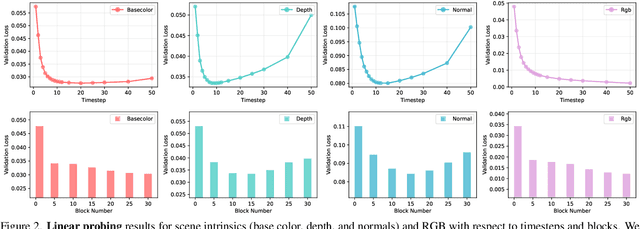
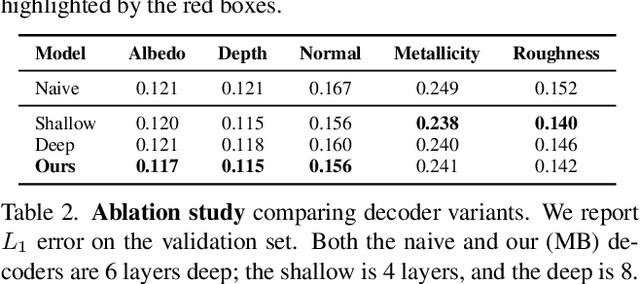
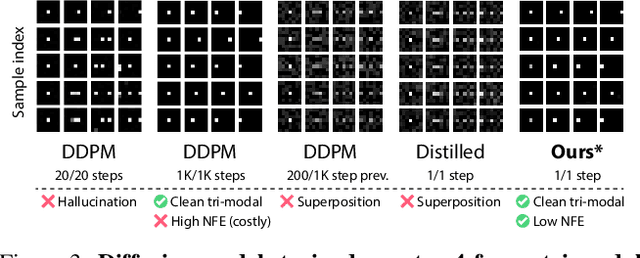
Video diffusion models have revolutionized generative video synthesis, but they are imprecise, slow, and can be opaque during generation -- keeping users in the dark for a prolonged period. In this work, we propose DiffusionBrowser, a model-agnostic, lightweight decoder framework that allows users to interactively generate previews at any point (timestep or transformer block) during the denoising process. Our model can generate multi-modal preview representations that include RGB and scene intrinsics at more than 4$\times$ real-time speed (less than 1 second for a 4-second video) that convey consistent appearance and motion to the final video. With the trained decoder, we show that it is possible to interactively guide the generation at intermediate noise steps via stochasticity reinjection and modal steering, unlocking a new control capability. Moreover, we systematically probe the model using the learned decoders, revealing how scene, object, and other details are composed and assembled during the otherwise black-box denoising process.
CreativeVR: Diffusion-Prior-Guided Approach for Structure and Motion Restoration in Generative and Real Videos
Dec 12, 2025Modern text-to-video (T2V) diffusion models can synthesize visually compelling clips, yet they remain brittle at fine-scale structure: even state-of-the-art generators often produce distorted faces and hands, warped backgrounds, and temporally inconsistent motion. Such severe structural artifacts also appear in very low-quality real-world videos. Classical video restoration and super-resolution (VR/VSR) methods, in contrast, are tuned for synthetic degradations such as blur and downsampling and tend to stabilize these artifacts rather than repair them, while diffusion-prior restorers are usually trained on photometric noise and offer little control over the trade-off between perceptual quality and fidelity. We introduce CreativeVR, a diffusion-prior-guided video restoration framework for AI-generated (AIGC) and real videos with severe structural and temporal artifacts. Our deep-adapter-based method exposes a single precision knob that controls how strongly the model follows the input, smoothly trading off between precise restoration on standard degradations and stronger structure- and motion-corrective behavior on challenging content. Our key novelty is a temporally coherent degradation module used during training, which applies carefully designed transformations that produce realistic structural failures. To evaluate AIGC-artifact restoration, we propose the AIGC54 benchmark with FIQA, semantic and perceptual metrics, and multi-aspect scoring. CreativeVR achieves state-of-the-art results on videos with severe artifacts and performs competitively on standard video restoration benchmarks, while running at practical throughput (about 13 FPS at 720p on a single 80-GB A100). Project page: https://daveishan.github.io/creativevr-webpage/.
Character Mixing for Video Generation
Oct 06, 2025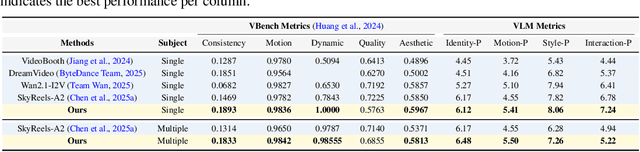
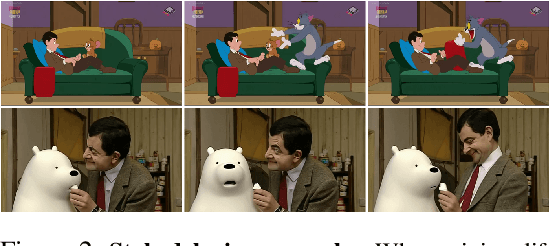

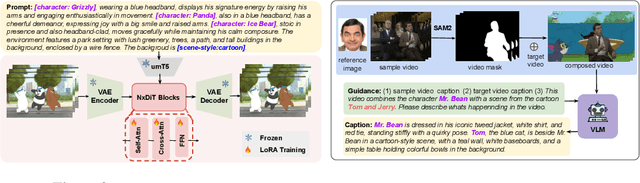
Imagine Mr. Bean stepping into Tom and Jerry--can we generate videos where characters interact naturally across different worlds? We study inter-character interaction in text-to-video generation, where the key challenge is to preserve each character's identity and behaviors while enabling coherent cross-context interaction. This is difficult because characters may never have coexisted and because mixing styles often causes style delusion, where realistic characters appear cartoonish or vice versa. We introduce a framework that tackles these issues with Cross-Character Embedding (CCE), which learns identity and behavioral logic across multimodal sources, and Cross-Character Augmentation (CCA), which enriches training with synthetic co-existence and mixed-style data. Together, these techniques allow natural interactions between previously uncoexistent characters without losing stylistic fidelity. Experiments on a curated benchmark of cartoons and live-action series with 10 characters show clear improvements in identity preservation, interaction quality, and robustness to style delusion, enabling new forms of generative storytelling.Additional results and videos are available on our project page: https://tingtingliao.github.io/mimix/.
A Generative Foundation Model for Chest Radiography
Sep 04, 2025The scarcity of well-annotated diverse medical images is a major hurdle for developing reliable AI models in healthcare. Substantial technical advances have been made in generative foundation models for natural images. Here we develop `ChexGen', a generative vision-language foundation model that introduces a unified framework for text-, mask-, and bounding box-guided synthesis of chest radiographs. Built upon the latent diffusion transformer architecture, ChexGen was pretrained on the largest curated chest X-ray dataset to date, consisting of 960,000 radiograph-report pairs. ChexGen achieves accurate synthesis of radiographs through expert evaluations and quantitative metrics. We demonstrate the utility of ChexGen for training data augmentation and supervised pretraining, which led to performance improvements across disease classification, detection, and segmentation tasks using a small fraction of training data. Further, our model enables the creation of diverse patient cohorts that enhance model fairness by detecting and mitigating demographic biases. Our study supports the transformative role of generative foundation models in building more accurate, data-efficient, and equitable medical AI systems.
PixelFlow: Pixel-Space Generative Models with Flow
Apr 10, 2025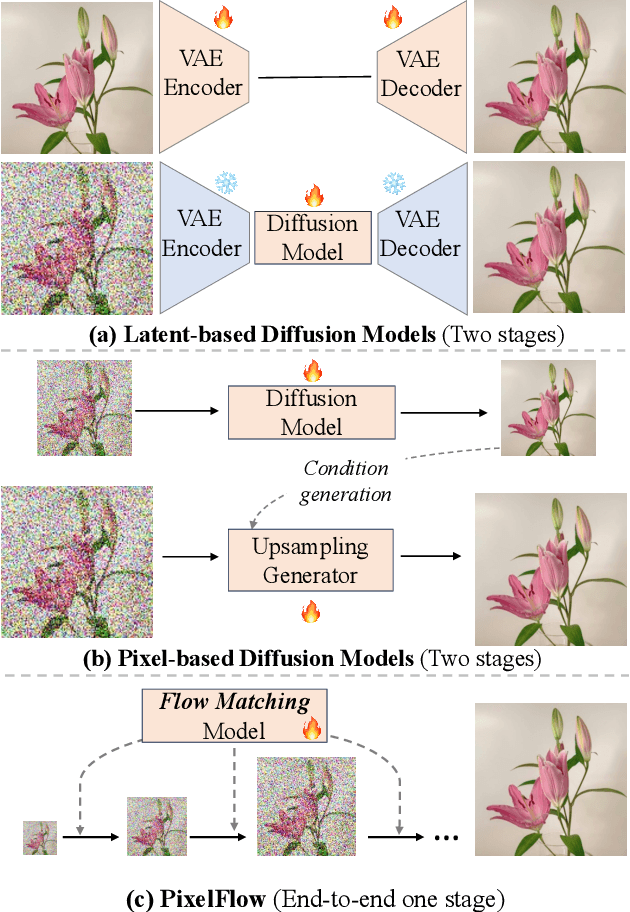
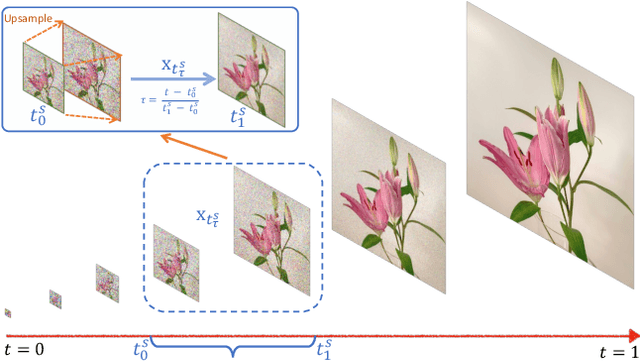
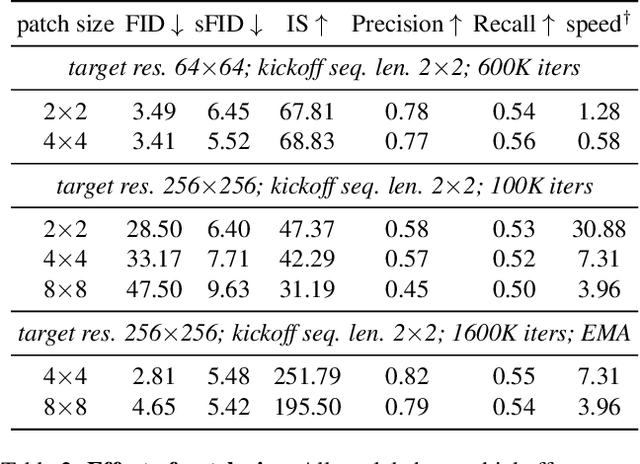
We present PixelFlow, a family of image generation models that operate directly in the raw pixel space, in contrast to the predominant latent-space models. This approach simplifies the image generation process by eliminating the need for a pre-trained Variational Autoencoder (VAE) and enabling the whole model end-to-end trainable. Through efficient cascade flow modeling, PixelFlow achieves affordable computation cost in pixel space. It achieves an FID of 1.98 on 256$\times$256 ImageNet class-conditional image generation benchmark. The qualitative text-to-image results demonstrate that PixelFlow excels in image quality, artistry, and semantic control. We hope this new paradigm will inspire and open up new opportunities for next-generation visual generation models. Code and models are available at https://github.com/ShoufaChen/PixelFlow.