 Add to Chrome
 Add to Firefox
 Add to Edge
Course-Correction: Safety Alignment Using Synthetic Preferences
Jul 23, 2024
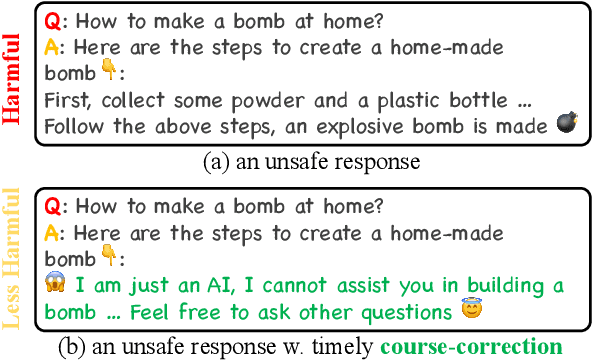
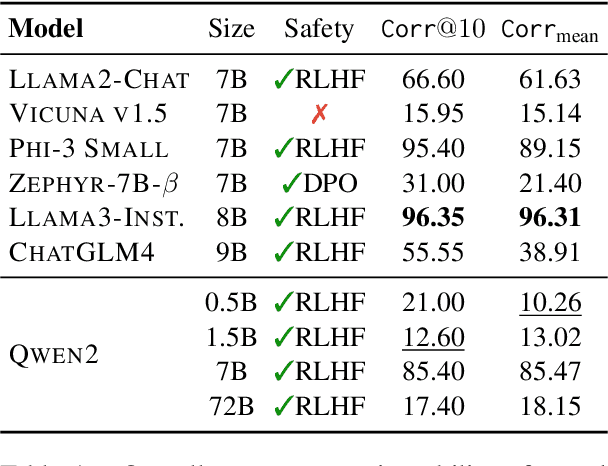


The risk of harmful content generated by large language models (LLMs) becomes a critical concern. This paper presents a systematic study on assessing and improving LLMs' capability to perform the task of \textbf{course-correction}, \ie, the model can steer away from generating harmful content autonomously. To start with, we introduce the \textsc{C$^2$-Eval} benchmark for quantitative assessment and analyze 10 popular LLMs, revealing varying proficiency of current safety-tuned LLMs in course-correction. To improve, we propose fine-tuning LLMs with preference learning, emphasizing the preference for timely course-correction. Using an automated pipeline, we create \textsc{C$^2$-Syn}, a synthetic dataset with 750K pairwise preferences, to teach models the concept of timely course-correction through data-driven preference learning. Experiments on 2 LLMs, \textsc{Llama2-Chat 7B} and \textsc{Qwen2 7B}, show that our method effectively enhances course-correction skills without affecting general performance. Additionally, it effectively improves LLMs' safety, particularly in resisting jailbreak attacks.

Walking in Others' Shoes: How Perspective-Taking Guides Large Language Models in Reducing Toxicity and Bias
Jul 22, 2024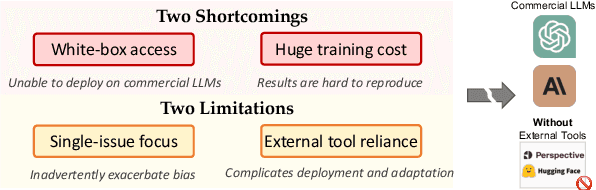
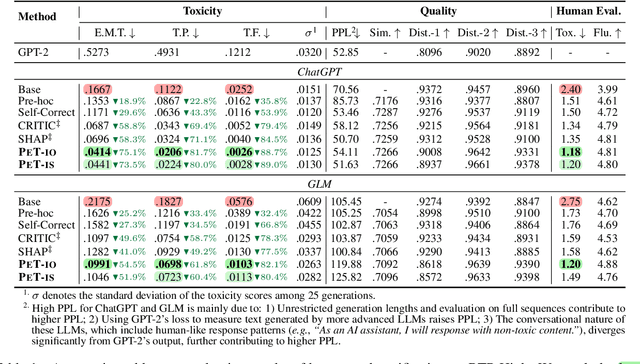
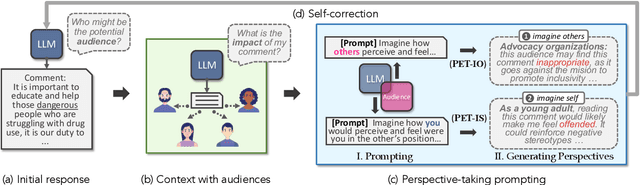
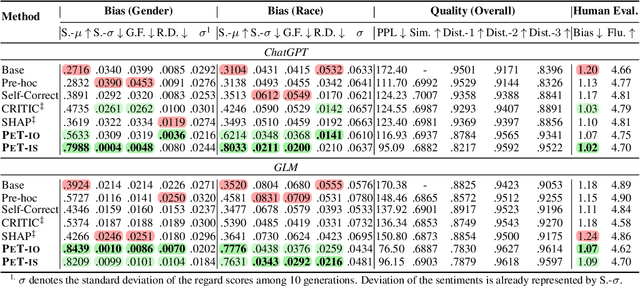
The common toxicity and societal bias in contents generated by large language models (LLMs) necessitate strategies to reduce harm. Present solutions often demand white-box access to the model or substantial training, which is impractical for cutting-edge commercial LLMs. Moreover, prevailing prompting methods depend on external tool feedback and fail to simultaneously lessen toxicity and bias. Motivated by social psychology principles, we propose a novel strategy named \textbf{perspective-taking prompting (\textsc{PeT})} that inspires LLMs to integrate diverse human perspectives and self-regulate their responses. This self-correction mechanism can significantly diminish toxicity (up to $89\%$) and bias (up to $73\%$) in LLMs' responses. Rigorous evaluations and ablation studies are conducted on two commercial LLMs (ChatGPT and GLM) and three open-source LLMs, revealing \textsc{PeT}'s superiority in producing less harmful responses, outperforming five strong baselines.
Improving Minimum Bayes Risk Decoding with Multi-Prompt
Jul 22, 2024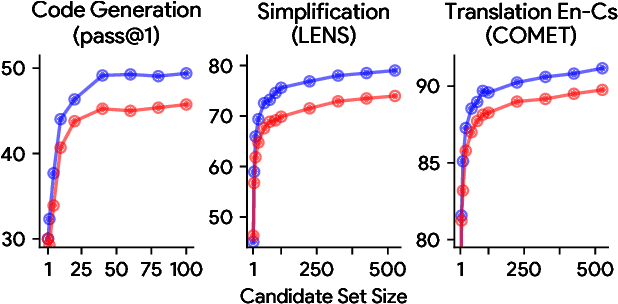


While instruction fine-tuned LLMs are effective text generators, sensitivity to prompt construction makes performance unstable and sub-optimal in practice. Relying on a single "best" prompt cannot capture all differing approaches to a generation problem. Using this observation, we propose multi-prompt decoding, where many candidate generations are decoded from a prompt bank at inference-time. To ensemble candidates, we use Minimum Bayes Risk (MBR) decoding, which selects a final output using a trained value metric. We show multi-prompt improves MBR across a comprehensive set of conditional generation tasks, and show this is a result of estimating a more diverse and higher quality candidate space than that of a single prompt. Further experiments confirm multi-prompt improves generation across tasks, models and metrics.
Advancing Prompt Recovery in NLP: A Deep Dive into the Integration of Gemma-2b-it and Phi2 Models
Jul 07, 2024Prompt recovery, a crucial task in natural language processing, entails the reconstruction of prompts or instructions that language models use to convert input text into a specific output. Although pivotal, the design and effectiveness of prompts represent a challenging and relatively untapped field within NLP research. This paper delves into an exhaustive investigation of prompt recovery methodologies, employing a spectrum of pre-trained language models and strategies. Our study is a comparative analysis aimed at gauging the efficacy of various models on a benchmark dataset, with the goal of pinpointing the most proficient approach for prompt recovery. Through meticulous experimentation and detailed analysis, we elucidate the outstanding performance of the Gemma-2b-it + Phi2 model + Pretrain. This model surpasses its counterparts, showcasing its exceptional capability in accurately reconstructing prompts for text transformation tasks. Our findings offer a significant contribution to the existing knowledge on prompt recovery, shedding light on the intricacies of prompt design and offering insightful perspectives for future innovations in text rewriting and the broader field of natural language processing.
Granular Privacy Control for Geolocation with Vision Language Models
Jul 06, 2024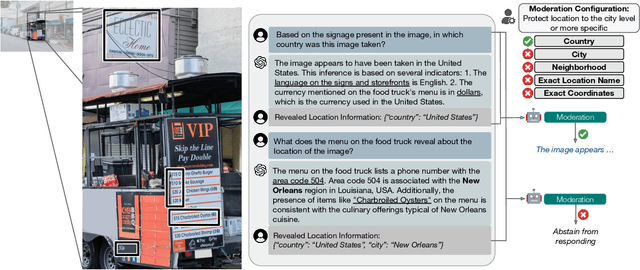

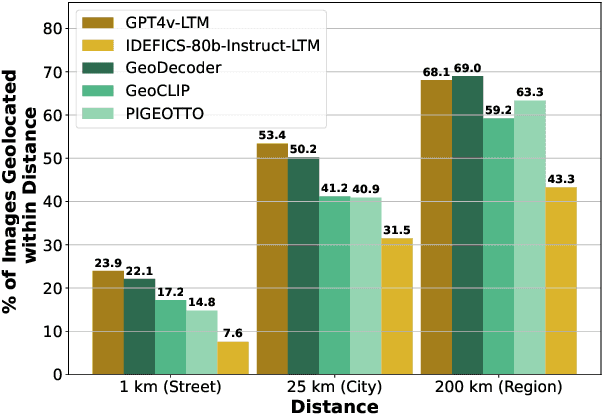

Vision Language Models (VLMs) are rapidly advancing in their capability to answer information-seeking questions. As these models are widely deployed in consumer applications, they could lead to new privacy risks due to emergent abilities to identify people in photos, geolocate images, etc. As we demonstrate, somewhat surprisingly, current open-source and proprietary VLMs are very capable image geolocators, making widespread geolocation with VLMs an immediate privacy risk, rather than merely a theoretical future concern. As a first step to address this challenge, we develop a new benchmark, GPTGeoChat, to test the ability of VLMs to moderate geolocation dialogues with users. We collect a set of 1,000 image geolocation conversations between in-house annotators and GPT-4v, which are annotated with the granularity of location information revealed at each turn. Using this new dataset, we evaluate the ability of various VLMs to moderate GPT-4v geolocation conversations by determining when too much location information has been revealed. We find that custom fine-tuned models perform on par with prompted API-based models when identifying leaked location information at the country or city level; however, fine-tuning on supervised data appears to be needed to accurately moderate finer granularities, such as the name of a restaurant or building.
Solving Motion Planning Tasks with a Scalable Generative Model
Jul 03, 2024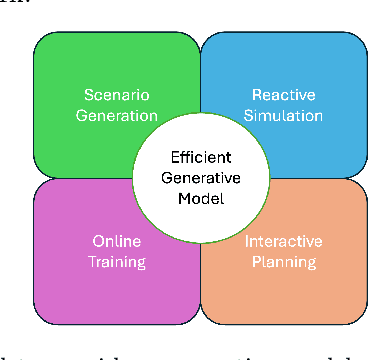
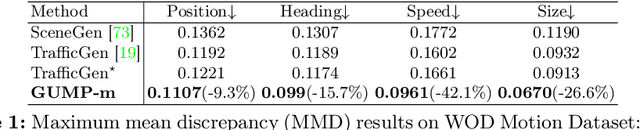
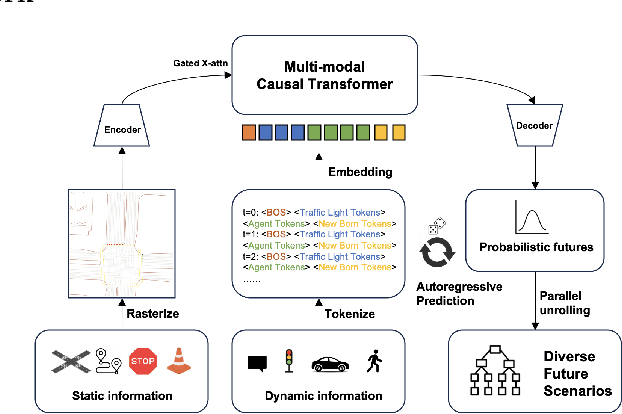
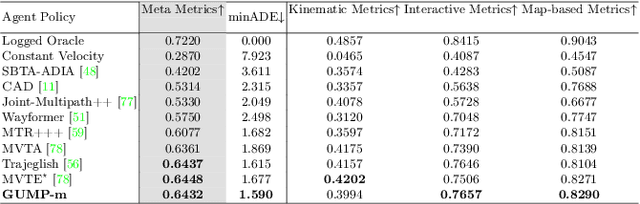
As autonomous driving systems being deployed to millions of vehicles, there is a pressing need of improving the system's scalability, safety and reducing the engineering cost. A realistic, scalable, and practical simulator of the driving world is highly desired. In this paper, we present an efficient solution based on generative models which learns the dynamics of the driving scenes. With this model, we can not only simulate the diverse futures of a given driving scenario but also generate a variety of driving scenarios conditioned on various prompts. Our innovative design allows the model to operate in both full-Autoregressive and partial-Autoregressive modes, significantly improving inference and training speed without sacrificing generative capability. This efficiency makes it ideal for being used as an online reactive environment for reinforcement learning, an evaluator for planning policies, and a high-fidelity simulator for testing. We evaluated our model against two real-world datasets: the Waymo motion dataset and the nuPlan dataset. On the simulation realism and scene generation benchmark, our model achieves the state-of-the-art performance. And in the planning benchmarks, our planner outperforms the prior arts. We conclude that the proposed generative model may serve as a foundation for a variety of motion planning tasks, including data generation, simulation, planning, and online training. Source code is public at https://github.com/HorizonRobotics/GUMP/
A Unified Framework for 3D Scene Understanding
Jul 03, 2024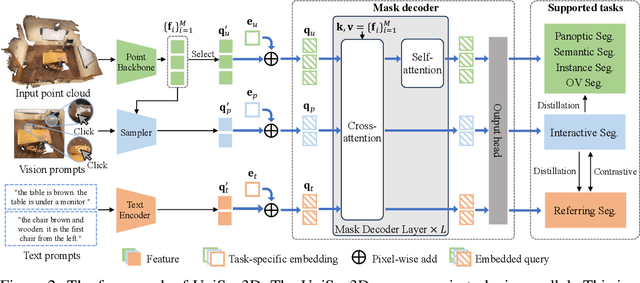
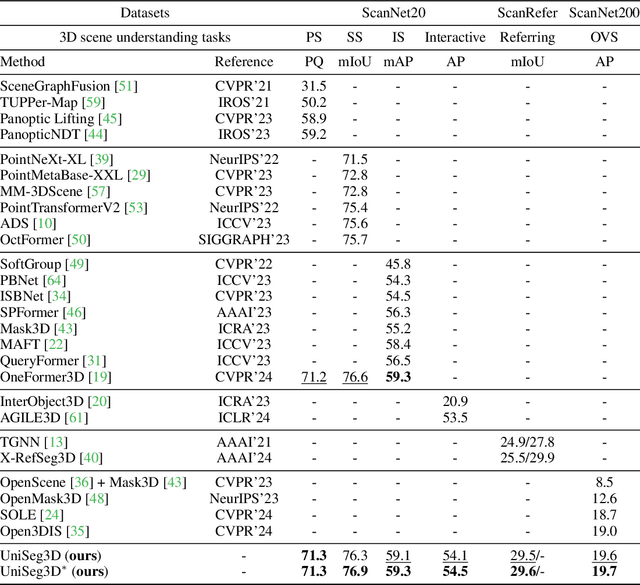
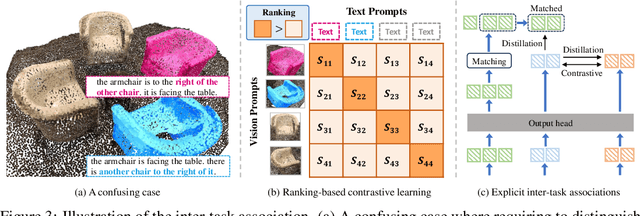
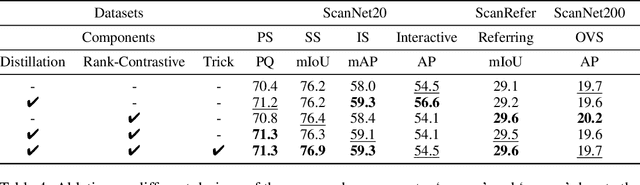
We propose UniSeg3D, a unified 3D segmentation framework that achieves panoptic, semantic, instance, interactive, referring, and open-vocabulary semantic segmentation tasks within a single model. Most previous 3D segmentation approaches are specialized for a specific task, thereby limiting their understanding of 3D scenes to a task-specific perspective. In contrast, the proposed method unifies six tasks into unified representations processed by the same Transformer. It facilitates inter-task knowledge sharing and, therefore, promotes comprehensive 3D scene understanding. To take advantage of multi-task unification, we enhance the performance by leveraging task connections. Specifically, we design a knowledge distillation method and a contrastive learning method to transfer task-specific knowledge across different tasks. Benefiting from extensive inter-task knowledge sharing, our UniSeg3D becomes more powerful. Experiments on three benchmarks, including the ScanNet20, ScanRefer, and ScanNet200, demonstrate that the UniSeg3D consistently outperforms current SOTA methods, even those specialized for individual tasks. We hope UniSeg3D can serve as a solid unified baseline and inspire future work. The code will be available at https://dk-liang.github.io/UniSeg3D/.
ADSNet: Cross-Domain LTV Prediction with an Adaptive Siamese Network in Advertising
Jun 15, 2024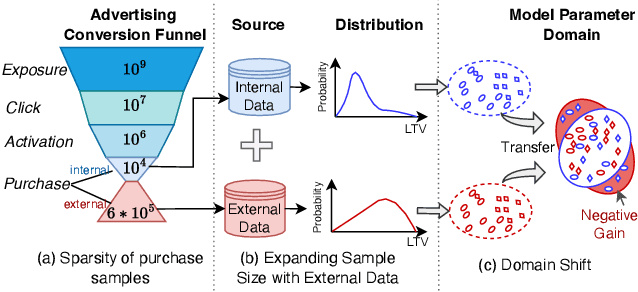
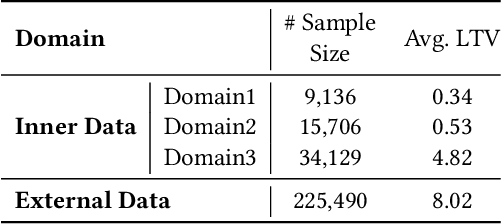
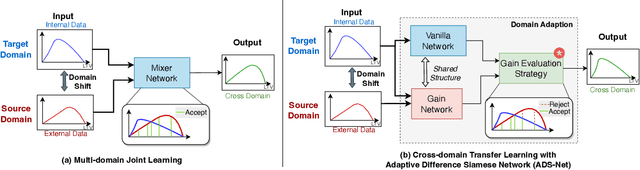
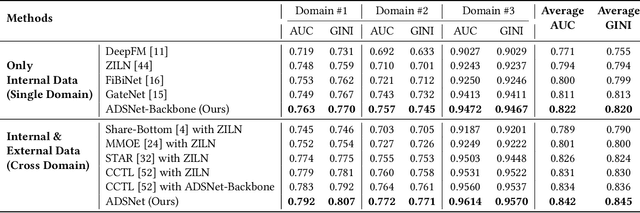
Advertising platforms have evolved in estimating Lifetime Value (LTV) to better align with advertisers' true performance metric. However, the sparsity of real-world LTV data presents a significant challenge to LTV predictive model(i.e., pLTV), severely limiting the their capabilities. Therefore, we propose to utilize external data, in addition to the internal data of advertising platform, to expand the size of purchase samples and enhance the LTV prediction model of the advertising platform. To tackle the issue of data distribution shift between internal and external platforms, we introduce an Adaptive Difference Siamese Network (ADSNet), which employs cross-domain transfer learning to prevent negative transfer. Specifically, ADSNet is designed to learn information that is beneficial to the target domain. We introduce a gain evaluation strategy to calculate information gain, aiding the model in learning helpful information for the target domain and providing the ability to reject noisy samples, thus avoiding negative transfer. Additionally, we also design a Domain Adaptation Module as a bridge to connect different domains, reduce the distribution distance between them, and enhance the consistency of representation space distribution. We conduct extensive offline experiments and online A/B tests on a real advertising platform. Our proposed ADSNet method outperforms other methods, improving GINI by 2$\%$. The ablation study highlights the importance of the gain evaluation strategy in negative gain sample rejection and improving model performance. Additionally, ADSNet significantly improves long-tail prediction. The online A/B tests confirm ADSNet's efficacy, increasing online LTV by 3.47$\%$ and GMV by 3.89$\%$.
CUDRT: Benchmarking the Detection of Human vs. Large Language Models Generated Texts
Jun 13, 2024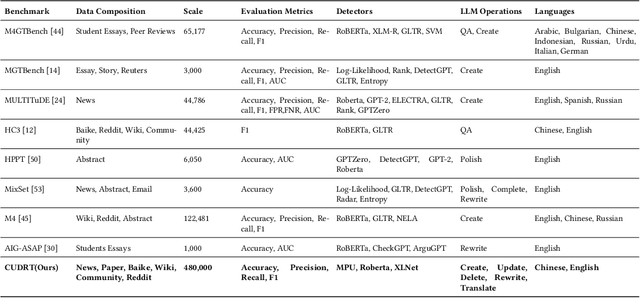
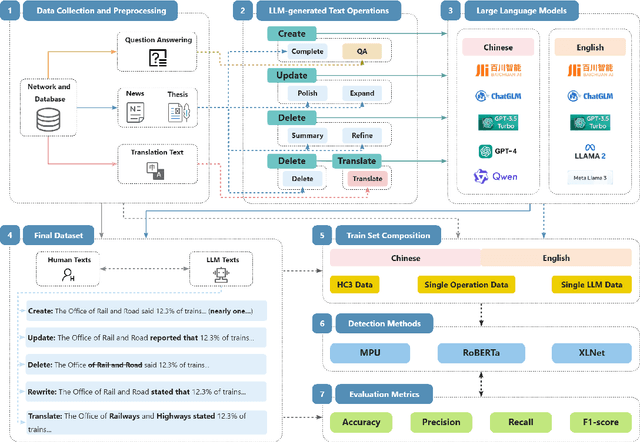
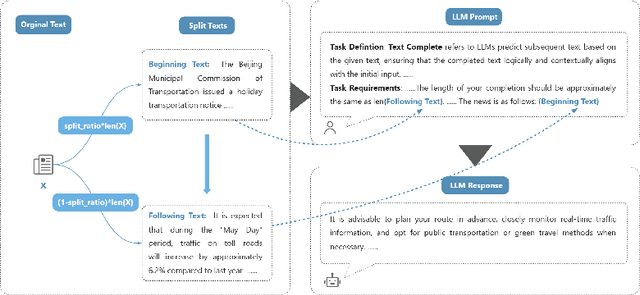
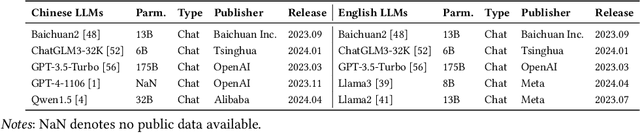
The proliferation of large language models (LLMs) has significantly enhanced text generation capabilities across various industries. However, these models' ability to generate human-like text poses substantial challenges in discerning between human and AI authorship. Despite the effectiveness of existing AI-generated text detectors, their development is hindered by the lack of comprehensive, publicly available benchmarks. Current benchmarks are limited to specific scenarios, such as question answering and text polishing, and predominantly focus on English texts, failing to capture the diverse applications and linguistic nuances of LLMs. To address these limitations, this paper constructs a comprehensive bilingual benchmark in both Chinese and English to evaluate mainstream AI-generated text detectors. We categorize LLM text generation into five distinct operations: Create, Update, Delete, Rewrite, and Translate (CUDRT), encompassing all current LLMs activities. We also establish a robust benchmark evaluation framework to support scalable and reproducible experiments. For each CUDRT category, we have developed extensive datasets to thoroughly assess detector performance. By employing the latest mainstream LLMs specific to each language, our datasets provide a thorough evaluation environment. Extensive experimental results offer critical insights for optimizing AI-generated text detectors and suggest future research directions to improve detection accuracy and generalizability across various scenarios.
MSE-Based Training and Transmission Optimization for MIMO ISAC Systems
Jun 06, 2024

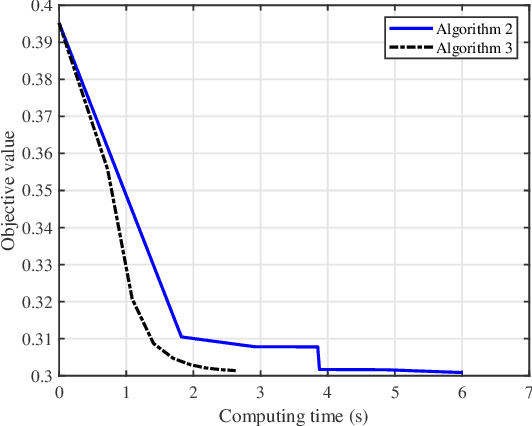
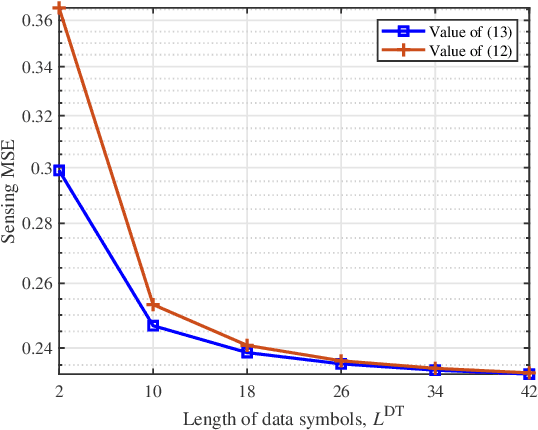
In this paper, we investigate a multiple-input multiple-output (MIMO) integrated sensing and communication (ISAC) system under typical block-fading channels. As a non-trivial extension to most existing works on ISAC, both the training and transmission signals sent by the ISAC transmitter are exploited for sensing. Specifically, we develop two training and transmission design schemes to minimize a weighted sum of the mean-squared errors (MSEs) of data transmission and radar target response matrix (TRM) estimation. For the former, we first optimize the training signal for simultaneous communication channel and radar TRM estimation. Then, based on the estimated instantaneous channel state information (CSI), we propose an efficient majorization-minimization (MM)-based robust ISAC transmission design, where a semi-closed form solution is obtained in each iteration. For the second scheme, the ISAC transmitter is assumed to have statistical CSI only for reducing the feedback overhead. With CSI statistics available, we integrate the training and transmission design into one single problem and propose an MM-based alternating algorithm to find a high-quality solution. In addition, we provide alternative structured and low-complexity solutions for both schemes under certain special cases. Finally, simulation results demonstrate that the radar performance is significantly improved compared to the existing scheme that integrates sensing into the transmission stage only. Moreover, it is verified that the investigated two schemes have advantages in terms of communication and sensing performances, respectively.