 Add to Chrome
 Add to Firefox
 Add to Edge
DRC: Enhancing Personalized Image Generation via Disentangled Representation Composition
Apr 24, 2025
Personalized image generation has emerged as a promising direction in multimodal content creation. It aims to synthesize images tailored to individual style preferences (e.g., color schemes, character appearances, layout) and semantic intentions (e.g., emotion, action, scene contexts) by leveraging user-interacted history images and multimodal instructions. Despite notable progress, existing methods -- whether based on diffusion models, large language models, or Large Multimodal Models (LMMs) -- struggle to accurately capture and fuse user style preferences and semantic intentions. In particular, the state-of-the-art LMM-based method suffers from the entanglement of visual features, leading to Guidance Collapse, where the generated images fail to preserve user-preferred styles or reflect the specified semantics. To address these limitations, we introduce DRC, a novel personalized image generation framework that enhances LMMs through Disentangled Representation Composition. DRC explicitly extracts user style preferences and semantic intentions from history images and the reference image, respectively, to form user-specific latent instructions that guide image generation within LMMs. Specifically, it involves two critical learning stages: 1) Disentanglement learning, which employs a dual-tower disentangler to explicitly separate style and semantic features, optimized via a reconstruction-driven paradigm with difficulty-aware importance sampling; and 2) Personalized modeling, which applies semantic-preserving augmentations to effectively adapt the disentangled representations for robust personalized generation. Extensive experiments on two benchmarks demonstrate that DRC shows competitive performance while effectively mitigating the guidance collapse issue, underscoring the importance of disentangled representation learning for controllable and effective personalized image generation.

Understanding Accuracy-Fairness Trade-offs in Re-ranking through Elasticity in Economics
Apr 21, 2025Fairness is an increasingly important factor in re-ranking tasks. Prior work has identified a trade-off between ranking accuracy and item fairness. However, the underlying mechanisms are still not fully understood. An analogy can be drawn between re-ranking and the dynamics of economic transactions. The accuracy-fairness trade-off parallels the coupling of the commodity tax transfer process. Fairness considerations in re-ranking, similar to a commodity tax on suppliers, ultimately translate into a cost passed on to consumers. Analogously, item-side fairness constraints result in a decline in user-side accuracy. In economics, the extent to which commodity tax on the supplier (item fairness) transfers to commodity tax on users (accuracy loss) is formalized using the notion of elasticity. The re-ranking fairness-accuracy trade-off is similarly governed by the elasticity of utility between item groups. This insight underscores the limitations of current fair re-ranking evaluations, which often rely solely on a single fairness metric, hindering comprehensive assessment of fair re-ranking algorithms. Centered around the concept of elasticity, this work presents two significant contributions. We introduce the Elastic Fairness Curve (EF-Curve) as an evaluation framework. This framework enables a comparative analysis of algorithm performance across different elasticity levels, facilitating the selection of the most suitable approach. Furthermore, we propose ElasticRank, a fair re-ranking algorithm that employs elasticity calculations to adjust inter-item distances within a curved space. Experiments on three widely used ranking datasets demonstrate its effectiveness and efficiency.
An LMM for Efficient Video Understanding via Reinforced Compression of Video Cubes
Apr 21, 2025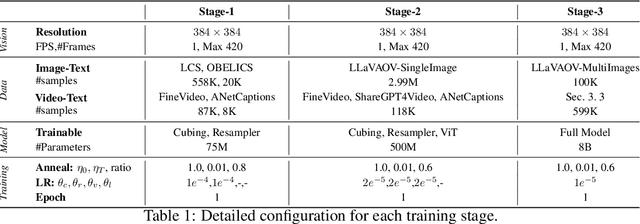
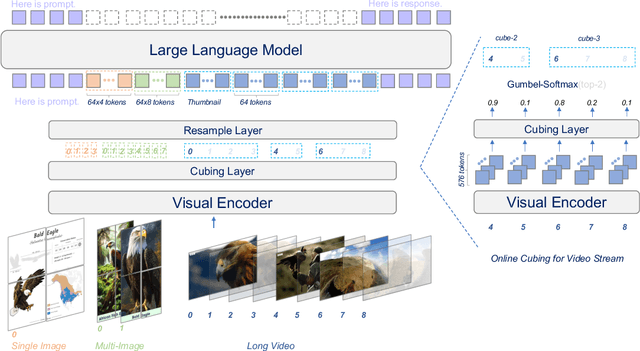
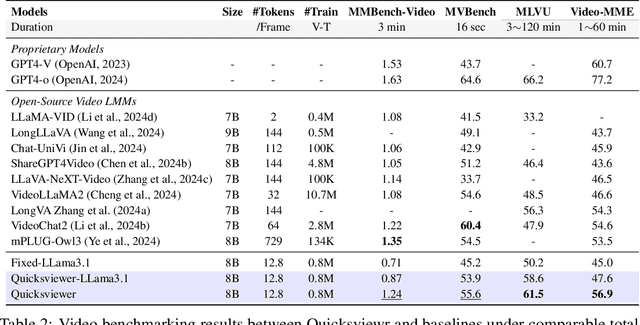
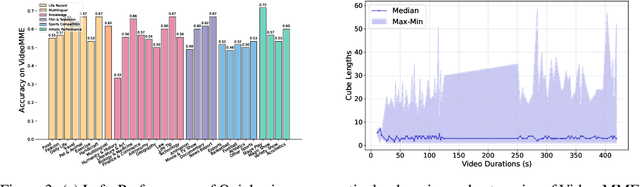
Large Multimodal Models (LMMs) uniformly perceive video frames, creating computational inefficiency for videos with inherently varying temporal information density. This paper present \textbf{Quicksviewer}, an LMM with new perceiving paradigm that partitions a video of nonuniform density into varying cubes using Gumbel Softmax, followed by a unified resampling for each cube to achieve efficient video understanding. This simple and intuitive approach dynamically compress video online based on its temporal density, significantly reducing spatiotemporal redundancy (overall 45$\times$ compression rate), while enabling efficient training with large receptive field. We train the model from a language backbone through three progressive stages, each incorporating lengthy videos on average of 420s/1fps thanks to the perceiving efficiency. With only 0.8M total video-text samples for training, our model outperforms the direct baseline employing a fixed partitioning strategy by a maximum of 8.72 in accuracy, demonstrating the effectiveness in performance. On Video-MME, Quicksviewer achieves SOTA under modest sequence lengths using just up to 5\% of tokens per frame required by baselines. With this paradigm, scaling up the number of input frames reveals a clear power law of the model capabilities. It is also empirically verified that the segments generated by the cubing network can help for analyzing continuous events in videos.
SemCORE: A Semantic-Enhanced Generative Cross-Modal Retrieval Framework with MLLMs
Apr 17, 2025Cross-modal retrieval (CMR) is a fundamental task in multimedia research, focused on retrieving semantically relevant targets across different modalities. While traditional CMR methods match text and image via embedding-based similarity calculations, recent advancements in pre-trained generative models have established generative retrieval as a promising alternative. This paradigm assigns each target a unique identifier and leverages a generative model to directly predict identifiers corresponding to input queries without explicit indexing. Despite its great potential, current generative CMR approaches still face semantic information insufficiency in both identifier construction and generation processes. To address these limitations, we propose a novel unified Semantic-enhanced generative Cross-mOdal REtrieval framework (SemCORE), designed to unleash the semantic understanding capabilities in generative cross-modal retrieval task. Specifically, we first construct a Structured natural language IDentifier (SID) that effectively aligns target identifiers with generative models optimized for natural language comprehension and generation. Furthermore, we introduce a Generative Semantic Verification (GSV) strategy enabling fine-grained target discrimination. Additionally, to the best of our knowledge, SemCORE is the first framework to simultaneously consider both text-to-image and image-to-text retrieval tasks within generative cross-modal retrieval. Extensive experiments demonstrate that our framework outperforms state-of-the-art generative cross-modal retrieval methods. Notably, SemCORE achieves substantial improvements across benchmark datasets, with an average increase of 8.65 points in Recall@1 for text-to-image retrieval.
AdaSteer: Your Aligned LLM is Inherently an Adaptive Jailbreak Defender
Apr 13, 2025Despite extensive efforts in safety alignment, large language models (LLMs) remain vulnerable to jailbreak attacks. Activation steering offers a training-free defense method but relies on fixed steering coefficients, resulting in suboptimal protection and increased false rejections of benign inputs. To address this, we propose AdaSteer, an adaptive activation steering method that dynamically adjusts model behavior based on input characteristics. We identify two key properties: Rejection Law (R-Law), which shows that stronger steering is needed for jailbreak inputs opposing the rejection direction, and Harmfulness Law (H-Law), which differentiates adversarial and benign inputs. AdaSteer steers input representations along both the Rejection Direction (RD) and Harmfulness Direction (HD), with adaptive coefficients learned via logistic regression, ensuring robust jailbreak defense while preserving benign input handling. Experiments on LLaMA-3.1, Gemma-2, and Qwen2.5 show that AdaSteer outperforms baseline methods across multiple jailbreak attacks with minimal impact on utility. Our results highlight the potential of interpretable model internals for real-time, flexible safety enforcement in LLMs.
Distilling Transitional Pattern to Large Language Models for Multimodal Session-based Recommendation
Apr 13, 2025Session-based recommendation (SBR) predicts the next item based on anonymous sessions. Traditional SBR explores user intents based on ID collaborations or auxiliary content. To further alleviate data sparsity and cold-start issues, recent Multimodal SBR (MSBR) methods utilize simplistic pre-trained models for modality learning but have limitations in semantic richness. Considering semantic reasoning abilities of Large Language Models (LLM), we focus on the LLM-enhanced MSBR scenario in this paper, which leverages LLM cognition for comprehensive multimodal representation generation, to enhance downstream MSBR. Tackling this problem faces two challenges: i) how to obtain LLM cognition on both transitional patterns and inherent multimodal knowledge, ii) how to align both features into one unified LLM, minimize discrepancy while maximizing representation utility. To this end, we propose a multimodal LLM-enhanced framework TPAD, which extends a distillation paradigm to decouple and align transitional patterns for promoting MSBR. TPAD establishes parallel Knowledge-MLLM and Transfer-MLLM, where the former interprets item knowledge-reflected features and the latter extracts transition-aware features underneath sessions. A transitional pattern alignment module harnessing mutual information estimation theory unites two MLLMs, alleviating distribution discrepancy and distilling transitional patterns into modal representations. Extensive experiments on real-world datasets demonstrate the effectiveness of our framework.
Large Language Model Empowered Recommendation Meets All-domain Continual Pre-Training
Apr 11, 2025Recent research efforts have investigated how to integrate Large Language Models (LLMs) into recommendation, capitalizing on their semantic comprehension and open-world knowledge for user behavior understanding. These approaches predominantly employ supervised fine-tuning on single-domain user interactions to adapt LLMs for specific recommendation tasks. However, they typically encounter dual challenges: the mismatch between general language representations and domain-specific preference patterns, as well as the limited adaptability to multi-domain recommendation scenarios. To bridge these gaps, we introduce CPRec -- an All-domain Continual Pre-Training framework for Recommendation -- designed to holistically align LLMs with universal user behaviors through the continual pre-training paradigm. Specifically, we first design a unified prompt template and organize users' multi-domain behaviors into domain-specific behavioral sequences and all-domain mixed behavioral sequences that emulate real-world user decision logic. To optimize behavioral knowledge infusion, we devise a Warmup-Stable-Annealing learning rate schedule tailored for the continual pre-training paradigm in recommendation to progressively enhance the LLM's capability in knowledge adaptation from open-world knowledge to universal recommendation tasks. To evaluate the effectiveness of our CPRec, we implement it on a large-scale dataset covering seven domains and conduct extensive experiments on five real-world datasets from two distinct platforms. Experimental results confirm that our continual pre-training paradigm significantly mitigates the semantic-behavioral discrepancy and achieves state-of-the-art performance in all recommendation scenarios. The source code will be released upon acceptance.
Extending Visual Dynamics for Video-to-Music Generation
Apr 10, 2025Music profoundly enhances video production by improving quality, engagement, and emotional resonance, sparking growing interest in video-to-music generation. Despite recent advances, existing approaches remain limited in specific scenarios or undervalue the visual dynamics. To address these limitations, we focus on tackling the complexity of dynamics and resolving temporal misalignment between video and music representations. To this end, we propose DyViM, a novel framework to enhance dynamics modeling for video-to-music generation. Specifically, we extract frame-wise dynamics features via a simplified motion encoder inherited from optical flow methods, followed by a self-attention module for aggregation within frames. These dynamic features are then incorporated to extend existing music tokens for temporal alignment. Additionally, high-level semantics are conveyed through a cross-attention mechanism, and an annealing tuning strategy benefits to fine-tune well-trained music decoders efficiently, therefore facilitating seamless adaptation. Extensive experiments demonstrate DyViM's superiority over state-of-the-art (SOTA) methods.
SafeMLRM: Demystifying Safety in Multi-modal Large Reasoning Models
Apr 09, 2025The rapid advancement of multi-modal large reasoning models (MLRMs) -- enhanced versions of multimodal language models (MLLMs) equipped with reasoning capabilities -- has revolutionized diverse applications. However, their safety implications remain underexplored. While prior work has exposed critical vulnerabilities in unimodal reasoning models, MLRMs introduce distinct risks from cross-modal reasoning pathways. This work presents the first systematic safety analysis of MLRMs through large-scale empirical studies comparing MLRMs with their base MLLMs. Our experiments reveal three critical findings: (1) The Reasoning Tax: Acquiring reasoning capabilities catastrophically degrades inherited safety alignment. MLRMs exhibit 37.44% higher jailbreaking success rates than base MLLMs under adversarial attacks. (2) Safety Blind Spots: While safety degradation is pervasive, certain scenarios (e.g., Illegal Activity) suffer 25 times higher attack rates -- far exceeding the average 3.4 times increase, revealing scenario-specific vulnerabilities with alarming cross-model and datasets consistency. (3) Emergent Self-Correction: Despite tight reasoning-answer safety coupling, MLRMs demonstrate nascent self-correction -- 16.9% of jailbroken reasoning steps are overridden by safe answers, hinting at intrinsic safeguards. These findings underscore the urgency of scenario-aware safety auditing and mechanisms to amplify MLRMs' self-correction potential. To catalyze research, we open-source OpenSafeMLRM, the first toolkit for MLRM safety evaluation, providing unified interface for mainstream models, datasets, and jailbreaking methods. Our work calls for immediate efforts to harden reasoning-augmented AI, ensuring its transformative potential aligns with ethical safeguards.
Benchmarking Multimodal CoT Reward Model Stepwise by Visual Program
Apr 09, 2025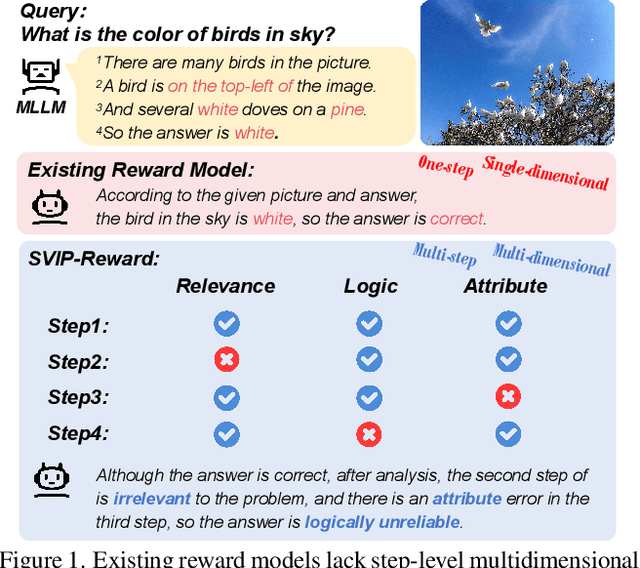
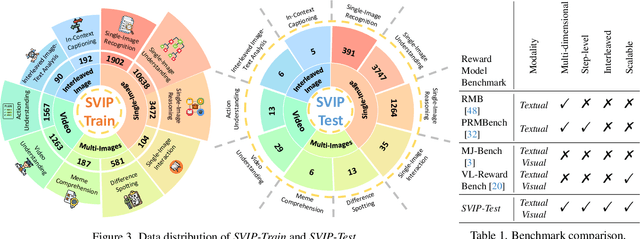
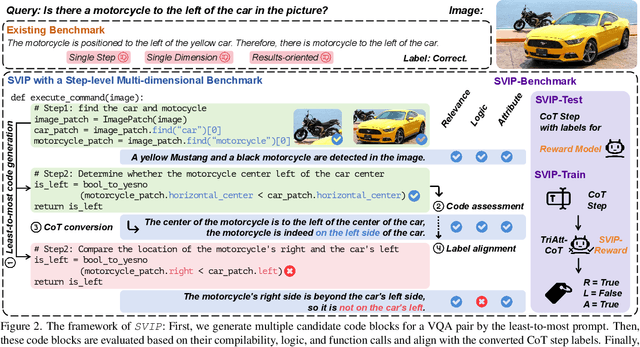
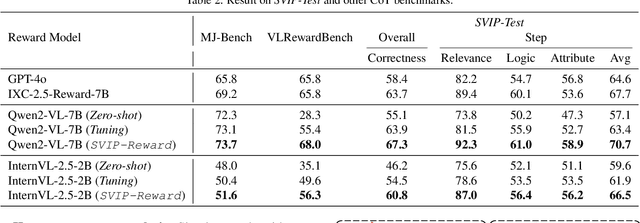
Recent advancements in reward signal usage for Large Language Models (LLMs) are remarkable. However, significant challenges exist when transitioning reward signal to the multimodal domain, including labor-intensive annotations, over-reliance on one-step rewards, and inadequate evaluation. To address these issues, we propose SVIP, a novel approach to train a step-level multi-dimensional Chain-of-Thought~(CoT) reward model automatically. It generates code for solving visual tasks and transforms the analysis of code blocks into the evaluation of CoT step as training samples. Then, we train SVIP-Reward model using a multi-head attention mechanism called TriAtt-CoT. The advantages of SVIP-Reward are evident throughout the entire process of MLLM. We also introduce a benchmark for CoT reward model training and testing. Experimental results demonstrate that SVIP-Reward improves MLLM performance across training and inference-time scaling, yielding better results on benchmarks while reducing hallucinations and enhancing reasoning ability.