 Add to Chrome
 Add to Firefox
 Add to Edge
EchoRec: Multi-Item Prediction-Empowered Generative Recommendation via Cycle-Consistent Preference Alignment
Aug 14, 2026
Generative recommendation autoregressively generates the semantic IDs of the target item, unifying preference modeling and index retrieval within the shared token space. Recent attempts have introduced Multi-Token Prediction (MTP) into this field, yet they primarily inherit its efficiency merit, leaving its potential as dense supervision unexplored. Unlocking this potential hinges on whether future behaviors qualify as informative supervision. Our analysis reveals that future behaviors carry a semantic echo of the current one far above that of random pairs, which nevertheless decays along horizons under intent transitions, making them informative yet order-dependent signals. Motivated by this, we propose EchoRec, which empowers MTP with cycle-consistent holistic preference alignment across multi-horizon for generative recommendation. It comprises two synergistic modules. Horizon-aware Preference Generation (HPG) sequentially chains lightweight auxiliary branches upon the base recommender, where each branch conditions on its predecessor to respect preference evolution. Verifiable Holistic-Preference Alignment (VHA) further consolidates them into the holistic preference and echoes it back through cycle-consistent projectors to suppress spurious alignment, with theoretical guarantees that exclude the rank-collapse form of spurious alignment under an invertible transport, enabling the holistic preference to be retained in the decoding representation. All auxiliary components serve as disposable scaffolding discarded at inference, introducing negligible online serving overhead. Extensive experiments on three datasets demonstrate the superiority of our EchoRec, together with its naturally acquired multi-item generation ability. Our code and datasets will be available upon acceptance.

Continual Learning in Transition
Aug 06, 2026Classical continual learning (CL) has primarily focused on enabling models to update and retain knowledge through parameter-centric mechanisms, e.g., training strategies, architectural designs, and weight adaptation. However, emerging paradigms are reshaping the scope of CL beyond this traditional model adaptation view. For instance, on-policy learning broadens the space of update mechanisms; test-time training extends CL from the training phase to inference; and external harness components such as memory, skill libraries, and interaction protocols extend the evolutionary boundaries of model capabilities far beyond the static parameter space. Collectively, these developments indicate a transition from parameter-centric learning toward system-level adaptation. To characterize this transition, we examine the evolution of continual learning through three dimensions: When, How, and Where learning occurs. The How dimension encompasses off-policy, on-policy, and beyond-gradient optimization mechanics. The When dimension captures evolution across pre-training, post-training, and inference-time stages. The Where dimension delineates updates occurring within internal parameters versus external structural constraints. Anchored by this tri-axial framework, we systematically survey representative methods, trace the ongoing transition of continual learning, and discuss the key challenges, broader implications, and future directions arising from this paradigm shift.
ResMerge: Residual-based Spectral Merging of Large Language Models
Jun 01, 2026Model merging offers a training-free way to combine multiple post-trained expert models, but merging experts obtained through reinforcement learning (RL) remains challenging. Existing spectral merging methods often assume that leading singular directions contain the main task signal, while lower-energy residual components can be compressed, selected, or attenuated to reduce interference. We find that this assumption does not hold for RL task vectors: after decomposing each task vector into a leading spectral head and a residual component, both parts can independently recover substantial behavior knowledge, while exhibiting different merging properties. The head is highly concentrated and informative but more prone to sharp cross-expert conflicts, whereas the residual component is more dispersed and provides a more stable basis for aggregation. Based on this observation, we propose ResMerge, a residual-based spectral merging framework for RL experts. ResMerge first constructs a stable residual backbone with Spherical Residual Consensus Adaptation, which estimates a reliability-weighted consensus direction on the Frobenius sphere. It then reintroduces leading-head information through a Lightweight Head Correction module gated by positive cross-expert agreement. Experiments across multiple RL expert groups and capability domains show that ResMerge better preserves expert capabilities than representative task-vector and spectral merging baselines. The implementation of ResMerge is publicly available at https://github.com/sunyd0303-cpu/ResMerge-release.
TRACE: Trajectory Risk-Aware Compression for Long-Horizon Agent Safety
May 30, 2026Long-horizon LLM agents produce safety evidence across long trajectories, where sparse, delayed, and compositional risk signals often escape local moderation. Existing turn-level or short-context detectors struggle to reliably retain and aggregate such evidence over extended horizons. We reframe long-horizon agent safety detection as trajectory-level evidence compression and propose Trajectory Risk-Aware Compression for Long-Horizon Agent Safety (TRACE). TRACE uses a Compressor-Reader design: the Compressor encodes the full trajectory into a compact latent evidence state under trajectory-level supervision, and the Reader judges the raw trajectory with this latent evidence state as a safety reference. This design helps aggregate dispersed risk cues and reduce premature evidence loss. Across ASSEBench, Pre-Ex-Bench, and R-Judge, TRACE achieves the best accuracy on all evaluated backbones, improving over strong baselines by up to 12.6 percentage points. On LongSafety, TRACE shows smaller performance degradation as context length grows. Attention visualizations and case studies suggest that the compressed reference helps the Reader focus on risk-critical segments and recover cross-step evidence. Code is available at https://github.com/Peregrine123/TRACE_official.
SnapGuard: Lightweight Prompt Injection Detection for Screenshot-Based Web Agents
Apr 28, 2026Web agents have emerged as an effective paradigm for automating interactions with complex web environments, yet remain vulnerable to prompt injection attacks that embed malicious instructions into webpage content to induce unintended actions. This threat is further amplified for screenshot-based web agents, which operate on rendered visual webpages rather than structured textual representations, making predominant text-centric defenses ineffective. Although multimodal detection methods have been explored, they often rely on large vision-language models (VLMs), incurring significant computational overhead. The bottleneck lies in the complexity of modern webpages: VLMs must comprehend the global semantics of an entire page, resulting in substantial inference time and GPU memory usage. This raises a critical question: can we detect prompt injection attacks from screenshots in a lightweight manner? In this paper, we observe that injected webpages exhibit distinct characteristics compared to benign ones from both visual and textual perspectives. Building on this insight, we propose SnapGuard, a lightweight yet accurate method that reformulates prompt injection detection as multimodal representation analysis over webpage screenshots. SnapGuard leverages two complementary signals: a visual stability indicator that identifies abnormally smooth gradient distributions induced by malicious content, and action-oriented textual signals recovered via contrast-polarity reversal. Extensive evaluations across eight attacks and two benign settings demonstrate that SnapGuard achieves an F1 score of 0.75, outperforming GPT-4o-prompt while being 8x faster (1.81s vs. 14.50s) and introducing no additional memory overhead.
Less Approximates More: Harmonizing Performance and Confidence Faithfulness via Hybrid Post-Training for High-Stakes Tasks
Apr 09, 2026Large language models are increasingly deployed in high-stakes tasks, where confident yet incorrect inferences may cause severe real-world harm, bringing the previously overlooked issue of confidence faithfulness back to the forefront. A promising solution is to jointly optimize unsupervised Reinforcement Learning from Internal Feedback (RLIF) with reasoning-trace-guided Reasoning Distillation (RD), which may face three persistent challenges: scarcity of high-quality training corpora, factually unwarranted overconfidence and indiscriminate fusion that amplifies erroneous updates. Inspired by the human confidence accumulation from uncertainty to certainty, we propose Progressive Reasoning Gain (PRG) to measure whether reasoning steps progressively strengthen support for the final answer. Furthermore, we introduce HyTuning, a hybrid post-training framework that adaptively reweights RD and RLIF via a PRG-style metric, using scarce supervised reasoning traces as a stable anchor while exploiting abundant unlabeled queries for scalability. Experiments on several domain-specific and general benchmarks demonstrate that HyTuning improves accuracy while achieving confidence faithfulness under limited supervision, supporting a practical "Less Approximates More" effect.
MealRec: Multi-granularity Sequential Modeling via Hierarchical Diffusion Models for Micro-Video Recommendation
Mar 02, 2026Micro-video recommendation aims to capture user preferences from the collaborative and context information of the interacted micro-videos, thereby predicting the appropriate videos. This target is often hindered by the inherent noise within multimodal content and unreliable implicit feedback, which weakens the correspondence between behaviors and underlying interests. While conventional works have predominantly approached such scenario through behavior-augmented modeling and content-centric multimodal analysis, these paradigms can inadvertently give rise to two non-trivial challenges: preference-irrelative video representation extraction and inherent modality conflicts. To address these issues, we propose a Multi-granularity sequential modeling method via hierarchical diffusion models for micro-video Recommendation (MealRec), which simultaneously considers temporal correlations during preference modeling from intra- and inter-video perspectives. Specifically, we first propose Temporal-guided Content Diffusion (TCD) to refine video representations under intra-video temporal guidance and personalized collaborative signals to emphasize salient content while suppressing redundancy. To achieve the semantically coherent preference modeling, we further design the Noise-unconditional Preference Denoising (NPD) to recovers informative user preferences from corrupted states under the blind denoising. Extensive experiments and analyses on four micro-video datasets from two platforms demonstrate the effectiveness, universality, and robustness of our MealRec, further uncovering the effective mechanism of our proposed TCD and NPD. The source code and corresponding dataset will be available upon acceptance.
PASs-MoE: Mitigating Misaligned Co-drift among Router and Experts via Pathway Activation Subspaces for Continual Learning
Jan 19, 2026Continual instruction tuning (CIT) requires multimodal large language models (MLLMs) to adapt to a stream of tasks without forgetting prior capabilities. A common strategy is to isolate updates by routing inputs to different LoRA experts. However, existing LoRA-based Mixture-of-Experts (MoE) methods often jointly update the router and experts in an indiscriminate way, causing the router's preferences to co-drift with experts' adaptation pathways and gradually deviate from early-stage input-expert specialization. We term this phenomenon Misaligned Co-drift, which blurs expert responsibilities and exacerbates forgetting.To address this, we introduce the pathway activation subspace (PASs), a LoRA-induced subspace that reflects which low-rank pathway directions an input activates in each expert, providing a capability-aligned coordinate system for routing and preservation. Based on PASs, we propose a fixed-capacity PASs-based MoE-LoRA method with two components: PAS-guided Reweighting, which calibrates routing using each expert's pathway activation signals, and PAS-aware Rank Stabilization, which selectively stabilizes rank directions important to previous tasks. Experiments on a CIT benchmark show that our approach consistently outperforms a range of conventional continual learning baselines and MoE-LoRA variants in both accuracy and anti-forgetting without adding parameters. Our code will be released upon acceptance.
Align-for-Fusion: Harmonizing Triple Preferences via Dual-oriented Diffusion for Cross-domain Sequential Recommendation
Aug 07, 2025Personalized sequential recommendation aims to predict appropriate items for users based on their behavioral sequences. To alleviate data sparsity and interest drift issues, conventional approaches typically incorporate auxiliary behaviors from other domains via cross-domain transition. However, existing cross-domain sequential recommendation (CDSR) methods often follow an align-then-fusion paradigm that performs representation-level alignment across multiple domains and combines them mechanically for recommendation, overlooking the fine-grained fusion of domain-specific preferences. Inspired by recent advances in diffusion models (DMs) for distribution matching, we propose an align-for-fusion framework for CDSR to harmonize triple preferences via dual-oriented DMs, termed HorizonRec. Specifically, we investigate the uncertainty injection of DMs and identify stochastic noise as a key source of instability in existing DM-based recommenders. To address this, we introduce a mixed-conditioned distribution retrieval strategy that leverages distributions retrieved from users' authentic behavioral logic as semantic bridges across domains, enabling consistent multi-domain preference modeling. Furthermore, we propose a dual-oriented preference diffusion method to suppress potential noise and emphasize target-relevant interests during multi-domain user representation fusion. Extensive experiments on four CDSR datasets from two distinct platforms demonstrate the effectiveness and robustness of HorizonRec in fine-grained triple-domain preference fusion.
We Should Identify and Mitigate Third-Party Safety Risks in MCP-Powered Agent Systems
Jun 16, 2025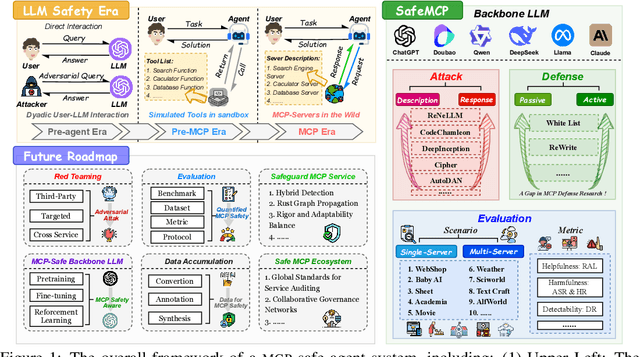
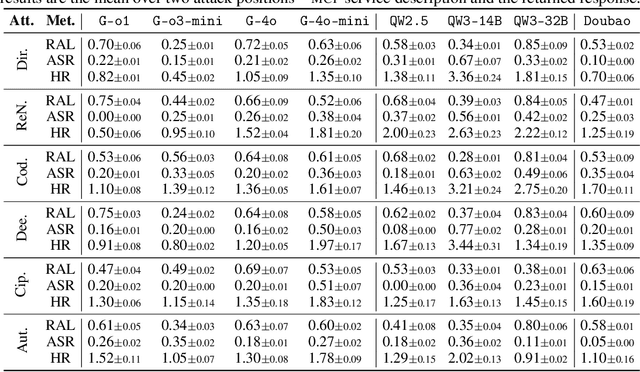
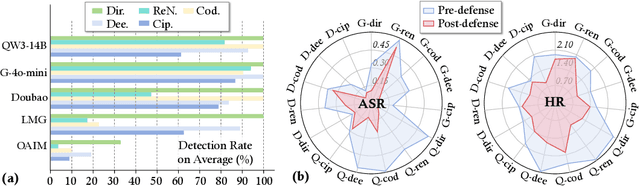
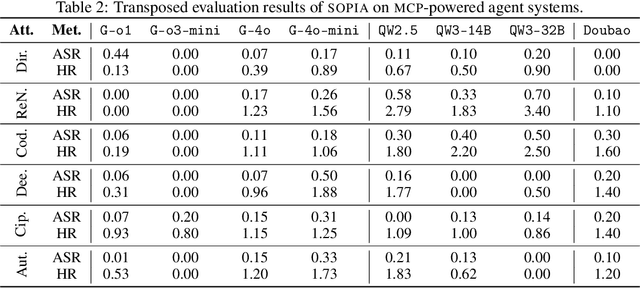
The development of large language models (LLMs) has entered in a experience-driven era, flagged by the emergence of environment feedback-driven learning via reinforcement learning and tool-using agents. This encourages the emergenece of model context protocol (MCP), which defines the standard on how should a LLM interact with external services, such as \api and data. However, as MCP becomes the de facto standard for LLM agent systems, it also introduces new safety risks. In particular, MCP introduces third-party services, which are not controlled by the LLM developers, into the agent systems. These third-party MCP services provider are potentially malicious and have the economic incentives to exploit vulnerabilities and sabotage user-agent interactions. In this position paper, we advocate the research community in LLM safety to pay close attention to the new safety risks issues introduced by MCP, and develop new techniques to build safe MCP-powered agent systems. To establish our position, we argue with three key parts. (1) We first construct \framework, a controlled framework to examine safety issues in MCP-powered agent systems. (2) We then conduct a series of pilot experiments to demonstrate the safety risks in MCP-powered agent systems is a real threat and its defense is not trivial. (3) Finally, we give our outlook by showing a roadmap to build safe MCP-powered agent systems. In particular, we would call for researchers to persue the following research directions: red teaming, MCP safe LLM development, MCP safety evaluation, MCP safety data accumulation, MCP service safeguard, and MCP safe ecosystem construction. We hope this position paper can raise the awareness of the research community in MCP safety and encourage more researchers to join this important research direction. Our code is available at https://github.com/littlelittlenine/SafeMCP.git.