 Add to Chrome
 Add to Firefox
 Add to Edge
Sharpness-aware Model Merging with Salience Recovery for LLM-based Cross-Domain Sequential Recommendation
Jul 28, 2026
LLM-based Cross-Domain Sequential Recommendation (CDSR) leverages LLMs to enhance target performance via deep semantic reasoning, alleviating the dependency on overlapping users. Among LLM-based paradigms, model merging is particularly promising for multi-domain scenarios due to its superior scalability and flexibility in integrating diverse knowledge sources. However, our empirical investigations reveal two critical bottlenecks: (1) cross-domain knowledge conflict; and (2) performance saturation in multi-domain fusion. Our analysis attributes these phenomena to parameter-level misalignment and statistical homogenization during the merging process. To address these bottlenecks, we propose SharpRec, Sharpness-aware Model Merging with Salience Recovery for LLM-based CDSR, a framework designed to lift the performance upper bound of merged models. SharpRec incorporates two synergistic modules: Sharpness-aware Geometric Alignment to establish a stable geometric foundation for interference-free fusion; and Preference Salience Activation to effectively recover the distinctive features essential for bolstering target domain performance. Extensive experiments in both dual-domain and multi-domain scenarios demonstrate that SharpRec consistently outperforms state-of-the-art baselines.
* Published in Proceedings of the 32nd ACM SIGKDD Conference on Knowledge Discovery and Data Mining (KDD '26). 12 pages, 6 figures, 4 tables. Code available at https://github.com/muyiahhh/SharpRec

OmniPlan: An Adaptive Framework for Timely and Near-Optimal Network Planning Optimization
Jun 17, 2026Network planning optimization is a fundamental problem across diverse domains, including transportation systems, communication networks, and power grids. It requires simultaneous optimization of multiple competing objectives under complex constraints. Existing network planning optimization frameworks rely on mixed integer programming (MIP) solvers, heuristics, and deep reinforcement learning (DRL) models to compute planning decisions. However, they lack effective adaptability to diverse and dynamic user intents, thus leading to the trade-off between execution time and optimality. In this paper, we propose OmniPlan, an adaptive framework that achieves both timeliness and near-optimality in network planning optimization. To achieve the adaptability lacking in existing solutions, OmniPlan employs a large language model (LLM)-based interpreter to convert heterogeneous natural-language intents into a unified and quantifiable user-preference vector. Then it employs a mixture-of-experts architecture that integrates MIP solvers, heuristics, and DRL models as specialized experts, where OmniPlan adapts to diverse intents by dynamically selecting timely and near-optimal experts. Finally, it incorporates a DRL-based expert configuration module that fine-tunes optimization objective weights to align planning decisions with user-specific preferences. We evaluate OmniPlan with a representative real-world workload, i.e., distributed machine learning (ML), where we leverage OmniPlan to offload a wide spectrum of ML inference tasks, e.g., decision trees, SVM, naive Bayes, XGBoost, and random forests, onto a network of hardware devices. Our experiments on a real-world testbed indicate that OmniPlan achieves near-optimal and low-execution-time offloading for real-world ML inference tasks, reducing latency by up to 97.8\% and network device resource consumption by up to 11.5\%.
Beyond Binary Edits Robust Multimodal Knowledge Editing with Adversarial Subspace Alignment
May 22, 2026Multimodal large language models (MLLMs) need efficient mechanisms to update knowledge without degrading existing capabilities. While intrinsic multimodal knowledge editing achieves strong reliability and locality, it often exhibits limited generality, failing to propagate edits across semantically equivalent visual and linguistic variations. This issue arises from the lack of explicit semantic supervision, rigid editing scopes, and biased anchoring to individual samples in high-dimensional multimodal spaces. We address robust intrinsic multimodal knowledge editing by explicitly targeting generalization. We formalize robustness through knowledge units that group semantically equivalent multimodal inputs and define generality as consistent predictions within each unit. To expose fragile semantic regions, we introduce Latent Adversarial Robustification (LAR), which generates adversarial yet semantically coherent variants in the joint latent space. We further propose Rank-Constrained Subspace Learning (RCSL), enforcing low-rank alignment of adversarial representations at the edit layer via a singular value-based objective. Extensive analysis demonstrates the effectiveness of ASAM empirically.
Generalizable Multimodal Large Language Model Editing via Invariant Trajectory Learning
Jan 30, 2026Knowledge editing emerges as a crucial technique for efficiently correcting incorrect or outdated knowledge in large language models (LLM). Existing editing methods rely on a rigid mapping from parameter or module modifications to output, which causes the generalization limitation in Multimodal LLM (MLLM). In this paper, we reformulate MLLM editing as an out-of-distribution (OOD) generalization problem, where the goal is to discern semantic shift with factual shift and thus achieve robust editing among diverse cross-modal prompting. The key challenge of this OOD problem lies in identifying invariant causal trajectories that generalize accurately while suppressing spurious correlations. To address it, we propose ODEdit, a plug-and-play invariant learning based framework that optimizes the tripartite OOD risk objective to simultaneously enhance editing reliability, locality, and generality.We further introduce an edit trajectory invariant learning method, which integrates a total variation penalty into the risk minimization objective to stabilize edit trajectories against environmental variations. Theoretical analysis and extensive experiments demonstrate the effectiveness of ODEdit.
Potent but Stealthy: Rethink Profile Pollution against Sequential Recommendation via Bi-level Constrained Reinforcement Paradigm
Nov 14, 2025Sequential Recommenders, which exploit dynamic user intents through interaction sequences, is vulnerable to adversarial attacks. While existing attacks primarily rely on data poisoning, they require large-scale user access or fake profiles thus lacking practicality. In this paper, we focus on the Profile Pollution Attack that subtly contaminates partial user interactions to induce targeted mispredictions. Previous PPA methods suffer from two limitations, i.e., i) over-reliance on sequence horizon impact restricts fine-grained perturbations on item transitions, and ii) holistic modifications cause detectable distribution shifts. To address these challenges, we propose a constrained reinforcement driven attack CREAT that synergizes a bi-level optimization framework with multi-reward reinforcement learning to balance adversarial efficacy and stealthiness. We first develop a Pattern Balanced Rewarding Policy, which integrates pattern inversion rewards to invert critical patterns and distribution consistency rewards to minimize detectable shifts via unbalanced co-optimal transport. Then we employ a Constrained Group Relative Reinforcement Learning paradigm, enabling step-wise perturbations through dynamic barrier constraints and group-shared experience replay, achieving targeted pollution with minimal detectability. Extensive experiments demonstrate the effectiveness of CREAT.
A Remarkably Efficient Paradigm to Multimodal Large Language Models for Sequential Recommendation
Nov 11, 2025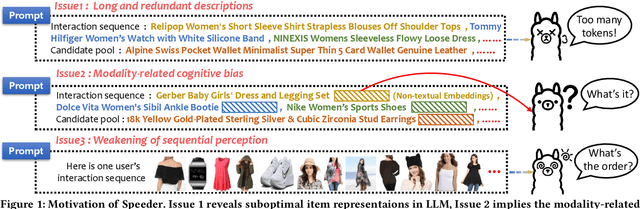
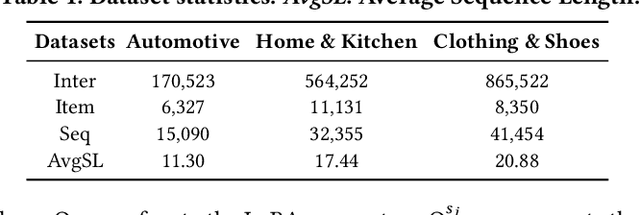
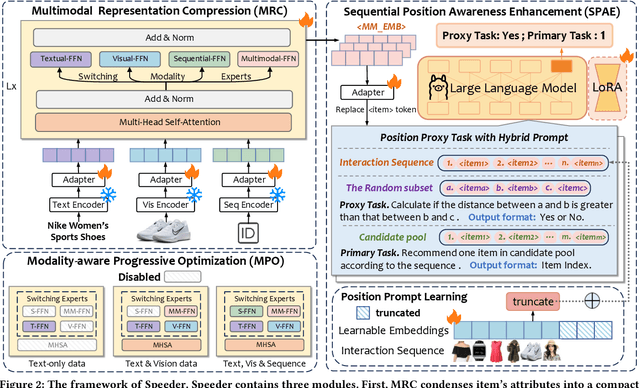
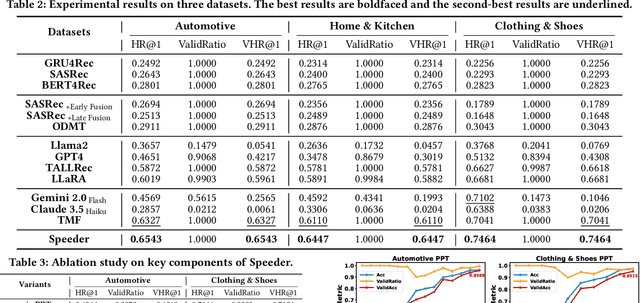
Sequential recommendations (SR) predict users' future interactions based on their historical behavior. The rise of Large Language Models (LLMs) has brought powerful generative and reasoning capabilities, significantly enhancing SR performance, while Multimodal LLMs (MLLMs) further extend this by introducing data like images and interactive relationships. However, critical issues remain, i.e., (a) Suboptimal item representations caused by lengthy and redundant descriptions, leading to inefficiencies in both training and inference; (b) Modality-related cognitive bias, as LLMs are predominantly pretrained on textual data, limiting their ability to effectively integrate and utilize non-textual modalities; (c) Weakening sequential perception in long interaction sequences, where attention mechanisms struggle to capture earlier interactions, hindering the modeling of long-range dependencies. To address these issues, we propose Speeder, an efficient MLLM-based paradigm for SR featuring three key innovations: 1) Multimodal Representation Compression (MRC), which condenses item attributes into concise yet informative tokens, reducing redundancy and computational cost; 2) Modality-aware Progressive Optimization (MPO), enabling gradual learning of multimodal representations; 3) Sequential Position Awareness Enhancement (SPAE), improving the LLM's capability to capture both relative and absolute sequential dependencies in long interaction sequences. Extensive experiments on real-world datasets demonstrate the effectiveness and efficiency of Speeder. Speeder increases training speed to 250% of the original while reducing inference time to 25% on the Amazon dataset.
Distilling Transitional Pattern to Large Language Models for Multimodal Session-based Recommendation
Apr 13, 2025Session-based recommendation (SBR) predicts the next item based on anonymous sessions. Traditional SBR explores user intents based on ID collaborations or auxiliary content. To further alleviate data sparsity and cold-start issues, recent Multimodal SBR (MSBR) methods utilize simplistic pre-trained models for modality learning but have limitations in semantic richness. Considering semantic reasoning abilities of Large Language Models (LLM), we focus on the LLM-enhanced MSBR scenario in this paper, which leverages LLM cognition for comprehensive multimodal representation generation, to enhance downstream MSBR. Tackling this problem faces two challenges: i) how to obtain LLM cognition on both transitional patterns and inherent multimodal knowledge, ii) how to align both features into one unified LLM, minimize discrepancy while maximizing representation utility. To this end, we propose a multimodal LLM-enhanced framework TPAD, which extends a distillation paradigm to decouple and align transitional patterns for promoting MSBR. TPAD establishes parallel Knowledge-MLLM and Transfer-MLLM, where the former interprets item knowledge-reflected features and the latter extracts transition-aware features underneath sessions. A transitional pattern alignment module harnessing mutual information estimation theory unites two MLLMs, alleviating distribution discrepancy and distilling transitional patterns into modal representations. Extensive experiments on real-world datasets demonstrate the effectiveness of our framework.
Enhancing Attributed Graph Networks with Alignment and Uniformity Constraints for Session-based Recommendation
Oct 14, 2024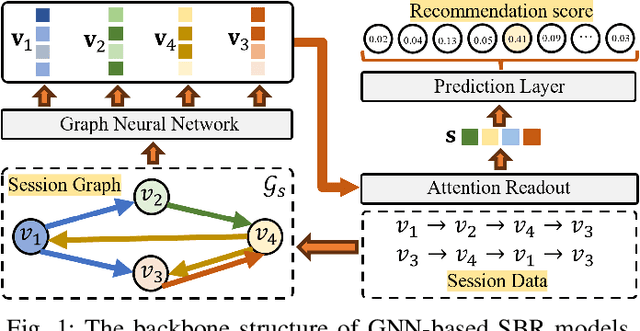
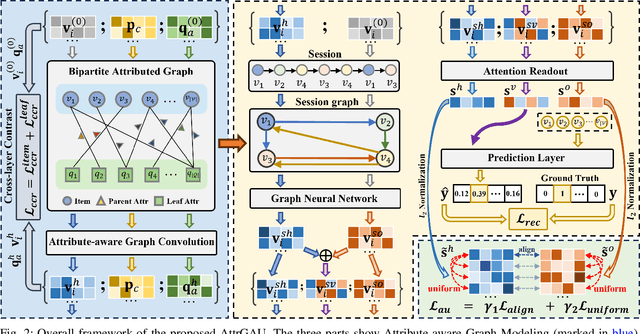
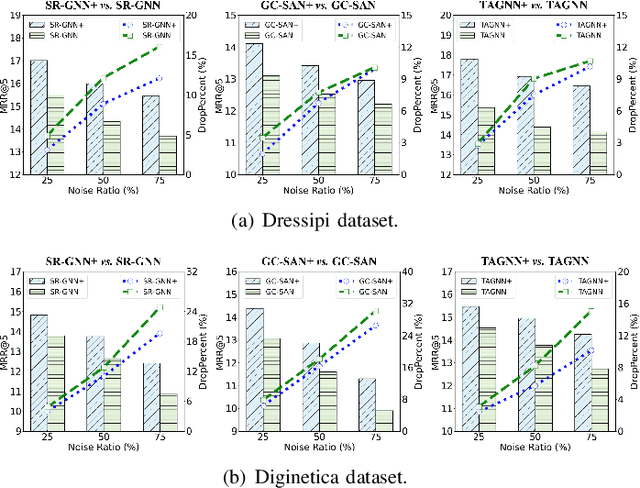

Session-based Recommendation (SBR), seeking to predict a user's next action based on an anonymous session, has drawn increasing attention for its practicability. Most SBR models only rely on the contextual transitions within a short session to learn item representations while neglecting additional valuable knowledge. As such, their model capacity is largely limited by the data sparsity issue caused by short sessions. A few studies have exploited the Modeling of Item Attributes (MIA) to enrich item representations. However, they usually involve specific model designs that can hardly transfer to existing attribute-agnostic SBR models and thus lack universality. In this paper, we propose a model-agnostic framework, named AttrGAU (Attributed Graph Networks with Alignment and Uniformity Constraints), to bring the MIA's superiority into existing attribute-agnostic models, to improve their accuracy and robustness for recommendation. Specifically, we first build a bipartite attributed graph and design an attribute-aware graph convolution to exploit the rich attribute semantics hidden in the heterogeneous item-attribute relationship. We then decouple existing attribute-agnostic SBR models into the graph neural network and attention readout sub-modules to satisfy the non-intrusive requirement. Lastly, we design two representation constraints, i.e., alignment and uniformity, to optimize distribution discrepancy in representation between the attribute semantics and collaborative semantics. Extensive experiments on three public benchmark datasets demonstrate that the proposed AttrGAU framework can significantly enhance backbone models' recommendation performance and robustness against data sparsity and data noise issues. Our implementation codes will be available at https://github.com/ItsukiFujii/AttrGAU.
Personalized Behavior-Aware Transformer for Multi-Behavior Sequential Recommendation
Feb 22, 2024
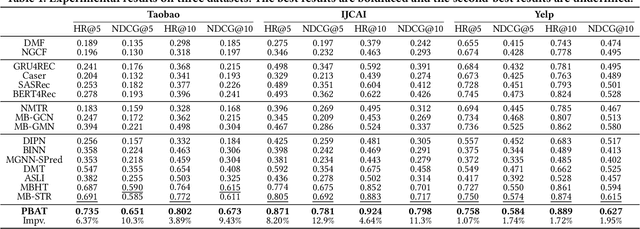

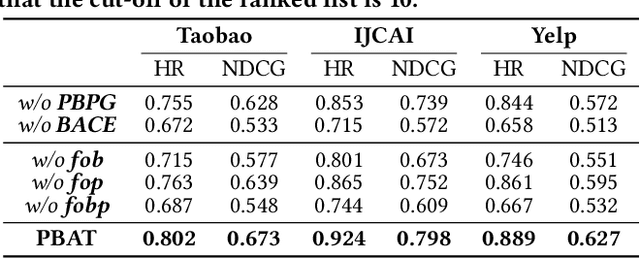
Sequential Recommendation (SR) captures users' dynamic preferences by modeling how users transit among items. However, SR models that utilize only single type of behavior interaction data encounter performance degradation when the sequences are short. To tackle this problem, we focus on Multi-Behavior Sequential Recommendation (MBSR) in this paper, which aims to leverage time-evolving heterogeneous behavioral dependencies for better exploring users' potential intents on the target behavior. Solving MBSR is challenging. On the one hand, users exhibit diverse multi-behavior patterns due to personal characteristics. On the other hand, there exists comprehensive co-influence between behavior correlations and item collaborations, the intensity of which is deeply affected by temporal factors. To tackle these challenges, we propose a Personalized Behavior-Aware Transformer framework (PBAT) for MBSR problem, which models personalized patterns and multifaceted sequential collaborations in a novel way to boost recommendation performance. First, PBAT develops a personalized behavior pattern generator in the representation layer, which extracts dynamic and discriminative behavior patterns for sequential learning. Second, PBAT reforms the self-attention layer with a behavior-aware collaboration extractor, which introduces a fused behavior-aware attention mechanism for incorporating both behavioral and temporal impacts into collaborative transitions. We conduct experiments on three benchmark datasets and the results demonstrate the effectiveness and interpretability of our framework. Our implementation code is released at https://github.com/TiliaceaeSU/PBAT.
DDGHM: Dual Dynamic Graph with Hybrid Metric Training for Cross-Domain Sequential Recommendation
Sep 21, 2022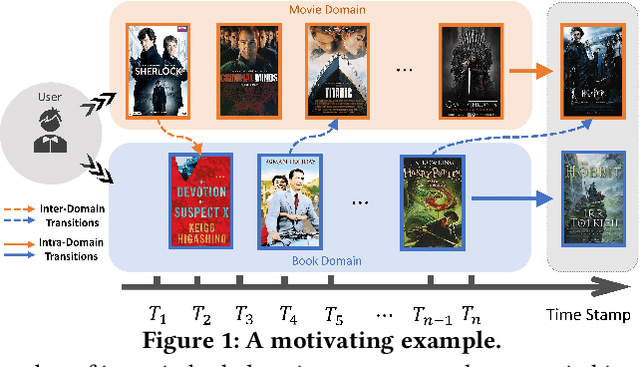
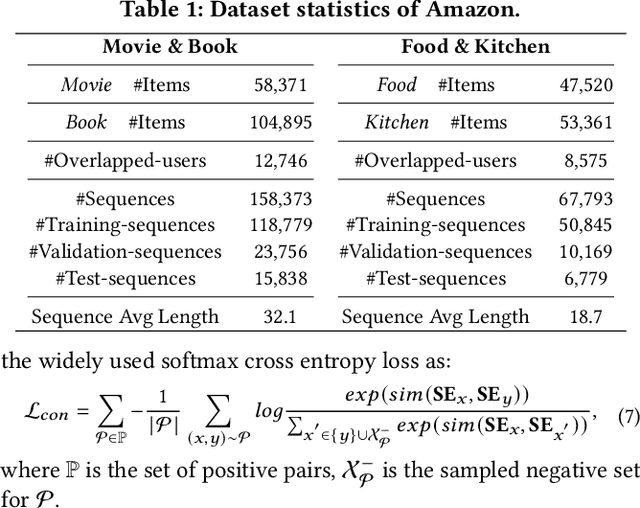
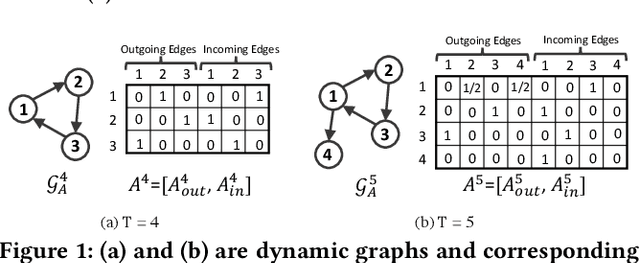
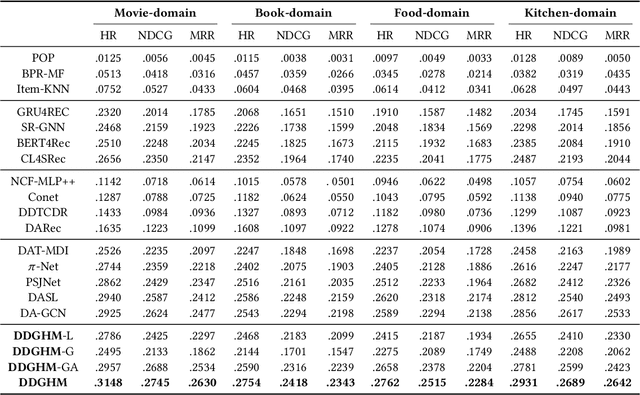
Sequential Recommendation (SR) characterizes evolving patterns of user behaviors by modeling how users transit among items. However, the short interaction sequences limit the performance of existing SR. To solve this problem, we focus on Cross-Domain Sequential Recommendation (CDSR) in this paper, which aims to leverage information from other domains to improve the sequential recommendation performance of a single domain. Solving CDSR is challenging. On the one hand, how to retain single domain preferences as well as integrate cross-domain influence remains an essential problem. On the other hand, the data sparsity problem cannot be totally solved by simply utilizing knowledge from other domains, due to the limited length of the merged sequences. To address the challenges, we propose DDGHM, a novel framework for the CDSR problem, which includes two main modules, i.e., dual dynamic graph modeling and hybrid metric training. The former captures intra-domain and inter-domain sequential transitions through dynamically constructing two-level graphs, i.e., the local graphs and the global graph, and incorporating them with a fuse attentive gating mechanism. The latter enhances user and item representations by employing hybrid metric learning, including collaborative metric for achieving alignment and contrastive metric for preserving uniformity, to further alleviate data sparsity issue and improve prediction accuracy. We conduct experiments on two benchmark datasets and the results demonstrate the effectiveness of DDHMG.