 Add to Chrome
 Add to Firefox
 Add to Edge
AgentGym2: Benchmarking Large Language Model Agents in De-Idealized Real-World Environments
Jul 06, 2026
Language agents, i.e., LLM agents, progress rapidly and are increasingly deployed in production environments. This trend underscores the urgent need for rigorous and realistic evaluations. However, most existing benchmarks evaluate agents in simplified, idealized settings. They typically rely on pre-packaged tool interfaces, overlook critical steps, and assume inputs are clean and fully specified. Consequently, they understate the difficulty of real deployments, where uncertainty and noise are ubiquitous and agents must proactively explore the environment to uncover new tools. To bridge this gap, we present AgentGym2, a new evaluation framework with task instances grounded in real-world end-to-end working demands. Beyond reasoning and planning, it measures agents' ability to execute end-to-end procedures, discover tools via exploration, compose tools for unseen tasks, and remain robust to noisy and underspecified information. Experiments on 15 proprietary and open-source models show that even SOTA systems like Gemini and GPT-5 struggle on AgentGym2, revealing a substantial gap between the capability of current agents and the demands of real-world applications.

SCOPE: Evolving Symbolic World for Planning in Open-Ended Environments
Jun 21, 2026Recent works have explored integrating Vision-Language Models (VLMs) with classical planners that rely on symbolic representations of planning problems to generate long-horizon plans for complex embodied tasks. However, in open-ended environments, these symbolic representations obtained from perception are often incomplete, leading to suboptimal performance. To address this, we introduce SCOPE, a self-adaptive symbolic planning framework that supports refining action plans and evolving the symbolic world, i.e., the symbolic representations of open-ended environments. SCOPE comprises two synergistic modules: a Symbolic Execution Simulator (SESim) that conducts symbolic validation and real execution of action plans, leveraging the feedback to refine the plans and evolve the symbolic world; and a Self-Adaptive Symbolic Memory (SASMem) that further distills feedback into evolving symbolic knowledge to enhance long-horizon planning and modeling of the symbolic world. Experiments in open-ended environments show that SCOPE significantly improves the completeness of the symbolic world, the success rate of plans under environment perturbations, and cross-task grounding and adaptability across diverse embodied scenarios.
What Limits Virtual Agent Application? OmniBench: A Scalable Multi-Dimensional Benchmark for Essential Virtual Agent Capabilities
Jun 10, 2025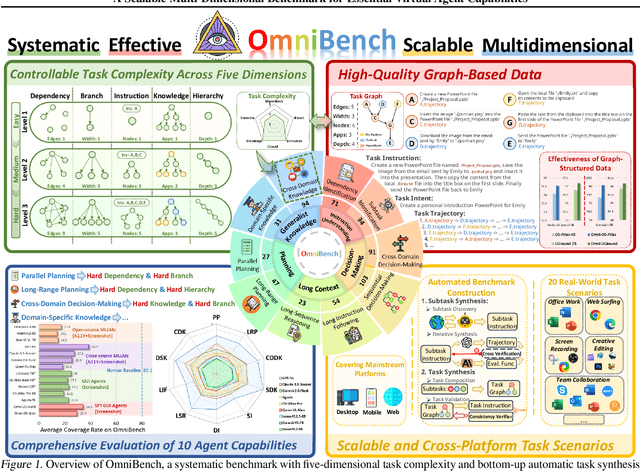
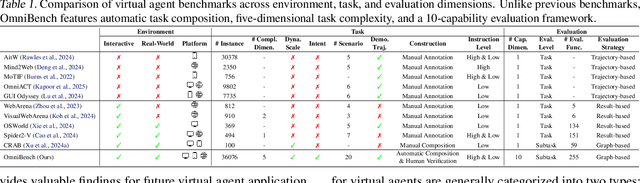
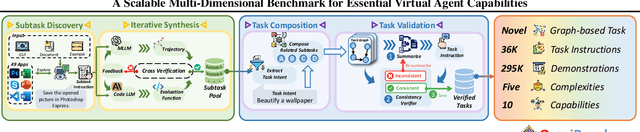
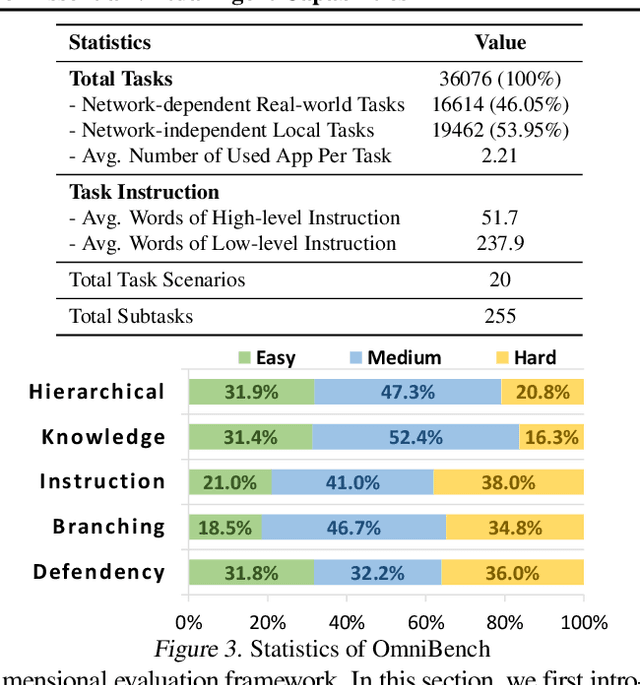
As multimodal large language models (MLLMs) advance, MLLM-based virtual agents have demonstrated remarkable performance. However, existing benchmarks face significant limitations, including uncontrollable task complexity, extensive manual annotation with limited scenarios, and a lack of multidimensional evaluation. In response to these challenges, we introduce OmniBench, a self-generating, cross-platform, graph-based benchmark with an automated pipeline for synthesizing tasks of controllable complexity through subtask composition. To evaluate the diverse capabilities of virtual agents on the graph, we further present OmniEval, a multidimensional evaluation framework that includes subtask-level evaluation, graph-based metrics, and comprehensive tests across 10 capabilities. Our synthesized dataset contains 36k graph-structured tasks across 20 scenarios, achieving a 91\% human acceptance rate. Training on our graph-structured data shows that it can more efficiently guide agents compared to manually annotated data. We conduct multidimensional evaluations for various open-source and closed-source models, revealing their performance across various capabilities and paving the way for future advancements. Our project is available at https://omni-bench.github.io/.
On Path to Multimodal Generalist: General-Level and General-Bench
May 07, 2025The Multimodal Large Language Model (MLLM) is currently experiencing rapid growth, driven by the advanced capabilities of LLMs. Unlike earlier specialists, existing MLLMs are evolving towards a Multimodal Generalist paradigm. Initially limited to understanding multiple modalities, these models have advanced to not only comprehend but also generate across modalities. Their capabilities have expanded from coarse-grained to fine-grained multimodal understanding and from supporting limited modalities to arbitrary ones. While many benchmarks exist to assess MLLMs, a critical question arises: Can we simply assume that higher performance across tasks indicates a stronger MLLM capability, bringing us closer to human-level AI? We argue that the answer is not as straightforward as it seems. This project introduces General-Level, an evaluation framework that defines 5-scale levels of MLLM performance and generality, offering a methodology to compare MLLMs and gauge the progress of existing systems towards more robust multimodal generalists and, ultimately, towards AGI. At the core of the framework is the concept of Synergy, which measures whether models maintain consistent capabilities across comprehension and generation, and across multiple modalities. To support this evaluation, we present General-Bench, which encompasses a broader spectrum of skills, modalities, formats, and capabilities, including over 700 tasks and 325,800 instances. The evaluation results that involve over 100 existing state-of-the-art MLLMs uncover the capability rankings of generalists, highlighting the challenges in reaching genuine AI. We expect this project to pave the way for future research on next-generation multimodal foundation models, providing a robust infrastructure to accelerate the realization of AGI. Project page: https://generalist.top/
Benchmarking Multimodal CoT Reward Model Stepwise by Visual Program
Apr 09, 2025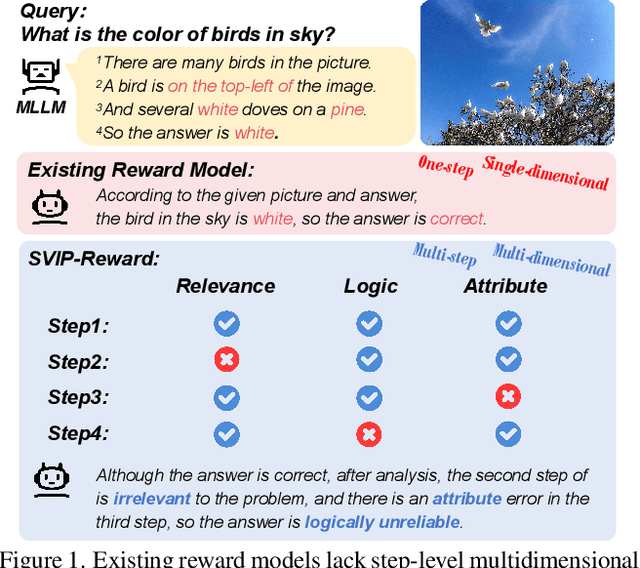
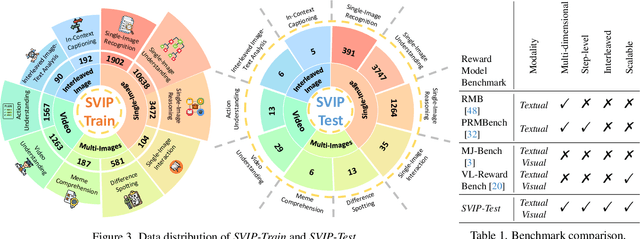
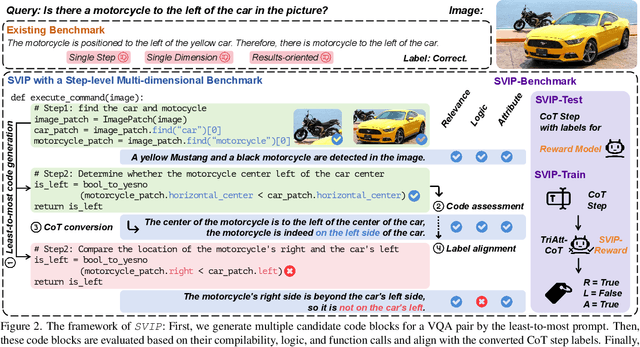
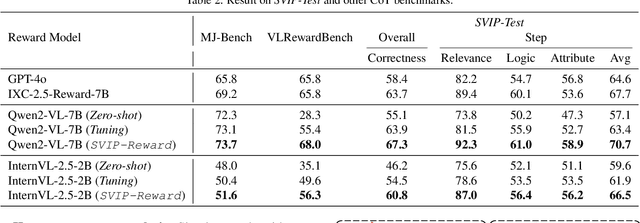
Recent advancements in reward signal usage for Large Language Models (LLMs) are remarkable. However, significant challenges exist when transitioning reward signal to the multimodal domain, including labor-intensive annotations, over-reliance on one-step rewards, and inadequate evaluation. To address these issues, we propose SVIP, a novel approach to train a step-level multi-dimensional Chain-of-Thought~(CoT) reward model automatically. It generates code for solving visual tasks and transforms the analysis of code blocks into the evaluation of CoT step as training samples. Then, we train SVIP-Reward model using a multi-head attention mechanism called TriAtt-CoT. The advantages of SVIP-Reward are evident throughout the entire process of MLLM. We also introduce a benchmark for CoT reward model training and testing. Experimental results demonstrate that SVIP-Reward improves MLLM performance across training and inference-time scaling, yielding better results on benchmarks while reducing hallucinations and enhancing reasoning ability.
Boosting Virtual Agent Learning and Reasoning: A Step-wise, Multi-dimensional, and Generalist Reward Model with Benchmark
Mar 24, 2025The development of Generalist Virtual Agents (GVAs) powered by Multimodal Large Language Models (MLLMs) has shown significant promise in autonomous task execution. However, current training paradigms face critical limitations, including reliance on outcome supervision and labor-intensive human annotations. To address these challenges, we propose Similar, a Step-wise Multi-dimensional Generalist Reward Model, which offers fine-grained signals for agent training and can choose better action for inference-time scaling. Specifically, we begin by systematically defining five dimensions for evaluating agent actions. Building on this framework, we design an MCTS-P algorithm to automatically collect and annotate step-wise, five-dimensional agent execution data. Using this data, we train Similar with the Triple-M strategy. Furthermore, we introduce the first benchmark in the virtual agent domain for step-wise, multi-dimensional reward model training and evaluation, named SRM. This benchmark consists of two components: SRMTrain, which serves as the training set for Similar, and SRMEval, a manually selected test set for evaluating the reward model. Experimental results demonstrate that Similar, through its step-wise, multi-dimensional assessment and synergistic gain, provides GVAs with effective intermediate signals during both training and inference-time scaling. The code is available at https://github.com/Galery23/Similar-v1.
Iris: Breaking GUI Complexity with Adaptive Focus and Self-Refining
Dec 13, 2024


Digital agents are increasingly employed to automate tasks in interactive digital environments such as web pages, software applications, and operating systems. While text-based agents built on Large Language Models (LLMs) often require frequent updates due to platform-specific APIs, visual agents leveraging Multimodal Large Language Models (MLLMs) offer enhanced adaptability by interacting directly with Graphical User Interfaces (GUIs). However, these agents face significant challenges in visual perception, particularly when handling high-resolution, visually complex digital environments. This paper introduces Iris, a foundational visual agent that addresses these challenges through two key innovations: Information-Sensitive Cropping (ISC) and Self-Refining Dual Learning (SRDL). ISC dynamically identifies and prioritizes visually dense regions using a edge detection algorithm, enabling efficient processing by allocating more computational resources to areas with higher information density. SRDL enhances the agent's ability to handle complex tasks by leveraging a dual-learning loop, where improvements in referring (describing UI elements) reinforce grounding (locating elements) and vice versa, all without requiring additional annotated data. Empirical evaluations demonstrate that Iris achieves state-of-the-art performance across multiple benchmarks with only 850K GUI annotations, outperforming methods using 10x more training data. These improvements further translate to significant gains in both web and OS agent downstream tasks.
STEP: Enhancing Video-LLMs' Compositional Reasoning by Spatio-Temporal Graph-guided Self-Training
Nov 29, 2024Video Large Language Models (Video-LLMs) have recently shown strong performance in basic video understanding tasks, such as captioning and coarse-grained question answering, but struggle with compositional reasoning that requires multi-step spatio-temporal inference across object relations, interactions, and events. The hurdles to enhancing this capability include extensive manual labor, the lack of spatio-temporal compositionality in existing data and the absence of explicit reasoning supervision. In this paper, we propose STEP, a novel graph-guided self-training method that enables Video-LLMs to generate reasoning-rich fine-tuning data from any raw videos to improve itself. Specifically, we first induce Spatio-Temporal Scene Graph (STSG) representation of diverse videos to capture fine-grained, multi-granular video semantics. Then, the STSGs guide the derivation of multi-step reasoning Question-Answer (QA) data with Chain-of-Thought (CoT) rationales. Both answers and rationales are integrated as training objective, aiming to enhance model's reasoning abilities by supervision over explicit reasoning steps. Experimental results demonstrate the effectiveness of STEP across models of varying scales, with a significant 21.3\% improvement in tasks requiring three or more reasoning steps. Furthermore, it achieves superior performance with a minimal amount of self-generated rationale-enriched training samples in both compositional reasoning and comprehensive understanding benchmarks, highlighting the broad applicability and vast potential.
Fact :Teaching MLLMs with Faithful, Concise and Transferable Rationales
Apr 17, 2024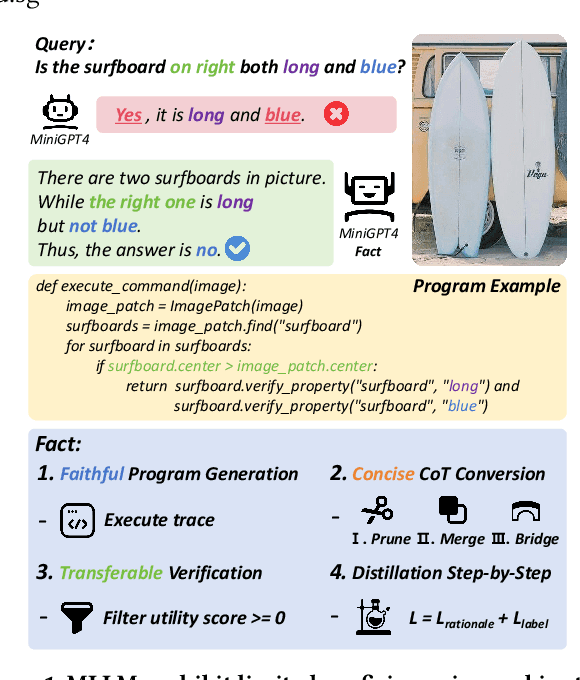

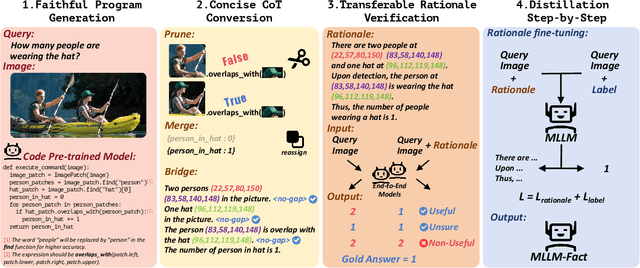

The remarkable performance of Multimodal Large Language Models (MLLMs) has unequivocally demonstrated their proficient understanding capabilities in handling a wide array of visual tasks. Nevertheless, the opaque nature of their black-box reasoning processes persists as an enigma, rendering them uninterpretable and struggling with hallucination. Their ability to execute intricate compositional reasoning tasks is also constrained, culminating in a stagnation of learning progression for these models. In this work, we introduce Fact, a novel paradigm designed to generate multimodal rationales that are faithful, concise, and transferable for teaching MLLMs. This paradigm utilizes verifiable visual programming to generate executable code guaranteeing faithfulness and precision. Subsequently, through a series of operations including pruning, merging, and bridging, the rationale enhances its conciseness. Furthermore, we filter rationales that can be transferred to end-to-end paradigms from programming paradigms to guarantee transferability. Empirical evidence from experiments demonstrates the superiority of our method across models of varying parameter sizes, significantly enhancing their compositional reasoning and generalization ability. Our approach also reduces hallucinations owing to its high correlation between images and text.
De-fine: Decomposing and Refining Visual Programs with Auto-Feedback
Nov 25, 2023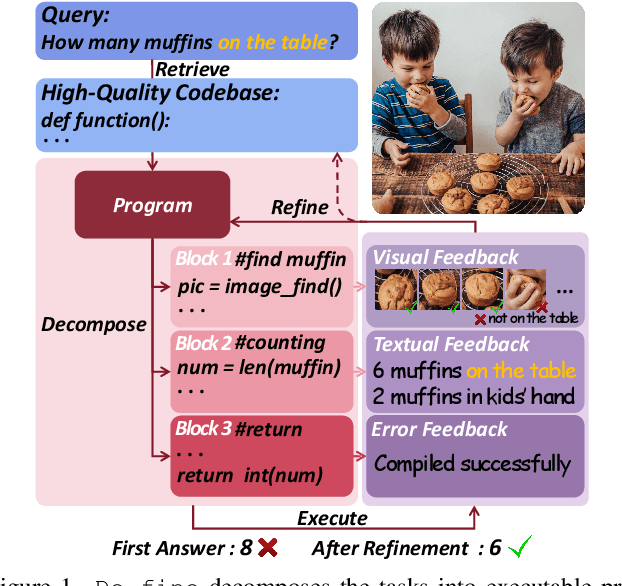
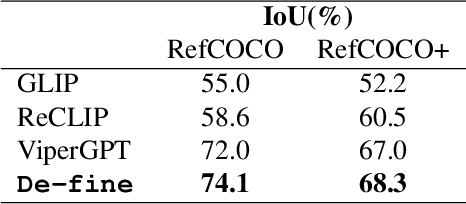
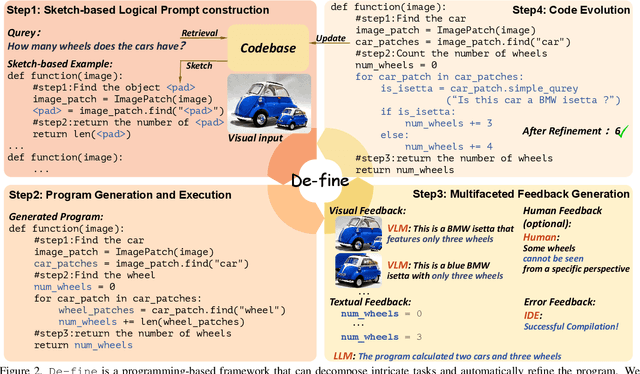
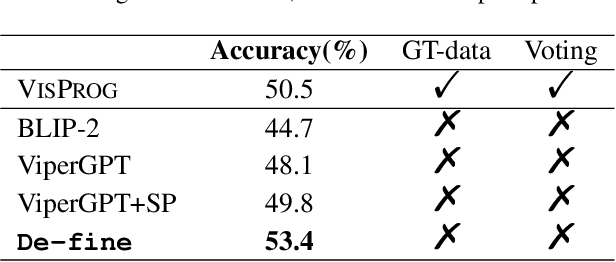
Visual programming, a modular and generalizable paradigm, integrates different modules and Python operators to solve various vision-language tasks. Unlike end-to-end models that need task-specific data, it advances in performing visual processing and reasoning in an unsupervised manner. Current visual programming methods generate programs in a single pass for each task where the ability to evaluate and optimize based on feedback, unfortunately, is lacking, which consequentially limits their effectiveness for complex, multi-step problems. Drawing inspiration from benders decomposition, we introduce De-fine, a general framework that automatically decomposes complex tasks into simpler subtasks and refines programs through auto-feedback. This model-agnostic approach can improve logical reasoning performance by integrating the strengths of multiple models. Our experiments across various visual tasks show that De-fine creates more accurate and robust programs, setting new benchmarks in the field.