 Add to Chrome
 Add to Firefox
 Add to Edge
FastMix: Fast Data Mixture Optimization via Gradient Descent
Jun 12, 2026
While large and diverse datasets have driven recent advances in large models, identifying the optimal data mixture for pre-training and post-training remains a significant open problem. We address this challenge with FASTMIX, a novel framework that automates data mixture discovery while training only a single proxy model. Instead of relying on predefined heuristics or resource-intensive simulations, FASTMIX jointly optimizes mixture coefficients and model parameters, substantially improving efficiency and scalability over prior approaches. At the core of FASTMIX is a reformulation of mixture selection as a bilevel optimization problem. Under this reformulation, we show that optimizing mixture ratios is mathematically equivalent to assigning per-source loss weights under uniform source sampling. This embeds the mixture coefficients directly into the differentiable iterative optimization objective, enabling efficient, gradient-based optimization of both mixture and model. To solve the optimization problem, FASTMIX implements an approximate iterative optimization procedure, alternating between (i) updating model parameters on data sampled according to current mixture ratios (inner loop) and (ii) updating mixture ratios based on validation feedback (outer loop). Across pre- and post-training, FASTMIX outperforms baselines while drastically reducing search cost. Code (https://github.com/hrtan/fastmix)

Beyond Encoder Accumulation: Measuring Encoder Roles in Multi-Encoder VLMs
Jun 02, 2026As foundation models scale toward fusing more heterogeneous visual streams, understanding how diverse encoders interact under joint training becomes a prerequisite for principled design. Yet large vision-language models (LVLMs) currently lack the tools to do so, and parameter-efficient encoder configurations remain hard to identify before training. To re-examine encoder roles under joint training, on the 16-benchmark Cambrian-1 suite we retrain and evaluate all 31 non-empty subsets of five common vision encoders under a unified pipeline (~20k GPU-hours total), and report three findings. First, retraining each subset from scratch reveals encoder rankings that differ from those obtained by masking encoders on a fixed checkpoint, including which encoder ranks first overall. Second, we decompose each encoder's contribution into two axes, Capacity, the score an encoder reaches on its own, and Necessity, the drop when it is removed from the full pool. The two axes are not interchangeable. Pairing the two highest-Capacity encoders is suboptimal, while pairing a high-Capacity anchor with an adaptive complement matches the full five-encoder model. Adding further encoders beyond this pair yields only marginal gains. Third, at fixed parameter count, per-encoder pre-projector effective rank explains the residual score variation. The strongest pairs combine an anchor whose rank survives joint training with a complement whose rank expands under it, suggesting that higher-rank, less-collapsed projector inputs correspond to a more favorable optimization regime at the encoder-projector interface. Together, the Capacity-Necessity decomposition and the pre-projector rank analysis, along with comprehensive evaluation through retraining, expose a methodological gap in multi-encoder LVLM design, and offer concrete primitives for closing it.
MHSA: A Lightweight Framework for Mitigating Hallucinations via Steered Attention in LVLMs
May 14, 2026Large vision-language models (LVLMs) have achieved remarkable performance across diverse multimodal tasks, yet they continue to suffer from hallucinations, generating content that is inconsistent with the visual input. Prior work DHCP (Detecting Hallucinations by Cross-modal Attention Pattern) has explored hallucination detection from the perspective of cross-modal attention, but does not address hallucination mitigation. In this paper, we propose MHSA (Mitigating Hallucinations via Steered Attention), a lightweight framework that mitigates hallucinations by learning to correct cross-modal attention patterns in LVLMs. MHSA trains a simple three-layer MLP generator to produce corrected attention, guided by supervisory signals from the DHCP discriminator and the LVLM itself. During inference, MHSA mitigates both discriminative and generative hallucinations across various datasets and LVLMs by simply replacing the original cross-modal attention with the corrected one, without modifying any LVLM parameters. By extending cross-modal attention mechanisms from hallucination detection to hallucination mitigation, MHSA offers a novel perspective on hallucination research in LVLMs and helps enhance their reliability.
Self-Distillation for Multi-Token Prediction
Mar 25, 2026As Large Language Models (LLMs) scale up, inference efficiency becomes a critical bottleneck. Multi-Token Prediction (MTP) could accelerate LLM inference by predicting multiple future tokens in parallel. However, existing MTP approaches still face two challenges: limited acceptance rates of MTP heads, and difficulties in jointly training multiple MTP heads. Therefore, we propose MTP-D, a simple yet effective self-distillation method with minimal additional training cost, which boosts MTP head acceptance rates (+7.5\%) while maximumly preserving main-head performance. We also introduce a looped extension strategy for MTP-D, enabling effective and economical MTP head extension and further significant inference speedup to 1-head MTP (+220.4\%). Moreover, we systematically explore and validate key insights on the distillation strategies and the potential scalability of MTP through extensive experiments on seven benchmarks. These results demonstrate that our MTP-D and looped extension strategy effectively enhance MTP-head performance and inference efficiency, facilitating the practical usage of MTP in LLMs.
Hybrid-Tower: Fine-grained Pseudo-query Interaction and Generation for Text-to-Video Retrieval
Sep 05, 2025The Text-to-Video Retrieval (T2VR) task aims to retrieve unlabeled videos by textual queries with the same semantic meanings. Recent CLIP-based approaches have explored two frameworks: Two-Tower versus Single-Tower framework, yet the former suffers from low effectiveness, while the latter suffers from low efficiency. In this study, we explore a new Hybrid-Tower framework that can hybridize the advantages of the Two-Tower and Single-Tower framework, achieving high effectiveness and efficiency simultaneously. We propose a novel hybrid method, Fine-grained Pseudo-query Interaction and Generation for T2VR, ie, PIG, which includes a new pseudo-query generator designed to generate a pseudo-query for each video. This enables the video feature and the textual features of pseudo-query to interact in a fine-grained manner, similar to the Single-Tower approaches to hold high effectiveness, even before the real textual query is received. Simultaneously, our method introduces no additional storage or computational overhead compared to the Two-Tower framework during the inference stage, thus maintaining high efficiency. Extensive experiments on five commonly used text-video retrieval benchmarks demonstrate that our method achieves a significant improvement over the baseline, with an increase of $1.6\% \sim 3.9\%$ in R@1. Furthermore, our method matches the efficiency of Two-Tower models while achieving near state-of-the-art performance, highlighting the advantages of the Hybrid-Tower framework.
Proximal Supervised Fine-Tuning
Aug 25, 2025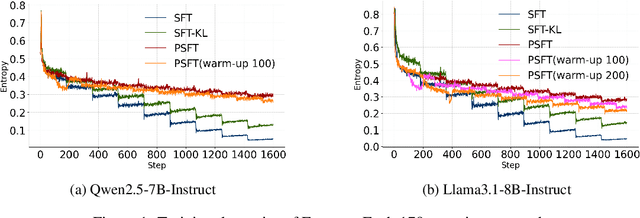
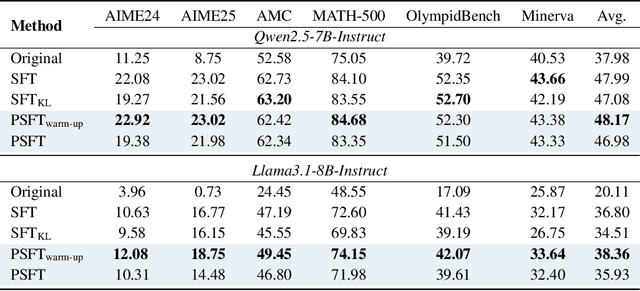
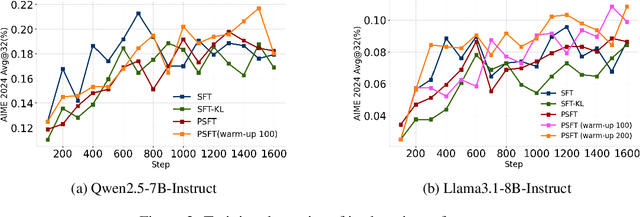
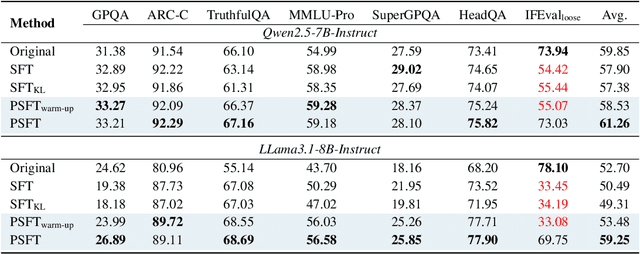
Supervised fine-tuning (SFT) of foundation models often leads to poor generalization, where prior capabilities deteriorate after tuning on new tasks or domains. Inspired by trust-region policy optimization (TRPO) and proximal policy optimization (PPO) in reinforcement learning (RL), we propose Proximal SFT (PSFT). This fine-tuning objective incorporates the benefits of trust-region, effectively constraining policy drift during SFT while maintaining competitive tuning. By viewing SFT as a special case of policy gradient methods with constant positive advantages, we derive PSFT that stabilizes optimization and leads to generalization, while leaving room for further optimization in subsequent post-training stages. Experiments across mathematical and human-value domains show that PSFT matches SFT in-domain, outperforms it in out-of-domain generalization, remains stable under prolonged training without causing entropy collapse, and provides a stronger foundation for the subsequent optimization.
The Climb Carves Wisdom Deeper Than the Summit: On the Noisy Rewards in Learning to Reason
May 28, 2025Recent studies on post-training large language models (LLMs) for reasoning through reinforcement learning (RL) typically focus on tasks that can be accurately verified and rewarded, such as solving math problems. In contrast, our research investigates the impact of reward noise, a more practical consideration for real-world scenarios involving the post-training of LLMs using reward models. We found that LLMs demonstrate strong robustness to substantial reward noise. For example, manually flipping 40% of the reward function's outputs in math tasks still allows a Qwen-2.5-7B model to achieve rapid convergence, improving its performance on math tasks from 5% to 72%, compared to the 75% accuracy achieved by a model trained with noiseless rewards. Surprisingly, by only rewarding the appearance of key reasoning phrases (namely reasoning pattern reward, RPR), such as ``first, I need to''-without verifying the correctness of answers, the model achieved peak downstream performance (over 70% accuracy for Qwen-2.5-7B) comparable to models trained with strict correctness verification and accurate rewards. Recognizing the importance of the reasoning process over the final results, we combined RPR with noisy reward models. RPR helped calibrate the noisy reward models, mitigating potential false negatives and enhancing the LLM's performance on open-ended tasks. These findings suggest the importance of improving models' foundational abilities during the pre-training phase while providing insights for advancing post-training techniques. Our code and scripts are available at https://github.com/trestad/Noisy-Rewards-in-Learning-to-Reason.
Hunyuan-TurboS: Advancing Large Language Models through Mamba-Transformer Synergy and Adaptive Chain-of-Thought
May 21, 2025As Large Language Models (LLMs) rapidly advance, we introduce Hunyuan-TurboS, a novel large hybrid Transformer-Mamba Mixture of Experts (MoE) model. It synergistically combines Mamba's long-sequence processing efficiency with Transformer's superior contextual understanding. Hunyuan-TurboS features an adaptive long-short chain-of-thought (CoT) mechanism, dynamically switching between rapid responses for simple queries and deep "thinking" modes for complex problems, optimizing computational resources. Architecturally, this 56B activated (560B total) parameter model employs 128 layers (Mamba2, Attention, FFN) with an innovative AMF/MF block pattern. Faster Mamba2 ensures linear complexity, Grouped-Query Attention minimizes KV cache, and FFNs use an MoE structure. Pre-trained on 16T high-quality tokens, it supports a 256K context length and is the first industry-deployed large-scale Mamba model. Our comprehensive post-training strategy enhances capabilities via Supervised Fine-Tuning (3M instructions), a novel Adaptive Long-short CoT Fusion method, Multi-round Deliberation Learning for iterative improvement, and a two-stage Large-scale Reinforcement Learning process targeting STEM and general instruction-following. Evaluations show strong performance: overall top 7 rank on LMSYS Chatbot Arena with a score of 1356, outperforming leading models like Gemini-2.0-Flash-001 (1352) and o4-mini-2025-04-16 (1345). TurboS also achieves an average of 77.9% across 23 automated benchmarks. Hunyuan-TurboS balances high performance and efficiency, offering substantial capabilities at lower inference costs than many reasoning models, establishing a new paradigm for efficient large-scale pre-trained models.
QAVA: Query-Agnostic Visual Attack to Large Vision-Language Models
Apr 15, 2025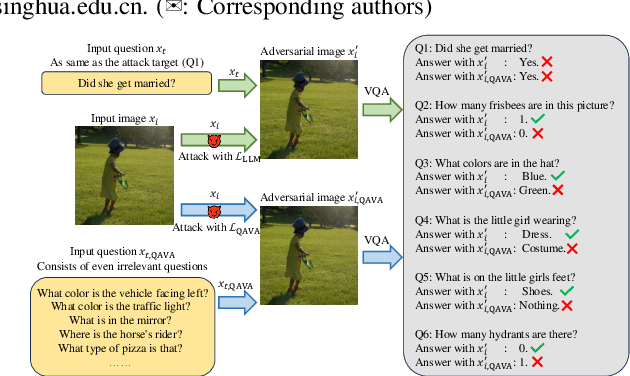
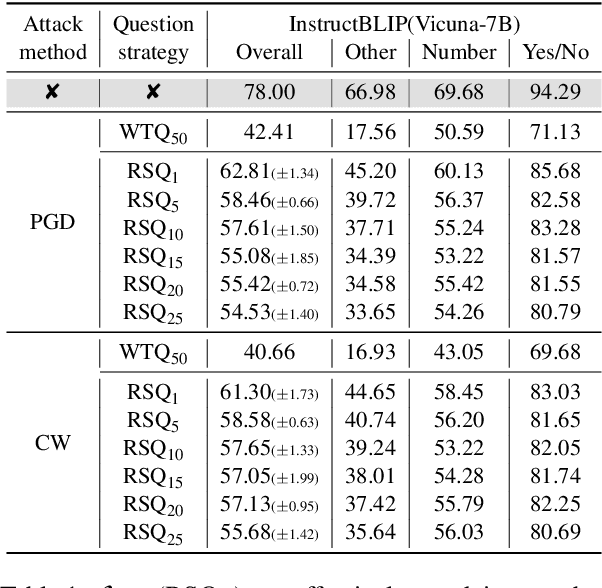
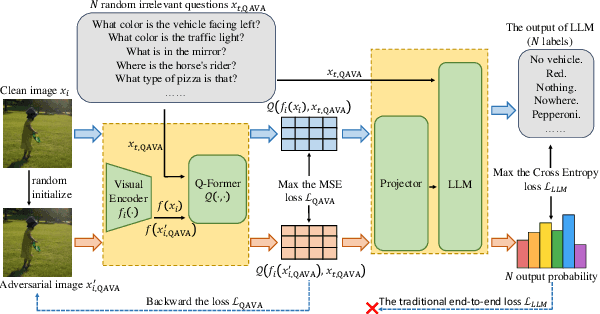
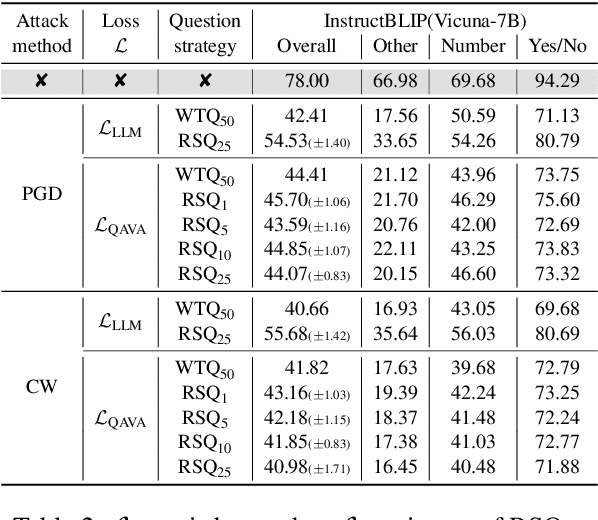
In typical multimodal tasks, such as Visual Question Answering (VQA), adversarial attacks targeting a specific image and question can lead large vision-language models (LVLMs) to provide incorrect answers. However, it is common for a single image to be associated with multiple questions, and LVLMs may still answer other questions correctly even for an adversarial image attacked by a specific question. To address this, we introduce the query-agnostic visual attack (QAVA), which aims to create robust adversarial examples that generate incorrect responses to unspecified and unknown questions. Compared to traditional adversarial attacks focused on specific images and questions, QAVA significantly enhances the effectiveness and efficiency of attacks on images when the question is unknown, achieving performance comparable to attacks on known target questions. Our research broadens the scope of visual adversarial attacks on LVLMs in practical settings, uncovering previously overlooked vulnerabilities, particularly in the context of visual adversarial threats. The code is available at https://github.com/btzyd/qava.
Large Language Model Empowered Recommendation Meets All-domain Continual Pre-Training
Apr 11, 2025Recent research efforts have investigated how to integrate Large Language Models (LLMs) into recommendation, capitalizing on their semantic comprehension and open-world knowledge for user behavior understanding. These approaches predominantly employ supervised fine-tuning on single-domain user interactions to adapt LLMs for specific recommendation tasks. However, they typically encounter dual challenges: the mismatch between general language representations and domain-specific preference patterns, as well as the limited adaptability to multi-domain recommendation scenarios. To bridge these gaps, we introduce CPRec -- an All-domain Continual Pre-Training framework for Recommendation -- designed to holistically align LLMs with universal user behaviors through the continual pre-training paradigm. Specifically, we first design a unified prompt template and organize users' multi-domain behaviors into domain-specific behavioral sequences and all-domain mixed behavioral sequences that emulate real-world user decision logic. To optimize behavioral knowledge infusion, we devise a Warmup-Stable-Annealing learning rate schedule tailored for the continual pre-training paradigm in recommendation to progressively enhance the LLM's capability in knowledge adaptation from open-world knowledge to universal recommendation tasks. To evaluate the effectiveness of our CPRec, we implement it on a large-scale dataset covering seven domains and conduct extensive experiments on five real-world datasets from two distinct platforms. Experimental results confirm that our continual pre-training paradigm significantly mitigates the semantic-behavioral discrepancy and achieves state-of-the-art performance in all recommendation scenarios. The source code will be released upon acceptance.