 Add to Chrome
 Add to Firefox
 Add to Edge
ARECHO: Autoregressive Evaluation via Chain-Based Hypothesis Optimization for Speech Multi-Metric Estimation
May 30, 2025
Speech signal analysis poses significant challenges, particularly in tasks such as speech quality evaluation and profiling, where the goal is to predict multiple perceptual and objective metrics. For instance, metrics like PESQ (Perceptual Evaluation of Speech Quality), STOI (Short-Time Objective Intelligibility), and MOS (Mean Opinion Score) each capture different aspects of speech quality. However, these metrics often have different scales, assumptions, and dependencies, making joint estimation non-trivial. To address these issues, we introduce ARECHO (Autoregressive Evaluation via Chain-based Hypothesis Optimization), a chain-based, versatile evaluation system for speech assessment grounded in autoregressive dependency modeling. ARECHO is distinguished by three key innovations: (1) a comprehensive speech information tokenization pipeline; (2) a dynamic classifier chain that explicitly captures inter-metric dependencies; and (3) a two-step confidence-oriented decoding algorithm that enhances inference reliability. Experiments demonstrate that ARECHO significantly outperforms the baseline framework across diverse evaluation scenarios, including enhanced speech analysis, speech generation evaluation, and noisy speech evaluation. Furthermore, its dynamic dependency modeling improves interpretability by capturing inter-metric relationships.

Interspeech 2025 URGENT Speech Enhancement Challenge
May 29, 2025There has been a growing effort to develop universal speech enhancement (SE) to handle inputs with various speech distortions and recording conditions. The URGENT Challenge series aims to foster such universal SE by embracing a broad range of distortion types, increasing data diversity, and incorporating extensive evaluation metrics. This work introduces the Interspeech 2025 URGENT Challenge, the second edition of the series, to explore several aspects that have received limited attention so far: language dependency, universality for more distortion types, data scalability, and the effectiveness of using noisy training data. We received 32 submissions, where the best system uses a discriminative model, while most other competitive ones are hybrid methods. Analysis reveals some key findings: (i) some generative or hybrid approaches are preferred in subjective evaluations over the top discriminative model, and (ii) purely generative SE models can exhibit language dependency.
Uni-VERSA: Versatile Speech Assessment with a Unified Network
May 27, 2025Subjective listening tests remain the golden standard for speech quality assessment, but are costly, variable, and difficult to scale. In contrast, existing objective metrics, such as PESQ, F0 correlation, and DNSMOS, typically capture only specific aspects of speech quality. To address these limitations, we introduce Uni-VERSA, a unified network that simultaneously predicts various objective metrics, encompassing naturalness, intelligibility, speaker characteristics, prosody, and noise, for a comprehensive evaluation of speech signals. We formalize its framework, evaluation protocol, and applications in speech enhancement, synthesis, and quality control. A benchmark based on the URGENT24 challenge, along with a baseline leveraging self-supervised representations, demonstrates that Uni-VERSA provides a viable alternative to single-aspect evaluation methods. Moreover, it aligns closely with human perception, making it a promising approach for future speech quality assessment.
Context-Driven Dynamic Pruning for Large Speech Foundation Models
May 24, 2025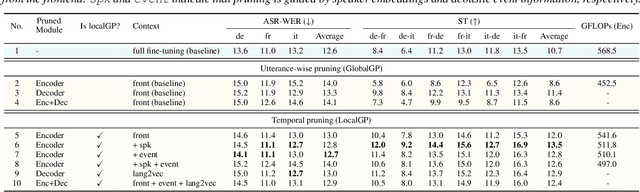
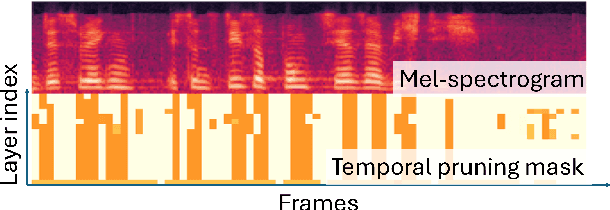
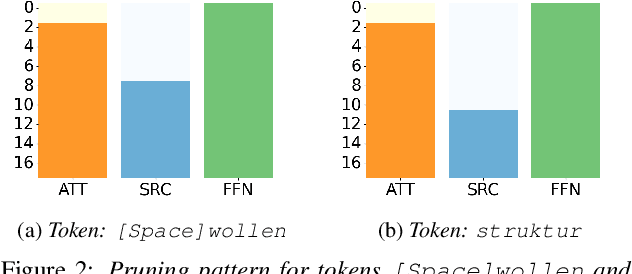
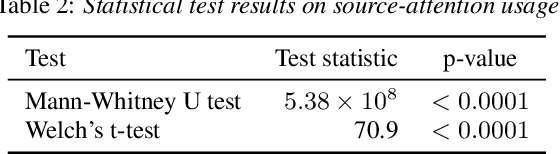
Speech foundation models achieve strong generalization across languages and acoustic conditions, but require significant computational resources for inference. In the context of speech foundation models, pruning techniques have been studied that dynamically optimize model structures based on the target audio leveraging external context. In this work, we extend this line of research and propose context-driven dynamic pruning, a technique that optimizes the model computation depending on the context between different input frames and additional context during inference. We employ the Open Whisper-style Speech Model (OWSM) and incorporate speaker embeddings, acoustic event embeddings, and language information as additional context. By incorporating the speaker embedding, our method achieves a reduction of 56.7 GFLOPs while improving BLEU scores by a relative 25.7% compared to the fully fine-tuned OWSM model.
Differentiable K-means for Fully-optimized Discrete Token-based ASR
May 22, 2025Recent studies have highlighted the potential of discrete tokens derived from self-supervised learning (SSL) models for various speech-related tasks. These tokens serve not only as substitutes for text in language modeling but also as intermediate representations for tasks such as automatic speech recognition (ASR). However, discrete tokens are typically obtained via k-means clustering of SSL features independently of downstream tasks, making them suboptimal for specific applications. This paper proposes the use of differentiable k-means, enabling the joint optimization of tokenization and downstream tasks. This approach enables the fine-tuning of the SSL parameters and learning weights for outputs from multiple SSL layers. Experiments were conducted with ASR as a downstream task. ASR accuracy successfully improved owing to the optimized tokens. The acquired tokens also exhibited greater purity of phonetic information, which were found to be useful even in speech resynthesis.
BLAB: Brutally Long Audio Bench
May 05, 2025Developing large audio language models (LMs) capable of understanding diverse spoken interactions is essential for accommodating the multimodal nature of human communication and can increase the accessibility of language technologies across different user populations. Recent work on audio LMs has primarily evaluated their performance on short audio segments, typically under 30 seconds, with limited exploration of long-form conversational speech segments that more closely reflect natural user interactions with these models. We introduce Brutally Long Audio Bench (BLAB), a challenging long-form audio benchmark that evaluates audio LMs on localization, duration estimation, emotion, and counting tasks using audio segments averaging 51 minutes in length. BLAB consists of 833+ hours of diverse, full-length audio clips, each paired with human-annotated, text-based natural language questions and answers. Our audio data were collected from permissively licensed sources and underwent a human-assisted filtering process to ensure task compliance. We evaluate six open-source and proprietary audio LMs on BLAB and find that all of them, including advanced models such as Gemini 2.0 Pro and GPT-4o, struggle with the tasks in BLAB. Our comprehensive analysis reveals key insights into the trade-offs between task difficulty and audio duration. In general, we find that audio LMs struggle with long-form speech, with performance declining as duration increases. They perform poorly on localization, temporal reasoning, counting, and struggle to understand non-phonemic information, relying more on prompts than audio content. BLAB serves as a challenging evaluation framework to develop audio LMs with robust long-form audio understanding capabilities.
On The Landscape of Spoken Language Models: A Comprehensive Survey
Apr 11, 2025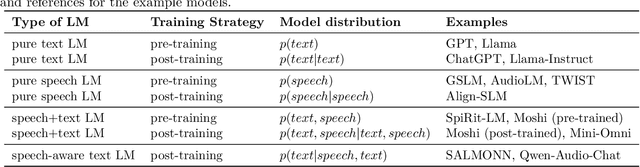
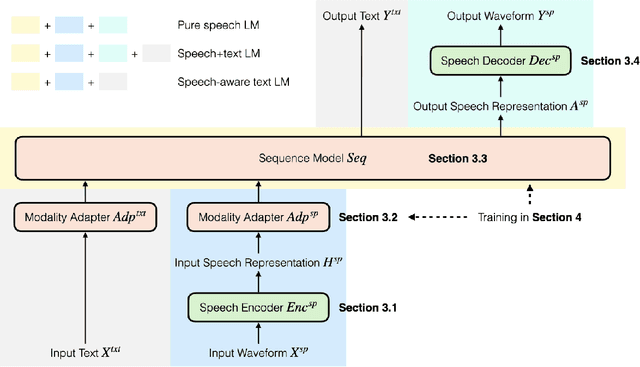
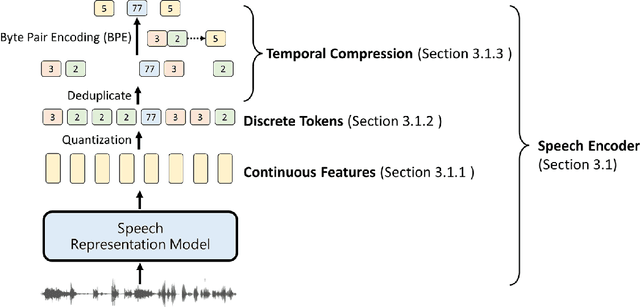
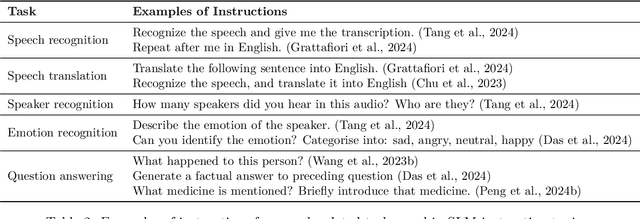
The field of spoken language processing is undergoing a shift from training custom-built, task-specific models toward using and optimizing spoken language models (SLMs) which act as universal speech processing systems. This trend is similar to the progression toward universal language models that has taken place in the field of (text) natural language processing. SLMs include both "pure" language models of speech -- models of the distribution of tokenized speech sequences -- and models that combine speech encoders with text language models, often including both spoken and written input or output. Work in this area is very diverse, with a range of terminology and evaluation settings. This paper aims to contribute an improved understanding of SLMs via a unifying literature survey of recent work in the context of the evolution of the field. Our survey categorizes the work in this area by model architecture, training, and evaluation choices, and describes some key challenges and directions for future work.
Aligning Text-to-Music Evaluation with Human Preferences
Mar 20, 2025Despite significant recent advances in generative acoustic text-to-music (TTM) modeling, robust evaluation of these models lags behind, relying in particular on the popular Fr\'echet Audio Distance (FAD). In this work, we rigorously study the design space of reference-based divergence metrics for evaluating TTM models through (1) designing four synthetic meta-evaluations to measure sensitivity to particular musical desiderata, and (2) collecting and evaluating on MusicPrefs, the first open-source dataset of human preferences for TTM systems. We find that not only is the standard FAD setup inconsistent on both synthetic and human preference data, but that nearly all existing metrics fail to effectively capture desiderata, and are only weakly correlated with human perception. We propose a new metric, the MAUVE Audio Divergence (MAD), computed on representations from a self-supervised audio embedding model. We find that this metric effectively captures diverse musical desiderata (average rank correlation 0.84 for MAD vs. 0.49 for FAD and also correlates more strongly with MusicPrefs (0.62 vs. 0.14).
ESPnet-SDS: Unified Toolkit and Demo for Spoken Dialogue Systems
Mar 11, 2025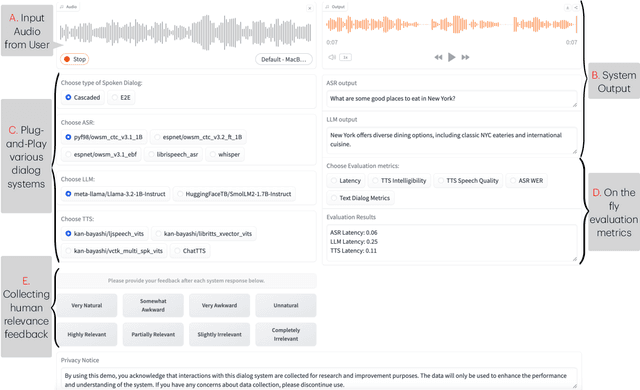
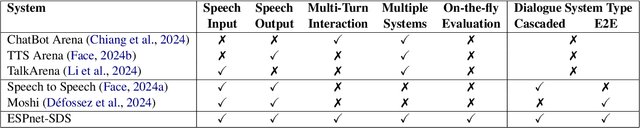
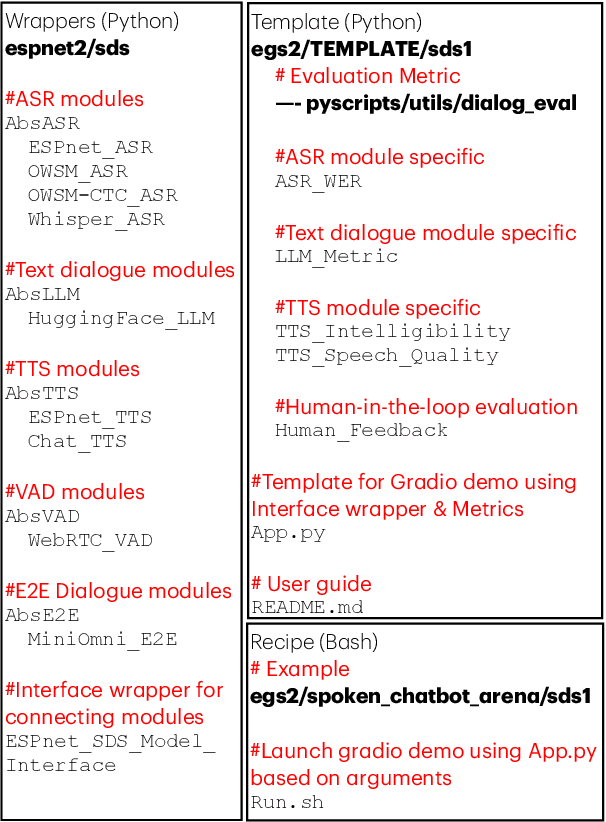
Advancements in audio foundation models (FMs) have fueled interest in end-to-end (E2E) spoken dialogue systems, but different web interfaces for each system makes it challenging to compare and contrast them effectively. Motivated by this, we introduce an open-source, user-friendly toolkit designed to build unified web interfaces for various cascaded and E2E spoken dialogue systems. Our demo further provides users with the option to get on-the-fly automated evaluation metrics such as (1) latency, (2) ability to understand user input, (3) coherence, diversity, and relevance of system response, and (4) intelligibility and audio quality of system output. Using the evaluation metrics, we compare various cascaded and E2E spoken dialogue systems with a human-human conversation dataset as a proxy. Our analysis demonstrates that the toolkit allows researchers to effortlessly compare and contrast different technologies, providing valuable insights such as current E2E systems having poorer audio quality and less diverse responses. An example demo produced using our toolkit is publicly available here: https://huggingface.co/spaces/Siddhant/Voice_Assistant_Demo.
Talking Turns: Benchmarking Audio Foundation Models on Turn-Taking Dynamics
Mar 03, 2025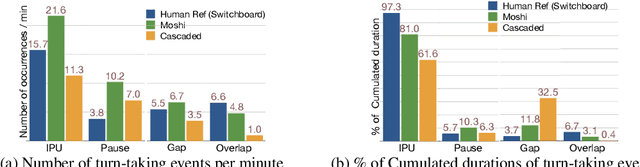
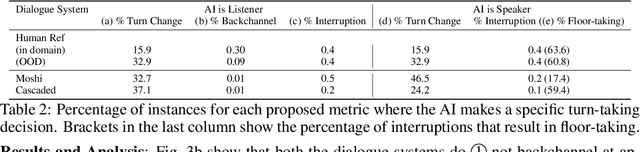
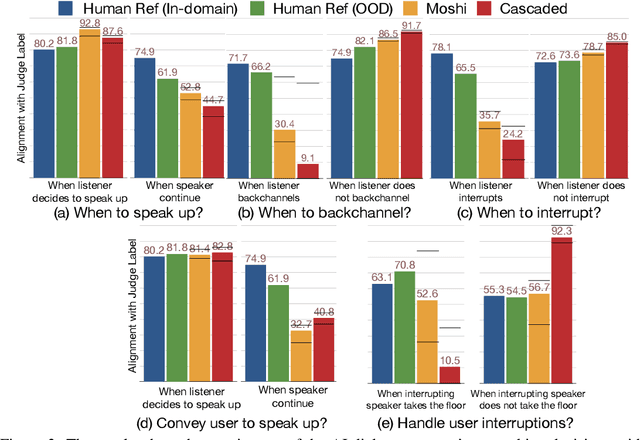
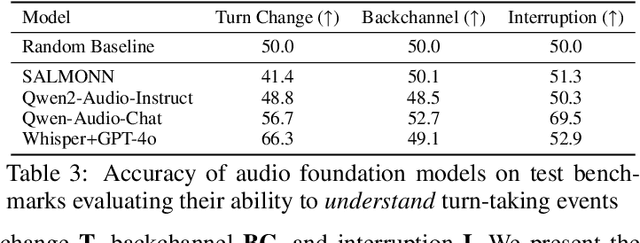
The recent wave of audio foundation models (FMs) could provide new capabilities for conversational modeling. However, there have been limited efforts to evaluate these audio FMs comprehensively on their ability to have natural and interactive conversations. To engage in meaningful conversation with the end user, we would want the FMs to additionally perform a fluent succession of turns without too much overlapping speech or long stretches of silence. Inspired by this, we ask whether the recently proposed audio FMs can understand, predict, and perform turn-taking events? To answer this, we propose a novel evaluation protocol that can assess spoken dialog system's turn-taking capabilities using a supervised model as a judge that has been trained to predict turn-taking events in human-human conversations. Using this protocol, we present the first comprehensive user study that evaluates existing spoken dialogue systems on their ability to perform turn-taking events and reveal many interesting insights, such as they sometimes do not understand when to speak up, can interrupt too aggressively and rarely backchannel. We further evaluate multiple open-source and proprietary audio FMs accessible through APIs on carefully curated test benchmarks from Switchboard to measure their ability to understand and predict turn-taking events and identify significant room for improvement. We will open source our evaluation platform to promote the development of advanced conversational AI systems.