 Add to Chrome
 Add to Firefox
 Add to Edge
ArrayDPS-Refine: Generative Refinement of Discriminative Multi-Channel Speech Enhancement
Mar 25, 2026
Multi-channel speech enhancement aims to recover clean speech from noisy multi-channel recordings. Most deep learning methods employ discriminative training, which can lead to non-linear distortions from regression-based objectives, especially under challenging environmental noise conditions. Inspired by ArrayDPS for unsupervised multi-channel source separation, we introduce ArrayDPS-Refine, a method designed to enhance the outputs of discriminative models using a clean speech diffusion prior. ArrayDPS-Refine is training-free, generative, and array-agnostic. It first estimates the noise spatial covariance matrix (SCM) from the enhanced speech produced by a discriminative model, then uses this estimated noise SCM for diffusion posterior sampling. This approach allows direct refinement of any discriminative model's output without retraining. Our results show that ArrayDPS-Refine consistently improves the performance of various discriminative models, including state-of-the-art waveform and STFT domain models. Audio demos are provided at https://xzwy.github.io/ArrayDPSRefineDemo/.

Unified Diffusion Refinement for Multi-Channel Speech Enhancement and Separation
Mar 25, 2026We propose Uni-ArrayDPS, a novel diffusion-based refinement framework for unified multi-channel speech enhancement and separation. Existing methods for multi-channel speech enhancement/separation are mostly discriminative and are highly effective at producing high-SNR outputs. However, they can still generate unnatural speech with non-linear distortions caused by the neural network and regression-based objectives. To address this issue, we propose Uni-ArrayDPS, which refines the outputs of any strong discriminative model using a speech diffusion prior. Uni-ArrayDPS is generative, array-agnostic, and training-free, and supports both enhancement and separation. Given a discriminative model's enhanced/separated speech, we use it, together with the noisy mixtures, to estimate the noise spatial covariance matrix (SCM). We then use this SCM to compute the likelihood required for diffusion posterior sampling of the clean speech source(s). Uni-ArrayDPS requires only a pre-trained clean-speech diffusion model as a prior and does not require additional training or fine-tuning, allowing it to generalize directly across tasks (enhancement/separation), microphone array geometries, and discriminative model backbones. Extensive experiments show that Uni-ArrayDPS consistently improves a wide range of discriminative models for both enhancement and separation tasks. We also report strong results on a real-world dataset. Audio demos are provided at \href{https://xzwy.github.io/Uni-ArrayDPS/}{https://xzwy.github.io/Uni-ArrayDPS/}.
ICASSP 2026 URGENT Speech Enhancement Challenge
Jan 20, 2026The ICASSP 2026 URGENT Challenge advances the series by focusing on universal speech enhancement (SE) systems that handle diverse distortions, domains, and input conditions. This overview paper details the challenge's motivation, task definitions, datasets, baseline systems, evaluation protocols, and results. The challenge is divided into two complementary tracks. Track 1 focuses on universal speech enhancement, while Track 2 introduces speech quality assessment for enhanced speech. The challenge attracted over 80 team registrations, with 29 submitting valid entries, demonstrating significant community interest in robust SE technologies.
SLAP: Scalable Language-Audio Pretraining with Variable-Duration Audio and Multi-Objective Training
Jan 18, 2026Contrastive language-audio pretraining (CLAP) has achieved notable success in learning semantically rich audio representations and is widely adopted for various audio-related tasks. However, current CLAP models face several key limitations. First, they are typically trained on relatively small datasets, often comprising a few million audio samples. Second, existing CLAP models are restricted to short and fixed duration, which constrains their usage in real-world scenarios with variable-duration audio. Third, the standard contrastive training objective operates on global representations, which may hinder the learning of dense, fine-grained audio features. To address these challenges, we introduce Scalable Language-Audio Pretraining (SLAP), which scales language-audio pretraining to 109 million audio-text pairs with variable audio durations and incorporates multiple training objectives. SLAP unifies contrastive loss with additional self-supervised and captioning losses in a single-stage training, facilitating the learning of richer dense audio representations. The proposed SLAP model achieves new state-of-the-art performance on audio-text retrieval and zero-shot audio classification tasks, demonstrating its effectiveness across diverse benchmarks.
Interspeech 2025 URGENT Speech Enhancement Challenge
May 29, 2025There has been a growing effort to develop universal speech enhancement (SE) to handle inputs with various speech distortions and recording conditions. The URGENT Challenge series aims to foster such universal SE by embracing a broad range of distortion types, increasing data diversity, and incorporating extensive evaluation metrics. This work introduces the Interspeech 2025 URGENT Challenge, the second edition of the series, to explore several aspects that have received limited attention so far: language dependency, universality for more distortion types, data scalability, and the effectiveness of using noisy training data. We received 32 submissions, where the best system uses a discriminative model, while most other competitive ones are hybrid methods. Analysis reveals some key findings: (i) some generative or hybrid approaches are preferred in subjective evaluations over the top discriminative model, and (ii) purely generative SE models can exhibit language dependency.
Adapting Whisper for Code-Switching through Encoding Refining and Language-Aware Decoding
Dec 24, 2024


Code-switching (CS) automatic speech recognition (ASR) faces challenges due to the language confusion resulting from accents, auditory similarity, and seamless language switches. Adaptation on the pre-trained multi-lingual model has shown promising performance for CS-ASR. In this paper, we adapt Whisper, which is a large-scale multilingual pre-trained speech recognition model, to CS from both encoder and decoder parts. First, we propose an encoder refiner to enhance the encoder's capacity of intra-sentence swithching. Second, we propose using two sets of language-aware adapters with different language prompt embeddings to achieve language-specific decoding information in each decoder layer. Then, a fusion module is added to fuse the language-aware decoding. The experimental results using the SEAME dataset show that, compared with the baseline model, the proposed approach achieves a relative MER reduction of 4.1% and 7.2% on the dev_man and dev_sge test sets, respectively, surpassing state-of-the-art methods. Through experiments, we found that the proposed method significantly improves the performance on non-native language in CS speech, indicating that our approach enables Whisper to better distinguish between the two languages.
Serialized Speech Information Guidance with Overlapped Encoding Separation for Multi-Speaker Automatic Speech Recognition
Sep 01, 2024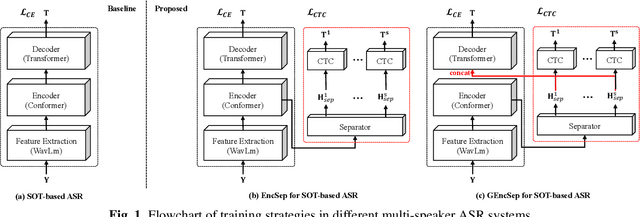
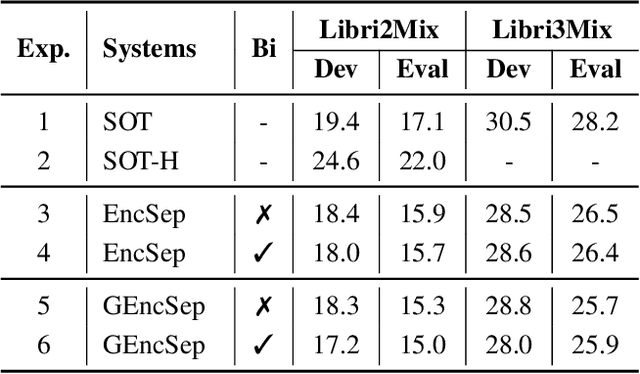
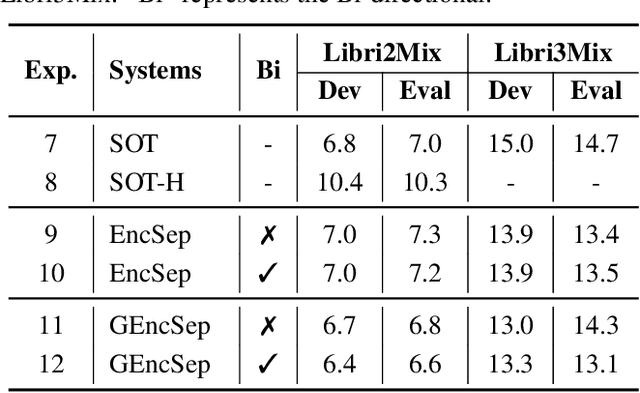

Serialized output training (SOT) attracts increasing attention due to its convenience and flexibility for multi-speaker automatic speech recognition (ASR). However, it is not easy to train with attention loss only. In this paper, we propose the overlapped encoding separation (EncSep) to fully utilize the benefits of the connectionist temporal classification (CTC) and attention hybrid loss. This additional separator is inserted after the encoder to extract the multi-speaker information with CTC losses. Furthermore, we propose the serialized speech information guidance SOT (GEncSep) to further utilize the separated encodings. The separated streams are concatenated to provide single-speaker information to guide attention during decoding. The experimental results on LibriMix show that the single-speaker encoding can be separated from the overlapped encoding. The CTC loss helps to improve the encoder representation under complex scenarios. GEncSep further improved performance.
High Fidelity Text-Guided Music Generation and Editing via Single-Stage Flow Matching
Jul 04, 2024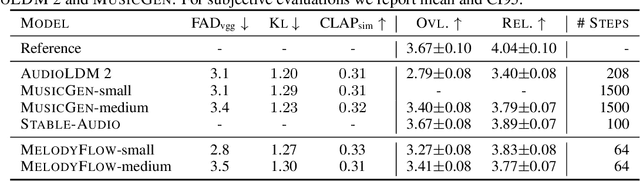
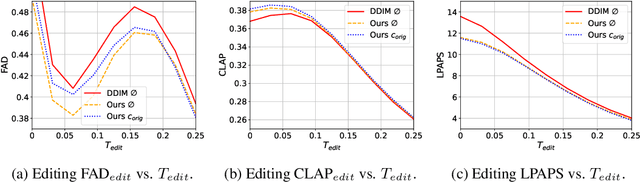

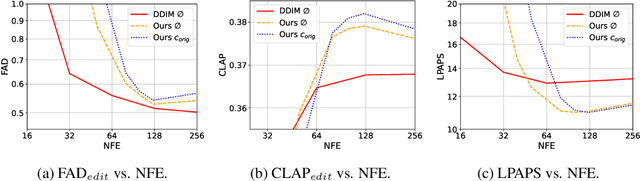
We introduce a simple and efficient text-controllable high-fidelity music generation and editing model. It operates on sequences of continuous latent representations from a low frame rate 48 kHz stereo variational auto encoder codec that eliminates the information loss drawback of discrete representations. Based on a diffusion transformer architecture trained on a flow-matching objective the model can generate and edit diverse high quality stereo samples of variable duration, with simple text descriptions. We also explore a new regularized latent inversion method for zero-shot test-time text-guided editing and demonstrate its superior performance over naive denoising diffusion implicit model (DDIM) inversion for variety of music editing prompts. Evaluations are conducted on both objective and subjective metrics and demonstrate that the proposed model is not only competitive to the evaluated baselines on a standard text-to-music benchmark - quality and efficiency-wise - but also outperforms previous state of the art for music editing when combined with our proposed latent inversion. Samples are available at https://melodyflow.github.io.
URGENT Challenge: Universality, Robustness, and Generalizability For Speech Enhancement
Jun 07, 2024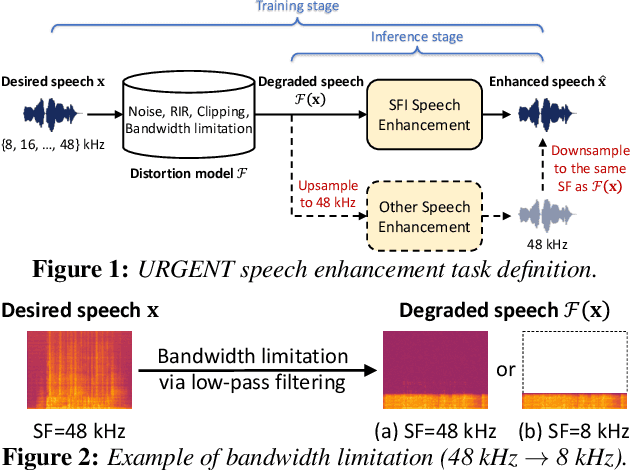


The last decade has witnessed significant advancements in deep learning-based speech enhancement (SE). However, most existing SE research has limitations on the coverage of SE sub-tasks, data diversity and amount, and evaluation metrics. To fill this gap and promote research toward universal SE, we establish a new SE challenge, named URGENT, to focus on the universality, robustness, and generalizability of SE. We aim to extend the SE definition to cover different sub-tasks to explore the limits of SE models, starting from denoising, dereverberation, bandwidth extension, and declipping. A novel framework is proposed to unify all these sub-tasks in a single model, allowing the use of all existing SE approaches. We collected public speech and noise data from different domains to construct diverse evaluation data. Finally, we discuss the insights gained from our preliminary baseline experiments based on both generative and discriminative SE methods with 12 curated metrics.
An Empirical Study on the Impact of Positional Encoding in Transformer-based Monaural Speech Enhancement
Jan 18, 2024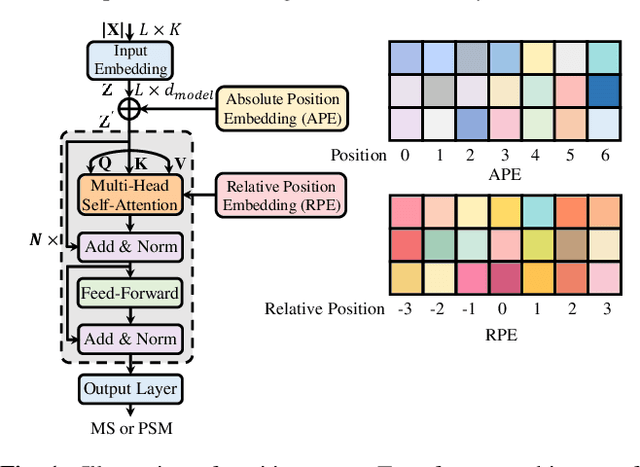
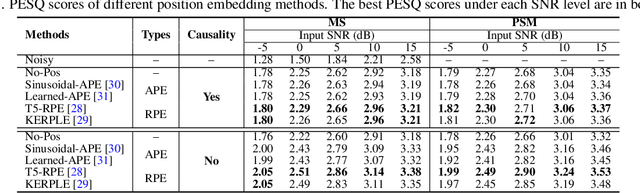
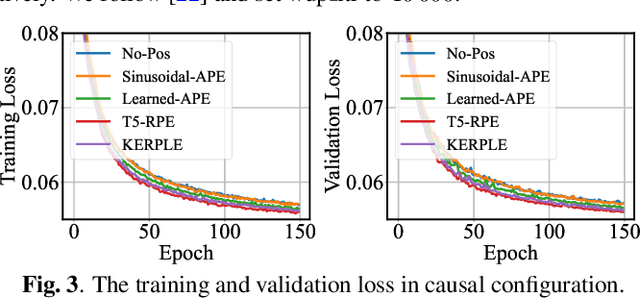
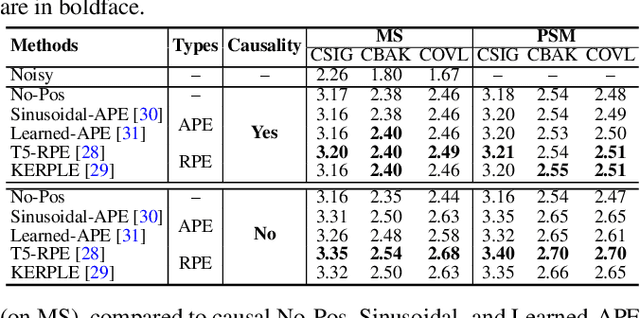
Transformer architecture has enabled recent progress in speech enhancement. Since Transformers are position-agostic, positional encoding is the de facto standard component used to enable Transformers to distinguish the order of elements in a sequence. However, it remains unclear how positional encoding exactly impacts speech enhancement based on Transformer architectures. In this paper, we perform a comprehensive empirical study evaluating five positional encoding methods, i.e., Sinusoidal and learned absolute position embedding (APE), T5-RPE, KERPLE, as well as the Transformer without positional encoding (No-Pos), across both causal and noncausal configurations. We conduct extensive speech enhancement experiments, involving spectral mapping and masking methods. Our findings establish that positional encoding is not quite helpful for the models in a causal configuration, which indicates that causal attention may implicitly incorporate position information. In a noncausal configuration, the models significantly benefit from the use of positional encoding. In addition, we find that among the four position embeddings, relative position embeddings outperform APEs.