 Add to Chrome
 Add to Firefox
 Add to Edge
CAAD: Contrastive Audio-Aware Distillation for Efficient Speech Language Models
Jun 22, 2026
Speech Language Models achieve reasoning capabilities, but are often hindered by massive parameter counts and a tendency to prioritize linguistic priors over acoustic features. While contrastive decoding enhances grounding by contrasting audio-aware and text-only logits, it increases inference latency. We propose Contrastive Audio-Aware Distillation (CAAD), a framework that internalizes the teacher's contrastive reasoning into the student model's weights. To overcome the high computational training overhead in the dual-path token-by-token contrastive distillation process, we introduce a synchronized teacher-forcing strategy. Anchored by unified Pseudo-Ground Truths, this mechanism enables simultaneous full-sequence generation of the teacher's contrastive distributions, allowing student to distill the audio-aware signal efficiently. Overall, CAAD yields a ~8% relative gain over standard knowledge distillation on Dynamic-SUPERB and successfully reduces linguistic bias in MCR-BENCH.

Steering Where to Listen: Instruction-Based Activation Steering Redirects Temporal Attention in Large Audio-Language Models
Jun 09, 2026Large Audio-Language Models (LALMs) excel at audio understanding but expose little about where in an audio signal they attend. We introduce instruction-based vector steering, which constructs a steering vector by contrasting activations from differently instructed prompts while keeping the audio fixed. Through a systematic probe of LALM attention, we find that - unlike standard prompting or audio-based steering - this intervention significantly redistributes the temporal attention allocated to audio tokens, concentrating it on acoustically relevant regions. We then show that this attention shift is behaviorally meaningful: in a controlled three-event setting, reading out the temporal position of maximal steering-induced attention change recovers the location of a queried sound event without any training, attaining 60.87% and 68.72% overlap with ground-truth intervals on Qwen2-Audio and Audio Flamingo 3, far above direct prompting (31.84%, 46.75%) and random baselines (27.74%). Our results characterize a mechanistic property of instruction-based steering in LALMs and provide a training-free probe for the latent temporal structure these models encode.
CodaRAG: Connecting the Dots with Associativity Inspired by Complementary Learning
Apr 12, 2026Large Language Models (LLMs) struggle with knowledge-intensive tasks due to hallucinations and fragmented reasoning over dispersed information. While Retrieval-Augmented Generation (RAG) grounds generation in external sources, existing methods often treat evidence as isolated units, failing to reconstruct the logical chains that connect these dots. Inspired by Complementary Learning Systems (CLS), we propose CodaRAG, a framework that evolves retrieval from passive lookup into active associative discovery. CodaRAG operates via a three-stage pipeline: (1) Knowledge Consolidation to unify fragmented extractions into a stable memory substrate; (2) Associative Navigation to traverse the graph via multi-dimensional pathways-semantic, contextualized, and functional-explicitly recovering dispersed evidence chains; and (3) Interference Elimination to prune hyper-associative noise, ensuring a coherent, high-precision reasoning context. On GraphRAG-Bench, CodaRAG achieves absolute gains of 7-10% in retrieval recall and 3-11% in generation accuracy. These results demonstrate CodaRAG's superior ability to systematically robustify associative evidence retrieval for factual, reasoning, and creative tasks.
Latent-Mark: An Audio Watermark Robust to Neural Resynthesis
Mar 05, 2026While existing audio watermarking techniques have achieved strong robustness against traditional digital signal processing (DSP) attacks, they remain vulnerable to neural resynthesis. This occurs because modern neural audio codecs act as semantic filters and discard the imperceptible waveform variations used in prior watermarking methods. To address this limitation, we propose Latent-Mark, the first zero-bit audio watermarking framework designed to survive semantic compression. Our key insight is that robustness to the encode-decode process requires embedding the watermark within the codec's invariant latent space. We achieve this by optimizing the audio waveform to induce a detectable directional shift in its encoded latent representation, while constraining perturbations to align with the natural audio manifold to ensure imperceptibility. To prevent overfitting to a single codec's quantization rules, we introduce Cross-Codec Optimization, jointly optimizing the waveform across multiple surrogate codecs to target shared latent invariants. Extensive evaluations demonstrate robust zero-shot transferability to unseen neural codecs, achieving state-of-the-art resilience against traditional DSP attacks while preserving perceptual imperceptibility. Our work inspires future research into universal watermarking frameworks capable of maintaining integrity across increasingly complex and diverse generative distortions.
On The Landscape of Spoken Language Models: A Comprehensive Survey
Apr 11, 2025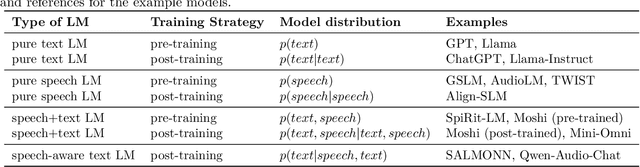
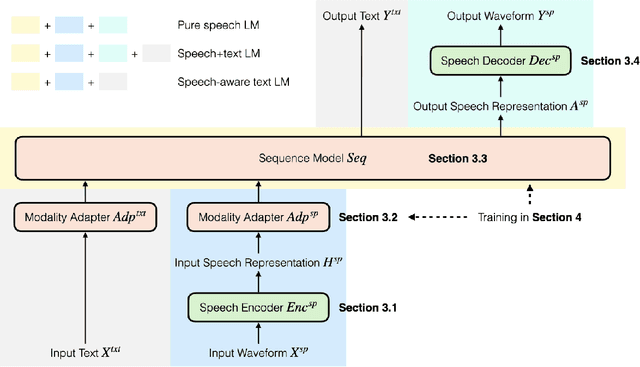
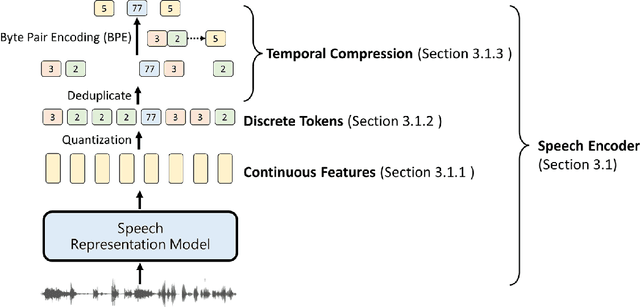
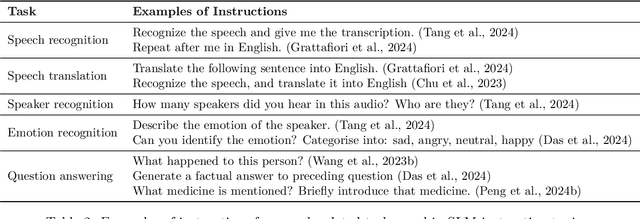
The field of spoken language processing is undergoing a shift from training custom-built, task-specific models toward using and optimizing spoken language models (SLMs) which act as universal speech processing systems. This trend is similar to the progression toward universal language models that has taken place in the field of (text) natural language processing. SLMs include both "pure" language models of speech -- models of the distribution of tokenized speech sequences -- and models that combine speech encoders with text language models, often including both spoken and written input or output. Work in this area is very diverse, with a range of terminology and evaluation settings. This paper aims to contribute an improved understanding of SLMs via a unifying literature survey of recent work in the context of the evolution of the field. Our survey categorizes the work in this area by model architecture, training, and evaluation choices, and describes some key challenges and directions for future work.
Investigating Video Reasoning Capability of Large Language Models with Tropes in Movies
Jun 16, 2024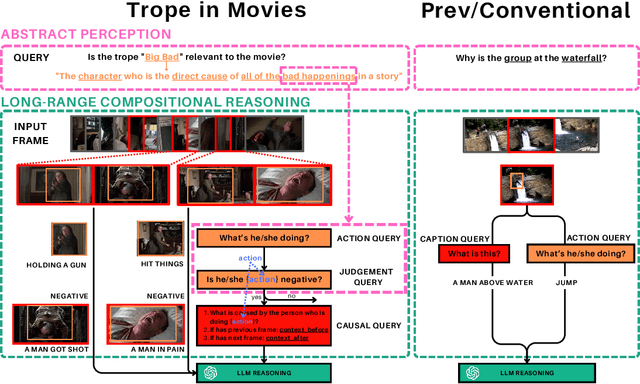
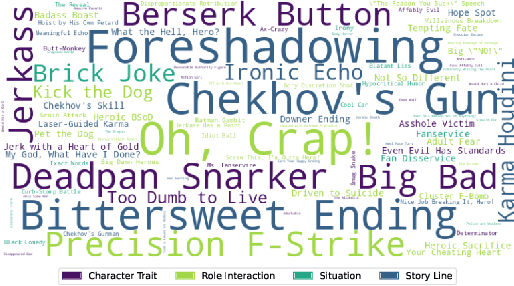


Large Language Models (LLMs) have demonstrated effectiveness not only in language tasks but also in video reasoning. This paper introduces a novel dataset, Tropes in Movies (TiM), designed as a testbed for exploring two critical yet previously overlooked video reasoning skills: (1) Abstract Perception: understanding and tokenizing abstract concepts in videos, and (2) Long-range Compositional Reasoning: planning and integrating intermediate reasoning steps for understanding long-range videos with numerous frames. Utilizing tropes from movie storytelling, TiM evaluates the reasoning capabilities of state-of-the-art LLM-based approaches. Our experiments show that current methods, including Captioner-Reasoner, Large Multimodal Model Instruction Fine-tuning, and Visual Programming, only marginally outperform a random baseline when tackling the challenges of Abstract Perception and Long-range Compositional Reasoning. To address these deficiencies, we propose Face-Enhanced Viper of Role Interactions (FEVoRI) and Context Query Reduction (ConQueR), which enhance Visual Programming by fostering role interaction awareness and progressively refining movie contexts and trope queries during reasoning processes, significantly improving performance by 15 F1 points. However, this performance still lags behind human levels (40 vs. 65 F1). Additionally, we introduce a new protocol to evaluate the necessity of Abstract Perception and Long-range Compositional Reasoning for task resolution. This is done by analyzing the code generated through Visual Programming using an Abstract Syntax Tree (AST), thereby confirming the increased complexity of TiM. The dataset and code are available at: https://ander1119.github.io/TiM
EMO-SUPERB: An In-depth Look at Speech Emotion Recognition
Feb 22, 2024Speech emotion recognition (SER) is a pivotal technology for human-computer interaction systems. However, 80.77% of SER papers yield results that cannot be reproduced. We develop EMO-SUPERB, short for EMOtion Speech Universal PERformance Benchmark, which aims to enhance open-source initiatives for SER. EMO-SUPERB includes a user-friendly codebase to leverage 15 state-of-the-art speech self-supervised learning models (SSLMs) for exhaustive evaluation across six open-source SER datasets. EMO-SUPERB streamlines result sharing via an online leaderboard, fostering collaboration within a community-driven benchmark and thereby enhancing the development of SER. On average, 2.58% of annotations are annotated using natural language. SER relies on classification models and is unable to process natural languages, leading to the discarding of these valuable annotations. We prompt ChatGPT to mimic annotators, comprehend natural language annotations, and subsequently re-label the data. By utilizing labels generated by ChatGPT, we consistently achieve an average relative gain of 3.08% across all settings.
Examining Forgetting in Continual Pre-training of Aligned Large Language Models
Jan 06, 2024Recent advances in Large Language Models (LLMs) have exhibited remarkable proficiency across various tasks. Given the potent applications of LLMs in numerous fields, there has been a surge in LLM development. In developing LLMs, a common practice involves continual pre-training on previously fine-tuned models. However, this can lead to catastrophic forgetting. In our work, we investigate the phenomenon of forgetting that occurs during continual pre-training on an existing fine-tuned LLM. We evaluate the impact of continuous pre-training on the fine-tuned LLM across various dimensions, including output format, knowledge, and reliability. Experiment results highlight the non-trivial challenge of addressing catastrophic forgetting during continual pre-training, especially the repetition issue.
Hierarchical Programmatic Reinforcement Learning via Learning to Compose Programs
Jan 30, 2023


Aiming to produce reinforcement learning (RL) policies that are human-interpretable and can generalize better to novel scenarios, Trivedi et al. (2021) present a method (LEAPS) that first learns a program embedding space to continuously parameterize diverse programs from a pre-generated program dataset, and then searches for a task-solving program in the learned program embedding space when given a task. Despite encouraging results, the program policies that LEAPS can produce are limited by the distribution of the program dataset. Furthermore, during searching, LEAPS evaluates each candidate program solely based on its return, failing to precisely reward correct parts of programs and penalize incorrect parts. To address these issues, we propose to learn a meta-policy that composes a series of programs sampled from the learned program embedding space. By composing programs, our proposed method can produce program policies that describe out-of-distributionally complex behaviors and directly assign credits to programs that induce desired behaviors. We design and conduct extensive experiments in the Karel domain. The experimental results show that our proposed framework outperforms baselines. The ablation studies confirm the limitations of LEAPS and justify our design choices.
SLUE Phase-2: A Benchmark Suite of Diverse Spoken Language Understanding Tasks
Dec 20, 2022Spoken language understanding (SLU) tasks have been studied for many decades in the speech research community, but have not received as much attention as lower-level tasks like speech and speaker recognition. In particular, there are not nearly as many SLU task benchmarks, and many of the existing ones use data that is not freely available to all researchers. Recent work has begun to introduce such benchmark datasets for several tasks. In this work, we introduce several new annotated SLU benchmark tasks based on freely available speech data, which complement existing benchmarks and address gaps in the SLU evaluation landscape. We contribute four tasks: question answering and summarization involve inference over longer speech sequences; named entity localization addresses the speech-specific task of locating the targeted content in the signal; dialog act classification identifies the function of a given speech utterance. We follow the blueprint of the Spoken Language Understanding Evaluation (SLUE) benchmark suite. In order to facilitate the development of SLU models that leverage the success of pre-trained speech representations, we will be publishing for each task (i) annotations for a relatively small fine-tuning set, (ii) annotated development and test sets, and (iii) baseline models for easy reproducibility and comparisons. In this work, we present the details of data collection and annotation and the performance of the baseline models. We also perform sensitivity analysis of pipeline models' performance (speech recognizer + text model) to the speech recognition accuracy, using more than 20 state-of-the-art speech recognition models.