 Add to Chrome
 Add to Firefox
 Add to Edge
Scaling Open Discrete Audio Foundation Models with Interleaved Semantic, Acoustic, and Text Tokens
Feb 18, 2026
Current audio language models are predominantly text-first, either extending pre-trained text LLM backbones or relying on semantic-only audio tokens, limiting general audio modeling. This paper presents a systematic empirical study of native audio foundation models that apply next-token prediction to audio at scale, jointly modeling semantic content, acoustic details, and text to support both general audio generation and cross-modal capabilities. We provide comprehensive empirical insights for building such models: (1) We systematically investigate design choices -- data sources, text mixture ratios, and token composition -- establishing a validated training recipe. (2) We conduct the first scaling law study for discrete audio models via IsoFLOP analysis on 64 models spanning $3{\times}10^{18}$ to $3{\times}10^{20}$ FLOPs, finding that optimal data grows 1.6$\times$ faster than optimal model size. (3) We apply these lessons to train SODA (Scaling Open Discrete Audio), a suite of models from 135M to 4B parameters on 500B tokens, comparing against our scaling predictions and existing models. SODA serves as a flexible backbone for diverse audio/text tasks -- we demonstrate this by fine-tuning for voice-preserving speech-to-speech translation, using the same unified architecture.

"Sorry, I Didn't Catch That": How Speech Models Miss What Matters Most
Feb 16, 2026Despite speech recognition systems achieving low word error rates on standard benchmarks, they often fail on short, high-stakes utterances in real-world deployments. Here, we study this failure mode in a high-stakes task: the transcription of U.S. street names as spoken by U.S. participants. We evaluate 15 models from OpenAI, Deepgram, Google, and Microsoft on recordings from linguistically diverse U.S. speakers and find an average transcription error rate of 44%. We quantify the downstream impact of failed transcriptions by geographic locations and show that mis-transcriptions systematically cause errors for all speakers, but that routing distance errors are twice as large for non-English primary speakers compared to English primary speakers. To mitigate this harm, we introduce a synthetic data generation approach that produces diverse pronunciations of named entities using open-source text-to-speech models. Fine-tuning with less than 1,000 synthetic samples improves street name transcription accuracy by nearly 60% (relative to base models) for non-English primary speakers. Our results highlight a critical gap between benchmark performance and real-world reliability in speech systems and demonstrate a simple, scalable path to reducing high-stakes transcription errors.
Categorize Early, Integrate Late: Divergent Processing Strategies in Automatic Speech Recognition
Jan 11, 2026In speech language modeling, two architectures dominate the frontier: the Transformer and the Conformer. However, it remains unknown whether their comparable performance stems from convergent processing strategies or distinct architectural inductive biases. We introduce Architectural Fingerprinting, a probing framework that isolates the effect of architecture on representation, and apply it to a controlled suite of 24 pre-trained encoders (39M-3.3B parameters). Our analysis reveals divergent hierarchies: Conformers implement a "Categorize Early" strategy, resolving phoneme categories 29% earlier in depth and speaker gender by 16% depth. In contrast, Transformers "Integrate Late," deferring phoneme, accent, and duration encoding to deep layers (49-57%). These fingerprints suggest design heuristics: Conformers' front-loaded categorization may benefit low-latency streaming, while Transformers' deep integration may favor tasks requiring rich context and cross-utterance normalization.
The ML-SUPERB 2.0 Challenge: Towards Inclusive ASR Benchmarking for All Language Varieties
Sep 08, 2025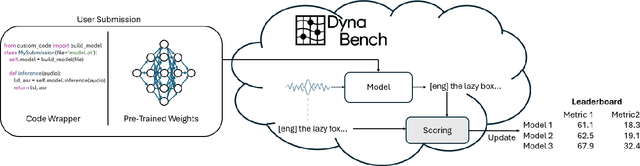
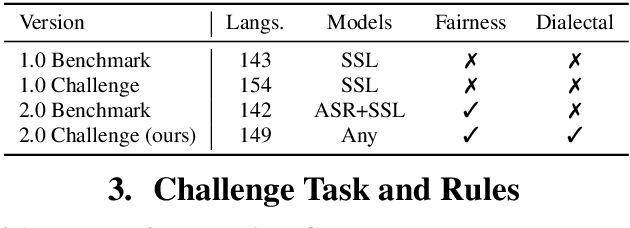
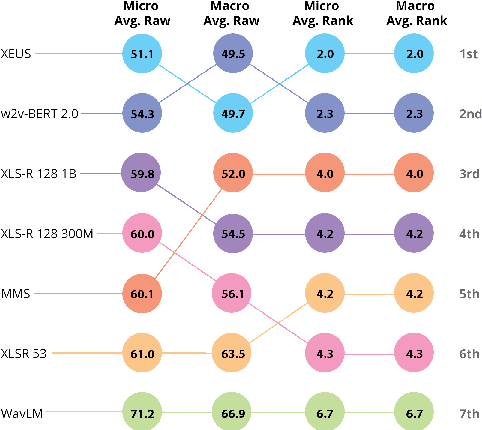
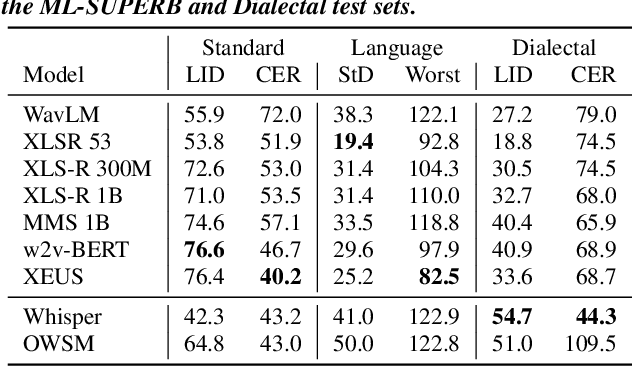
Recent improvements in multilingual ASR have not been equally distributed across languages and language varieties. To advance state-of-the-art (SOTA) ASR models, we present the Interspeech 2025 ML-SUPERB 2.0 Challenge. We construct a new test suite that consists of data from 200+ languages, accents, and dialects to evaluate SOTA multilingual speech models. The challenge also introduces an online evaluation server based on DynaBench, allowing for flexibility in model design and architecture for participants. The challenge received 5 submissions from 3 teams, all of which outperformed our baselines. The best-performing submission achieved an absolute improvement in LID accuracy of 23% and a reduction in CER of 18% when compared to the best baseline on a general multilingual test set. On accented and dialectal data, the best submission obtained 30.2% lower CER and 15.7% higher LID accuracy, showing the importance of community challenges in making speech technologies more inclusive.
OLMoASR: Open Models and Data for Training Robust Speech Recognition Models
Aug 28, 2025Improvements in training data scale and quality have led to significant advances, yet its influence in speech recognition remains underexplored. In this paper, we present a large-scale dataset, OLMoASR-Pool, and series of models, OLMoASR, to study and develop robust zero-shot speech recognition models. Beginning from OLMoASR-Pool, a collection of 3M hours of English audio and 17M transcripts, we design text heuristic filters to remove low-quality or mistranscribed data. Our curation pipeline produces a new dataset containing 1M hours of high-quality audio-transcript pairs, which we call OLMoASR-Mix. We use OLMoASR-Mix to train the OLMoASR-Mix suite of models, ranging from 39M (tiny.en) to 1.5B (large.en) parameters. Across all model scales, OLMoASR achieves comparable average performance to OpenAI's Whisper on short and long-form speech recognition benchmarks. Notably, OLMoASR-medium.en attains a 12.8\% and 11.0\% word error rate (WER) that is on par with Whisper's largest English-only model Whisper-medium.en's 12.4\% and 10.5\% WER for short and long-form recognition respectively (at equivalent parameter count). OLMoASR-Pool, OLMoASR models, and filtering, training and evaluation code will be made publicly available to further research on robust speech processing.
BLAB: Brutally Long Audio Bench
May 05, 2025Developing large audio language models (LMs) capable of understanding diverse spoken interactions is essential for accommodating the multimodal nature of human communication and can increase the accessibility of language technologies across different user populations. Recent work on audio LMs has primarily evaluated their performance on short audio segments, typically under 30 seconds, with limited exploration of long-form conversational speech segments that more closely reflect natural user interactions with these models. We introduce Brutally Long Audio Bench (BLAB), a challenging long-form audio benchmark that evaluates audio LMs on localization, duration estimation, emotion, and counting tasks using audio segments averaging 51 minutes in length. BLAB consists of 833+ hours of diverse, full-length audio clips, each paired with human-annotated, text-based natural language questions and answers. Our audio data were collected from permissively licensed sources and underwent a human-assisted filtering process to ensure task compliance. We evaluate six open-source and proprietary audio LMs on BLAB and find that all of them, including advanced models such as Gemini 2.0 Pro and GPT-4o, struggle with the tasks in BLAB. Our comprehensive analysis reveals key insights into the trade-offs between task difficulty and audio duration. In general, we find that audio LMs struggle with long-form speech, with performance declining as duration increases. They perform poorly on localization, temporal reasoning, counting, and struggle to understand non-phonemic information, relying more on prompts than audio content. BLAB serves as a challenging evaluation framework to develop audio LMs with robust long-form audio understanding capabilities.
CTC-DRO: Robust Optimization for Reducing Language Disparities in Speech Recognition
Feb 03, 2025Modern deep learning models often achieve high overall performance, but consistently fail on specific subgroups. Group distributionally robust optimization (group DRO) addresses this problem by minimizing the worst-group loss, but it fails when group losses misrepresent performance differences between groups. This is common in domains like speech, where the widely used connectionist temporal classification (CTC) loss scales with input length and varies with linguistic and acoustic properties, leading to spurious differences between group losses. We present CTC-DRO, which addresses the shortcomings of the group DRO objective by smoothing the group weight update to prevent overemphasis on consistently high-loss groups, while using input length-matched batching to mitigate CTC's scaling issues. We evaluate CTC-DRO on the task of multilingual automatic speech recognition (ASR) across five language sets from the ML-SUPERB 2.0 benchmark. CTC-DRO consistently outperforms group DRO and CTC-based baseline models, reducing the worst-language error by up to 65.9% and the average error by up to 47.7%. CTC-DRO can be applied to ASR with minimal computational costs, and offers the potential for reducing group disparities in other domains with similar challenges.
ML-SUPERB 2.0: Benchmarking Multilingual Speech Models Across Modeling Constraints, Languages, and Datasets
Jun 12, 2024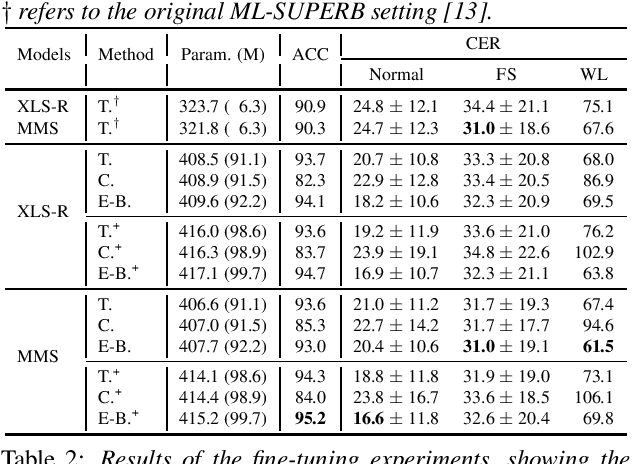
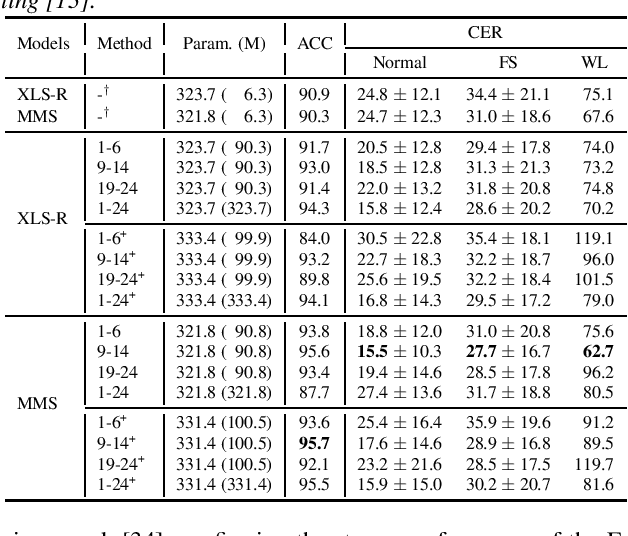
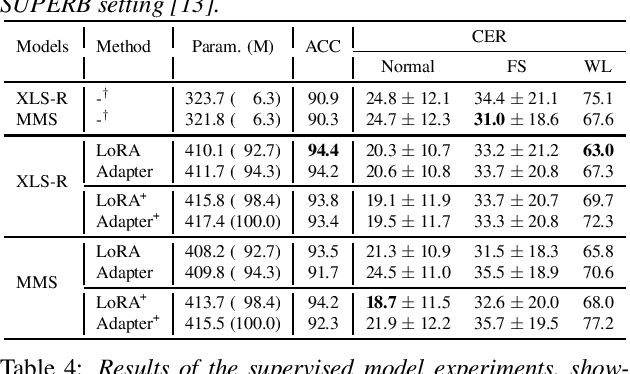
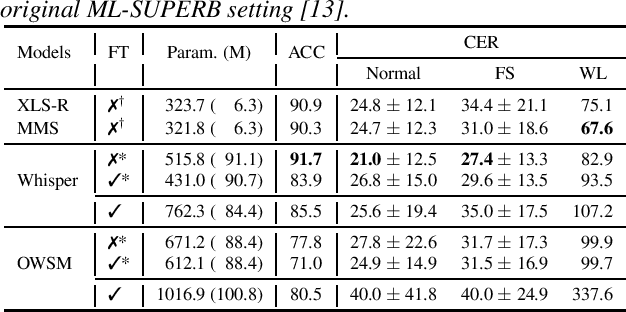
ML-SUPERB evaluates self-supervised learning (SSL) models on the tasks of language identification and automatic speech recognition (ASR). This benchmark treats the models as feature extractors and uses a single shallow downstream model, which can be fine-tuned for a downstream task. However, real-world use cases may require different configurations. This paper presents ML-SUPERB~2.0, which is a new benchmark for evaluating pre-trained SSL and supervised speech models across downstream models, fine-tuning setups, and efficient model adaptation approaches. We find performance improvements over the setup of ML-SUPERB. However, performance depends on the downstream model design. Also, we find large performance differences between languages and datasets, suggesting the need for more targeted approaches to improve multilingual ASR performance.
Making More of Little Data: Improving Low-Resource Automatic Speech Recognition Using Data Augmentation
May 19, 2023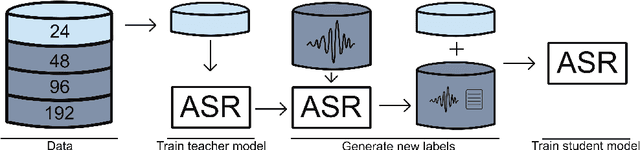
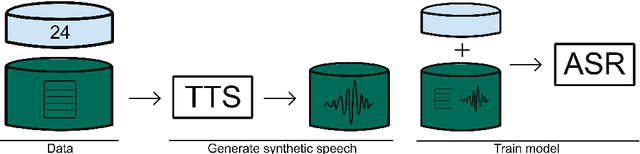
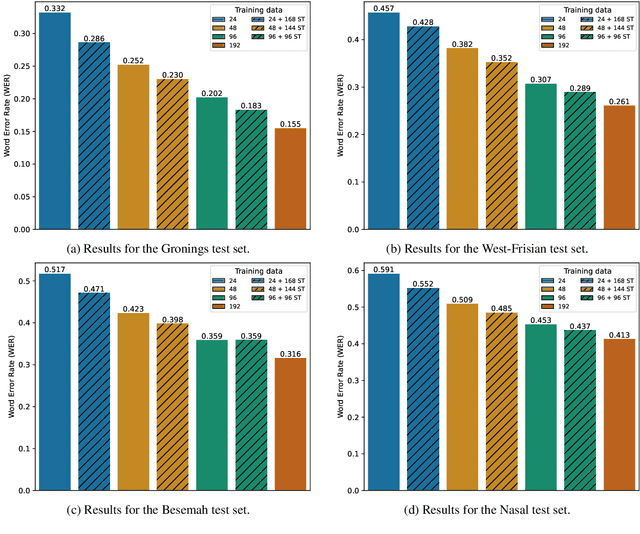
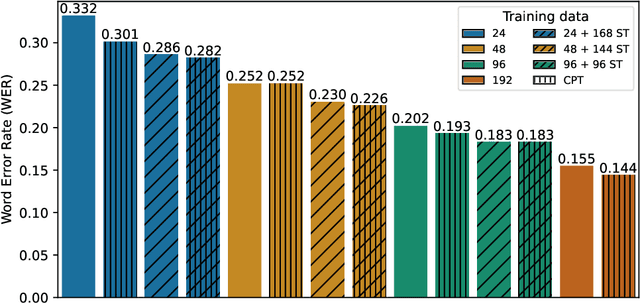
The performance of automatic speech recognition (ASR) systems has advanced substantially in recent years, particularly for languages for which a large amount of transcribed speech is available. Unfortunately, for low-resource languages, such as minority languages, regional languages or dialects, ASR performance generally remains much lower. In this study, we investigate whether data augmentation techniques could help improve low-resource ASR performance, focusing on four typologically diverse minority languages or language variants (West Germanic: Gronings, West-Frisian; Malayo-Polynesian: Besemah, Nasal). For all four languages, we examine the use of self-training, where an ASR system trained with the available human-transcribed data is used to generate transcriptions, which are then combined with the original data to train a new ASR system. For Gronings, for which there was a pre-existing text-to-speech (TTS) system available, we also examined the use of TTS to generate ASR training data from text-only sources. We find that using a self-training approach consistently yields improved performance (a relative WER reduction up to 20.5% compared to using an ASR system trained on 24 minutes of manually transcribed speech). The performance gain from TTS augmentation for Gronings was even stronger (up to 25.5% relative reduction in WER compared to a system based on 24 minutes of manually transcribed speech). In sum, our results show the benefit of using self-training or (if possible) TTS-generated data as an efficient solution to overcome the limitations of data availability for resource-scarce languages in order to improve ASR performance.
Leveraging supplementary text data to kick-start automatic speech recognition system development with limited transcriptions
Feb 09, 2023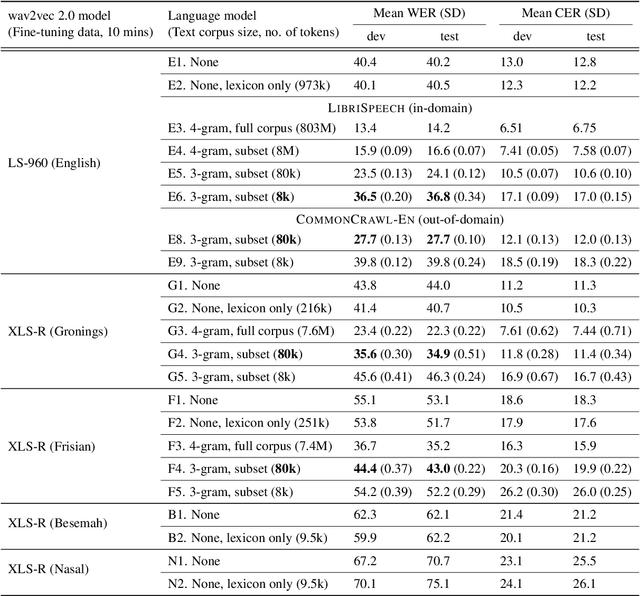
Recent research using pre-trained transformer models suggests that just 10 minutes of transcribed speech may be enough to fine-tune such a model for automatic speech recognition (ASR) -- at least if we can also leverage vast amounts of text data (803 million tokens). But is that much text data necessary? We study the use of different amounts of text data, both for creating a lexicon that constrains ASR decoding to possible words (e.g. *dogz vs. dogs), and for training larger language models that bias the system toward probable word sequences (e.g. too dogs vs. two dogs). We perform experiments using 10 minutes of transcribed speech from English (for replicating prior work) and two additional pairs of languages differing in the availability of supplemental text data: Gronings and Frisian (~7.5M token corpora available), and Besemah and Nasal (only small lexica available). For all languages, we found that using only a lexicon did not appreciably improve ASR performance. For Gronings and Frisian, we found that lexica and language models derived from 'novel-length' 80k token subcorpora reduced the word error rate (WER) to 39% on average. Our findings suggest that where a text corpus in the upper tens of thousands of tokens or more is available, fine-tuning a transformer model with just tens of minutes of transcribed speech holds some promise towards obtaining human-correctable transcriptions near the 30% WER rule-of-thumb.