 Add to Chrome
 Add to Firefox
 Add to Edge
MindZero: Learning Online Mental Reasoning With Zero Annotations
May 29, 2026
Effective real-world assistance requires AI agents with robust Theory of Mind (ToM): inferring human mental states from their behavior. Despite recent advances, several key challenges remain, including (1) online inference with robust uncertainty updates over multiple hypotheses; (2) efficient reasoning suitable for real-time assistance; and (3) the lack of ground-truth mental state annotations in real-world domains. We address these challenges by introducing MindZero, a self-supervised reinforcement learning framework that trains multimodal large language models (MLLMs) for efficient and robust online mental reasoning. During training, the model is rewarded for generating mental state hypotheses that maximize the likelihood of observed actions estimated by a planner, similar to model-based ToM reasoning. This method thus eliminates the need for explicit mental state annotations. After training, MindZero internalizes model-based reasoning into fast single-pass inference. We evaluate MindZero against baselines across challenging mental reasoning and AI assistance tasks in gridworld and household domains. We found that LLMs alone are insufficient; model-based methods improve accuracy but are slow, costly, and limited by backbone MLLM capacity. In contrast, MindZero enhances MLLMs' intrinsic ToM ability and significantly outperforms model-based methods in both accuracy and efficiency, showing that mental reasoning can be effectively learned as a self-supervised skill.

The Stochastic Parrot on LLM's Shoulder: A Summative Assessment of Physical Concept Understanding
Feb 13, 2025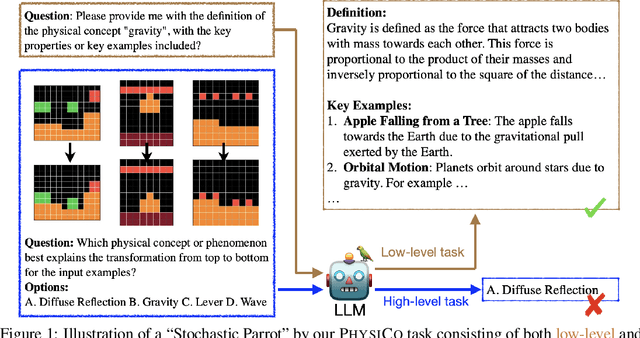
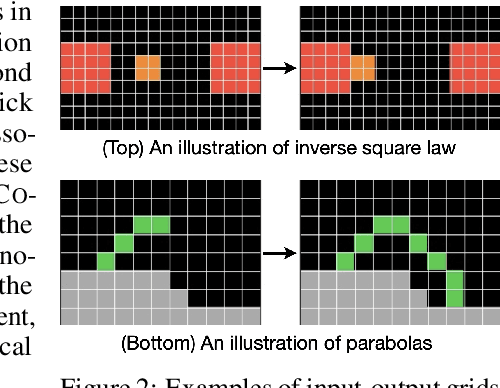
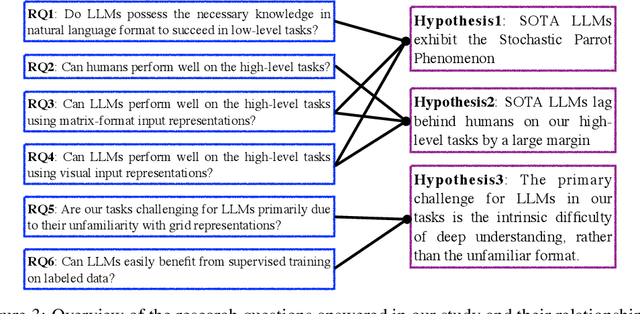
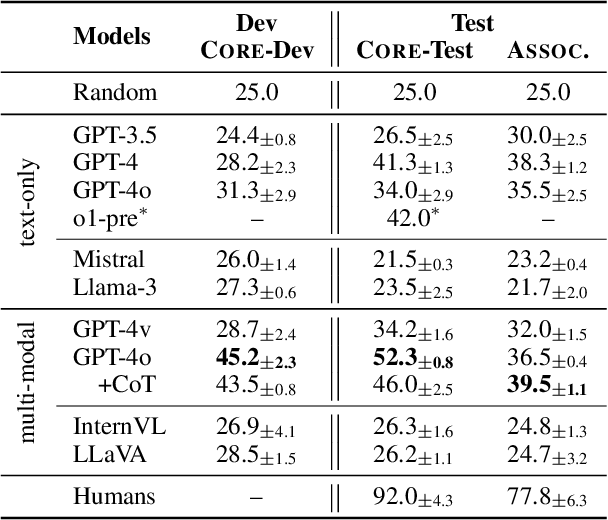
In a systematic way, we investigate a widely asked question: Do LLMs really understand what they say?, which relates to the more familiar term Stochastic Parrot. To this end, we propose a summative assessment over a carefully designed physical concept understanding task, PhysiCo. Our task alleviates the memorization issue via the usage of grid-format inputs that abstractly describe physical phenomena. The grids represents varying levels of understanding, from the core phenomenon, application examples to analogies to other abstract patterns in the grid world. A comprehensive study on our task demonstrates: (1) state-of-the-art LLMs, including GPT-4o, o1 and Gemini 2.0 flash thinking, lag behind humans by ~40%; (2) the stochastic parrot phenomenon is present in LLMs, as they fail on our grid task but can describe and recognize the same concepts well in natural language; (3) our task challenges the LLMs due to intrinsic difficulties rather than the unfamiliar grid format, as in-context learning and fine-tuning on same formatted data added little to their performance.
The Essence of Contextual Understanding in Theory of Mind: A Study on Question Answering with Story Characters
Jan 03, 2025

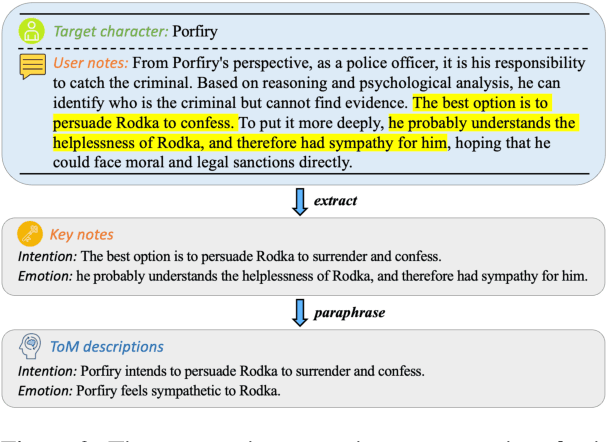
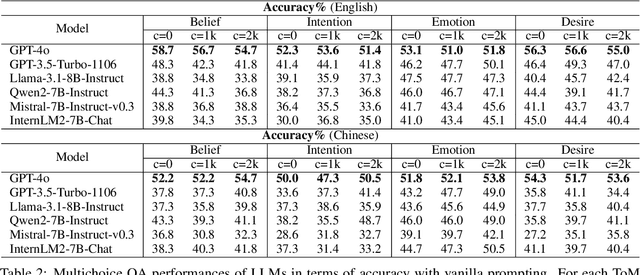
Theory-of-Mind (ToM) is a fundamental psychological capability that allows humans to understand and interpret the mental states of others. Humans infer others' thoughts by integrating causal cues and indirect clues from broad contextual information, often derived from past interactions. In other words, human ToM heavily relies on the understanding about the backgrounds and life stories of others. Unfortunately, this aspect is largely overlooked in existing benchmarks for evaluating machines' ToM capabilities, due to their usage of short narratives without global backgrounds. In this paper, we verify the importance of understanding long personal backgrounds in ToM and assess the performance of LLMs in such realistic evaluation scenarios. To achieve this, we introduce a novel benchmark, CharToM-QA, comprising 1,035 ToM questions based on characters from classic novels. Our human study reveals a significant disparity in performance: the same group of educated participants performs dramatically better when they have read the novels compared to when they have not. In parallel, our experiments on state-of-the-art LLMs, including the very recent o1 model, show that LLMs still perform notably worse than humans, despite that they have seen these stories during pre-training. This highlights the limitations of current LLMs in capturing the nuanced contextual information required for ToM reasoning.
Dynamic Relation Transformer for Contextual Text Block Detection
Jan 17, 2024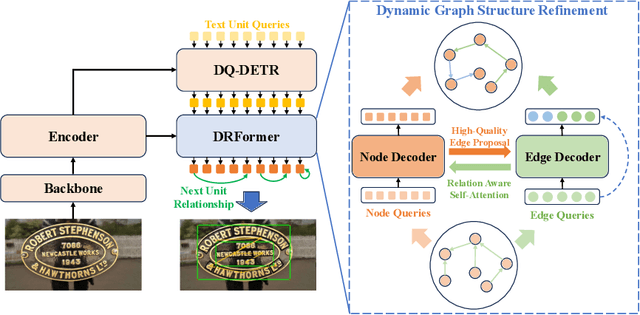

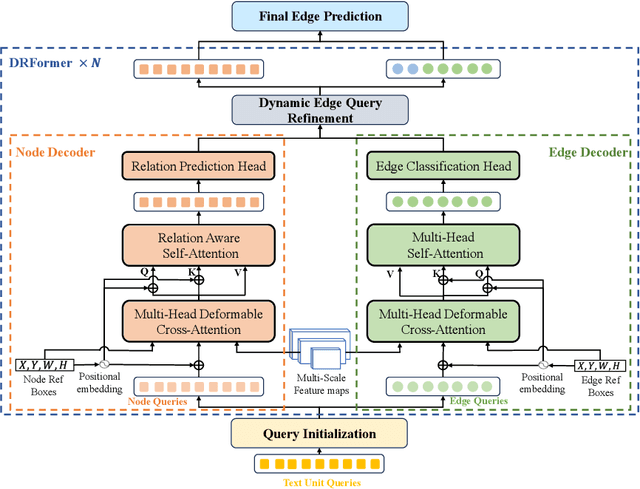

Contextual Text Block Detection (CTBD) is the task of identifying coherent text blocks within the complexity of natural scenes. Previous methodologies have treated CTBD as either a visual relation extraction challenge within computer vision or as a sequence modeling problem from the perspective of natural language processing. We introduce a new framework that frames CTBD as a graph generation problem. This methodology consists of two essential procedures: identifying individual text units as graph nodes and discerning the sequential reading order relationships among these units as graph edges. Leveraging the cutting-edge capabilities of DQ-DETR for node detection, our framework innovates further by integrating a novel mechanism, a Dynamic Relation Transformer (DRFormer), dedicated to edge generation. DRFormer incorporates a dual interactive transformer decoder that deftly manages a dynamic graph structure refinement process. Through this iterative process, the model systematically enhances the graph's fidelity, ultimately resulting in improved precision in detecting contextual text blocks. Comprehensive experimental evaluations conducted on both SCUT-CTW-Context and ReCTS-Context datasets substantiate that our method achieves state-of-the-art results, underscoring the effectiveness and potential of our graph generation framework in advancing the field of CTBD.