 Add to Chrome
 Add to Firefox
 Add to Edge
Many-Shot CoT-ICL: Making In-Context Learning Truly Learn
May 13, 2026
In-context learning (ICL) adapts large language models (LLMs) to new tasks by conditioning on demonstrations in the prompt without parameter updates. With long-context models, many-shot ICL can use dozens to hundreds of examples and achieve performance comparable to fine-tuning, yet current understanding of its scaling behavior is largely derived from non-reasoning tasks. We study many-shot chain-of-thought in-context learning (CoT-ICL) for reasoning and show that standard many-shot rules do not transfer. Across non-reasoning and reasoning-oriented LLMs and across non-reasoning and reasoning tasks, we find: (i) a setting-dependent scaling effect, where increasing the number of CoT demonstrations is unstable for non-reasoning LLMs and benefits mainly reasoning-oriented LLMs; (ii) similarity-based retrieval helps on non-reasoning tasks but fails on reasoning, since semantic similarity poorly predicts procedural (i.e., CoT) compatibility; and (iii) an order-scaling effect, where performance variance grows with more CoT demonstrations. We interpret these behaviors by viewing many-shot CoT-ICL as in-context test-time learning rather than scaled pattern matching, and suggests two principles: (i) demonstrations should be easy for the target model to understand, and (ii) they should be ordered to support a smooth conceptual progression. Guided by the principle, we propose Curvilinear Demonstration Selection (CDS), a simple ordering method that yields up to a 5.42 percentage-point gain on geometry with 64 demonstrations. Overall, our results reframe the long context window from a retrieval buffer into a structured curriculum for in-context test-time learning.

XQ-MEval: A Dataset with Cross-lingual Parallel Quality for Benchmarking Translation Metrics
Apr 16, 2026Automatic evaluation metrics are essential for building multilingual translation systems. The common practice of evaluating these systems is averaging metric scores across languages, yet this is suspicious since metrics may suffer from cross-lingual scoring bias, where translations of equal quality receive different scores across languages. This problem has not been systematically studied because no benchmark exists that provides parallel-quality instances across languages, and expert annotation is not realistic. In this work, we propose XQ-MEval, a semi-automatically built dataset covering nine translation directions, to benchmark translation metrics. Specifically, we inject MQM-defined errors into gold translations automatically, filter them by native speakers for reliability, and merge errors to generate pseudo translations with controllable quality. These pseudo translations are then paired with corresponding sources and references to form triplets used in assessing the qualities of translation metrics. Using XQ-MEval, our experiments on nine representative metrics reveal the inconsistency between averaging and human judgment and provide the first empirical evidence of cross-lingual scoring bias. Finally, we propose a normalization strategy derived from XQ-MEval that aligns score distributions across languages, improving the fairness and reliability of multilingual metric evaluation.
Judge Like Human Examiners: A Weighted Importance Multi-Point Evaluation Framework for Generative Tasks with Long-form Answers
Apr 14, 2026Evaluating the quality of model responses remains challenging in generative tasks with long-form answers, as the expected answers usually contain multiple semantically distinct yet complementary factors that should be factorized for fine-grained assessment. Recent evaluation methods resort to relying on either task-level rubrics or question-aware checklists. However, they still 1) struggle to assess whether a response is genuinely grounded in provided contexts; 2) fail to capture the heterogeneous importance of different aspects of reference answers. Inspired by human examiners, we propose a Weighted Importance Multi-Point Evaluation (WIMPE) framework, which factorizes each reference answer into weighted context-bound scoring points. Two complementary metrics, namely Weighted Point-wise Alignment (WPA) and Point-wise Conflict Penalty (PCP), are designed to measure the alignment and contradiction between model responses and reference answers. Extensive experiments on 10 generative tasks demonstrate that WIMPE achieves higher correlations with human annotations.
A Decomposition Perspective to Long-context Reasoning for LLMs
Apr 09, 2026Long-context reasoning is essential for complex real-world applications, yet remains a significant challenge for Large Language Models (LLMs). Despite the rapid evolution in long-context reasoning, current research often overlooks the internal complexity of the long-context reasoning task itself. In this paper, we move beyond this holistic view and decompose long-context reasoning into a set of fundamental atomic skills, and we then automatically synthesize a suite of pseudo datasets, each explicitly targeting a specific atomic skill. Our empirical analysis confirms that proficiency in these atomic skills is strongly correlated with general long-text reasoning performance. Building on this insight, we employ reinforcement learning on these pseudo datasets to sharpen the model's atomic skills, in the hope of boosting its general long-context reasoning ability. Extensive experiments across multiple benchmarks demonstrate the effectiveness of our approach: it outperforms a strong baseline by an average margin of 7.7\% (improving from 46.3\% to 54.0\%) across Loogle, Loong, LongBench-v2, BrowscompLong, Ruler-qa2, and MRCR.
Towards Privacy-Preserving Machine Translation at the Inference Stage: A New Task and Benchmark
Mar 16, 2026Current online translation services require sending user text to cloud servers, posing a risk of privacy leakage when the text contains sensitive information. This risk hinders the application of online translation services in privacy-sensitive scenarios. One way to mitigate this risk for online translation services is introducing privacy protection mechanisms targeting the inference stage of translation models. However, compared to subfields of NLP like text classification and summarization, the machine translation research community has limited exploration of privacy protection during the inference stage. There is no clearly defined privacy protection task for the inference stage, dedicated evaluation datasets and metrics, and reference benchmark methods. The absence of these elements has seriously constrained researchers' in-depth exploration of this direction. To bridge this gap, this paper proposes a novel "Privacy-Preserving Machine Translation" (PPMT) task, aiming to protect the private information in text during the model inference stage. For this task, we constructed three benchmark test datasets, designed corresponding evaluation metrics, and proposed a series of benchmark methods as a starting point for this task. The definition of privacy is complex and diverse. Considering that named entities often contain a large amount of personal privacy and commercial secrets, we have focused our research on protecting only the named entity's privacy in the text. We expect this research work will provide a new perspective and a solid foundation for the privacy protection problem in machine translation.
VC-Bench: Pioneering the Video Connecting Benchmark with a Dataset and Evaluation Metrics
Jan 27, 2026While current video generation focuses on text or image conditions, practical applications like video editing and vlogging often need to seamlessly connect separate clips. In our work, we introduce Video Connecting, an innovative task that aims to generate smooth intermediate video content between given start and end clips. However, the absence of standardized evaluation benchmarks has hindered the development of this task. To bridge this gap, we proposed VC-Bench, a novel benchmark specifically designed for video connecting. It includes 1,579 high-quality videos collected from public platforms, covering 15 main categories and 72 subcategories to ensure diversity and structure. VC-Bench focuses on three core aspects: Video Quality Score VQS, Start-End Consistency Score SECS, and Transition Smoothness Score TSS. Together, they form a comprehensive framework that moves beyond conventional quality-only metrics. We evaluated multiple state-of-the-art video generation models on VC-Bench. Experimental results reveal significant limitations in maintaining start-end consistency and transition smoothness, leading to lower overall coherence and fluidity. We expect that VC-Bench will serve as a pioneering benchmark to inspire and guide future research in video connecting. The evaluation metrics and dataset are publicly available at: https://anonymous.4open.science/r/VC-Bench-1B67/.
DivLogicEval: A Framework for Benchmarking Logical Reasoning Evaluation in Large Language Models
Sep 19, 2025Logic reasoning in natural language has been recognized as an important measure of human intelligence for Large Language Models (LLMs). Popular benchmarks may entangle multiple reasoning skills and thus provide unfaithful evaluations on the logic reasoning skill. Meanwhile, existing logic reasoning benchmarks are limited in language diversity and their distributions are deviated from the distribution of an ideal logic reasoning benchmark, which may lead to biased evaluation results. This paper thereby proposes a new classical logic benchmark DivLogicEval, consisting of natural sentences composed of diverse statements in a counterintuitive way. To ensure a more reliable evaluation, we also introduce a new evaluation metric that mitigates the influence of bias and randomness inherent in LLMs. Through experiments, we demonstrate the extent to which logical reasoning is required to answer the questions in DivLogicEval and compare the performance of different popular LLMs in conducting logical reasoning.
DBudgetKV: Dynamic Budget in KV Cache Compression for Ensuring Optimal Performance
Feb 24, 2025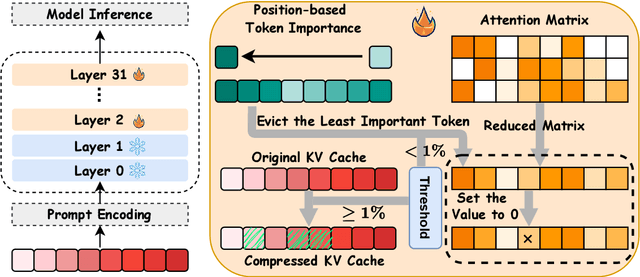
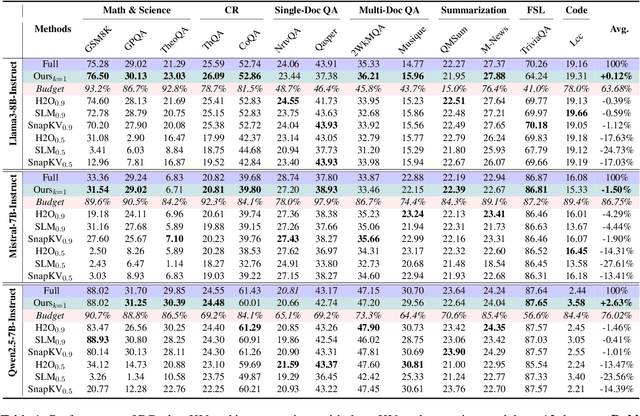
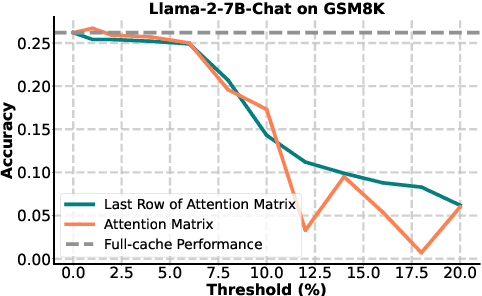
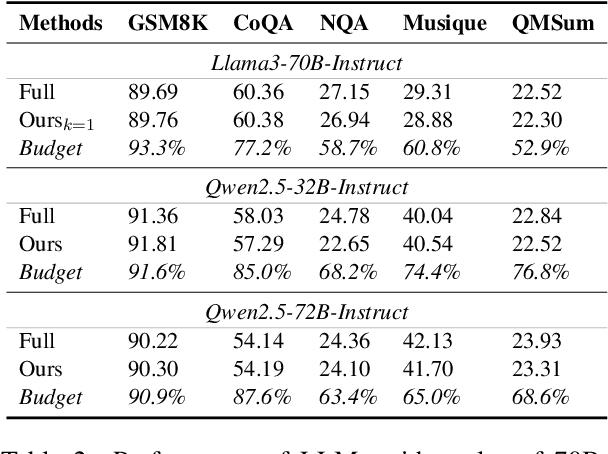
To alleviate memory burden during inference of large language models (LLMs), numerous studies have focused on compressing the KV cache by exploring aspects such as attention sparsity. However, these techniques often require a pre-defined cache budget; as the optimal budget varies with different input lengths and task types, it limits their practical deployment accepting open-domain instructions. To address this limitation, we propose a new KV cache compression objective: to always ensure the full-cache performance regardless of specific inputs, while maximizing KV cache pruning as much as possible. To achieve this goal, we introduce a novel KV cache compression method dubbed DBudgetKV, which features an attention-based metric to signal when the remaining KV cache is unlikely to match the full-cache performance, then halting the pruning process. Empirical evaluation spanning diverse context lengths, task types, and model sizes suggests that our method achieves lossless KV pruning effectively and robustly, exceeding 25% compression ratio on average. Furthermore, our method is easy to integrate within LLM inference, not only optimizing memory space, but also showing reduced inference time compared to existing methods.
The Stochastic Parrot on LLM's Shoulder: A Summative Assessment of Physical Concept Understanding
Feb 13, 2025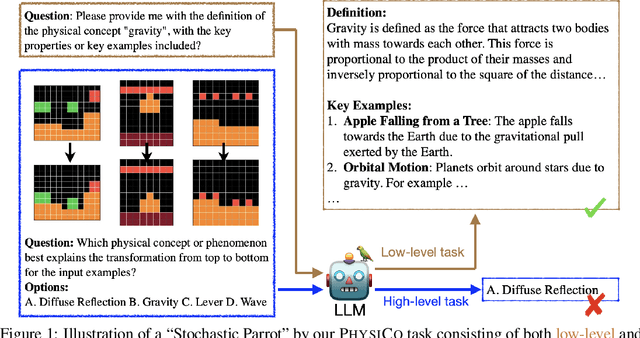
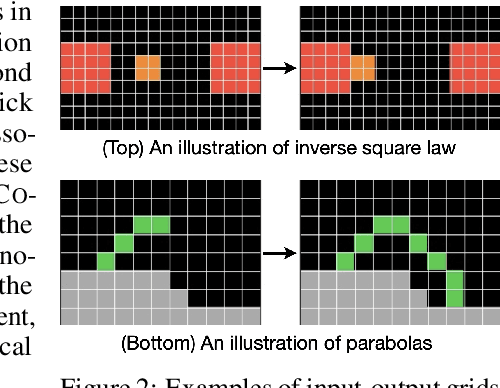
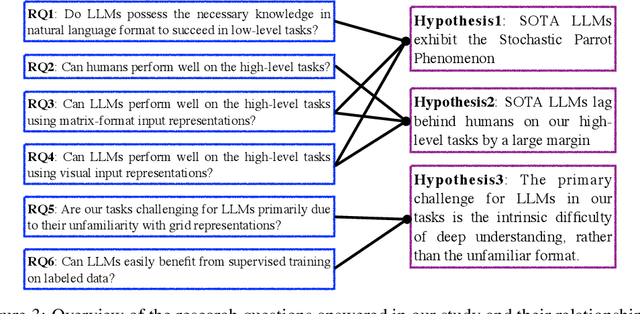
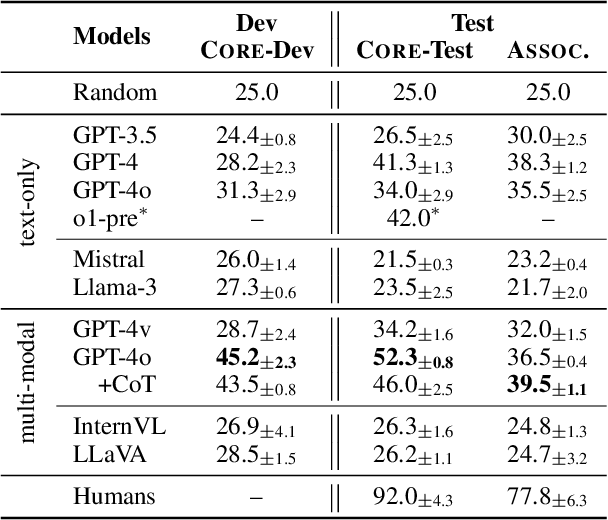
In a systematic way, we investigate a widely asked question: Do LLMs really understand what they say?, which relates to the more familiar term Stochastic Parrot. To this end, we propose a summative assessment over a carefully designed physical concept understanding task, PhysiCo. Our task alleviates the memorization issue via the usage of grid-format inputs that abstractly describe physical phenomena. The grids represents varying levels of understanding, from the core phenomenon, application examples to analogies to other abstract patterns in the grid world. A comprehensive study on our task demonstrates: (1) state-of-the-art LLMs, including GPT-4o, o1 and Gemini 2.0 flash thinking, lag behind humans by ~40%; (2) the stochastic parrot phenomenon is present in LLMs, as they fail on our grid task but can describe and recognize the same concepts well in natural language; (3) our task challenges the LLMs due to intrinsic difficulties rather than the unfamiliar grid format, as in-context learning and fine-tuning on same formatted data added little to their performance.
Understanding LLMs' Fluid Intelligence Deficiency: An Analysis of the ARC Task
Feb 11, 2025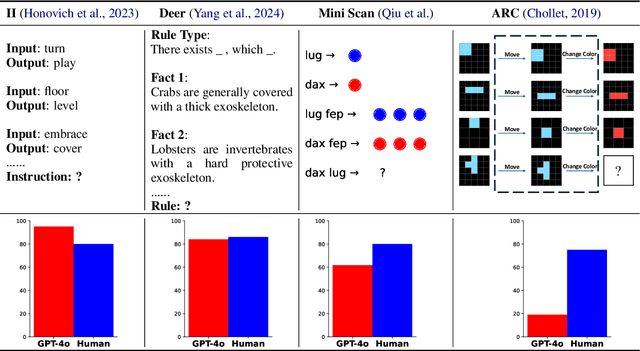
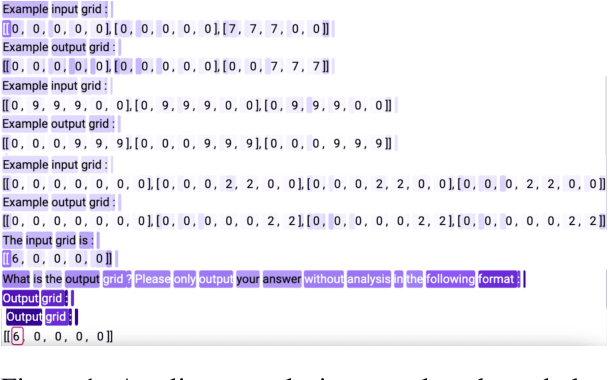
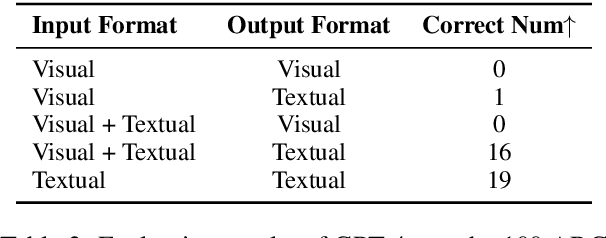
While LLMs have exhibited strong performance on various NLP tasks, it is noteworthy that most of these tasks rely on utilizing the vast amount of knowledge encoded in LLMs' parameters, rather than solving new problems without prior knowledge. In cognitive research, the latter ability is referred to as fluid intelligence, which is considered to be critical for assessing human intelligence. Recent research on fluid intelligence assessments has highlighted significant deficiencies in LLMs' abilities. In this paper, we analyze the challenges LLMs face in demonstrating fluid intelligence through controlled experiments, using the most representative ARC task as an example. Our study revealed three major limitations in existing LLMs: limited ability for skill composition, unfamiliarity with abstract input formats, and the intrinsic deficiency of left-to-right decoding. Our data and code can be found in https://wujunjie1998.github.io/araoc-benchmark.github.io/.