 Add to Chrome
 Add to Firefox
 Add to Edge
UniTalker: Scaling up Audio-Driven 3D Facial Animation through A Unified Model
Aug 01, 2024
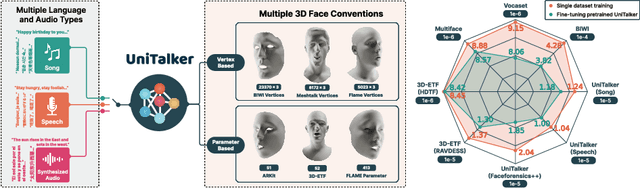
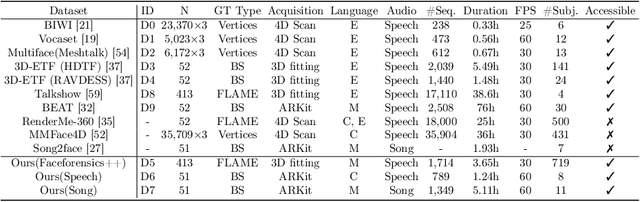

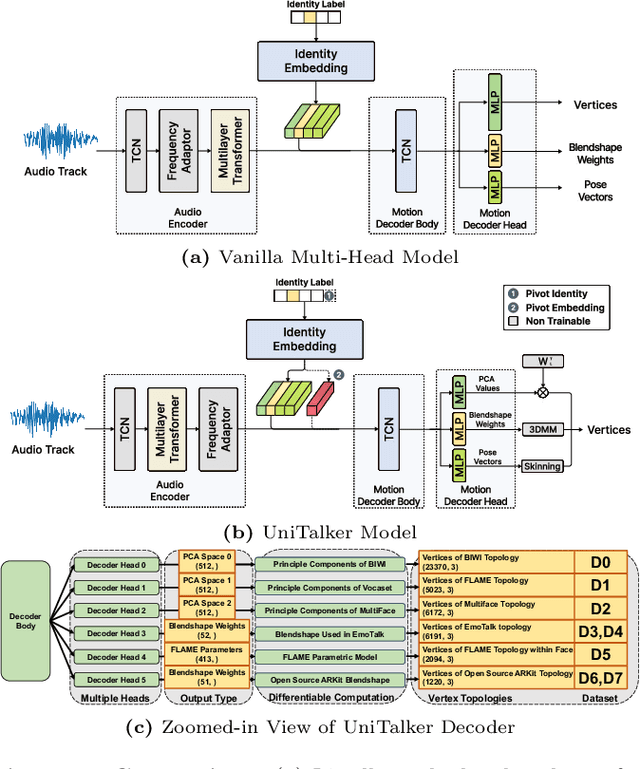
Audio-driven 3D facial animation aims to map input audio to realistic facial motion. Despite significant progress, limitations arise from inconsistent 3D annotations, restricting previous models to training on specific annotations and thereby constraining the training scale. In this work, we present UniTalker, a unified model featuring a multi-head architecture designed to effectively leverage datasets with varied annotations. To enhance training stability and ensure consistency among multi-head outputs, we employ three training strategies, namely, PCA, model warm-up, and pivot identity embedding. To expand the training scale and diversity, we assemble A2F-Bench, comprising five publicly available datasets and three newly curated datasets. These datasets contain a wide range of audio domains, covering multilingual speech voices and songs, thereby scaling the training data from commonly employed datasets, typically less than 1 hour, to 18.5 hours. With a single trained UniTalker model, we achieve substantial lip vertex error reductions of 9.2% for BIWI dataset and 13.7% for Vocaset. Additionally, the pre-trained UniTalker exhibits promise as the foundation model for audio-driven facial animation tasks. Fine-tuning the pre-trained UniTalker on seen datasets further enhances performance on each dataset, with an average error reduction of 6.3% on A2F-Bench. Moreover, fine-tuning UniTalker on an unseen dataset with only half the data surpasses prior state-of-the-art models trained on the full dataset. The code and dataset are available at the project page https://github.com/X-niper/UniTalker.

Differentiable Convex Polyhedra Optimization from Multi-view Images
Jul 22, 2024This paper presents a novel approach for the differentiable rendering of convex polyhedra, addressing the limitations of recent methods that rely on implicit field supervision. Our technique introduces a strategy that combines non-differentiable computation of hyperplane intersection through duality transform with differentiable optimization for vertex positioning with three-plane intersection, enabling gradient-based optimization without the need for 3D implicit fields. This allows for efficient shape representation across a range of applications, from shape parsing to compact mesh reconstruction. This work not only overcomes the challenges of previous approaches but also sets a new standard for representing shapes with convex polyhedra.
APS-USCT: Ultrasound Computed Tomography on Sparse Data via AI-Physic Synergy
Jul 18, 2024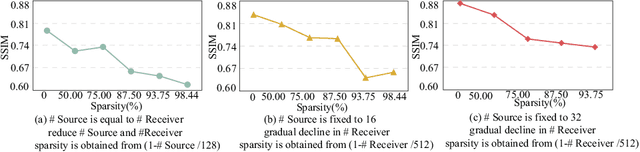
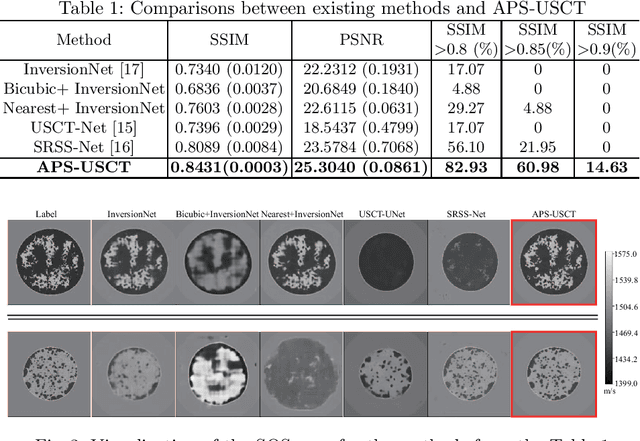
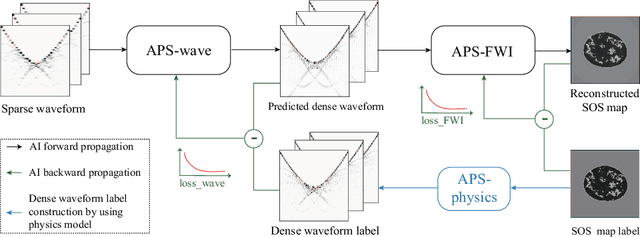
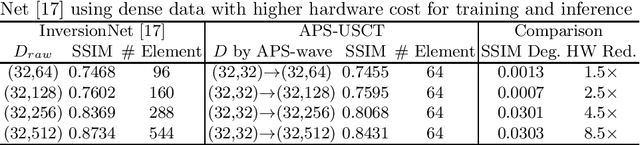
Ultrasound computed tomography (USCT) is a promising technique that achieves superior medical imaging reconstruction resolution by fully leveraging waveform information, outperforming conventional ultrasound methods. Despite its advantages, high-quality USCT reconstruction relies on extensive data acquisition by a large number of transducers, leading to increased costs, computational demands, extended patient scanning times, and manufacturing complexities. To mitigate these issues, we propose a new USCT method called APS-USCT, which facilitates imaging with sparse data, substantially reducing dependence on high-cost dense data acquisition. Our APS-USCT method consists of two primary components: APS-wave and APS-FWI. The APS-wave component, an encoder-decoder system, preprocesses the waveform data, converting sparse data into dense waveforms to augment sample density prior to reconstruction. The APS-FWI component, utilizing the InversionNet, directly reconstructs the speed of sound (SOS) from the ultrasound waveform data. We further improve the model's performance by incorporating Squeeze-and-Excitation (SE) Blocks and source encoding techniques. Testing our method on a breast cancer dataset yielded promising results. It demonstrated outstanding performance with an average Structural Similarity Index (SSIM) of 0.8431. Notably, over 82% of samples achieved an SSIM above 0.8, with nearly 61% exceeding 0.85, highlighting the significant potential of our approach in improving USCT image reconstruction by efficiently utilizing sparse data.
Data-Algorithm-Architecture Co-Optimization for Fair Neural Networks on Skin Lesion Dataset
Jul 18, 2024As Artificial Intelligence (AI) increasingly integrates into our daily lives, fairness has emerged as a critical concern, particularly in medical AI, where datasets often reflect inherent biases due to social factors like the underrepresentation of marginalized communities and socioeconomic barriers to data collection. Traditional approaches to mitigating these biases have focused on data augmentation and the development of fairness-aware training algorithms. However, this paper argues that the architecture of neural networks, a core component of Machine Learning (ML), plays a crucial role in ensuring fairness. We demonstrate that addressing fairness effectively requires a holistic approach that simultaneously considers data, algorithms, and architecture. Utilizing Automated ML (AutoML) technology, specifically Neural Architecture Search (NAS), we introduce a novel framework, BiaslessNAS, designed to achieve fair outcomes in analyzing skin lesion datasets. BiaslessNAS incorporates fairness considerations at every stage of the NAS process, leading to the identification of neural networks that are not only more accurate but also significantly fairer. Our experiments show that BiaslessNAS achieves a 2.55% increase in accuracy and a 65.50% improvement in fairness compared to traditional NAS methods, underscoring the importance of integrating fairness into neural network architecture for better outcomes in medical AI applications.
Language-Augmented Symbolic Planner for Open-World Task Planning
Jul 13, 2024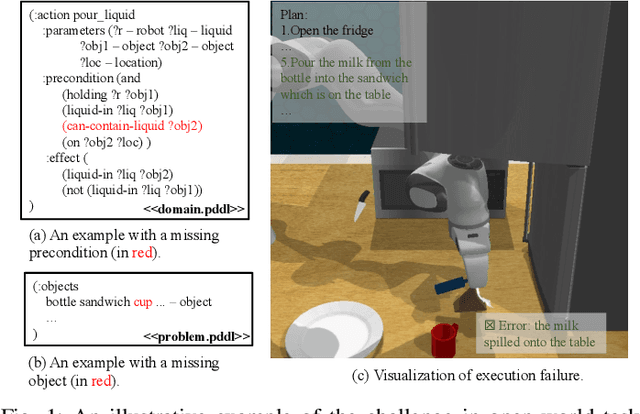
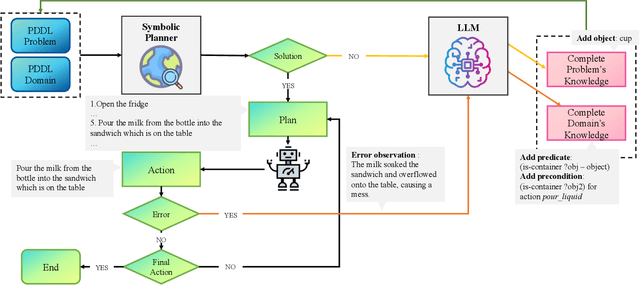
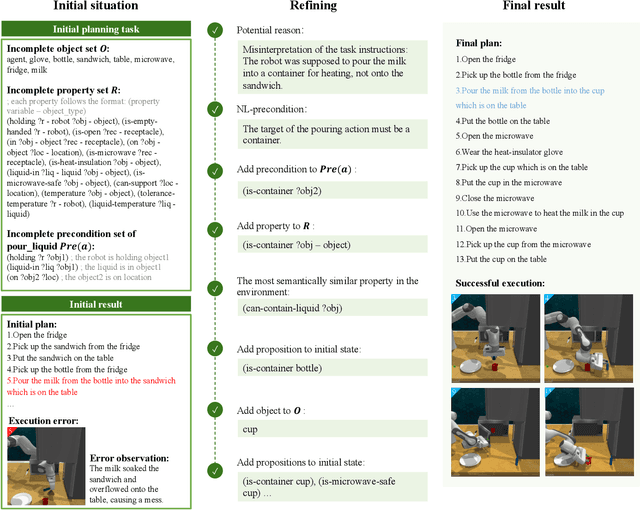
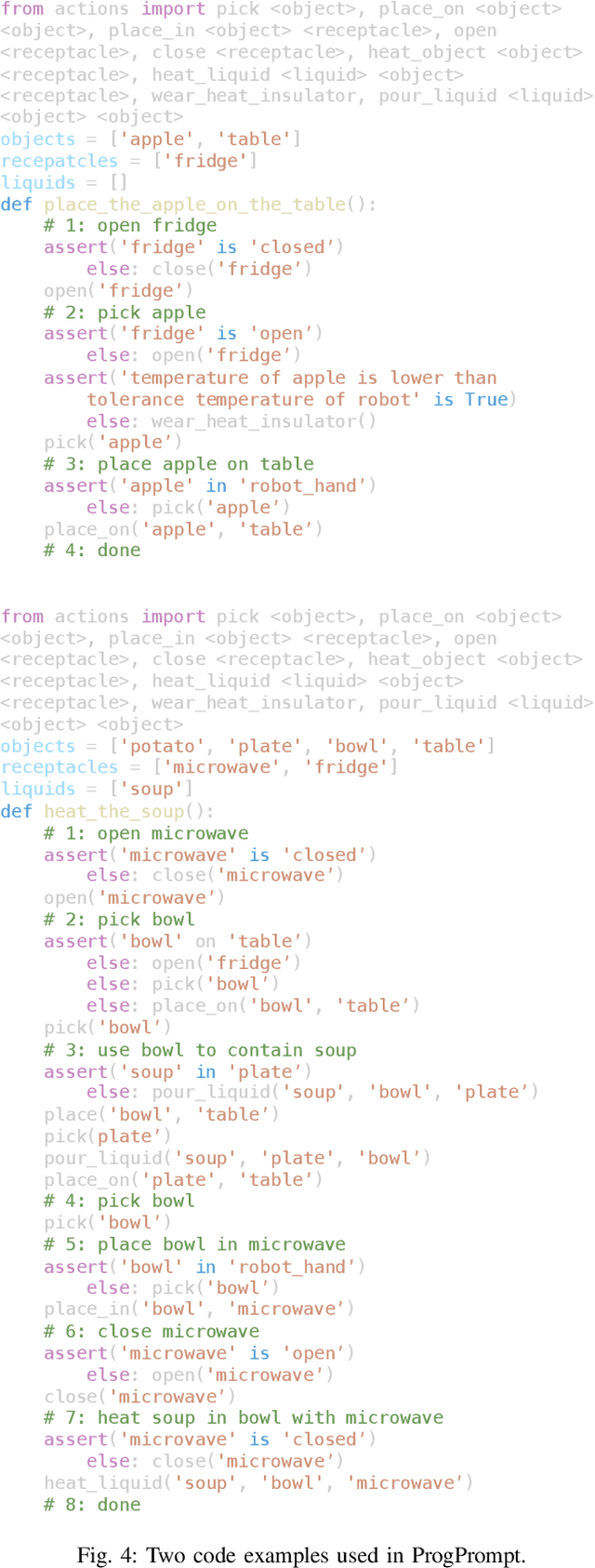
Enabling robotic agents to perform complex long-horizon tasks has been a long-standing goal in robotics and artificial intelligence (AI). Despite the potential shown by large language models (LLMs), their planning capabilities remain limited to short-horizon tasks and they are unable to replace the symbolic planning approach. Symbolic planners, on the other hand, may encounter execution errors due to their common assumption of complete domain knowledge which is hard to manually prepare for an open-world setting. In this paper, we introduce a Language-Augmented Symbolic Planner (LASP) that integrates pre-trained LLMs to enable conventional symbolic planners to operate in an open-world environment where only incomplete knowledge of action preconditions, objects, and properties is initially available. In case of execution errors, LASP can utilize the LLM to diagnose the cause of the error based on the observation and interact with the environment to incrementally build up its knowledge base necessary for accomplishing the given tasks. Experiments demonstrate that LASP is proficient in solving planning problems in the open-world setting, performing well even in situations where there are multiple gaps in the knowledge.
$\mathrm{E^{2}CFD}$: Towards Effective and Efficient Cost Function Design for Safe Reinforcement Learning via Large Language Model
Jul 08, 2024Different classes of safe reinforcement learning algorithms have shown satisfactory performance in various types of safety requirement scenarios. However, the existing methods mainly address one or several classes of specific safety requirement scenario problems and cannot be applied to arbitrary safety requirement scenarios. In addition, the optimization objectives of existing reinforcement learning algorithms are misaligned with the task requirements. Based on the need to address these issues, we propose $\mathrm{E^{2}CFD}$, an effective and efficient cost function design framework. $\mathrm{E^{2}CFD}$ leverages the capabilities of a large language model (LLM) to comprehend various safety scenarios and generate corresponding cost functions. It incorporates the \textit{fast performance evaluation (FPE)} method to facilitate rapid and iterative updates to the generated cost function. Through this iterative process, $\mathrm{E^{2}CFD}$ aims to obtain the most suitable cost function for policy training, tailored to the specific tasks within the safety scenario. Experiments have proven that the performance of policies trained using this framework is superior to traditional safe reinforcement learning algorithms and policies trained with carefully designed cost functions.
One Fling to Goal: Environment-aware Dynamics for Goal-conditioned Fabric Flinging
Jun 20, 2024Fabric manipulation dynamically is commonly seen in manufacturing and domestic settings. While dynamically manipulating a fabric piece to reach a target state is highly efficient, this task presents considerable challenges due to the varying properties of different fabrics, complex dynamics when interacting with environments, and meeting required goal conditions. To address these challenges, we present \textit{One Fling to Goal}, an algorithm capable of handling fabric pieces with diverse shapes and physical properties across various scenarios. Our method learns a graph-based dynamics model equipped with environmental awareness. With this dynamics model, we devise a real-time controller to enable high-speed fabric manipulation in one attempt, requiring less than 3 seconds to finish the goal-conditioned task. We experimentally validate our method on a goal-conditioned manipulation task in five diverse scenarios. Our method significantly improves this goal-conditioned task, achieving an average error of 13.2mm in complex scenarios. Our method can be seamlessly transferred to real-world robotic systems and generalized to unseen scenarios in a zero-shot manner.
SparseDet: A Simple and Effective Framework for Fully Sparse LiDAR-based 3D Object Detection
Jun 16, 2024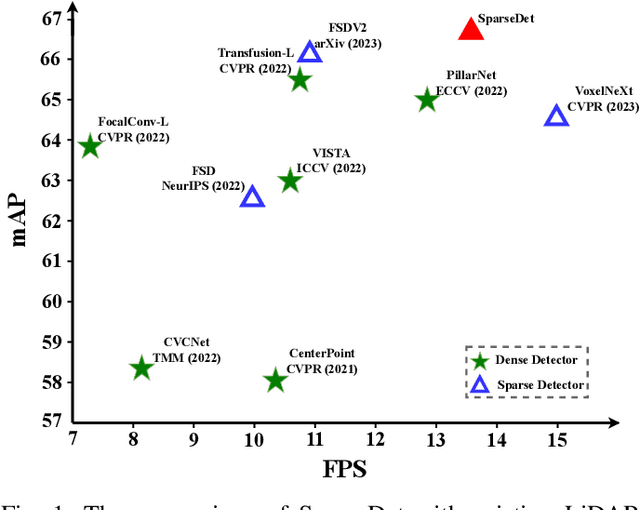
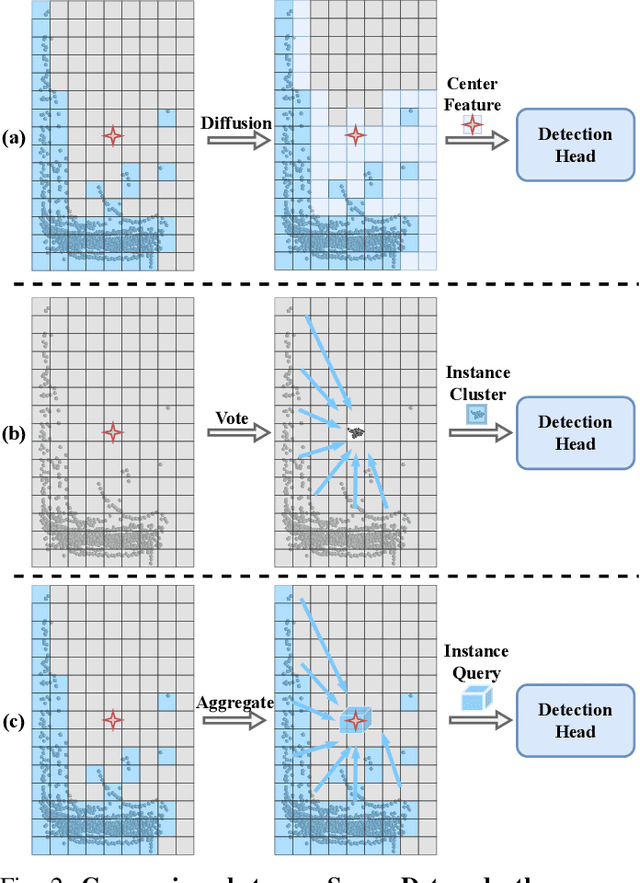
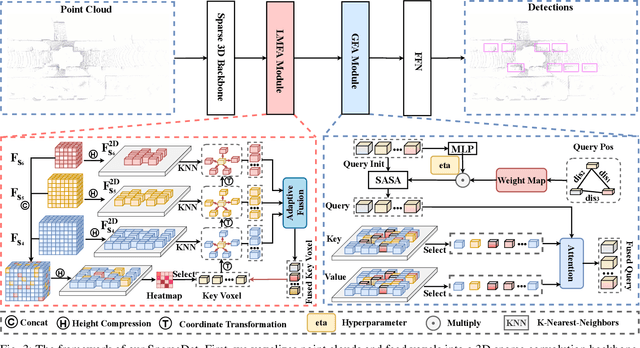
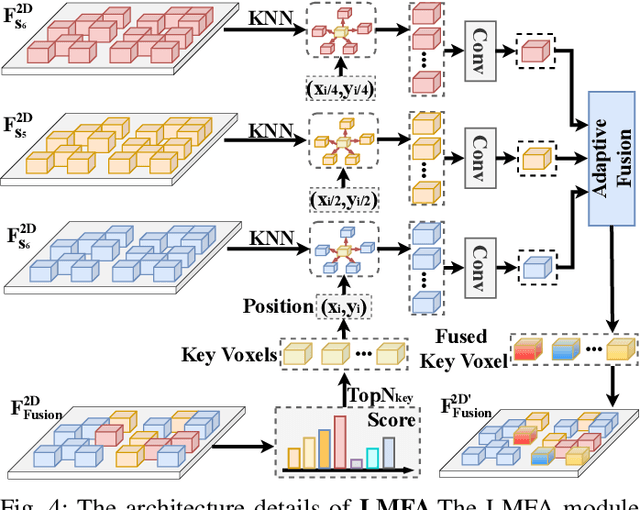
LiDAR-based sparse 3D object detection plays a crucial role in autonomous driving applications due to its computational efficiency advantages. Existing methods either use the features of a single central voxel as an object proxy, or treat an aggregated cluster of foreground points as an object proxy. However, the former lacks the ability to aggregate contextual information, resulting in insufficient information expression in object proxies. The latter relies on multi-stage pipelines and auxiliary tasks, which reduce the inference speed. To maintain the efficiency of the sparse framework while fully aggregating contextual information, in this work, we propose SparseDet which designs sparse queries as object proxies. It introduces two key modules, the Local Multi-scale Feature Aggregation (LMFA) module and the Global Feature Aggregation (GFA) module, aiming to fully capture the contextual information, thereby enhancing the ability of the proxies to represent objects. Where LMFA sub-module achieves feature fusion across different scales for sparse key voxels %which does this through via coordinate transformations and using nearest neighbor relationships to capture object-level details and local contextual information, GFA sub-module uses self-attention mechanisms to selectively aggregate the features of the key voxels across the entire scene for capturing scene-level contextual information. Experiments on nuScenes and KITTI demonstrate the effectiveness of our method. Specifically, on nuScene, SparseDet surpasses the previous best sparse detector VoxelNeXt by 2.2\% mAP with 13.5 FPS, and on KITTI, it surpasses VoxelNeXt by 1.12\% $\mathbf{AP_{3D}}$ on hard level tasks with 17.9 FPS.
MeshAnything: Artist-Created Mesh Generation with Autoregressive Transformers
Jun 14, 2024

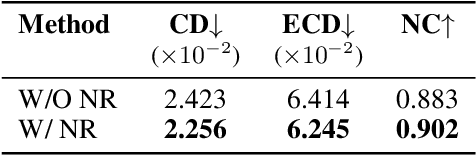

Recently, 3D assets created via reconstruction and generation have matched the quality of manually crafted assets, highlighting their potential for replacement. However, this potential is largely unrealized because these assets always need to be converted to meshes for 3D industry applications, and the meshes produced by current mesh extraction methods are significantly inferior to Artist-Created Meshes (AMs), i.e., meshes created by human artists. Specifically, current mesh extraction methods rely on dense faces and ignore geometric features, leading to inefficiencies, complicated post-processing, and lower representation quality. To address these issues, we introduce MeshAnything, a model that treats mesh extraction as a generation problem, producing AMs aligned with specified shapes. By converting 3D assets in any 3D representation into AMs, MeshAnything can be integrated with various 3D asset production methods, thereby enhancing their application across the 3D industry. The architecture of MeshAnything comprises a VQ-VAE and a shape-conditioned decoder-only transformer. We first learn a mesh vocabulary using the VQ-VAE, then train the shape-conditioned decoder-only transformer on this vocabulary for shape-conditioned autoregressive mesh generation. Our extensive experiments show that our method generates AMs with hundreds of times fewer faces, significantly improving storage, rendering, and simulation efficiencies, while achieving precision comparable to previous methods.
DreamMat: High-quality PBR Material Generation with Geometry- and Light-aware Diffusion Models
May 27, 20242D diffusion model, which often contains unwanted baked-in shading effects and results in unrealistic rendering effects in the downstream applications. Generating Physically Based Rendering (PBR) materials instead of just RGB textures would be a promising solution. However, directly distilling the PBR material parameters from 2D diffusion models still suffers from incorrect material decomposition, such as baked-in shading effects in albedo. We introduce DreamMat, an innovative approach to resolve the aforementioned problem, to generate high-quality PBR materials from text descriptions. We find out that the main reason for the incorrect material distillation is that large-scale 2D diffusion models are only trained to generate final shading colors, resulting in insufficient constraints on material decomposition during distillation. To tackle this problem, we first finetune a new light-aware 2D diffusion model to condition on a given lighting environment and generate the shading results on this specific lighting condition. Then, by applying the same environment lights in the material distillation, DreamMat can generate high-quality PBR materials that are not only consistent with the given geometry but also free from any baked-in shading effects in albedo. Extensive experiments demonstrate that the materials produced through our methods exhibit greater visual appeal to users and achieve significantly superior rendering quality compared to baseline methods, which are preferable for downstream tasks such as game and film production.