 Add to Chrome
 Add to Firefox
 Add to Edge
Two Teachers Better Than One: Hardware-Physics Co-Guided Distributed Scientific Machine Learning
Mar 10, 2026
Scientific machine learning (SciML) is increasingly applied to in-field processing, controlling, and monitoring; however, wide-area sensing, real-time demands, and strict energy and reliability constraints make centralized SciML implementation impractical. Most SciML models assume raw data aggregation at a central node, incurring prohibitively high communication latency and energy costs; yet, distributing models developed for general-purpose ML often breaks essential physical principles, resulting in degraded performance. To address these challenges, we introduce EPIC, a hardware- and physics-co-guided distributed SciML framework, using full-waveform inversion (FWI) as a representative task. EPIC performs lightweight local encoding on end devices and physics-aware decoding at a central node. By transmitting compact latent features rather than high-volume raw data and by using cross-attention to capture inter-receiver wavefield coupling, EPIC significantly reduces communication cost while preserving physical fidelity. Evaluated on a distributed testbed with five end devices and one central node, and across 10 datasets from OpenFWI, EPIC reduces latency by 8.9$\times$ and communication energy by 33.8$\times$, while even improving reconstruction fidelity on 8 out of 10 datasets.

APS-USCT: Ultrasound Computed Tomography on Sparse Data via AI-Physic Synergy
Jul 18, 2024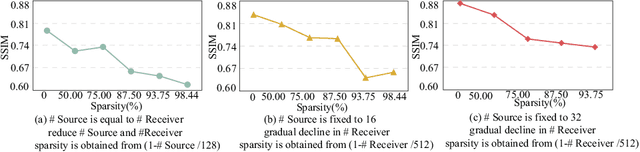
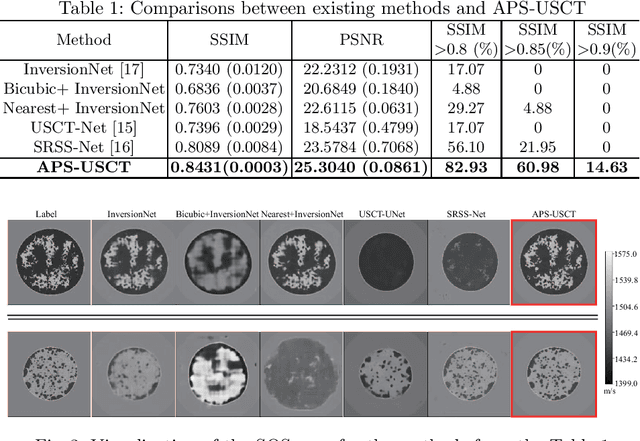
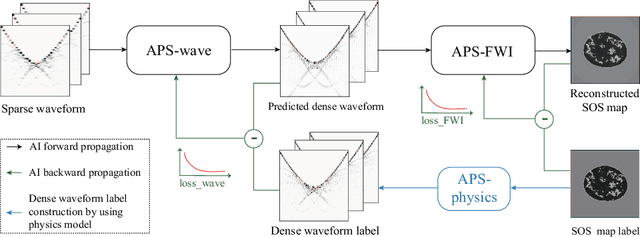
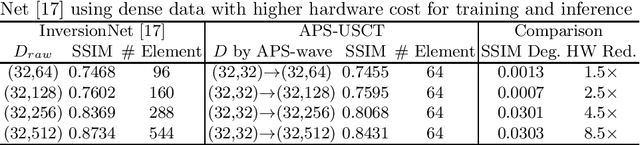
Ultrasound computed tomography (USCT) is a promising technique that achieves superior medical imaging reconstruction resolution by fully leveraging waveform information, outperforming conventional ultrasound methods. Despite its advantages, high-quality USCT reconstruction relies on extensive data acquisition by a large number of transducers, leading to increased costs, computational demands, extended patient scanning times, and manufacturing complexities. To mitigate these issues, we propose a new USCT method called APS-USCT, which facilitates imaging with sparse data, substantially reducing dependence on high-cost dense data acquisition. Our APS-USCT method consists of two primary components: APS-wave and APS-FWI. The APS-wave component, an encoder-decoder system, preprocesses the waveform data, converting sparse data into dense waveforms to augment sample density prior to reconstruction. The APS-FWI component, utilizing the InversionNet, directly reconstructs the speed of sound (SOS) from the ultrasound waveform data. We further improve the model's performance by incorporating Squeeze-and-Excitation (SE) Blocks and source encoding techniques. Testing our method on a breast cancer dataset yielded promising results. It demonstrated outstanding performance with an average Structural Similarity Index (SSIM) of 0.8431. Notably, over 82% of samples achieved an SSIM above 0.8, with nearly 61% exceeding 0.85, highlighting the significant potential of our approach in improving USCT image reconstruction by efficiently utilizing sparse data.