 Add to Chrome
 Add to Firefox
 Add to Edge
ABot-World-0: Infinite Interactive World Rollout on a Single Desktop GPU
Jul 21, 2026
We present ABot-World-0, an action-conditioned video world model for real-time, long-horizon closed-loop interaction, supported by a multi-source data infrastructure spanning AAA games, simulation engines, and internet videos to learn controllable world dynamics. WorldExplorer performs agent-driven collection guided by training feedback, while a unified pipeline applies 14 deterministic quality checks, VLM-based assessment, and synchronized action and text annotation. We progressively distill a bidirectional action-conditioned teacher into a causal student through teacher forcing and ODE distillation, and introduce LongForcing to align long student self-rollouts with an extended-horizon teacher, mitigating accumulated distribution shift and autoregressive drift. Raw keyboard actions provide a unified control interface for scene roaming and third-person character interaction, while reference-character memory provides persistent appearance cues for identity consistency during third-person rollouts. For deployment, we co-design a streaming inference stack with a lightweight VAE decoder, efficient attention, memory-aware scheduling, and low-bit DiT inference. Across optimized low-bit configurations, ABot-World-0 streams 720P video at up to 16 FPS on a single NVIDIA RTX 5090 desktop GPU, with 1.2s action-to-first-frame latency and approximately 19GiB peak VRAM. Experiments on WorldRoamBench and extended interactive rollouts demonstrate competitive controllability and coherent long-horizon world evolution.

ABot-3DWorld 0: A Universal World Model to Explore Any 3D Space
Jul 14, 2026We present ABot-3DWorld 0, a universal multimodal 3D world model that turns text, image, and video inputs into high-fidelity, explorable 3D worlds. At the heart of our framework is a unified Spatial Generative Primitive (SGP), a compact tuple of a high-quality panorama and a spatial point cloud that delivers an efficient description of any 3D space. Multimodal inputs are first lifted into this primitive; a 3D-consistent panoramic video generator then explores the primitive along a planned trajectory; finally, our panoramic video reconstruction engine converts the generated video into a clean, photorealistic 3D Gaussian Splatting (3DGS) world. This pipeline covers two regimes: rich inputs (multi-view sets, casual video) are lifted into the SGP through a geometry-rigorous recovery that mirrors the observed scene, while a single image or sentence is completed generatively into a creative world. The result is one low-barrier engine for general 3D content creation that further anchors generated worlds to geographic points of interest, enabling map-native spatial exploration at consumer scale. Experiments show that ABot-3DWorld 0 sets the state of the art among open-source methods and demonstrates stronger scene fidelity than Marble under rich multimodal inputs.
ABot-N1: Toward a General Visual Language Navigation Foundation Model
Jul 14, 2026Visual Language Navigation foundation models aim to unify deep reasoning for grounded spatial decisions with broad versatility for diverse embodied tasks. Current approaches typically achieve this integration via monolithic policies that map observations directly to actions, yet they often suffer from coordinate drift and poor handling of long-tail semantics. Furthermore, these black-box mappings lack interpretability, hindering the simultaneous achievement of generality, robustness, and transparency. We present ABot-N1, a step toward a general Visual Language Navigation foundation model, that addresses these challenges by decoupling cognition from control via a slow-fast architecture guided by dual visual-language signals. More specifically, a slow vision-language reasoner performs explicit Chain-of-Thought reasoning while producing a pixel goal. This compact set of image-space anchor points serves as a universal interface for diverse tasks, including point-goal, object-goal, poi-goal, instruction-following, and person-following. Subsequently, a fast action expert leverages both the textual cues and the pixel guidance to generate continuous waypoints at the native control frequency. By bridging high-level intents and low-level control through pixel-grounded anchors paired with explicit linguistic traces, our approach ensures robust, generalizable, and interpretable navigation across simulation and real-world benchmarks. ABot-N1 establishes new state-of-the-art records, delivering massive gains specifically in urban-scale navigation: boosting POI arrival by 35.0% (to 77.3%) and achieving 95.4%/92.9% SR in complex indoor and outdoor scenes. It also maintains superior robustness across object-reaching, person-following, and instruction-following tasks. New Point-Goal/POI-Goal benchmarks are released as open source to advance the field of urban-scale navigation.
WorldOdysseyBench: An Open-World Benchmark for Long-Horizon Stability of Interactive World Models
Jul 02, 2026Despite rapid progress in interactive world models (IWMs), existing benchmarks evaluate action following only at trajectory level and ignore memory and interaction physics. We introduce WorldOdysseyBench, an open-world benchmark for long-horizon stability across four dimensions, each with tailored innovations: (i) Action: per-frame action metric bypassing cross-model semantic scale disparity and exposing failures hidden by trajectory; (ii) Vision: segment-based drift metric capturing non-monotonic mid-sequence collapse missed by start-vs-end comparisons; (iii) Physics: controllability-gated evaluation over mechanics, optics, and 3D consistency, scoring plausibility under faithful action execution; (iv) Memory: action-decoupled protocol evaluating scene memory via transition-localized 3D point-cloud reconstruction and subject memory via tracking-plus-VLM reasoning. The benchmark comprises 600+ test cases across Nature, Urban, and Indoor scenes in first/third-person views with WASD 10-60s continuous interaction. Evaluating 10+ open/closed-source models reveals none reliably satisfies all dimensions; even the best achieves only moderate scores. Advances on WorldOdysseyBench are steps toward IWMs that are stable, physically grounded, memory-faithful, and deployable in real-world applications.
WorldRoamBench: An Open-World Benchmark for Long-Horizon Stability of Interactive World Models
Jun 30, 2026Despite rapid progress in interactive world models (IWMs), existing benchmarks evaluate action following only at trajectory level and ignore memory and interaction physics. We introduce WorldRoamBench, an open-world benchmark for long-horizon stability across four dimensions, each with tailored innovations: (i) Action: per-frame action metric bypassing cross-model semantic scale disparity and exposing failures hidden by trajectory; (ii) Vision: segment-based drift metric capturing non-monotonic mid-sequence collapse missed by start-vs-end comparisons; (iii) Physics: controllability-gated evaluation over mechanics, optics, and 3D consistency, scoring plausibility under faithful action execution; (iv) Memory: action-decoupled protocol evaluating scene memory via transition-localized 3D point-cloud reconstruction and subject memory via tracking-plus-VLM reasoning. The benchmark comprises 600+ test cases across Nature, Urban, and Indoor scenes in first/third-person views with WASD 10-60s continuous interaction. Evaluating 10+ open/closed-source models reveals none reliably satisfies all dimensions; even the best achieves only moderate scores. Advances on WorldRoamBench are steps toward IWMs that are stable, physically grounded, memory-faithful, and deployable in real-world applications.
ABot-Earth 0.5: Generative 3D Earth Model
Jun 08, 2026We present ABot-Earth 0.5, a generative 3D framework designed to synthesize vast, seamless 3D environments from ubiquitous, geospatially referenced satellite imagery. To achieve this, we propose a novel generative model formulated directly with the 3D Gaussian Splatting (3DGS) representation. The model is trained on a diverse corpus of existing real-world urban reconstructions, learning to generate realistic geometry and textures. At inference, it synthesizes novel 3D scenes conditioned solely on satellite imagery at a scalable rate of under 10 minutes per square kilometer, while demonstrating exceptional realism. The framework is designed for accessibility, with integrated hierarchical level-of-detail (LOD) structures that permit real-time, interactive visualization on web-based map engines. This high-fidelity simulation sandbox effectively mitigates the sim-to-real domain gap, enabling critical downstream Embodied AI applications like closed-loop UAV navigation. By providing an ultra-low-cost and high-efficiency solution, ABot-Earth 0.5 significantly lowers the technical and financial barriers to large-scale 3D reconstruction and empowers the future of global digital earth visualization.
ABot-N0: Technical Report on the VLA Foundation Model for Versatile Embodied Navigation
Feb 12, 2026Embodied navigation has long been fragmented by task-specific architectures. We introduce ABot-N0, a unified Vision-Language-Action (VLA) foundation model that achieves a ``Grand Unification'' across 5 core tasks: Point-Goal, Object-Goal, Instruction-Following, POI-Goal, and Person-Following. ABot-N0 utilizes a hierarchical ``Brain-Action'' architecture, pairing an LLM-based Cognitive Brain for semantic reasoning with a Flow Matching-based Action Expert for precise, continuous trajectory generation. To support large-scale learning, we developed the ABot-N0 Data Engine, curating 16.9M expert trajectories and 5.0M reasoning samples across 7,802 high-fidelity 3D scenes (10.7 $\text{km}^2$). ABot-N0 achieves new SOTA performance across 7 benchmarks, significantly outperforming specialized models. Furthermore, our Agentic Navigation System integrates a planner with hierarchical topological memory, enabling robust, long-horizon missions in dynamic real-world environments.
Two Tasks, One Goal: Uniting Motion and Planning for Excellent End To End Autonomous Driving Performance
Apr 17, 2025End-to-end autonomous driving has made impressive progress in recent years. Former end-to-end autonomous driving approaches often decouple planning and motion tasks, treating them as separate modules. This separation overlooks the potential benefits that planning can gain from learning out-of-distribution data encountered in motion tasks. However, unifying these tasks poses significant challenges, such as constructing shared contextual representations and handling the unobservability of other vehicles' states. To address these challenges, we propose TTOG, a novel two-stage trajectory generation framework. In the first stage, a diverse set of trajectory candidates is generated, while the second stage focuses on refining these candidates through vehicle state information. To mitigate the issue of unavailable surrounding vehicle states, TTOG employs a self-vehicle data-trained state estimator, subsequently extended to other vehicles. Furthermore, we introduce ECSA (equivariant context-sharing scene adapter) to enhance the generalization of scene representations across different agents. Experimental results demonstrate that TTOG achieves state-of-the-art performance across both planning and motion tasks. Notably, on the challenging open-loop nuScenes dataset, TTOG reduces the L2 distance by 36.06\%. Furthermore, on the closed-loop Bench2Drive dataset, our approach achieves a 22\% improvement in the driving score (DS), significantly outperforming existing baselines.
Don't Shake the Wheel: Momentum-Aware Planning in End-to-End Autonomous Driving
Mar 05, 2025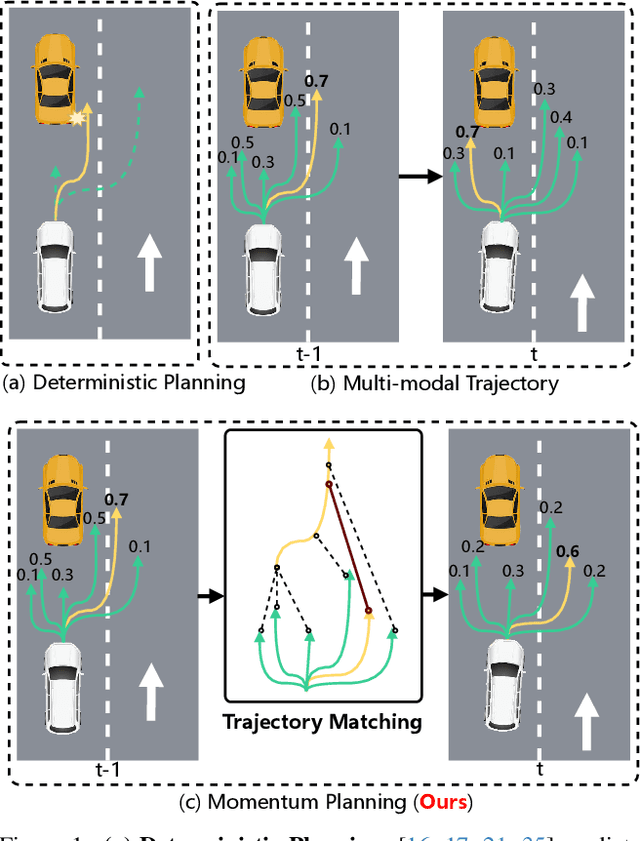


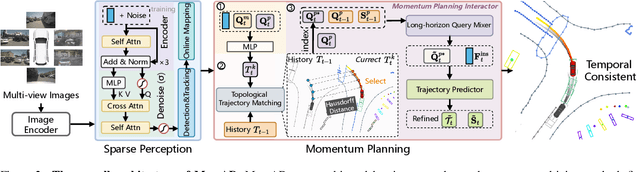
End-to-end autonomous driving frameworks enable seamless integration of perception and planning but often rely on one-shot trajectory prediction, which may lead to unstable control and vulnerability to occlusions in single-frame perception. To address this, we propose the Momentum-Aware Driving (MomAD) framework, which introduces trajectory momentum and perception momentum to stabilize and refine trajectory predictions. MomAD comprises two core components: (1) Topological Trajectory Matching (TTM) employs Hausdorff Distance to select the optimal planning query that aligns with prior paths to ensure coherence;(2) Momentum Planning Interactor (MPI) cross-attends the selected planning query with historical queries to expand static and dynamic perception files. This enriched query, in turn, helps regenerate long-horizon trajectory and reduce collision risks. To mitigate noise arising from dynamic environments and detection errors, we introduce robust instance denoising during training, enabling the planning model to focus on critical signals and improve its robustness. We also propose a novel Trajectory Prediction Consistency (TPC) metric to quantitatively assess planning stability. Experiments on the nuScenes dataset demonstrate that MomAD achieves superior long-term consistency (>=3s) compared to SOTA methods. Moreover, evaluations on the curated Turning-nuScenes shows that MomAD reduces the collision rate by 26% and improves TPC by 0.97m (33.45%) over a 6s prediction horizon, while closedloop on Bench2Drive demonstrates an up to 16.3% improvement in success rate.
SparseDet: A Simple and Effective Framework for Fully Sparse LiDAR-based 3D Object Detection
Jun 16, 2024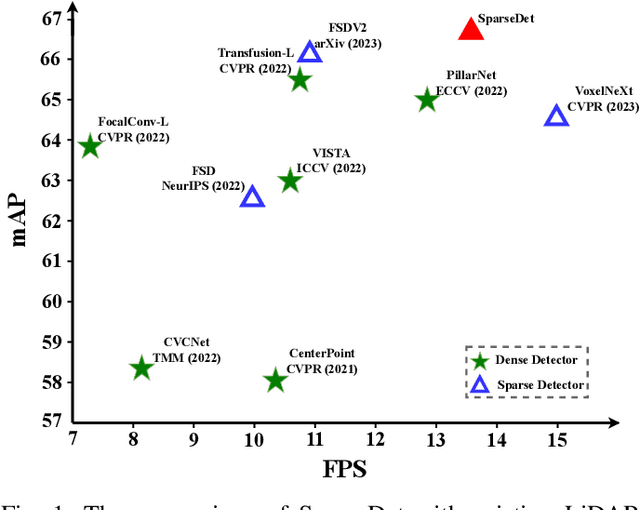
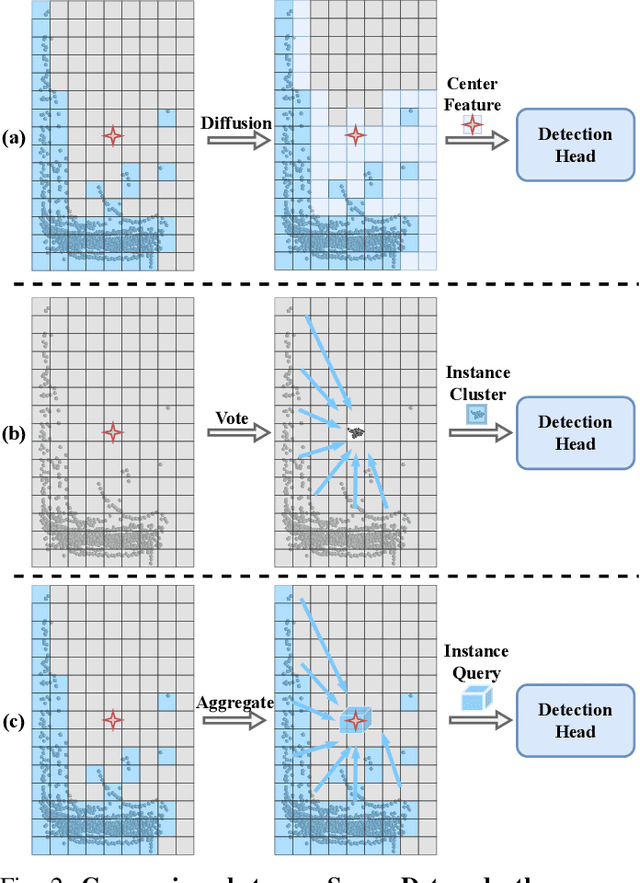
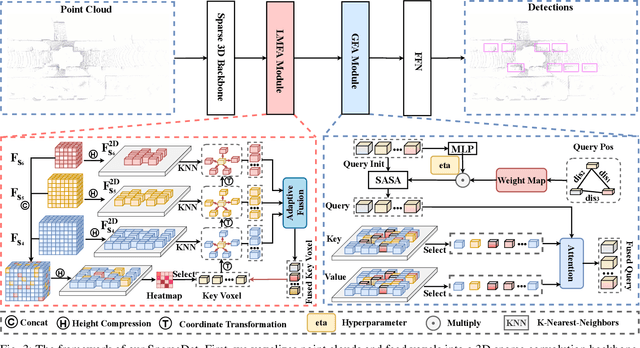
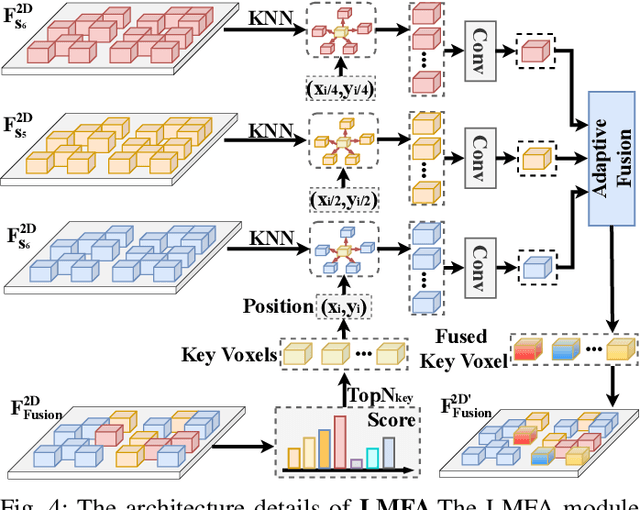
LiDAR-based sparse 3D object detection plays a crucial role in autonomous driving applications due to its computational efficiency advantages. Existing methods either use the features of a single central voxel as an object proxy, or treat an aggregated cluster of foreground points as an object proxy. However, the former lacks the ability to aggregate contextual information, resulting in insufficient information expression in object proxies. The latter relies on multi-stage pipelines and auxiliary tasks, which reduce the inference speed. To maintain the efficiency of the sparse framework while fully aggregating contextual information, in this work, we propose SparseDet which designs sparse queries as object proxies. It introduces two key modules, the Local Multi-scale Feature Aggregation (LMFA) module and the Global Feature Aggregation (GFA) module, aiming to fully capture the contextual information, thereby enhancing the ability of the proxies to represent objects. Where LMFA sub-module achieves feature fusion across different scales for sparse key voxels %which does this through via coordinate transformations and using nearest neighbor relationships to capture object-level details and local contextual information, GFA sub-module uses self-attention mechanisms to selectively aggregate the features of the key voxels across the entire scene for capturing scene-level contextual information. Experiments on nuScenes and KITTI demonstrate the effectiveness of our method. Specifically, on nuScene, SparseDet surpasses the previous best sparse detector VoxelNeXt by 2.2\% mAP with 13.5 FPS, and on KITTI, it surpasses VoxelNeXt by 1.12\% $\mathbf{AP_{3D}}$ on hard level tasks with 17.9 FPS.