 Add to Chrome
 Add to Firefox
 Add to Edge
Breaking the Compression Barrier: Cross-Architecture Compression Boundary Learning via Reverse Regrowth
Aug 17, 2026
Model compression is critical for deploying networks on resource-constrained edge devices. While pruning-based methods can significantly reduce model size, they often suffer from abrupt performance collapse beyond a sparsity thresh-old, making it difficult to identify the feasible compression limit of the model. To address this challenge, we propose a boundary-Learning reverse regrowth framework, BRIDGE, that reformulates compression as a constructive boundary-search problem. Unlike forward pruning, our method first drives the model to an extremely sparse state to expose the collapse region, and then selectively regenerates the critical structure to restore performance. The proposed framework employs a hierarchical regeneration strategy, including coarse-grained layer selection and fine-grained regeneration parameter selection, to accurately identify which parameters require recovery. Experiments show that our method can recover models from the brink of collapse on both CNNs and Transformer architectures, demonstrating its architecture in-dependence. BRIDGE achieves a performance improvement of up to 1.49% in unstructured pruning and up to 4.77% in structured pruning. These results demonstrate that reverse regeneration can effectively extend the compression limit while maintaining stable performance. The source code is available at https://github.com/EnumaCaliber/BRIDGE.

BAP-MOS: Bandit-Based Adaptive Prompting for Boundary-Sensitive Multi-Organ Segmentation
Aug 08, 2026Multi-organ ultrasound segmentation remains challenging when anatomically adjacent structures must be delineated jointly, as localized boundary errors can persist even when Dice scores are high. To address these challenges, we propose Boundary-Adaptive Prompting for Multi-Organ Segmentation (BAP-MOS), a closed-loop adaptive prompting framework. BAP-MOS formulates prompt selection as an organ-specific multi-armed bandit problem over box, point, and combined prompts. An outer Tree-structured Parzen Estimator (TPE) loop selects the prompt-selection parameter vector, while an inner UCB-Tuned loop adapts per-organ prompt preferences during fine-tuning using a bounded Dice--MSD--HD95 validation-probe reward. The framework further introduces an organ-scaled negative prompt ring to adapt sparse prompt geometry across anatomical scales, while keeping the image and prompt encoders frozen and updating only the mask decoder. We evaluate BAP-MOS on pooled prostate-region TRUS cohorts against U-Net, nnU-Net, MedSAM, fixed-prompt SAM/MedSAM, and adaptive policy variants. On this benchmark, BAP-MOS achieves Dice 0.982, HD95 0.482, and MSD 0.204, reducing HD95 by approximately 48% and MSD by 45% relative to the strongest conventional baseline. To verify the generalization ability of the framework, we tested it on the external PFUS1 pelvic-floor ultrasound corpus using MedSAM and its adaptive strategy variants, and the results were good. These results support adaptive prompt allocation as an effective mechanism for improving boundary-sensitive multi-organ ultrasound segmentation without modifying the foundation-model backbone. Source Code is available at: https://github.com/SatvikPraveen/BAP-MOS
Zero-Fi: Zero-Shot Wi-Fi-Based Human Activity Recognition via Contrastive Signal-Language Alignment
Jul 29, 2026Wi-Fi-based human activity recognition has advanced substantially, but most existing methods assume a closed set of activities and require labeled Wi-Fi samples for every target class, limiting their ability to recognize unseen activities. We present Zero-Fi, a contrastive signal-language alignment framework for zero-shot Wi-Fi-based human activity recognition. Zero-Fi learns unified representations from complementary Wi-Fi signal features and aligns them with the semantic representations of natural-language activity descriptions in a shared embedding space. This cross-modal alignment enables Zero-Fi to recognize new activity classes without requiring labeled Wi-Fi samples or model adaptation for those classes. Experiments on large-scale public benchmark datasets demonstrate effective zero-shot recognition of held-out activity classes, highlighting the potential of signal-language alignment to extend Wi-Fi sensing beyond predefined activity classes.
Embodied Foundation Models at the Edge: A Survey of Deployment Constraints and Mitigation Strategies
Mar 19, 2026Deploying foundation models in embodied edge systems is fundamentally a systems problem, not just a problem of model compression. Real-time control must operate within strict size, weight, and power constraints, where memory traffic, compute latency, timing variability, and safety margins interact directly. The Deployment Gauntlet organizes these constraints into eight coupled barriers that determine whether embodied foundation models can run reliably in practice. Across representative edge workloads, autoregressive Vision-Language-Action policies are constrained primarily by memory bandwidth, whereas diffusion-based controllers are limited more by compute latency and sustained execution cost. Reliable deployment therefore depends on system-level co-design across memory, scheduling, communication, and model architecture, including decompositions that separate fast control from slower semantic reasoning.
Beyond One-Way Pruning: Bidirectional Pruning-Regrowth for Extreme Accuracy-Sparsity Tradeoff
Nov 11, 2025As a widely adopted model compression technique, model pruning has demonstrated strong effectiveness across various architectures. However, we observe that when sparsity exceeds a certain threshold, both iterative and one-shot pruning methods lead to a steep decline in model performance. This rapid degradation limits the achievable compression ratio and prevents models from meeting the stringent size constraints required by certain hardware platforms, rendering them inoperable. To overcome this limitation, we propose a bidirectional pruning-regrowth strategy. Starting from an extremely compressed network that satisfies hardware constraints, the method selectively regenerates critical connections to recover lost performance, effectively mitigating the sharp accuracy drop commonly observed under high sparsity conditions.
A Novel Diffusion Model for Pairwise Geoscience Data Generation with Unbalanced Training Dataset
Jan 01, 2025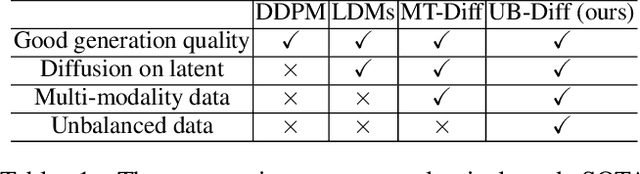
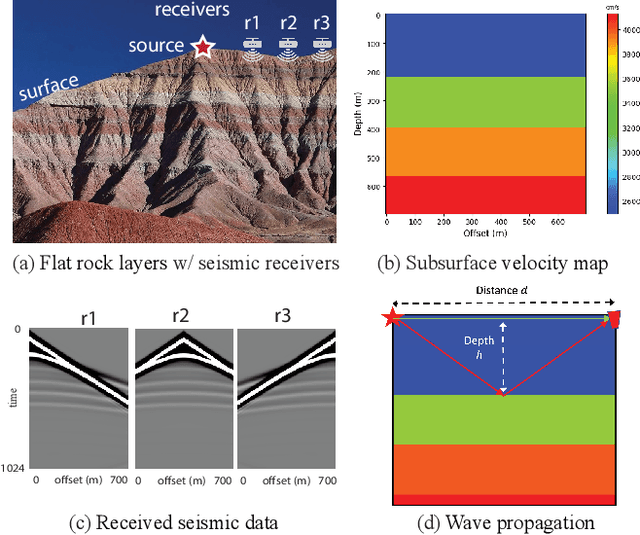
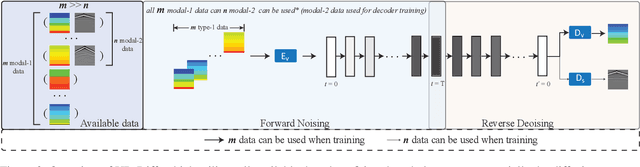
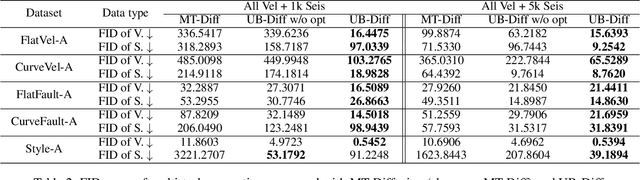
Recently, the advent of generative AI technologies has made transformational impacts on our daily lives, yet its application in scientific applications remains in its early stages. Data scarcity is a major, well-known barrier in data-driven scientific computing, so physics-guided generative AI holds significant promise. In scientific computing, most tasks study the conversion of multiple data modalities to describe physical phenomena, for example, spatial and waveform in seismic imaging, time and frequency in signal processing, and temporal and spectral in climate modeling; as such, multi-modal pairwise data generation is highly required instead of single-modal data generation, which is usually used in natural images (e.g., faces, scenery). Moreover, in real-world applications, the unbalance of available data in terms of modalities commonly exists; for example, the spatial data (i.e., velocity maps) in seismic imaging can be easily simulated, but real-world seismic waveform is largely lacking. While the most recent efforts enable the powerful diffusion model to generate multi-modal data, how to leverage the unbalanced available data is still unclear. In this work, we use seismic imaging in subsurface geophysics as a vehicle to present ``UB-Diff'', a novel diffusion model for multi-modal paired scientific data generation. One major innovation is a one-in-two-out encoder-decoder network structure, which can ensure pairwise data is obtained from a co-latent representation. Then, the co-latent representation will be used by the diffusion process for pairwise data generation. Experimental results on the OpenFWI dataset show that UB-Diff significantly outperforms existing techniques in terms of Fr\'{e}chet Inception Distance (FID) score and pairwise evaluation, indicating the generation of reliable and useful multi-modal pairwise data.
APS-USCT: Ultrasound Computed Tomography on Sparse Data via AI-Physic Synergy
Jul 18, 2024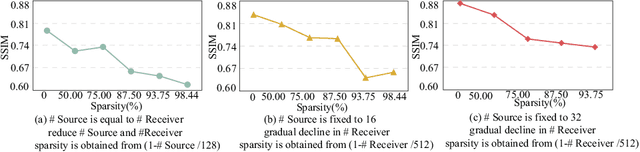
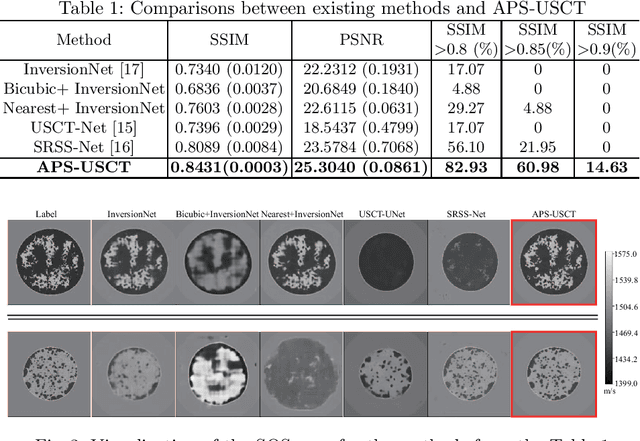
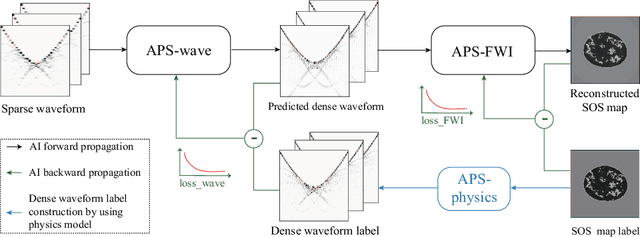
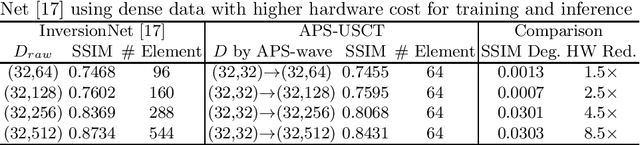
Ultrasound computed tomography (USCT) is a promising technique that achieves superior medical imaging reconstruction resolution by fully leveraging waveform information, outperforming conventional ultrasound methods. Despite its advantages, high-quality USCT reconstruction relies on extensive data acquisition by a large number of transducers, leading to increased costs, computational demands, extended patient scanning times, and manufacturing complexities. To mitigate these issues, we propose a new USCT method called APS-USCT, which facilitates imaging with sparse data, substantially reducing dependence on high-cost dense data acquisition. Our APS-USCT method consists of two primary components: APS-wave and APS-FWI. The APS-wave component, an encoder-decoder system, preprocesses the waveform data, converting sparse data into dense waveforms to augment sample density prior to reconstruction. The APS-FWI component, utilizing the InversionNet, directly reconstructs the speed of sound (SOS) from the ultrasound waveform data. We further improve the model's performance by incorporating Squeeze-and-Excitation (SE) Blocks and source encoding techniques. Testing our method on a breast cancer dataset yielded promising results. It demonstrated outstanding performance with an average Structural Similarity Index (SSIM) of 0.8431. Notably, over 82% of samples achieved an SSIM above 0.8, with nearly 61% exceeding 0.85, highlighting the significant potential of our approach in improving USCT image reconstruction by efficiently utilizing sparse data.
Data-Algorithm-Architecture Co-Optimization for Fair Neural Networks on Skin Lesion Dataset
Jul 18, 2024As Artificial Intelligence (AI) increasingly integrates into our daily lives, fairness has emerged as a critical concern, particularly in medical AI, where datasets often reflect inherent biases due to social factors like the underrepresentation of marginalized communities and socioeconomic barriers to data collection. Traditional approaches to mitigating these biases have focused on data augmentation and the development of fairness-aware training algorithms. However, this paper argues that the architecture of neural networks, a core component of Machine Learning (ML), plays a crucial role in ensuring fairness. We demonstrate that addressing fairness effectively requires a holistic approach that simultaneously considers data, algorithms, and architecture. Utilizing Automated ML (AutoML) technology, specifically Neural Architecture Search (NAS), we introduce a novel framework, BiaslessNAS, designed to achieve fair outcomes in analyzing skin lesion datasets. BiaslessNAS incorporates fairness considerations at every stage of the NAS process, leading to the identification of neural networks that are not only more accurate but also significantly fairer. Our experiments show that BiaslessNAS achieves a 2.55% increase in accuracy and a 65.50% improvement in fairness compared to traditional NAS methods, underscoring the importance of integrating fairness into neural network architecture for better outcomes in medical AI applications.
PristiQ: A Co-Design Framework for Preserving Data Security of Quantum Learning in the Cloud
Apr 20, 2024Benefiting from cloud computing, today's early-stage quantum computers can be remotely accessed via the cloud services, known as Quantum-as-a-Service (QaaS). However, it poses a high risk of data leakage in quantum machine learning (QML). To run a QML model with QaaS, users need to locally compile their quantum circuits including the subcircuit of data encoding first and then send the compiled circuit to the QaaS provider for execution. If the QaaS provider is untrustworthy, the subcircuit to encode the raw data can be easily stolen. Therefore, we propose a co-design framework for preserving the data security of QML with the QaaS paradigm, namely PristiQ. By introducing an encryption subcircuit with extra secure qubits associated with a user-defined security key, the security of data can be greatly enhanced. And an automatic search algorithm is proposed to optimize the model to maintain its performance on the encrypted quantum data. Experimental results on simulation and the actual IBM quantum computer both prove the ability of PristiQ to provide high security for the quantum data while maintaining the model performance in QML.
A Physics-guided Generative AI Toolkit for Geophysical Monitoring
Jan 06, 2024Full-waveform inversion (FWI) plays a vital role in geoscience to explore the subsurface. It utilizes the seismic wave to image the subsurface velocity map. As the machine learning (ML) technique evolves, the data-driven approaches using ML for FWI tasks have emerged, offering enhanced accuracy and reduced computational cost compared to traditional physics-based methods. However, a common challenge in geoscience, the unprivileged data, severely limits ML effectiveness. The issue becomes even worse during model pruning, a step essential in geoscience due to environmental complexities. To tackle this, we introduce the EdGeo toolkit, which employs a diffusion-based model guided by physics principles to generate high-fidelity velocity maps. The toolkit uses the acoustic wave equation to generate corresponding seismic waveform data, facilitating the fine-tuning of pruned ML models. Our results demonstrate significant improvements in SSIM scores and reduction in both MAE and MSE across various pruning ratios. Notably, the ML model fine-tuned using data generated by EdGeo yields superior quality of velocity maps, especially in representing unprivileged features, outperforming other existing methods.