 Add to Chrome
 Add to Firefox
 Add to Edge
MuseCritic: Learning Multi-Aspect Song Rewards through Natural-Language Aesthetic Critiques
Aug 12, 2026
Long-form song generation models continue to improve in duration, structural integrity, and acoustic complexity, making reliable aesthetic rewards increasingly important for aligning these models with human preferences. However, reward models for complete songs remain limited, and existing evaluators typically predict scores in a single forward pass without providing readable explanations. We introduce MUSECRITIC, a semi-scalar reward model that generates a natural-language critique covering five aesthetic dimensions and uses it as an intermediate representation to predict continuous reward scores. MUSECRITIC follows a two-stage training pipeline: a teacher model first provides high-quality critiques for supervised fine-tuning, after which the fine-tuned model generates its own critiques for reward learning, mitigating distribution shift between training and inference. On an in-domain test set of 200 SongEval songs, MUSECRITIC reduces macro-averaged mean squared error from 0.2875 to 0.2316 and improves macro-averaged LCC, SRCC, and Kendall's tau to 0.9068, 0.8838, and 0.7178, respectively. On the out-of-domain Music Arena benchmark with 733 preference pairs, it achieves the highest accuracy of 71.35%. Moreover, using MUSECRITIC with GRPO improves Muse-0.6B on all nine aesthetic metrics from SongEval and Audiobox Aesthetics. These results demonstrate that critique-conditioned reward modeling reduces scoring error and provides an effective optimization signal for song generation. The project repository is available at https://github.com/WuqnEl/MuseCritic.

Multivariate Time Series Forecasting needs Cross Variable Loss
Aug 06, 2026Multivariate time series forecasting presents unique challenges because future variables often co-evolve under shared system dynamics. While existing studies mainly focus on cross-variable dependencies in historical observations, dependencies among future values are much less explored. Specifically, modern forecasting models largely follow the Direct Forecasting (DF) paradigm, generating multi-step forecasts with point-wise objectives that do not explicitly constrain cross-variable structure. In this work, we show that the DF objective is mismatched in the presence of cross-variable and lagged dependencies, revealing an objective gap. To address this issue, we propose \textbf{C}ross-\textbf{V}ariable \textbf{Loss} (CvLoss), a plug-in structural regularizer that constrains forecast residuals on a cross-variable graph. CvLoss penalizes inconsistent edge-wise residual differences over forecast patches, encouraging consistency across both synchronous and asynchronous interactions. Our experiments show that CvLoss consistently improves competitive forecasting models, outperforms representative learning objectives, and is compatible with a variety of forecasting backbones.
MUX-USCT: A Noise-Robust Neural Network for Ultrasound Computed Tomography
Jul 12, 2026Deep neural networks (DNNs) have shown strong potential for ultrasound computed tomography (USCT) reconstruction in ideal noise-free environments, yet existing DNNs are vulnerable to the noisy conditions in clinical practice, as they equally treat inputs that suffer mild, moderate, or severe noise. More challenging, the distributions of noise shift along with the environment, indicating the less effectiveness of noise-aware training, which injects a specific noise distribution into the training data. We rethink these challenges and observe that the DNN models can become more robust to noise if we know the noise sources and filter them out. This filtering operation is very alike the Multiplexers (or MUX), a fundamental combinational circuit in digital logic design. However, the challenge here is that noise can happen randomly during inference; as a result, the manually predefined MUX cannot work. To address these challenges, we propose MUX-USCT, a novel encoder-decoder DNN architecture that encodes the known acoustic acquisition geometry with an "adaptive MUX" that can automatically identify and filter noise, where the attention mechanism is applied in reconstructing the speed-of-sound map. On the OpenPros benchmark, MUX-USCT reaches 6.88 m/s MAE with 17% fewer parameters than the leading baseline with 7.65 m/s of MAE. Under simulated clinical noise, it remains stable across diverse degradation types that cause geometry-agnostic baselines to fail. Results show that the attention distributions in MUX-USCT provide interpretable indicators of the signal quality between pairs of transducers.
OpenHalDet: A Unified Benchmark for Hallucination Detection across Diverse Generation Scenarios
Jun 05, 2026Hallucination detection is essential for the reliable deployment of large language models (LLMs). However, existing evaluations face two core challenges: inconsistent inference configuration and evaluation, and limited coverage of downstream domains and tasks. Consequently, reported detector performance is often difficult to compare, reproduce, and generalize beyond specific experimental settings. We introduce OpenHalDet, a unified benchmark for hallucination detection across diverse generation scenarios. OpenHalDet standardizes the evaluation pipeline, from prompt construction and response generation to truthfulness annotation, detector scoring, and metric computation. It supports heterogeneous detector families under different access settings, including black-box methods that use only generated outputs, gray-box methods that rely on probability-based signals, and white-box methods that exploit internal model signals. By bringing diverse tasks, models, and detectors into a shared framework, OpenHalDet enables controlled comparison and provides a systematic view of how different detection paradigms behave in LLM applications. We release OpenHalDet as an open and extensible codebase to facilitate reproducible evaluation and future development of hallucination detection methods. The code and datasets are available at https://github.com/Nellie179/Hallucination-Detection.
Multi-Agent Coordination Adaptation via Structure-Guided Orchestration
May 25, 2026As large language model (LLM)-based multi-agent systems scale to handle increasingly complex tasks, balancing structural stability and dynamic adaptability becomes increasingly challenging. Existing systems typically adopt either structure-centric methods, committing to structures determined upfront that limit fine-grained control, or orchestration-centric methods, adapting decisions dynamically while leaving coordination structure implicit and unstable. To address this challenge, we revisit multi-agent coordination from a probabilistic perspective, casting it as posterior inference over the joint distribution of structure and orchestration. We introduce MACA, an automated coordination framework that learns a task- and budget-conditioned structural prior over agent participation and interactions. This prior guides a policy-based orchestration as an approximation to posterior inference, enabling efficient solutions with fine-grained control. Across benchmarks, MACA outperforms adaptive multi-agent baselines by an average of 8.42% while using 43.19% fewer tokens. Further investigation reveals that joint adaptation of structure and orchestration suppresses redundant interactions, converging coordination toward task-effective execution.
GCCM: Enhancing Generative Graph Prediction via Contrastive Consistency Model
May 07, 2026Conditional generative models, particularly diffusion-based methods, have recently been applied to graph prediction by modeling the target as a conditional distribution given the input graph, yielding competitive results compared to deterministic predictor. However, existing diffusion-based prediction methods typically require expensive iterative denoising at inference and often suffer from unstable sampling, which motivates recent efforts to reduce inference denoising steps and enable stable sampling via techniques such as consistency training. Despite this progress, we find that existing consistency training methods for graph prediction could potentially fall into a shortcut solution: the model may attempt to satisfy the self-consistency constraint by ignoring the noisy target (i.e., assigning it negligible weight), ultimately collapsing into a purely deterministic predictor. To mitigate such shortcut solution, we propose GCCM, a graph contrastive consistency model that goes beyond isolated pairwise matching between the same target at different noise levels by introducing negative pairs into a contrastive consistency objective. This adds an additional separation requirement, making the shortcut solution no longer trivially sufficient to satisfy the proposed objective. Moreover, we apply feature perturbation to the input node/edge features to break identical conditioning on the input graph, so that the shortcut no longer yields the same predictions across noise levels and becomes less attractive. Extensive experiments on benchmark datasets demonstrate that GCCM mitigates the shortcut solution and yields consistent performance improvements in graph prediction compared to deterministic predictors.
Small Shifts, Large Gains: Unlocking Traditional TSP Heuristic Guided-Sampling via Unsupervised Neural Instance Modification
Jan 31, 2026The Traveling Salesman Problem (TSP) is one of the most representative NP-hard problems in route planning and a long-standing benchmark in combinatorial optimization. Traditional heuristic tour constructors, such as Farthest or Nearest Insertion, are computationally efficient and highly practical, but their deterministic behavior limits exploration and often leads to local optima. In contrast, neural-based heuristic tour constructors alleviate this issue through guided-sampling and typically achieve superior solution quality, but at the cost of extensive training and reliance on ground-truth supervision, hindering their practical use. To bridge this gap, we propose TSP-MDF, a novel instance modification framework that equips traditional deterministic heuristic tour constructors with guided-sampling capability. Specifically, TSP-MDF introduces a neural-based instance modifier that strategically shifts node coordinates to sample multiple modified instances, on which the base traditional heuristic tour constructor constructs tours that are mapped back to the original instance, allowing traditional tour constructors to explore higher-quality tours and escape local optima. At the same time, benefiting from our instance modification formulation, the neural-based instance modifier can be trained efficiently without any ground-truth supervision, ensuring the framework maintains practicality. Extensive experiments on large-scale TSP benchmarks and real-world benchmarks demonstrate that TSP-MDF significantly improves the performance of traditional heuristics tour constructors, achieving solution quality comparable to neural-based heuristic tour constructors, but with an extremely short training time.
TwinWeaver: An LLM-Based Foundation Model Framework for Pan-Cancer Digital Twins
Jan 28, 2026Precision oncology requires forecasting clinical events and trajectories, yet modeling sparse, multi-modal clinical time series remains a critical challenge. We introduce TwinWeaver, an open-source framework that serializes longitudinal patient histories into text, enabling unified event prediction as well as forecasting with large language models, and use it to build Genie Digital Twin (GDT) on 93,054 patients across 20 cancer types. In benchmarks, GDT significantly reduces forecasting error, achieving a median Mean Absolute Scaled Error (MASE) of 0.87 compared to 0.97 for the strongest time-series baseline (p<0.001). Furthermore, GDT improves risk stratification, achieving an average concordance index (C-index) of 0.703 across survival, progression, and therapy switching tasks, surpassing the best baseline of 0.662. GDT also generalizes to out-of-distribution clinical trials, matching trained baselines at zero-shot and surpassing them with fine-tuning, achieving a median MASE of 0.75-0.88 and outperforming the strongest baseline in event prediction with an average C-index of 0.672 versus 0.648. Finally, TwinWeaver enables an interpretable clinical reasoning extension, providing a scalable and transparent foundation for longitudinal clinical modeling.
Muse: Towards Reproducible Long-Form Song Generation with Fine-Grained Style Control
Jan 08, 2026Recent commercial systems such as Suno demonstrate strong capabilities in long-form song generation, while academic research remains largely non-reproducible due to the lack of publicly available training data, hindering fair comparison and progress. To this end, we release a fully open-source system for long-form song generation with fine-grained style conditioning, including a licensed synthetic dataset, training and evaluation pipelines, and Muse, an easy-to-deploy song generation model. The dataset consists of 116k fully licensed synthetic songs with automatically generated lyrics and style descriptions paired with audio synthesized by SunoV5. We train Muse via single-stage supervised finetuning of a Qwen-based language model extended with discrete audio tokens using MuCodec, without task-specific losses, auxiliary objectives, or additional architectural components. Our evaluations find that although Muse is trained with a modest data scale and model size, it achieves competitive performance on phoneme error rate, text--music style similarity, and audio aesthetic quality, while enabling controllable segment-level generation across different musical structures. All data, model weights, and training and evaluation pipelines will be publicly released, paving the way for continued progress in controllable long-form song generation research. The project repository is available at https://github.com/yuhui1038/Muse.
FADTI: Fourier and Attention Driven Diffusion for Multivariate Time Series Imputation
Dec 17, 2025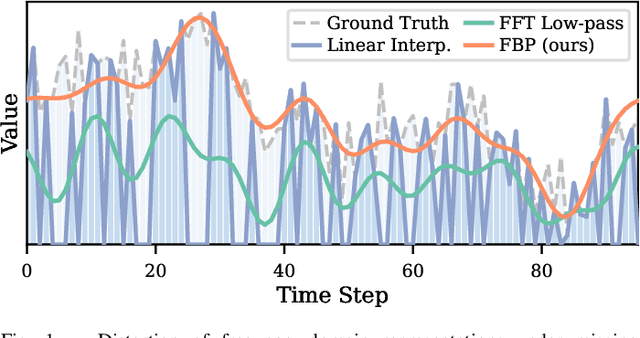
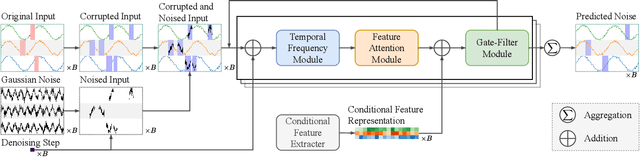
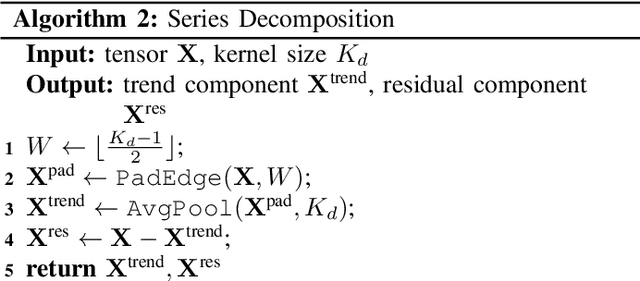
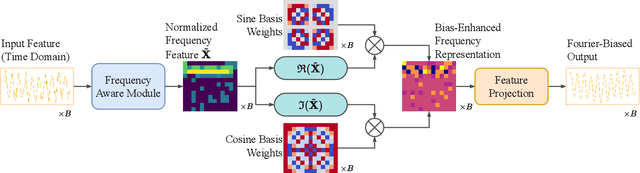
Multivariate time series imputation is fundamental in applications such as healthcare, traffic forecasting, and biological modeling, where sensor failures and irregular sampling lead to pervasive missing values. However, existing Transformer- and diffusion-based models lack explicit inductive biases and frequency awareness, limiting their generalization under structured missing patterns and distribution shifts. We propose FADTI, a diffusion-based framework that injects frequency-informed feature modulation via a learnable Fourier Bias Projection (FBP) module and combines it with temporal modeling through self-attention and gated convolution. FBP supports multiple spectral bases, enabling adaptive encoding of both stationary and non-stationary patterns. This design injects frequency-domain inductive bias into the generative imputation process. Experiments on multiple benchmarks, including a newly introduced biological time series dataset, show that FADTI consistently outperforms state-of-the-art methods, particularly under high missing rates. Code is available at https://anonymous.4open.science/r/TimeSeriesImputation-52BF