 Add to Chrome
 Add to Firefox
 Add to Edge
Exact Acceleration of Subgraph Graph Neural Networks by Eliminating Computation Redundancy
Dec 24, 2024
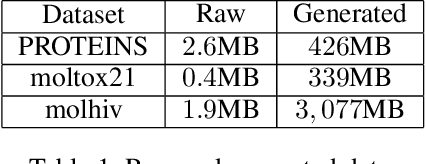


Graph neural networks (GNNs) have become a prevalent framework for graph tasks. Many recent studies have proposed the use of graph convolution methods over the numerous subgraphs of each graph, a concept known as subgraph graph neural networks (subgraph GNNs), to enhance GNNs' ability to distinguish non-isomorphic graphs. To maximize the expressiveness, subgraph GNNs often require each subgraph to have equal size to the original graph. Despite their impressive performance, subgraph GNNs face challenges due to the vast number and large size of subgraphs which lead to a surge in training data, resulting in both storage and computational inefficiencies. In response to this problem, this paper introduces Ego-Nets-Fit-All (ENFA), a model that uniformly takes the smaller ego nets as subgraphs, thereby providing greater storage and computational efficiency, while at the same time guarantees identical outputs to the original subgraph GNNs even taking the whole graph as subgraphs. The key is to identify and eliminate the redundant computation among subgraphs. For example, a node $v_i$ may appear in multiple subgraphs but is far away from all of their centers (the unsymmetric part between subgraphs). Therefore, its first few rounds of message passing within each subgraph can be computed once in the original graph instead of being computed multiple times within each subgraph. Such strategy enables our ENFA to accelerate subgraph GNNs in an exact way, unlike previous sampling approaches that often lose the performance. Extensive experiments across various datasets reveal that compared with the conventional subgraph GNNs, ENFA can reduce storage space by 29.0% to 84.5% and improve training efficiency by up to 1.66x.

Qwen2.5 Technical Report
Dec 19, 2024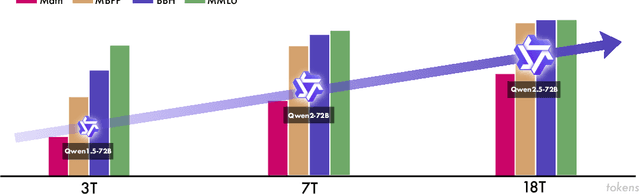
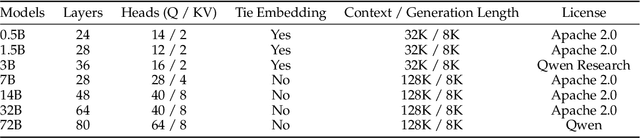
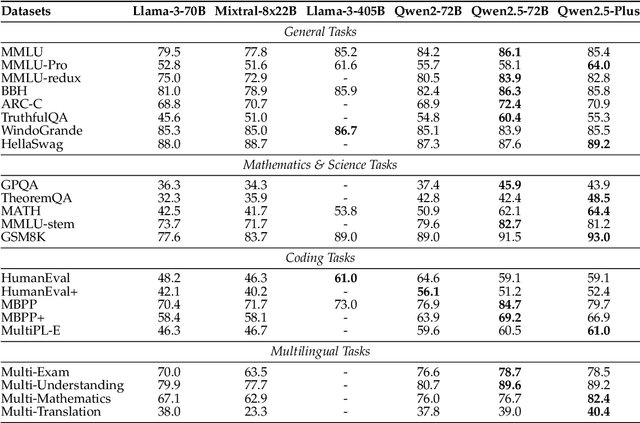
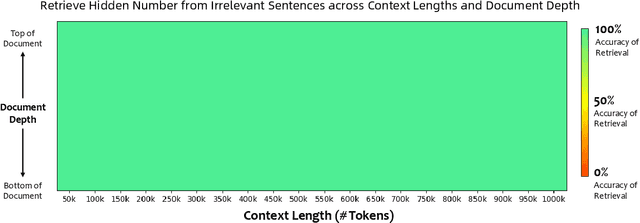
In this report, we introduce Qwen2.5, a comprehensive series of large language models (LLMs) designed to meet diverse needs. Compared to previous iterations, Qwen 2.5 has been significantly improved during both the pre-training and post-training stages. In terms of pre-training, we have scaled the high-quality pre-training datasets from the previous 7 trillion tokens to 18 trillion tokens. This provides a strong foundation for common sense, expert knowledge, and reasoning capabilities. In terms of post-training, we implement intricate supervised finetuning with over 1 million samples, as well as multistage reinforcement learning. Post-training techniques enhance human preference, and notably improve long text generation, structural data analysis, and instruction following. To handle diverse and varied use cases effectively, we present Qwen2.5 LLM series in rich sizes. Open-weight offerings include base and instruction-tuned models, with quantized versions available. In addition, for hosted solutions, the proprietary models currently include two mixture-of-experts (MoE) variants: Qwen2.5-Turbo and Qwen2.5-Plus, both available from Alibaba Cloud Model Studio. Qwen2.5 has demonstrated top-tier performance on a wide range of benchmarks evaluating language understanding, reasoning, mathematics, coding, human preference alignment, etc. Specifically, the open-weight flagship Qwen2.5-72B-Instruct outperforms a number of open and proprietary models and demonstrates competitive performance to the state-of-the-art open-weight model, Llama-3-405B-Instruct, which is around 5 times larger. Qwen2.5-Turbo and Qwen2.5-Plus offer superior cost-effectiveness while performing competitively against GPT-4o-mini and GPT-4o respectively. Additionally, as the foundation, Qwen2.5 models have been instrumental in training specialized models such as Qwen2.5-Math, Qwen2.5-Coder, QwQ, and multimodal models.
ChatDiT: A Training-Free Baseline for Task-Agnostic Free-Form Chatting with Diffusion Transformers
Dec 17, 2024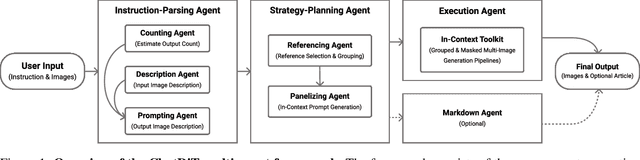

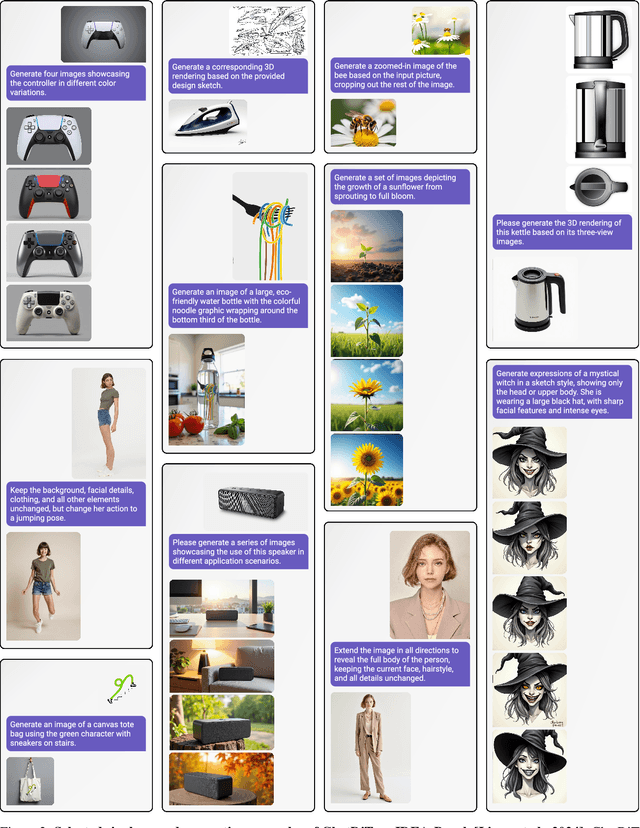
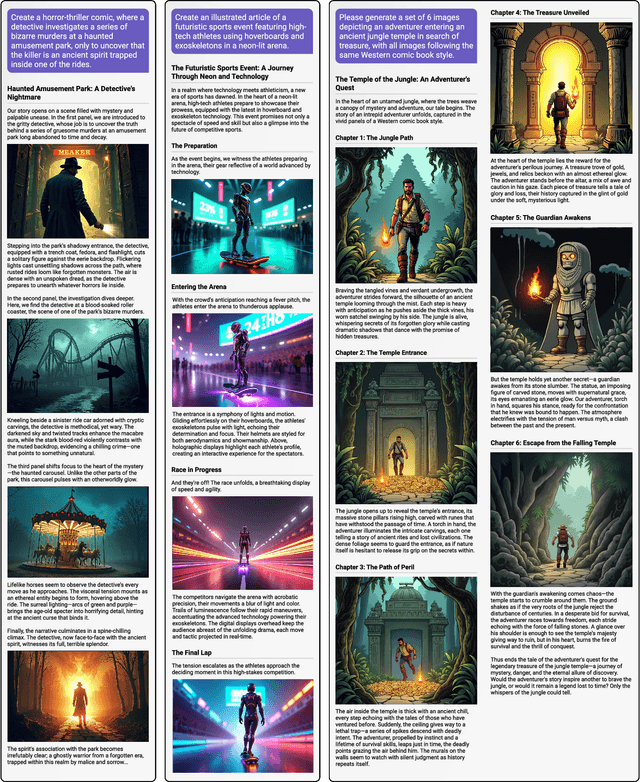
Recent research arXiv:2410.15027 arXiv:2410.23775 has highlighted the inherent in-context generation capabilities of pretrained diffusion transformers (DiTs), enabling them to seamlessly adapt to diverse visual tasks with minimal or no architectural modifications. These capabilities are unlocked by concatenating self-attention tokens across multiple input and target images, combined with grouped and masked generation pipelines. Building upon this foundation, we present ChatDiT, a zero-shot, general-purpose, and interactive visual generation framework that leverages pretrained diffusion transformers in their original form, requiring no additional tuning, adapters, or modifications. Users can interact with ChatDiT to create interleaved text-image articles, multi-page picture books, edit images, design IP derivatives, or develop character design settings, all through free-form natural language across one or more conversational rounds. At its core, ChatDiT employs a multi-agent system comprising three key components: an Instruction-Parsing agent that interprets user-uploaded images and instructions, a Strategy-Planning agent that devises single-step or multi-step generation actions, and an Execution agent that performs these actions using an in-context toolkit of diffusion transformers. We thoroughly evaluate ChatDiT on IDEA-Bench arXiv:2412.11767, comprising 100 real-world design tasks and 275 cases with diverse instructions and varying numbers of input and target images. Despite its simplicity and training-free approach, ChatDiT surpasses all competitors, including those specifically designed and trained on extensive multi-task datasets. We further identify key limitations of pretrained DiTs in zero-shot adapting to tasks. We release all code, agents, results, and intermediate outputs to facilitate further research at https://github.com/ali-vilab/ChatDiT
CosyVoice 2: Scalable Streaming Speech Synthesis with Large Language Models
Dec 13, 2024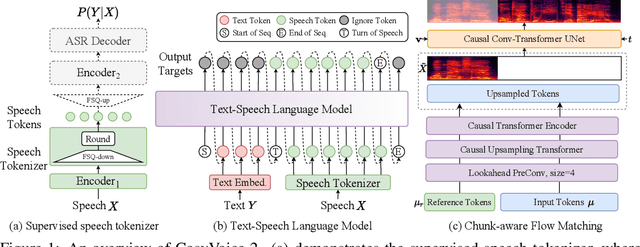
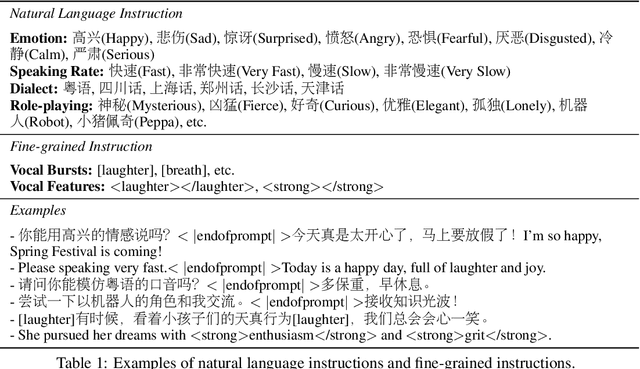
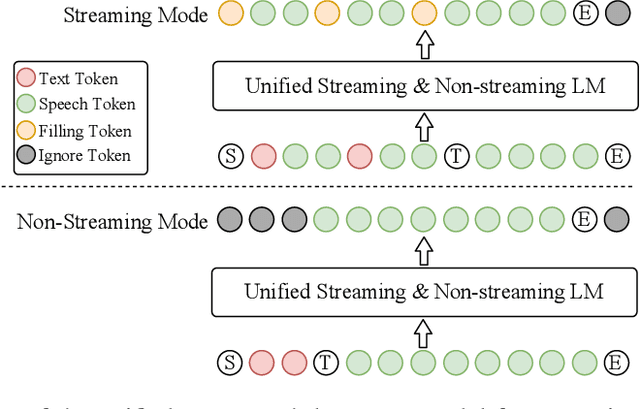
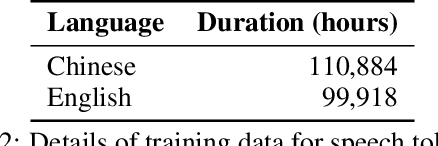
In our previous work, we introduced CosyVoice, a multilingual speech synthesis model based on supervised discrete speech tokens. By employing progressive semantic decoding with two popular generative models, language models (LMs) and Flow Matching, CosyVoice demonstrated high prosody naturalness, content consistency, and speaker similarity in speech in-context learning. Recently, significant progress has been made in multi-modal large language models (LLMs), where the response latency and real-time factor of speech synthesis play a crucial role in the interactive experience. Therefore, in this report, we present an improved streaming speech synthesis model, CosyVoice 2, which incorporates comprehensive and systematic optimizations. Specifically, we introduce finite-scalar quantization to improve the codebook utilization of speech tokens. For the text-speech LM, we streamline the model architecture to allow direct use of a pre-trained LLM as the backbone. In addition, we develop a chunk-aware causal flow matching model to support various synthesis scenarios, enabling both streaming and non-streaming synthesis within a single model. By training on a large-scale multilingual dataset, CosyVoice 2 achieves human-parity naturalness, minimal response latency, and virtually lossless synthesis quality in the streaming mode. We invite readers to listen to the demos at https://funaudiollm.github.io/cosyvoice2.
ProcessBench: Identifying Process Errors in Mathematical Reasoning
Dec 10, 2024


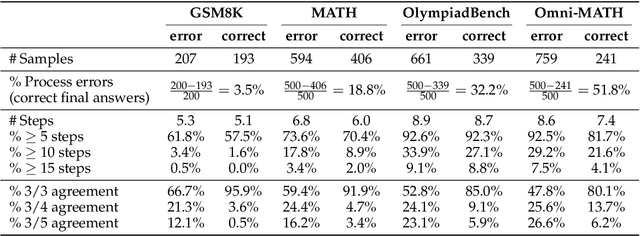
As language models regularly make mistakes when solving math problems, automated identification of errors in the reasoning process becomes increasingly significant for their scalable oversight. In this paper, we introduce ProcessBench for measuring the ability to identify erroneous steps in mathematical reasoning. It consists of 3,400 test cases, primarily focused on competition- and Olympiad-level math problems. Each test case contains a step-by-step solution with error location annotated by human experts. Models are required to identify the earliest step that contains an error, or conclude that all steps are correct. We conduct extensive evaluation on ProcessBench, involving two types of models: process reward models (PRMs) and critic models, where for the latter we prompt general language models to critique each solution step by step. We draw two main observations: (1) Existing PRMs typically fail to generalize to more challenging math problems beyond GSM8K and MATH. They underperform both critic models (i.e., prompted general language models) and our own trained PRM that is straightforwardly fine-tuned on the PRM800K dataset. (2) The best open-source model, QwQ-32B-Preview, has demonstrated the critique capability competitive with the proprietary model GPT-4o, despite that it still lags behind the reasoning-specialized o1-mini. We hope ProcessBench can foster future research in reasoning process assessment, paving the way toward scalable oversight of language models.
A Simple and Provable Scaling Law for the Test-Time Compute of Large Language Models
Nov 29, 2024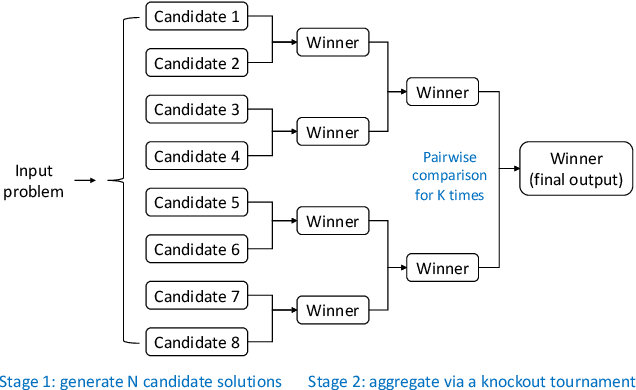
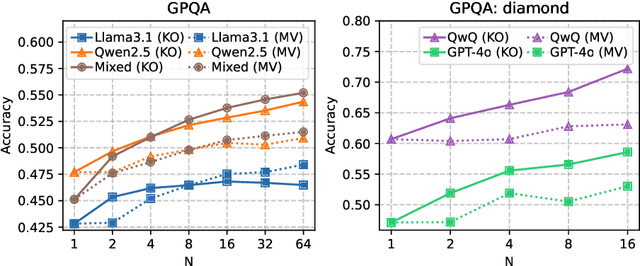
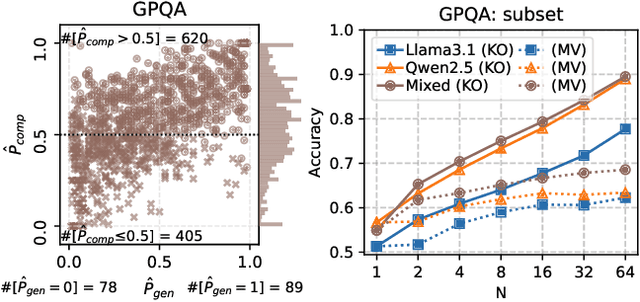
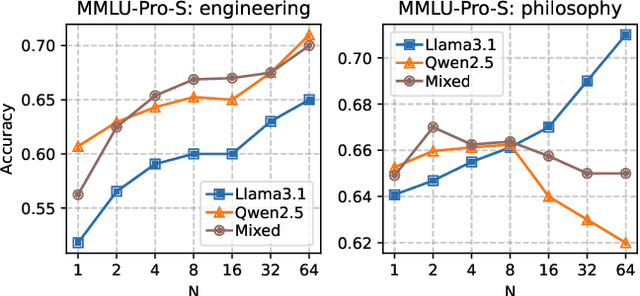
We propose a general two-stage algorithm that enjoys a provable scaling law for the test-time compute of large language models (LLMs). Given an input problem, the proposed algorithm first generates $N$ candidate solutions, and then chooses the best one via a multiple-round knockout tournament where each pair of candidates are compared for $K$ times and only the winners move on to the next round. In a minimalistic implementation, both stages can be executed with a black-box LLM alone and nothing else (e.g., no external verifier or reward model), and a total of $N \times (K + 1)$ highly parallelizable LLM calls are needed for solving an input problem. Assuming that a generated candidate solution is correct with probability $p_{\text{gen}} > 0$ and a comparison between a pair of correct and incorrect solutions identifies the right winner with probability $p_{\text{comp}} > 0.5$ (i.e., better than a random guess), we prove theoretically that the failure probability of the proposed algorithm decays to zero exponentially with respect to $N$ and $K$: $$\mathbb{P}(\text{final output is incorrect}) \le (1 - p_{\text{gen}})^N + \lceil \log_2 N \rceil e^{-2 K (p_{\text{comp}} - 0.5)^2}.$$ Our empirical results with the challenging MMLU-Pro benchmark validate the technical assumptions, as well as the efficacy of the proposed algorithm and the gains from scaling up its test-time compute.
P-MMEval: A Parallel Multilingual Multitask Benchmark for Consistent Evaluation of LLMs
Nov 14, 2024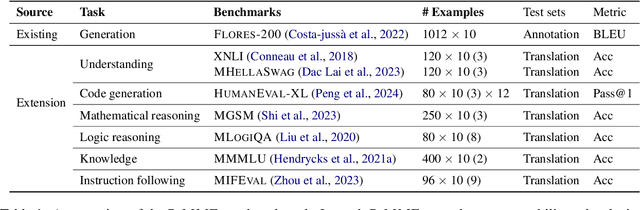
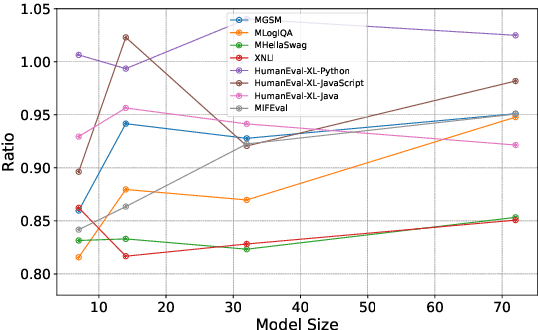

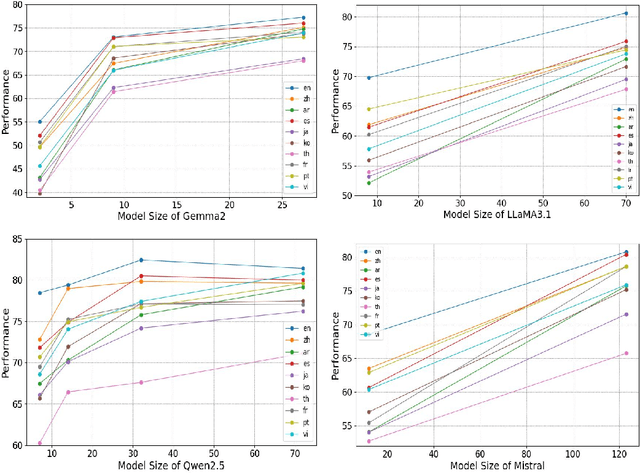
Recent advancements in large language models (LLMs) showcase varied multilingual capabilities across tasks like translation, code generation, and reasoning. Previous assessments often limited their scope to fundamental natural language processing (NLP) or isolated capability-specific tasks. To alleviate this drawback, we aim to present a comprehensive multilingual multitask benchmark. First, we present a pipeline for selecting available and reasonable benchmarks from massive ones, addressing the oversight in previous work regarding the utility of these benchmarks, i.e., their ability to differentiate between models being evaluated. Leveraging this pipeline, we introduce P-MMEval, a large-scale benchmark covering effective fundamental and capability-specialized datasets. Furthermore, P-MMEval delivers consistent language coverage across various datasets and provides parallel samples. Finally, we conduct extensive experiments on representative multilingual model series to compare performances across models, analyze dataset effectiveness, examine prompt impacts on model performances, and explore the relationship between multilingual performances and factors such as tasks, model sizes, and languages. These insights offer valuable guidance for future research. The dataset is available at https://huggingface.co/datasets/Qwen/P-MMEval.
Benchmarking Multimodal Retrieval Augmented Generation with Dynamic VQA Dataset and Self-adaptive Planning Agent
Nov 05, 2024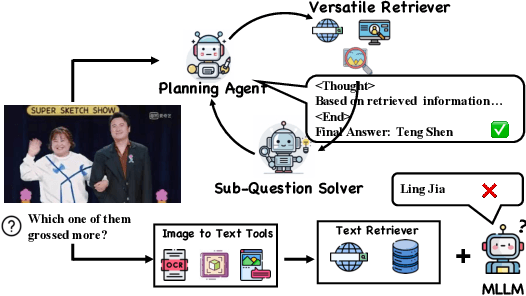
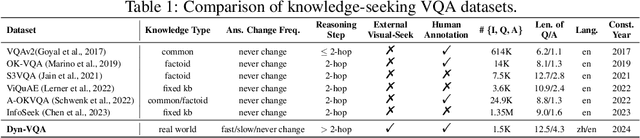
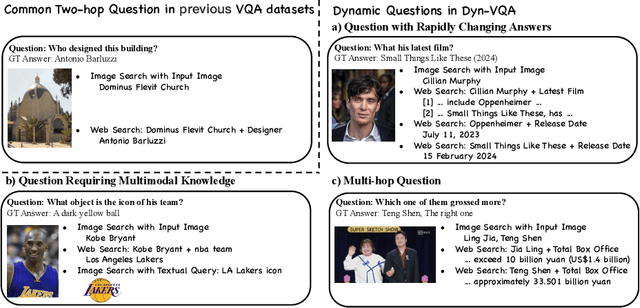

Multimodal Retrieval Augmented Generation (mRAG) plays an important role in mitigating the "hallucination" issue inherent in multimodal large language models (MLLMs). Although promising, existing heuristic mRAGs typically predefined fixed retrieval processes, which causes two issues: (1) Non-adaptive Retrieval Queries. (2) Overloaded Retrieval Queries. However, these flaws cannot be adequately reflected by current knowledge-seeking visual question answering (VQA) datasets, since the most required knowledge can be readily obtained with a standard two-step retrieval. To bridge the dataset gap, we first construct Dyn-VQA dataset, consisting of three types of "dynamic" questions, which require complex knowledge retrieval strategies variable in query, tool, and time: (1) Questions with rapidly changing answers. (2) Questions requiring multi-modal knowledge. (3) Multi-hop questions. Experiments on Dyn-VQA reveal that existing heuristic mRAGs struggle to provide sufficient and precisely relevant knowledge for dynamic questions due to their rigid retrieval processes. Hence, we further propose the first self-adaptive planning agent for multimodal retrieval, OmniSearch. The underlying idea is to emulate the human behavior in question solution which dynamically decomposes complex multimodal questions into sub-question chains with retrieval action. Extensive experiments prove the effectiveness of our OmniSearch, also provide direction for advancing mRAG. The code and dataset will be open-sourced at https://github.com/Alibaba-NLP/OmniSearch.
Language Models can Self-Lengthen to Generate Long Texts
Oct 31, 2024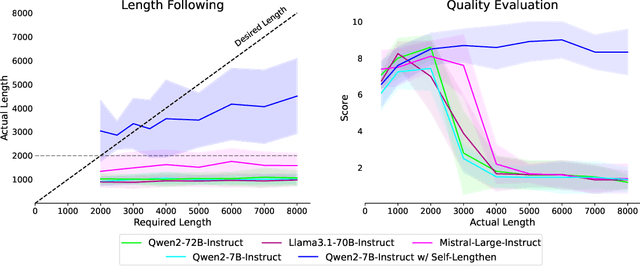
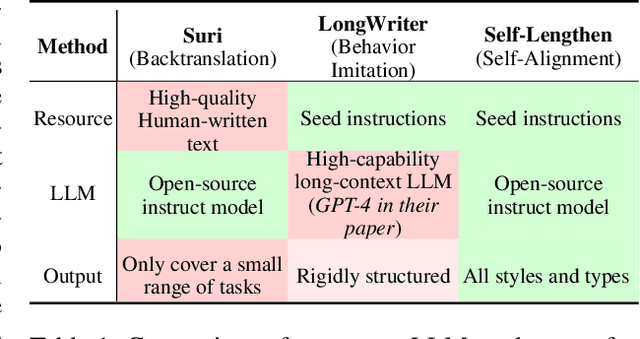
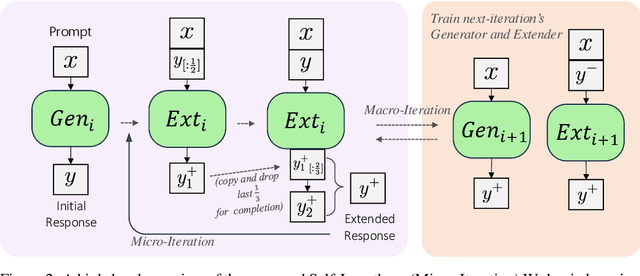
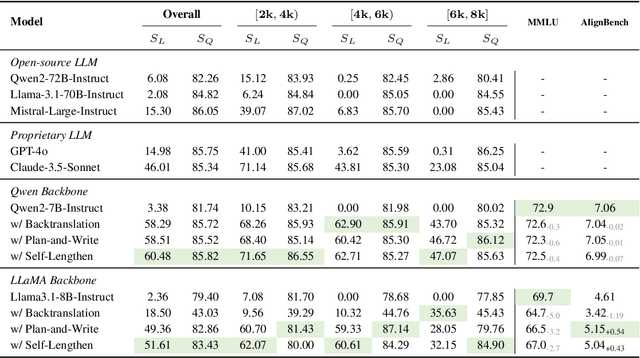
Recent advancements in Large Language Models (LLMs) have significantly enhanced their ability to process long contexts, yet a notable gap remains in generating long, aligned outputs. This limitation stems from a training gap where pre-training lacks effective instructions for long-text generation, and post-training data primarily consists of short query-response pairs. Current approaches, such as instruction backtranslation and behavior imitation, face challenges including data quality, copyright issues, and constraints on proprietary model usage. In this paper, we introduce an innovative iterative training framework called Self-Lengthen that leverages only the intrinsic knowledge and skills of LLMs without the need for auxiliary data or proprietary models. The framework consists of two roles: the Generator and the Extender. The Generator produces the initial response, which is then split and expanded by the Extender. This process results in a new, longer response, which is used to train both the Generator and the Extender iteratively. Through this process, the models are progressively trained to handle increasingly longer responses. Experiments on benchmarks and human evaluations show that Self-Lengthen outperforms existing methods in long-text generation, when applied to top open-source LLMs such as Qwen2 and LLaMA3. Our code is publicly available at https://github.com/QwenLM/Self-Lengthen.
In-Context LoRA for Diffusion Transformers
Oct 31, 2024

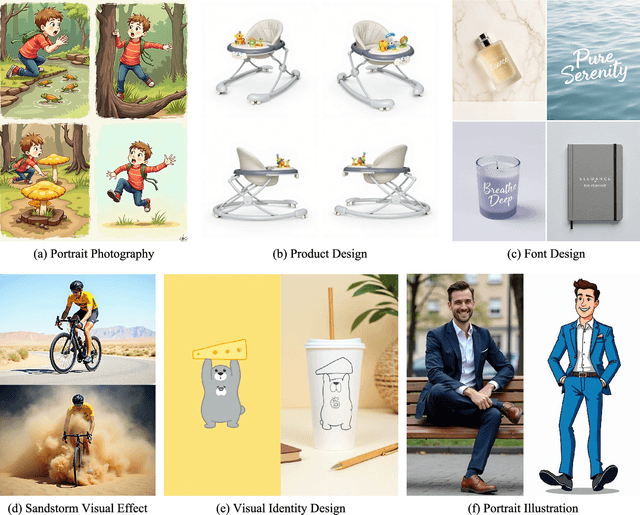

Recent research arXiv:2410.15027 has explored the use of diffusion transformers (DiTs) for task-agnostic image generation by simply concatenating attention tokens across images. However, despite substantial computational resources, the fidelity of the generated images remains suboptimal. In this study, we reevaluate and streamline this framework by hypothesizing that text-to-image DiTs inherently possess in-context generation capabilities, requiring only minimal tuning to activate them. Through diverse task experiments, we qualitatively demonstrate that existing text-to-image DiTs can effectively perform in-context generation without any tuning. Building on this insight, we propose a remarkably simple pipeline to leverage the in-context abilities of DiTs: (1) concatenate images instead of tokens, (2) perform joint captioning of multiple images, and (3) apply task-specific LoRA tuning using small datasets (e.g., $20\sim 100$ samples) instead of full-parameter tuning with large datasets. We name our models In-Context LoRA (IC-LoRA). This approach requires no modifications to the original DiT models, only changes to the training data. Remarkably, our pipeline generates high-fidelity image sets that better adhere to prompts. While task-specific in terms of tuning data, our framework remains task-agnostic in architecture and pipeline, offering a powerful tool for the community and providing valuable insights for further research on product-level task-agnostic generation systems. We release our code, data, and models at https://github.com/ali-vilab/In-Context-LoRA